How to Lower Chlorine in Pool Water Safely
How to lower chlorine in pool water: stop dosing, uncover the pool, and if you need it fast, add sodium thiosulfate, about 1.2 oz per 10,000 gallons per 1 ppm (2024 MAHC Annex). Most labels allow swimming at 4 ppm.
- ✓Swim at 4 ppm or lessFour of five EPA pool chlorine labels we pulled bar re-entry above 4 ppm free chlorine; one sets 3 ppm.
- ✓Neutralizer doses differ 2.6 timesSodium thiosulfate: 1.0 oz (Florida DOH) to 2.6 oz (Horizon) per 1 ppm per 10,000 gallons.
- ✓Above 10 ppm, tests lieCDC warns DPD samples can bleach out above 10 ppm and read falsely low or zero.
Key takeaways
- Four of the five EPA pool chlorine labels we pulled bar swimming above 4 ppm free chlorine; a Doheny tablet label sets 3 ppm (EPA label 56890-4).
- The 2024 Model Aquatic Health Code treats more than 10 ppm free chlorine with swimmers present as an imminent health hazard at public pools (MAHC 6.6.3.1).
- Published sodium thiosulfate doses run 1.0 to 2.6 oz per 1 ppm per 10,000 gallons; CDC’s MAHC Annex uses 1.2 oz (MAHC Annex, Appendix 3).
- Above 10 ppm a DPD test can bleach out and read falsely low or zero, so dilute the sample before you trust it (CDC).
- Replacing water lowers chlorine by the share replaced: 10 to 4 ppm means swapping 60% of the pool, about $129 of water at the median rate in our 25 city fill cost study.
How high is too high for chlorine in a pool?
Free chlorine above 4 ppm is too high to swim in under most EPA pool chlorine labels: four of the five labels we pulled prohibit re-entry above 4 ppm and one sets 3 ppm. CDC publishes only minimums (1 ppm, or 2 ppm with cyanuric acid), and the 2024 Model Aquatic Health Code treats more than 10 ppm with swimmers present as an imminent health hazard.
The ceiling is a label rule, not a CDC number. The 2024 Model Aquatic Health Code (MAHC), CDC’s model code for public pools, says in section 5.7.3.1.1.5 that maximum free chlorine is whatever the EPA-registered product label allows. For day-to-day targets, the MAHC Annex recommends 2 to 4 ppm free chlorine in pools and 3 to 5 ppm in spas, which keeps a margin above the minimums.
| Rule | Number | Applies to | Source |
|---|---|---|---|
| Minimum free chlorine | 1 ppm (2 ppm with cyanuric acid; 3 ppm in hot tubs) | Home pools and hot tubs | CDC, page updated May 2024 |
| Minimum DPD free chlorine | 1.0 ppm (2.0 ppm with cyanuric acid; 3.0 ppm in spas) | Public pools | 2024 MAHC 5.7.3.1.1.2 |
| Recommended operating range | 2 to 4 ppm in pools; 3 to 5 ppm in spas | Public pools (guidance) | 2024 MAHC Annex |
| Maximum free chlorine | The product label limit | Public pools | 2024 MAHC 5.7.3.1.1.5 |
| Re-entry limit on the label | 3 ppm or 4 ppm (see next table) | Any pool using that product | EPA-accepted labels |
| Imminent health hazard | Above 10 ppm with swimmers present | Public pools | 2024 MAHC 6.6.3.1 |
| Act on combined chlorine | Above 0.4 ppm | Public pools | 2024 MAHC 5.7.4.4.2 |
| DPD test may bleach out | Above 10 ppm (false low or 0 ppm) | Any test kit user | CDC; Taylor Technologies |
Sources: CDC, Home Pool and Hot Tub Water Treatment and Testing; 2024 MAHC code; 2024 MAHC Annex; Taylor Technologies FAQ. Accessed October 19, 2026. Download CSV
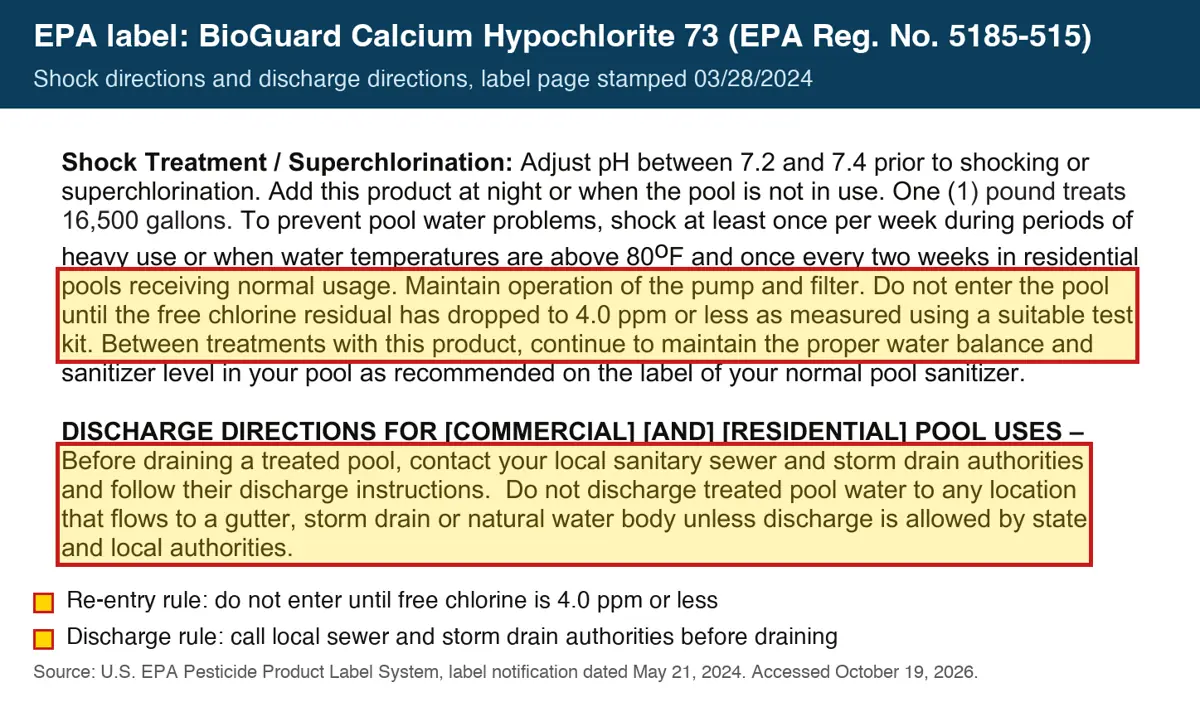
We pulled five pool chlorine labels from the EPA Pesticide Product Label System, covering calcium hypochlorite, trichlor, dichlor and liquid sodium hypochlorite. The BioGuard Calcium Hypochlorite 73 label (EPA Reg. No. 5185-515) says not to enter until free chlorine has dropped to 4.0 ppm or less. The Doheny 1-inch Chlorinating Tablets label (EPA Reg. No. 56890-4, April 2020) draws the line at 3 ppm. Use the number on the product you actually added.
| Product (EPA Reg. No.) | Active ingredient | Label document date | Routine range on label | Re-entry rule on label |
|---|---|---|---|---|
| BioGuard Calcium Hypochlorite 73 (5185-515) | Calcium hypochlorite 73% | May 21, 2024 | Shock: 1 lb per 16,500 gal | Do not enter until free chlorine is 4.0 ppm or less |
| BioGuard Silk (5185-501) | Trichlor 94.05% | July 2, 2024 | 1 to 4 ppm | Prohibited above 4 ppm |
| RWP Master Dihydrate Granular (67262-1) | Dichlor dihydrate 99.0% | July 8, 2019 | 1 to 4 ppm | Prohibited above 4 ppm |
| Aqua Guard Chlorinating Sanitizer (33458-23) | Sodium hypochlorite 10.5% | August 4, 2014 | Shock to 5 to 10 ppm, then wait | Prohibited above 4 ppm in pools, 5 ppm in spas |
| 1-inch Chlorinating Tablets, Doheny (56890-4) | Trichlor 99% | April 30, 2020 | 1 to 3 ppm | Prohibited above 3 ppm |
Sources: EPA Pesticide Product Label System: 5185-515, 5185-501, 67262-1, 33458-23, 56890-4. Accessed October 19, 2026. Download CSV
Label limits apply to pools treated with that product. The MAHC line is a closure trigger, not a safe swimming level.
Source: Source: EPA-accepted labels for EPA Reg. Nos. 5185-515, 5185-501, 67262-1, 33458-23 and 56890-4; CDC 2024 MAHC 6.6.3.1.. Download chart data (CSV)
Comfort problems start below the hazard line. In The Swim, a pool supply retailer, says swimmers may notice itchy skin and irritated eyes above 5.0 ppm and that swimsuits can fade above 10 ppm (In The Swim guide, 2024). Those are retailer observations, not health standards, so the label limit stays the rule to follow.
Is it free chlorine or combined chlorine that is high?
Check which number is high before you treat. Total chlorine minus free chlorine equals combined chlorine under the MAHC definitions, and the 2024 MAHC calls for action when combined chlorine passes 0.4 ppm. High free chlorine needs lowering; high combined chlorine needs the opposite, a shock. Above 10 ppm, CDC warns a DPD test can bleach out and read falsely low or zero.
A DPD kit reports free and total chlorine separately, and CDC recommends DPD over test strips, testing at least twice a day. If free chlorine reads 3 ppm and total chlorine reads 6 ppm, combined chlorine is 3 ppm. That pool needs breakpoint shocking, not a neutralizer, and our guide on how to shock a pool covers the dose. Our free chlorine vs total chlorine guide lists the test errors that make those two numbers disagree.
Should I still shock my pool if chlorine is high? Only when the high number is combined chlorine. The Doheny tablet label says to shock whenever combined chlorine is above 0.5 ppm, and the MAHC action point is 0.4 ppm. If free chlorine is already above 4 ppm and combined chlorine is low, another shock only pushes back the time you can swim.
Why does my test read zero right after I shocked? Very high chlorine bleaches the DPD dye. Taylor Technologies says sanitizer above 10 ppm can cause total or partial bleaching and false-low readings, and its dilution instructions give the fix in the table below.
| Pool sample in the 9 mL tube | Chlorine-free water added | Dilution | Multiply the reading by |
|---|---|---|---|
| 9 mL | 0 mL | None | 1 |
| 4.5 mL | 4.5 mL | 1:1 | 2 |
| 1.8 mL | 7.2 mL | 1:4 | 5 |
Source: Taylor Technologies, How and When to Use Dilutions in Pool and Spa Water Testing. Accessed October 19, 2026. Download CSV
What is the fastest way to lower chlorine in a pool?
The fastest way to lower chlorine in a pool is a chemical neutralizer, sodium thiosulfate, and one product listing says to retest 30 to 60 minutes after adding it. A partial drain works the same day but costs water. Sunlight, an open cover and running the pump cost nothing but have no published timeline, and cyanuric acid slows the sunlight route.
| Method | How it lowers chlorine | Dose or rule | What else it changes | Source |
|---|---|---|---|---|
| Stop adding chlorine | Swimmers, dirt and sun keep using it up | Pull floater tablets; tape the highest feeder hole above 4 ppm | Nothing | BioGuard Silk label; CDC |
| Uncover the pool in sun | Sunlight breaks chlorine down | No published hours figure; slower when cyanuric acid is present | Nothing | CDC; Virginia DOH; Florida DOH |
| Run the pump and aerate | Chlorine gasses off at the surface | No published dose | Nothing | In The Swim (retailer guide) |
| Partial drain and refill | Dilution | Replace 1 minus target / current of the water | Also lowers cyanuric acid, alkalinity and calcium | 2024 MAHC 5.7.4.4.2 (water exchange); PC&S arithmetic |
| Sodium thiosulfate (chlorine neutralizer) | Chemical reduction | 1.0 to 2.6 oz per 1 ppm per 10,000 gal | An overdose eats the next chlorine you add | 2024 MAHC Annex; Florida DOH; product labels |
| Hydrogen peroxide, 27% pool grade | Breaks chlorine down | 7 oz per 10,000 gal for about 3 ppm | Lowers pH | In The Swim (retailer guide) |
| Ascorbic acid (vitamin C) | Chemical reduction | 10 oz per 10,000 gal for about 3 ppm | Sold mainly as a stain remover | In The Swim (retailer guide) |
Sources: BioGuard Silk label; CDC; Virginia DOH; Florida DOH; 2024 MAHC; MAHC Annex; In The Swim (retailer guide). Download CSV
CDC lists sunlight among the things that reduce chlorine, and the Virginia Department of Health operator guide says sunlight and heat can degrade chlorine quickly. Cyanuric acid exists to slow that loss: the Florida DOH operators manual says it prevents rapid dissipation from the sun’s UV rays. We found no primary source that puts a reliable hours figure on sunlight decay, so test morning and evening, 2 readings a day as CDC advises, and let your own numbers set the wait.
Pick by deadline and by what else the method changes. A 60% drain also cuts cyanuric acid by about 60%, because tap water carries none, which helps when stabilizer is high; alkalinity and calcium fall by less, since the refill water brings its own; see our cyanuric acid pool guide. In The Swim notes that hydrogen peroxide lowers pH, so plan a check with our pH adjustment guide after a peroxide dose.
How much chlorine neutralizer should you add?
Published sodium thiosulfate doses run from 1.0 to 2.6 oz per 1 ppm per 10,000 gallons, a 2.6 times spread across 7 sources. CDC’s 2024 MAHC Annex lists 1.2 oz of sodium thiosulfate pentahydrate and Florida DOH lists 1.0 oz, while retail product labels sit at 2.0 to 2.6 oz. Start at the low figure, wait, retest and add more only if needed.
| Source | Document or product | Type of source | Sodium thiosulfate per 1 ppm per 10,000 gal (oz) |
|---|---|---|---|
| Florida DOH (Collier County) | Swimming Pool Operators' Manual, 2016 | State health department | 1.0 |
| CDC | 2024 MAHC Annex, Appendix 3 (pentahydrate) | Federal model code annex | 1.2 |
| Simplified Pools | Regal Chlorine and Bromine Neutralizer, 1 lb | Product listing | 2.0 |
| In The Swim | How to Reduce Pool or Spa Chlorine Levels | Retailer guide | 2.0 |
| Poolweb | Haviland Chlor Out, 2 lb | Product listing | 2.5 |
| Knorr Systems | Chemical Dosing Charts (1.6 lb per 10 ppm) | Commercial supplier chart | 2.56 |
| Horizon Commercial Pools | Horizon Chlorine and Bromine Neutralizer (De-Chlor) | Product listing | 2.6 |
Sources: Florida DOH (Collier County) manual, 2016; CDC 2024 MAHC Annex, Appendix 3; Regal listing; In The Swim; Chlor Out listing; Knorr Systems; Horizon. Accessed October 19, 2026. Download CSV
Knorr's value is 1.6 lb per 10 ppm converted to ounces per ppm. Start at the low end and retest.
Source: Source: Florida DOH 2016 manual; CDC 2024 MAHC Annex Appendix 3; Regal, In The Swim, Haviland Chlor Out, Knorr Systems and Horizon product documents.. Download chart data (CSV)
The formula is the same for every source: ounces = dose rate x ppm to remove x pool gallons / 10,000. For a 20,000 gallon pool at 10 ppm that you want at 4 ppm, the drop is 6 ppm, so multiply the rate by 12. That gives 14.4 oz at the MAHC rate, 24 oz at the Regal label rate and 31.2 oz at the Horizon label rate.
| Dose rate used | oz per ppm per 10,000 gal | ppm drop (10 to 4) | Pool size (gal) | Neutralizer needed (oz) | Cost at listed price |
|---|---|---|---|---|---|
| Florida DOH | 1.0 | 6 | 20,000 | 12.0 | n/a |
| 2024 MAHC Annex | 1.2 | 6 | 20,000 | 14.4 | n/a |
| Regal label | 2.0 | 6 | 20,000 | 24 | $29.63 ($19.75 per 1 lb bottle) |
| Chlor Out label | 2.5 | 6 | 20,000 | 30 | $25.44 ($27.14 per 2 lb canister) |
| Knorr Systems | 2.56 | 6 | 20,000 | 30.7 | n/a |
| Horizon label | 2.6 | 6 | 20,000 | 31.2 | n/a |
PC&S arithmetic from the dose table above; prices from Simplified Pools and Poolweb listings on October 19, 2026. Download CSV
Get the gallons right before you weigh anything, because the dose scales with volume: a 20,000 gallon pool needs twice the ounces of a 10,000 gallon pool. Our pool volume calculator works it out from length, width and depth.
How to lower chlorine in pool water, step by step
Test free and total chlorine, stop every chlorine source, then choose time or neutralizer. With a neutralizer, weigh the dose from the rate x ppm x gallons formula, broadcast it with the pump running, wait 30 to 60 minutes and retest. Swim again once free chlorine is back inside 1 to 4 ppm, or 2 to 4 ppm in a stabilized pool, and under your label’s limit.
- Test free and total chlorineUse a DPD kit. If the sample turns clear or reads 0 after a large dose, dilute it 1:1 and multiply by 2 (Taylor Technologies).
- Stop every chlorine sourcePull tablets from the floater or skimmer, close the feeder and lower salt cell output. The BioGuard Silk label says to tape over the highest feeder hole when chlorine reads above 4 ppm.
- Confirm the gallonsMeasure or use the pool volume calculator. Every dose below scales with volume.
- Decide on time or chemistryIf nobody needs to swim today, uncover the pool, run the pump and retest the next morning.
- Weigh the neutralizerOunces = rate x ppm to remove x gallons / 10,000. Start with the MAHC Annex rate of 1.2 oz per ppm per 10,000 gallons unless your label says otherwise.
- Broadcast it with the pump runningThe Chlor Out listing says to spread it over the surface, not through the skimmer, and to wait 12 hours after a shock before applying.
- Wait, then retestThe Regal listing says to wait 30 minutes to 1 hour. Add a second, smaller dose only if the retest is still above the target.
- Reopen inside the rangeFree chlorine 1 to 4 ppm (2 to 4 ppm with cyanuric acid) and at or below the re-entry limit on the label of the product you added.
Doing it yourself costs the neutralizer, about $25 to $30 of sodium thiosulfate to take a 20,000 gallon pool from 10 to 4 ppm at listed retail prices. Handing water care to a weekly service costs more: our pool service cost guide found a $160 monthly median across 71 published company prices in 20 metros in October 2026.
When does draining water make sense?
Draining makes sense when something else must come down too, usually cyanuric acid. The share of water to replace is 1 minus target divided by current, so going from 10 to 4 ppm means replacing 60%, or 12,000 gallons of a 20,000 gallon pool. At the median rate in our 25 city fill cost study, that water costs about $129, against about $25 to $30 of neutralizer.
| Current free chlorine (ppm) | Target (ppm) | Share of water to replace | Gallons in a 20,000 gal pool | Water cost at Sacramento rate | At 25 city median rate | At Houston rate |
|---|---|---|---|---|---|---|
| 10 | 4 | 60% | 12,000 | $23.40 | $129.05 | $389.99 |
| 10 | 3 | 70% | 14,000 | n/a | n/a | n/a |
| 8 | 4 | 50% | 10,000 | n/a | n/a | n/a |
| 6 | 4 | 33% | 6,667 | n/a | n/a | n/a |
| 5 | 3 | 40% | 8,000 | n/a | n/a | n/a |
PC&S arithmetic. Water and sewer costs scaled from 20,000 gallon fill costs in PC&S research: Cost to Fill a Pool (Sacramento $39.00, 25 city median $215.09, Houston $649.98; rates in effect October 4, 2026). Download CSV
Discharge rules apply before the first gallon leaves. The BioGuard Calcium Hypochlorite 73 label says to contact local sanitary sewer and storm drain authorities and not to send treated water toward a gutter, storm drain or natural water body unless state and local authorities allow it. The Aqua Guard label adds: do not chlorinate within 24 hours before discharge. Our guide on how to drain a pool covers pumps, hoses and where the water can go.
Why does pool chlorine stay too high?
Chlorine stays high when it goes in faster than sun, swimmers and dirt use it up. The usual sources are an oversized shock (one label doses 1 lb per 16,500 gallons), a floater or feeder set too high, a salt cell running long hours and a cover that blocks sunlight. Over-stabilized water adds a twist: the Virginia Department of Health warns chlorine can build to excessive levels when cyanuric acid is high.
- Shock sized for a bigger pool The BioGuard Calcium Hypochlorite 73 label doses 1 lb per 16,500 gallons; on a 10,000 gallon pool the same pound lands much higher.
- Feeder or floater set too high The BioGuard Silk label’s fix above 4 ppm is to cover the highest hole with waterproof tape.
- Low swimmer load CDC names pee, sweat and dirt from swimmers among the things that use up chlorine; an unused pool loses less.
- Cover left on Sunlight is one of the main ways chlorine leaves the water (CDC), and a cover blocks it.
- High cyanuric acid Virginia DOH says over-stabilized pools can trap chlorine, letting levels rise until they irritate bathers and corrode plumbing.
Prevention is a dosing question. Our guide on how much chlorine to add to a pool works out doses by product and pool size, which is the easiest way to avoid landing at 10 ppm in the first place.
What to do at your chlorine reading
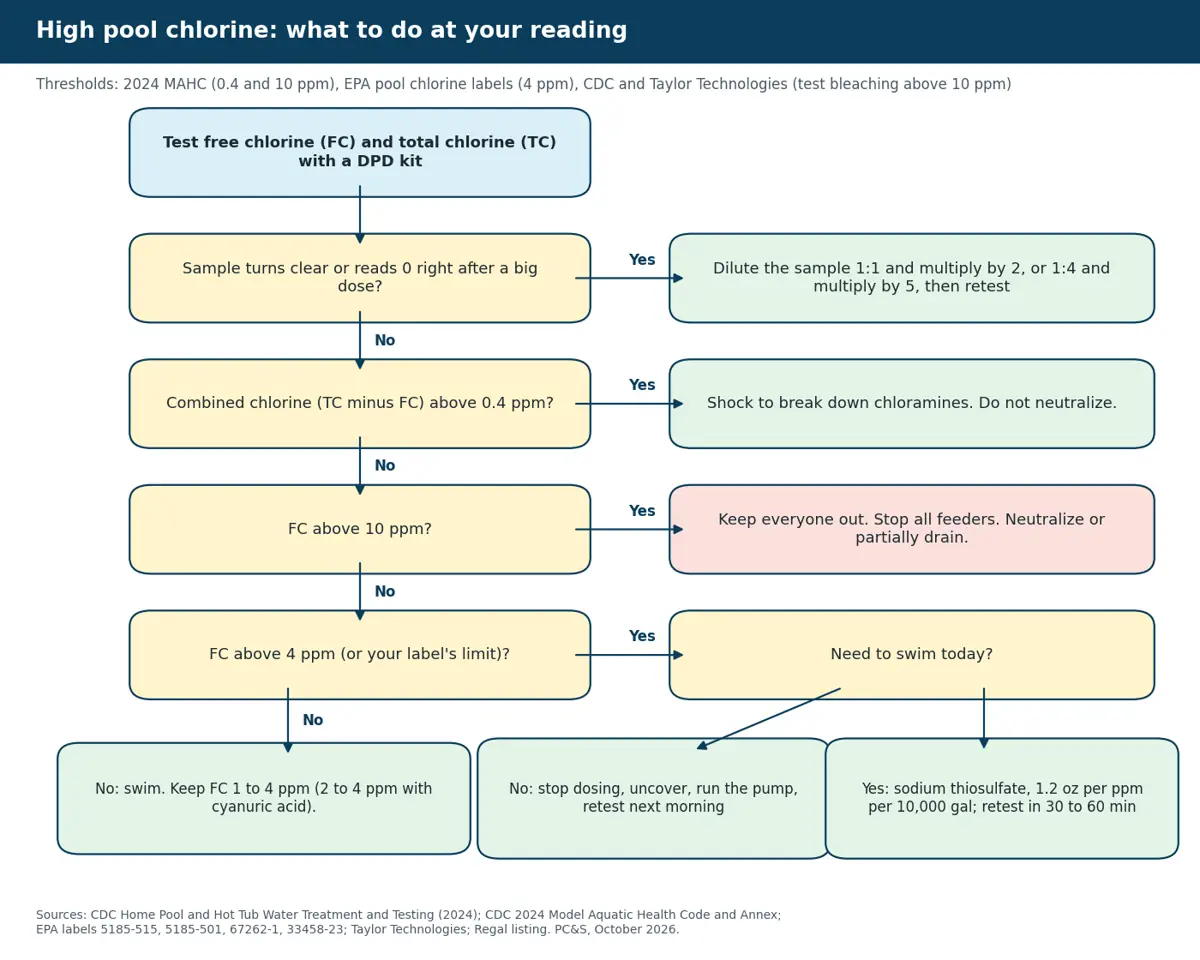
Match the reading to a row. Between 1 and 4 ppm free chlorine (2 and 4 ppm with stabilizer) there is nothing to lower. Above 4 ppm, wait if you can and neutralize if you cannot. Above 10 ppm, keep everyone out. If total chlorine is high but free chlorine is normal, the problem is combined chlorine and the fix is a shock, not a neutralizer.
| If your situation is | Do this | Rule behind it |
|---|---|---|
| Free chlorine 1 to 4 ppm (2 to 4 ppm with cyanuric acid), combined chlorine 0.4 ppm or less | Nothing to lower. Swim. | CDC minimums; most label re-entry limits |
| Free chlorine above 4 ppm, nobody needs to swim today | Stop dosing, uncover, run the pump, retest next morning | Labels bar re-entry above 4 ppm (3 ppm on some) |
| Free chlorine above 4 ppm and you want to swim today | Add sodium thiosulfate at 1.2 oz per ppm per 10,000 gal to reach 3 to 4 ppm, wait 30 to 60 minutes, retest | 2024 MAHC Annex dose; Regal wait time |
| The test sample turns clear or reads 0 right after a big dose | Assume it is above 10 ppm. Dilute the sample 1:1 (multiply by 2) or 1:4 (multiply by 5) and retest | CDC; Taylor Technologies |
| Free chlorine above 10 ppm | Keep everyone out, stop all feeders, then neutralize or partially drain | 2024 MAHC imminent health hazard line |
| Total chlorine high but free chlorine normal (combined chlorine above 0.4 ppm) | Do not neutralize. Shock to break down chloramines | 2024 MAHC 5.7.4.4.2 |
| Free chlorine high every week on tablets or a salt cell | Lower the feeder or cell output; test cyanuric acid | BioGuard Silk label; Virginia DOH |
| Free chlorine still above 10 ppm the next day with every feeder off | Call a pool service to check the feeder, salt cell or test kit | 2024 MAHC hazard line; CDC test bleaching note |
| Cyanuric acid is also high | A partial drain fixes both; replace 1 minus target / current of the water | Dilution arithmetic |
Sources: CDC; 2024 MAHC; MAHC Annex; EPA labels 5185-515 and 5185-501; Taylor Technologies; Regal listing; Virginia DOH. Download CSV
Is chlorine neutralizer safe to handle?
Sodium thiosulfate is milder than the chlorine it removes, but its safety data sheet still lists hazards: heating it above 100 C releases sulfur dioxide gas, and it is incompatible with strong oxidizers and acids. Store it away from dry chlorine, add it to pool water rather than mixing it in a bucket with other products, and wear gloves and goggles as NPIC advises.
Pool chemicals send people to the emergency room every year. CDC estimated a median of 4,535 emergency department visits a year for pool chemical injuries in the United States from 2008 to 2017 (MMWR 2019); our pool injury statistics report puts that figure next to drowning and diving data. The Chlorine Neutralizer safety data sheet lists sodium thiosulfate pentahydrate at over 90% and recommends gloves and goggles for spills.
How we compiled this
We compiled this page in October 2026 from 23 documents: CDC’s home pool guidance, the 2024 MAHC code and annex, five EPA-accepted pool chlorine labels, Florida and Virginia health department manuals, four neutralizer product documents (three listings and one safety data sheet), one supplier chart (Knorr Systems), two Taylor Technologies test pages, NPIC, a CDC MMWR report, one retailer guide (In The Swim, labeled as such) two of our own research reports (fill cost and injuries) and our pool service cost survey. We did not test any product; every dose comes from those documents. Forum threads were read for question wording only and are not used as sources.
Frequently Asked Questions
How do I lower the chlorine level in my pool fast?
Add sodium thiosulfate with the pump running. CDC’s 2024 MAHC Annex uses 1.2 oz per 1 ppm per 10,000 gallons, and product labels run 2.0 to 2.6 oz. Retest after 30 to 60 minutes, as the Regal listing advises, and stop once free chlorine is at or under your label’s re-entry limit, usually 4 ppm.
Does baking soda lower chlorine in the pool?
No. Baking soda is sodium bicarbonate, which health department manuals such as Florida DOH’s list as the chemical for raising total alkalinity, not for removing chlorine. The neutralizer on every chart we found, from the 2024 MAHC Annex to Knorr Systems, is sodium thiosulfate at 1.0 to 2.6 oz per 1 ppm per 10,000 gallons.
What happens if chlorine is too high in a pool?
Swimmers are exposed above the re-entry limit on the product label, 4 ppm on four of the five EPA labels we checked and 3 ppm on one. In The Swim reports itchy skin and irritated eyes above 5.0 ppm and faded swimsuits above 10 ppm. The 2024 MAHC treats more than 10 ppm with swimmers present as an imminent health hazard.
Should I still shock my pool if chlorine is high?
Only if combined chlorine is the high number. Subtract free chlorine from total chlorine: the 2024 MAHC calls for action above 0.4 ppm combined chlorine, and the Doheny tablet label says to shock above 0.5 ppm. If free chlorine is already above 4 ppm and combined chlorine is low, skip the shock and let the level fall.
Is 5 too high for chlorine in a pool?
Yes for swimming under most labels: four of five EPA pool chlorine labels we pulled prohibit re-entry above 4 ppm, and the Doheny tablet label sets 3 ppm. It is not a public health emergency, since the 2024 MAHC hazard line is above 10 ppm, but wait or neutralize down to 4 ppm or less before anyone swims.
How long does it take for chlorine levels to lower?
With sodium thiosulfate, the Regal listing says to retest after 30 minutes to 1 hour. Without a neutralizer there is no reliable published figure, because sunlight, cover use, swimmers and cyanuric acid all change the rate. Test in the morning and the evening; the drop between the two readings is your pool’s own rate per half day. Estimates built from the sunlight loss rates that are published sit in our guide on how long after shocking a pool you can swim.
What will neutralize chlorine in a pool?
Sodium thiosulfate, sold as chlorine neutralizer or dechlor. Doses range from 1.0 oz (Florida DOH) and 1.2 oz (CDC MAHC Annex) to 2.6 oz (Horizon) per 1 ppm per 10,000 gallons. In The Swim also lists hydrogen peroxide (7 oz of a 27% product per 10,000 gallons for about 3 ppm) and ascorbic acid.
What happens if I add too much sodium thiosulfate to my pool?
Free chlorine can drop below CDC’s 1 ppm minimum, or 2 ppm with cyanuric acid, and the leftover thiosulfate keeps consuming new chlorine. In The Swim says an overdose makes it hard to add chlorine until it dissipates, which takes a few days. Test, then add chlorine in small doses until the reading holds.
Sources
- Centers for Disease Control and Prevention (CDC). Home Pool and Hot Tub Water Treatment and Testing (page updated May 10, 2024). Accessed 2026-10-19.
- CDC. 2024 Model Aquatic Health Code, 5th Edition, Code Language. Accessed 2026-10-19.
- CDC. 2024 Model Aquatic Health Code, 5th Edition, Annex. Accessed 2026-10-19.
- U.S. EPA Pesticide Product Label System. BioGuard Calcium Hypochlorite 73, EPA Reg. No. 5185-515, label notification May 21, 2024. Accessed 2026-10-19.
- U.S. EPA Pesticide Product Label System. BioGuard Silk, EPA Reg. No. 5185-501, label notification July 2, 2024. Accessed 2026-10-19.
- U.S. EPA Pesticide Product Label System. RWP Master Dihydrate Granular, EPA Reg. No. 67262-1, label notification July 8, 2019. Accessed 2026-10-19.
- U.S. EPA Pesticide Product Label System. Aqua Guard Chlorinating Sanitizer, EPA Reg. No. 33458-23, label notification August 4, 2014. Accessed 2026-10-19.
- U.S. EPA Pesticide Product Label System. 1-inch Chlorinating Tablets (Doheny), EPA Reg. No. 56890-4, notice of registration April 30, 2020. Accessed 2026-10-19.
- Florida Department of Health in Collier County. Swimming Pool Operators' Manual, 2016 Version. Accessed 2026-10-19.
- Virginia Department of Health. Pool Operation and Maintenance Guide (Portsmouth Health Department, 2018). Accessed 2026-10-19.
- Knorr Systems (supplier chart). Chemical Dosing Charts. Accessed 2026-10-19.
- Simplified Pools (retailer). Regal Chlorine and Bromine Neutralizer, 1 lb (product listing). Accessed 2026-10-19.
- Poolweb (retailer). Chlor Out Chlorine Neutralizer, 2 lb (product listing). Accessed 2026-10-19.
- Horizon Commercial Pools. Horizon Chlorine and Bromine Neutralizer (De-Chlor) (product listing). Accessed 2026-10-19.
- In The Swim (retailer guide). How to Reduce Pool or Spa Chlorine Levels (modified June 17, 2024; Wayback capture May 14, 2026). Accessed 2026-10-19.
- Taylor Technologies. Water Testing Technical FAQs. Accessed 2026-10-19.
- Taylor Technologies. How and When to Use Dilutions in Pool and Spa Water Testing. Accessed 2026-10-19.
- Allchem Performance Products. Safety Data Sheet: Chlorine Neutralizer (sodium thiosulfate pentahydrate). Accessed 2026-10-19.
- National Pesticide Information Center (Oregon State University). Pool and Spa Chemicals Fact Sheet. Accessed 2026-10-19.
- CDC. Pool Chemical Injuries in Public and Residential Settings, United States, 2008 to 2017 (MMWR 2019;68(19)). Accessed 2026-10-19.
- Pool Construction & Service. Cost to Fill a Pool (PC&S research, rates in effect October 4, 2026). Accessed 2026-10-19.
- Pool Construction & Service. Pool Injury Statistics (PC&S research). Accessed 2026-10-19.
- Pool Construction & Service. Pool Service Cost per Month (PC&S survey of 71 company prices in 20 metros, October 2026). Accessed 2026-10-19.
Related pages
Get Quotes From Licensed Local Pool Pros
Tell us what you need and your ZIP code. We match you with pool companies that cover your area.