
Variable Speed Pool Pump: How It Works, What It Saves and 7 Models Compared
A variable speed pool pump runs its motor at adjustable RPM, so it can filter slowly: DOE's model shows 69% less electricity than single-speed, about $449 against $1,451 a year if run daily at July 2026 US prices.
- ✓Federal rule since July 19, 2021New standard-size in-ground pumps must meet a WEF only variable speed designs reach (10 CFR 431.465).
- ✓7 models, one tableWEF, watts at the low-flow test point and dated retail prices from ENERGY STAR data and named retailers.
- ✓Median-state saving $487 a yearAt EIA July 2026 electricity prices and DOE swim seasons, from $203 in Washington to $2,628 in Hawaii.
Key takeaways
- A federal-standard variable speed pool pump uses 69% less electricity than a single-speed baseline in DOE’s national model: 1,390 against 4,495 kWh a year (DOE technical support document).
- Since July 19, 2021, new self-priming pool filter pumps of 0.711 to under 2.5 hydraulic horsepower must meet a weighted energy factor (WEF) set at the variable-speed level (10 CFR 431.465(f)).
- Replacement pool pump motors of 1.15 to 5 total horsepower made since Sept 29, 2025 must be variable speed; motors of 0.5 to under 1.15 THP follow on Sept 28, 2027 (10 CFR 431.485).
- At the July 2026 US average of 18.31 cents per kWh, DOE’s model pump costs $1,451 a year to run single-speed every day and $449 as variable speed (EIA Table 5.6.A, PC&S calculation).
- The median listed price of a 1.5 to 1.65 THP in-ground variable speed pump was $1,739 across Leslie’s, Home Depot and Walmart.com listings in 2026 (PC&S price panel).
- 2026 utility rebates on ENERGY STAR variable speed pumps run from $100 (DTE Energy, Michigan) to $500 at LADWP, which paid $750 during its June 1 to Sept 30, 2026 summer special (LADWP).
What is a variable speed pool pump?
A variable speed pool pump is a filter pump whose motor and electronic drive can run at any speed in a programmed range instead of one fixed speed. The 3 HP Pentair IntelliFlo3 VSF, for example, runs from 450 to 3,450 RPM, so it can filter for many hours at low speed and speed up only for cleaning, spa jets or priming.
A single-speed pump runs at one speed whenever it is on; a two-speed pump adds one low setting. A variable speed pump uses an electronically commutated motor, the construction ENERGY STAR lists for all seven models compared below (ENERGY STAR certified pool pump data), driven by electronics that set speed in small steps. Pentair’s install guide gives 450 to 3,450 RPM for the 3 HP IntelliFlo3 VSF and 400 to 4,000 RPM for the 1.5 HP model (Pentair IntelliFlo3 VSF install guide).
| Pump type (DOE efficiency level) | Modeled electricity (kWh/yr) | Cost at 18.31 cents/kWh ($/yr) | Versus single-speed baseline | Source |
|---|---|---|---|---|
| EL0: single-speed, low-efficiency motor (baseline) | 4,495 | $823 | baseline | DOE DPPP technical support document (2016), 0.95 hhp pump; price EIA July 2026 |
| EL1: single-speed, medium-efficiency motor | 3,582 | $656 | 20% less | DOE DPPP technical support document (2016), 0.95 hhp pump; price EIA July 2026 |
| EL2: single-speed, high-efficiency motor | 3,211 | $588 | 29% less | DOE DPPP technical support document (2016), 0.95 hhp pump; price EIA July 2026 |
| EL3: two-speed, low-efficiency motor | 2,443 | $447 | 46% less | DOE DPPP technical support document (2016), 0.95 hhp pump; price EIA July 2026 |
| EL4: two-speed, medium-efficiency motor | 2,101 | $385 | 53% less | DOE DPPP technical support document (2016), 0.95 hhp pump; price EIA July 2026 |
| EL5: two-speed, high-efficiency motor | 1,971 | $361 | 56% less | DOE DPPP technical support document (2016), 0.95 hhp pump; price EIA July 2026 |
| EL6: variable-speed (federal standard level since July 19, 2021) | 1,390 | $255 | 69% less | DOE DPPP technical support document (2016), 0.95 hhp pump; price EIA July 2026 |
| EL7: variable-speed, high hydraulic efficiency (max tech) | 1,217 | $223 | 73% less | DOE DPPP technical support document (2016), 0.95 hhp pump; price EIA July 2026 |
Sources: DOE dedicated-purpose pool pump technical support document; EIA Electric Power Monthly Table 5.6.A; PC&S calculation. Download CSV
Two-speed pumps sit in between. DOE’s model puts them at 1,971 to 2,443 kWh a year, 46% to 56% below the single-speed baseline, while a variable speed pump at the federal standard level uses 1,390 kWh and the most efficient design DOE modeled uses 1,217 kWh, 73% below baseline. At 18.31 cents per kWh, that is $255 a year against $823 for the baseline pump over DOE’s national-average season.
Why does slowing a pool pump save so much energy?
Because pump power falls with the cube of speed while flow falls only in proportion to speed. Under the affinity laws, a pump at half speed moves half the water on one-eighth of the power, so moving the same water by running twice as long takes one-quarter of the energy. ENERGY STAR states the same one-eighth rule for pool pumps.
| Pump speed (% of maximum) | Flow (% of maximum) | Head (% of maximum) | Power draw (% of maximum) | Energy to move the same water (% of maximum-speed energy) | Source |
|---|---|---|---|---|---|
| 100% | 100% | 100% | 100% | 100% | Affinity laws (Engineering ToolBox) |
| 75% | 75% | 56.25% | 42.2% | 56.25% | Affinity laws (Engineering ToolBox) |
| 50% | 50% | 25% | 12.5% | 25% | Affinity laws (Engineering ToolBox) |
| 25% | 25% | 6.25% | 1.6% | 6.25% | Affinity laws (Engineering ToolBox) |
| Measured: ENERGY STAR low-flow test point vs maximum speed (median of 127 in-ground models) | 37.7% | not reported | 7.63% | 20.3% | ENERGY STAR certified pool pump data, Oct 2, 2026 update |
Sources: Engineering ToolBox, affinity laws for pumps; ENERGY STAR pool pumps; ENERGY STAR certified pool pump dataset (updated Oct 2, 2026); PC&S calculation. Download CSV
Measured ENERGY STAR data are less ideal: at the low-flow test point the median model moved 37.7% of maximum flow on 7.63% of maximum power.
Source: Affinity laws as stated by Engineering ToolBox; PC&S calculation. Download chart data (CSV)
The affinity laws for a centrifugal pump say flow changes with speed, head with speed squared and power with speed cubed. ENERGY STAR puts it in plain words: reducing pump speed by one-half lets the pump use one-eighth as much energy (ENERGY STAR). Energy per gallon falls with speed squared, which is the number that matters when the same water has to pass through the filter.
Real pumps fall short of the ideal because motors, drives and plumbing add losses. Across 127 ENERGY STAR certified in-ground variable speed models with full test data, the median pump at the low-flow test point moved 37.7% of its maximum-speed flow on 7.63% of its maximum power; the affinity laws predict 5.37%. Energy per gallon still fell to 20.3% of the maximum-speed figure, about 80% less.
The practical rule is to run slower for longer. ENERGY STAR’s tip that filtering 6 hours instead of 24 cuts energy use 75% (ENERGY STAR) holds for a single-speed pump at a fixed draw; on a variable speed pump, the same water moved at lower speed over more hours costs less.
Do federal rules require a variable speed pump?
In effect, yes, for most in-ground pools. Since July 19, 2021, new self-priming pool filter pumps of 0.711 to under 2.5 hydraulic horsepower must meet a WEF that only variable speed designs reach, and since Sept 29, 2025, replacement motors of 1.15 to 5 total horsepower must be variable speed. Smaller pumps and motors have later dates or lower floors.
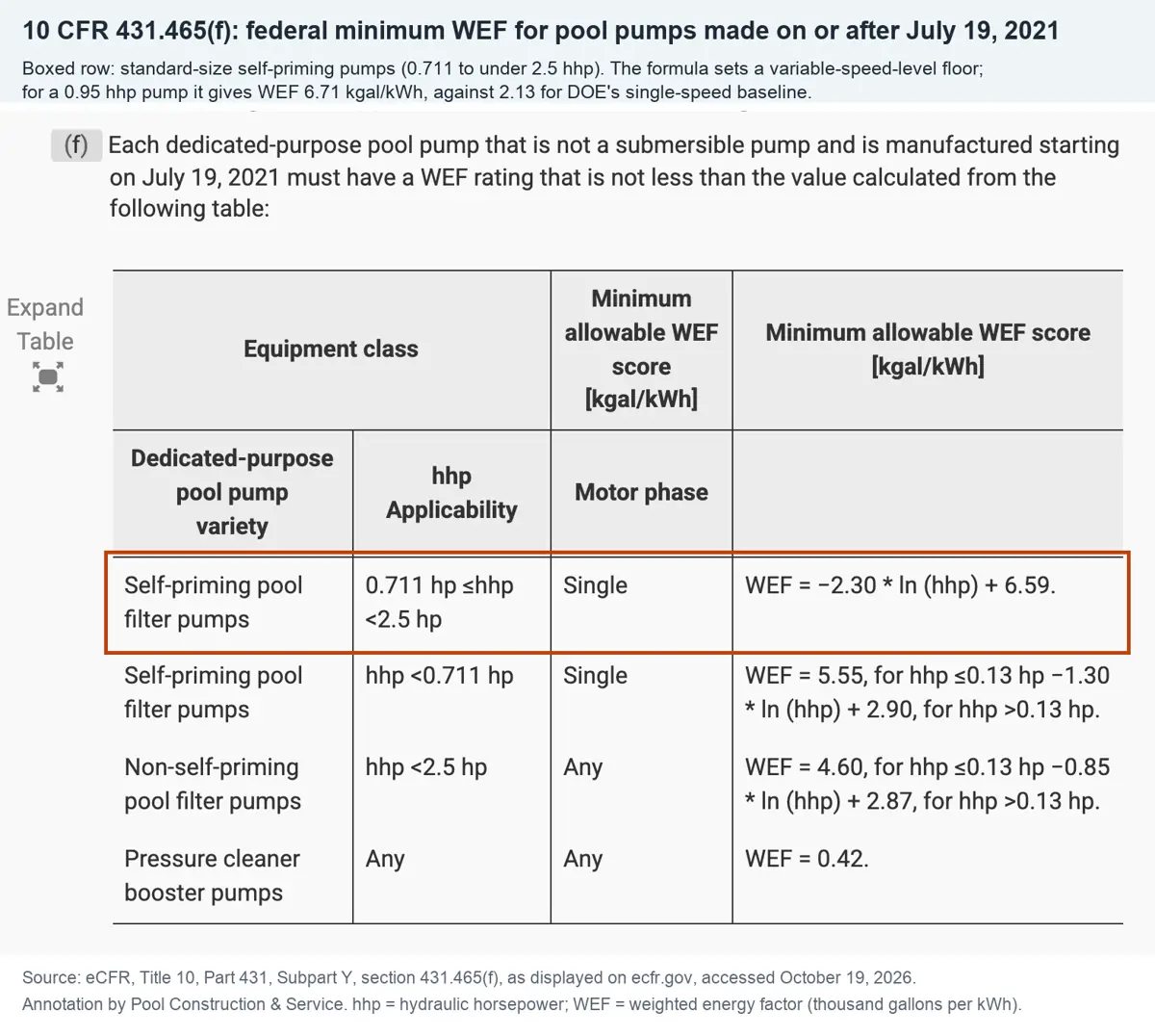
WEF is thousands of gallons pumped per kWh, weighted 80% on a low-flow test point and 20% on a high-flow point for variable speed pumps (10 CFR 431, Subpart Y, Appendix C). For a 0.95 hhp pump the federal formula, WEF = -2.30 x ln(hhp) + 6.59, gives a minimum of 6.71, while DOE’s single-speed baseline scored 2.13 (82 FR 5650). DOE’s adopted level for this class was its variable-speed level, EL6.
Pumps under 0.711 hhp face a lower floor, -1.30 x ln(hhp) + 2.90, and DOE’s adopted level for that class was a single-speed pump with a high-efficiency motor (82 FR 5650), so single-speed models remain on sale in the smaller classes. The motor rule closes the repair path for larger pumps: since Sept 29, 2025, pool pump motors of 1.15 to 5 THP must be variable speed control motors (10 CFR 431.485(c)).
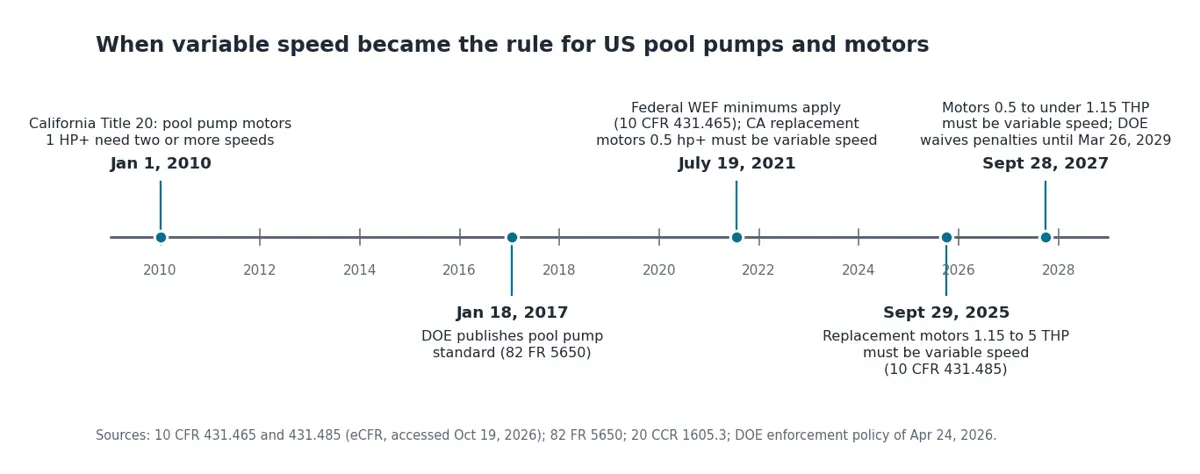
| Date | Rule | What it requires | Source URL |
|---|---|---|---|
| Jan 1, 2010 | California Title 20, 20 CCR 1605.3 | Residential pool pump motors of 1 HP or more sold in California must run at two or more speeds, low speed no more than half of maximum | https://www.law.cornell.edu/regulations/california/20-CCR-1605.3 |
| Jan 18, 2017 | DOE direct final rule, 82 FR 5650 | Sets federal WEF minimums for dedicated-purpose pool pumps | https://www.govinfo.gov/content/pkg/FR-2017-01-18/html/2016-31666.htm |
| July 19, 2021 | 10 CFR 431.465(f) | Self-priming pool filter pumps of 0.711 to under 2.5 hhp: WEF at least -2.30 x ln(hhp) + 6.59, a level single-speed motors cannot reach | https://www.ecfr.gov/current/title-10/chapter-II/subchapter-D/part-431/subpart-Y/section-431.465 |
| July 19, 2021 | 10 CFR 431.465(h) | Freeze protection ships off, or set to 40 F or lower, 1 hour or less per cycle, and no more than half of maximum speed | https://www.ecfr.gov/current/title-10/chapter-II/subchapter-D/part-431/subpart-Y/section-431.465 |
| July 19, 2021 | California Title 20, 20 CCR 1605.3 | Replacement pool pump motors of 0.5 hp or more must be variable-speed; the drive sold with them defaults to no more than 55% of maximum speed | https://www.law.cornell.edu/regulations/california/20-CCR-1605.3 |
| Sept 29, 2025 | 10 CFR 431.485(c) | Standard-size pool pump motors (1.15 to 5 total horsepower) made from this date must be variable speed control motors | https://www.ecfr.gov/current/title-10/chapter-II/subchapter-D/part-431/subpart-Z/section-431.485 |
| Apr 24, 2026 | DOE enforcement policy | No civil penalties for small-size motors (0.5 to under 1.15 THP) made Sept 28, 2027 to before March 26, 2029 | https://www.energy.gov/sites/default/files/2026-04/2026_DPPPM_Enforcement_Policy.pdf |
| Sept 28, 2027 | 10 CFR 431.485(c) | Small-size pool pump motors (0.5 to under 1.15 THP) must be variable speed control motors | https://www.ecfr.gov/current/title-10/chapter-II/subchapter-D/part-431/subpart-Z/section-431.485 |
Sources: 10 CFR 431.465; 10 CFR 431.485; 82 FR 5650; 20 CCR 1605.3; DOE enforcement policy, Apr 24, 2026. Download CSV
How do 7 models compare on WEF, power and price?
On ENERGY STAR test data, the seven models below score WEF 7.1 to 10.17, 27% to 178% above their federal minimums, and draw 92 to 135 watts at the low-flow test point. Listed prices ran $1,285 to $2,699 at named retailers between August and October 2026. Compare WEF within a size class, because larger pumps score lower.
| Model | Model no. | Total HP (maker) | Voltage | Hydraulic hp in ENERGY STAR test, 230 V row for dual-voltage models (DOE size class) | WEF (kgal/kWh) | Federal minimum WEF at that hhp | Margin over federal minimum | Draw at low-flow test point | kWh/day to move 46,260 gal | Cost per month at 18.31 cents | Cost per year, 365 days | Listed price (retailer, date) |
|---|---|---|---|---|---|---|---|---|---|---|---|---|
| Pentair IntelliFlo3 VSF 3.0 HP | 011075 | 3.0 | 208 to 230 V | 1.735 (standard-size) | 7.1 | 5.32 | +33% | 119 W at 31.2 gpm | 6.52 | $36 | $435 | $1,719.99 with a promotion, regular $2,149.99 (Leslie's, Sept 16, 2026 capture) |
| Hayward TriStar VS 2.7 THP | W3SP3206VSP | 2.7 at 230 V; 1.5 at 115 V | 230/115 V | 1.817 (standard-size) | 7.267 | 5.22 | +39% | 117 W at 31.4 gpm | 6.37 | $35 | $425 | $2,699 (Leslie's, Aug 7, 2026 capture) |
| Jandy VS FloPro 1.85 HP | VSFHP185DV2A | 1.85 | 115/208 to 230 V | 1.150 (standard-size) | 8.52 | 6.27 | +36% | 117 W at 30.6 gpm | 5.43 | $30 | $363 | $1,449.72 to $1,729 (Benchmark Pool Supply, PoolCleaningParts.com, Pool Supply Express, Oct 19, 2026) |
| Pentair SuperFlo VS | EC-342001 | 1.5 in retailer listings; 2.2 rated hp in ENERGY STAR data | 115/208 to 230 V | 1.001 (standard-size) | 8.6 | 6.59 | +31% | 115 W at 31.2 gpm | 5.38 | $30 | $359 | $1,609 (Leslie's, Sept 16, 2026 capture); $1,285 (Walmart.com, Oct 14, 2026) |
| Pentair IntelliFlo3 VSF 1.5 HP | 011065 | 1.5 | 115/208 to 230 V | 0.896 (standard-size) | 9.4 | 6.84 | +37% | 124 W at 31.2 gpm | 4.92 | $27 | $329 | $1,299.99 (PoolCleaningParts.com, Oct 19, 2026) |
| Hayward Super Pump VS | W3SP2603VSP | 1.65 at 230 V; 0.85 at 115 V | 230/115 V | 0.831 (standard-size) | 8.9 | 7.02 | +27% | 135 W at 31.5 gpm | 5.20 | $29 | $347 | $1,749 (Leslie's, Sept 16, 2026 capture; Walmart.com, Oct 14, 2026) |
| Hayward MaxFlo VS | W3SP2303VSP | 1.65 at 230 V; 0.85 at 115 V | 230/115 V | 0.559 (small-size) | 10.168 | 3.66 | +178% | 92 W at 24.9 gpm | 4.55 | $25 | $304 | $1,749 (Leslie's, Aug 5, 2026 capture; Walmart.com, Oct 14, 2026) |
Sources: ENERGY STAR certified pool pumps dataset (accessed Oct 19, 2026); Pentair IntelliFlo3 VSF specifications; Hayward TriStar VS listing; Jandy VS FloPro 1.85 HP; retailer pages and Wayback Machine captures listed under Sources; 10 CFR 431.465(f); PC&S calculation at EIA July 2026 prices. Download CSV
WEF falls as pump size (hhp) rises, so compare models within a size class. The MaxFlo VS tests at 0.559 hhp, which DOE classes as small-size with a lower minimum.
Source: ENERGY STAR certified pool pumps dataset; 10 CFR 431.465(f); PC&S calculation. Download chart data (CSV)
The cost columns put every model on the same job: DOE’s reference volume of 46,260 gallons a day divided by the model’s WEF, priced at 18.31 cents per kWh. On that basis the 3.0 HP IntelliFlo3 VSF costs $435 a year and the MaxFlo VS $304, against $1,451 for DOE’s single-speed baseline. WEF measures efficiency, not capacity: the MaxFlo VS tests at 0.559 hhp and will not match the flow of a 1.817 hhp TriStar VS on a large pool with a spa. To find the flow your pool actually needs before comparing models, use our pool pump size calculator, which also checks the gpm against your pipe size.
- Voltage changes output. Hayward rates the TriStar VS W3SP3206VSP at 2.7 total horsepower on 230 V and ENERGY STAR lists the same pump at 1.5 rated hp on 115 V (Hayward). Jandy markets the VS FloPro 1.85 HP as the only 115/230 V pump in its class with the same performance at either voltage (Jandy).
- Horsepower labels differ by source. Retailers sell the Pentair SuperFlo VS EC-342001 as a 1.5 HP pump; the ENERGY STAR record for EC-342001 lists 2.2 rated hp. Compare hhp and WEF, which come from the same DOE test.
- Current draw sets the circuit. Pentair lists 12.4 to 11.2 full-load amps at 208 to 230 V for the 3 HP IntelliFlo3 VSF and a maximum input of 2,590 W (Pentair install guide).
- Warranty depends on the sales channel. Hayward’s Open Line listing for the TriStar VS W3SP3206VSP shows a 1-year parts warranty and no labor warranty (Hayward); ask the seller which channel and term apply before you buy.
How much does a variable speed pool pump save per year?
At the July 2026 US average of 18.31 cents per kWh, DOE’s model pump costs $1,451 a year single-speed and $449 variable speed if it runs every day, a $1,003 saving. Over each state’s DOE swim season, the median saving across 51 jurisdictions is $487, from $203 in Washington to $2,628 in Hawaii.
| Step | Input or result | Arithmetic | Source |
|---|---|---|---|
| 1 | Flow of DOE representative 0.95 hhp pump at maximum speed (system curve C) | 77.1 gpm | DOE 2017 rule, 82 FR 5650 |
| 2 | Water moved in a 10-hour day (DOE weighted average run time) | 77.1 x 60 x 10 = 46,260 gal | DOE 2017 rule |
| 3 | Single-speed baseline weighted energy factor | 2.13 kgal/kWh | DOE 2017 rule |
| 4 | Single-speed power draw | 77.1 x 60 / (2.13 x 1,000) = 2.17 kW | PC&S calculation |
| 5 | Single-speed energy per day | 2.17 kW x 10 h = 21.72 kWh | PC&S calculation |
| 6 | Variable-speed energy per day (DOE ratio 1,390 / 4,495 kWh) | 21.72 x 1,390 / 4,495 = 6.72 kWh | DOE technical support document; PC&S calculation |
| 7 | US average residential price, July 2026 | 18.31 cents/kWh | EIA Electric Power Monthly, Table 5.6.A |
| 8 | Cost per day | single-speed $3.98; variable-speed $1.23 | PC&S calculation |
| 9 | Cost per month of operation (30.42 days) | single-speed $121; variable-speed $37 | PC&S calculation |
| 10 | Cost per year if the pool runs 365 days | single-speed $1,451; variable-speed $449; saving $1,003 | PC&S calculation |
| 11 | Median of 51 jurisdictions at DOE swim seasons and state prices | single-speed $705; variable-speed $218; saving $487 | PC&S pump cost research (EIA, DOE) |
Sources: DOE, 82 FR 5650; DOE technical support document; EIA Table 5.6.A (Sept 24, 2026 release); PC&S pool pump running cost report. Download CSV
Seasons: 365 days in HI, CA, TX, AZ, FL; 214 in NC; 123 in NY and PA; 92 in WA.
Source: PC&S pump cost research using EIA Table 5.6.A (July 2026) and DOE season lengths. Download chart data (CSV)
Two inputs move these numbers. Your rate: Hawaii averaged 48.00 cents per kWh in July 2026 and Louisiana 12.72 cents (EIA). Your season: DOE models 365 days of operation in Florida, Texas and Arizona but 92 in Washington. State-by-state detail, including payback, is in our pool pump running cost report.
Some widely repeated savings figures compare different things. The table below sets four of them against their own fine print and the DOE model, which compares pumps of the same size on the same plumbing.
| Where it appears | What it says | What the fine print or definition shows | What the primary source shows |
|---|---|---|---|
| Pentair IntelliFlo3 product page | Save up to 90% in energy consumption | Pentair footnote: compared with a single-speed pump running 12 hours a day at $0.16 per kWh in a 20,000-gallon pool | DOE national model: 69% less electricity for a federal-standard variable-speed pump, 73% for the most efficient level (1,390 and 1,217 vs 4,495 kWh/yr) |
| ENERGY STAR pool pump page | Certified in-ground pumps use 20% less energy than standard pumps, about $50 a year | The comparison is against a standard pump, which since July 19, 2021 already means variable-speed-level efficiency | Median certified in-ground variable-speed WEF is 8.6, 37.4% above each model's federal minimum (PC&S calculation) |
| ClearComfort guide (top-10 result) | Half speed costs one-eighth; savings upwards of $500 a year | One-eighth is the power at half speed; running twice as long to move the same water takes one-quarter of the energy | Affinity laws: power falls with speed cubed, energy per gallon with speed squared; median-state saving $487 at July 2026 prices |
| ENERGY STAR pool pump page | Running 6 hours instead of 24 cuts energy 75% | True for a single-speed pump at a fixed draw | For a variable speed pump, a longer run at lower speed moves the same water for less energy (affinity laws) |
Sources: Pentair IntelliFlo3 VSF page; ENERGY STAR pool pumps; ClearComfort variable speed pump guide; DOE technical support document; ENERGY STAR dataset; Engineering ToolBox. All accessed Oct 19, 2026. Download CSV
What speed should you set, and for how many hours?
Use the lowest speed that still turns the pool over in your target time. ENERGY STAR’s pool pump fact sheet sets the minimum speed as the one that gives a 12-hour turnover, following ANSI/NSPI-5. Then add short high-speed windows only for jobs that need them; DOE assumes up to 2 hours a day at high speed for variable speed pumps. Hours by pool size and flow, utility schedules and monthly cost by state are in our guide on how long to run a pool pump.
- Find the pool volumeMultiply length x width x average depth in feet by 7.48 gallons per cubic foot (USGS). A 16 x 32 ft pool at 5 ft average depth holds about 19,150 gallons; our pool volume calculator handles round and kidney shapes.
- Work out the flow for a 12-hour turnoverDivide gallons by 720 minutes: 19,150 gallons needs about 27 gpm. ENERGY STAR uses the 12-hour turnover speed as the minimum calibration speed (ENERGY STAR fact sheet).
- Set the filtration programOn a flow-controlled pump such as the IntelliFlo3 VSF, enter gpm directly: its factory Program 1 runs 24 hours at 30 GPM, with a 20 GPM minimum (Pentair install guide). On an RPM-only pump, start near 1,250 RPM, the median speed at ENERGY STAR’s 31 gpm low-flow test point, then check filter pressure and skimmer action.
- Add short high-speed windowsProgram 1 to 2 hours at higher speed for a pressure-side cleaner, spa jets or a water feature, in line with DOE’s assumption of up to 2 hours a day at high speed. Confirm the minimum flow listed in your heater or salt cell manual.
- Keep priming and freeze protection onPentair’s guide says not to run more than 30 minutes without prime and ships a maximum priming duration of 11 minutes. Federal rules ship freeze protection off, or set at 40 F or lower and no more than half of maximum speed (10 CFR 431.465(h)); turn it on where pipes can freeze.
Should I leave my variable speed pool pump on all the time? Running 24 hours at low speed is a legitimate schedule: it is the IntelliFlo3 VSF factory default of 30 GPM. Under the affinity laws, halving speed and doubling hours moves the same water on one-quarter of the energy, so 24 hours at 27 gpm beats 12 hours at 54 gpm, provided skimmers still pull debris and the heater or chlorinator gets its minimum flow. When the pump has to share a schedule with a heater, spa valves or lights, our pool automation system guide lines up the controllers that coordinate them, relay by relay.
What does one cost, and which rebates apply?
The pump alone listed at a $1,739 median for 1.5 to 1.65 THP in-ground models in 2026, against $849 for a 0.75 to 1 HP single-speed pump, across Leslie’s, Home Depot and Walmart.com listings. Labor, electrical work and permits come on top. Six utilities checked on Oct 19, 2026 pay $100 to $500 back on ENERGY STAR models.
Prices have climbed. Leslie’s listed the Hayward MaxFlo VS at $1,379 in April 2024 and $1,749 in August 2026, up 26.8% (Wayback Machine capture), while the BLS producer price index for pumps rose 10.2% from January 2024 to August 2026 (PC&S price panel). Tariffs are one input: a Chinese-origin pool pump faced 37.5% in stacked U.S. duty in October 2026, against 12.5% from Vietnam or Thailand (PC&S tariff registry).
Installed totals, labor rates, electrical permit fees and the motor-only option are covered in our pool pump replacement cost guide.
| Utility (state) | Rebate | Terms stated on the utility page | Source URL |
|---|---|---|---|
| Los Angeles Department of Water and Power (CA) | $500 standard; $750 summer special | Summer special: bought and installed June 1 to Sept 30, 2026, applied by Dec 31, 2026 | https://www.ladwp.com/residential-services/assistance-programs/consumer-rebate-program |
| NHSaves utilities (NH) | $350 | Bought and installed Jan 1 to Dec 31, 2026; apply within 90 days, by Jan 31, 2027 | https://nhsaves.com/residential/pool-pumps/ |
| Dominion Energy Virginia (VA) | $300 | ENERGY STAR variable-speed pump of 1/2 hp or more; Virginia customers | https://www.domsavings.com/home-program/water-energy-rebate |
| Wright-Hennepin Cooperative Electric (MN) | up to $200 | Purchased Jan 1 to Dec 31, 2026; submit within 90 days of installation | https://www.whe.org/sites/default/files/2026-01/eco-residential-pool-pumps-2026.pdf |
| DTE Energy (MI) | $100 | Apply within 6 months of purchase and by Dec 31, 2026; limit two per customer | https://www.dteenergy.com/us/en/residential/save-money-energy/rebates-and-offers/pool-pumps.html |
| Rochester Public Utilities (MN) | $100, capped at 50% of cost | 2026 purchases; applications by March 31, 2027; EC, DC brushless or permanent magnet motor | https://www.rpu.org/media/bp0ix2d2/2026-variable-speed-pool-pump-rebate-application-fillable-form.pdf |
Sources: LADWP; NHSaves; Dominion Energy Virginia; Wright-Hennepin; DTE Energy; Rochester Public Utilities. Download CSV
Is a variable speed pool pump worth it?
For most owners, yes. Replacing a working single-speed pump pays back in under 2 years in 15 of 51 jurisdictions at July 2026 prices, using DOE’s installed cost of $1,206 in 2026 dollars, and from 0.5 years in Hawaii to 5.9 in Washington. When a pump fails anyway, only the price gap over a single-speed unit has to pay back.
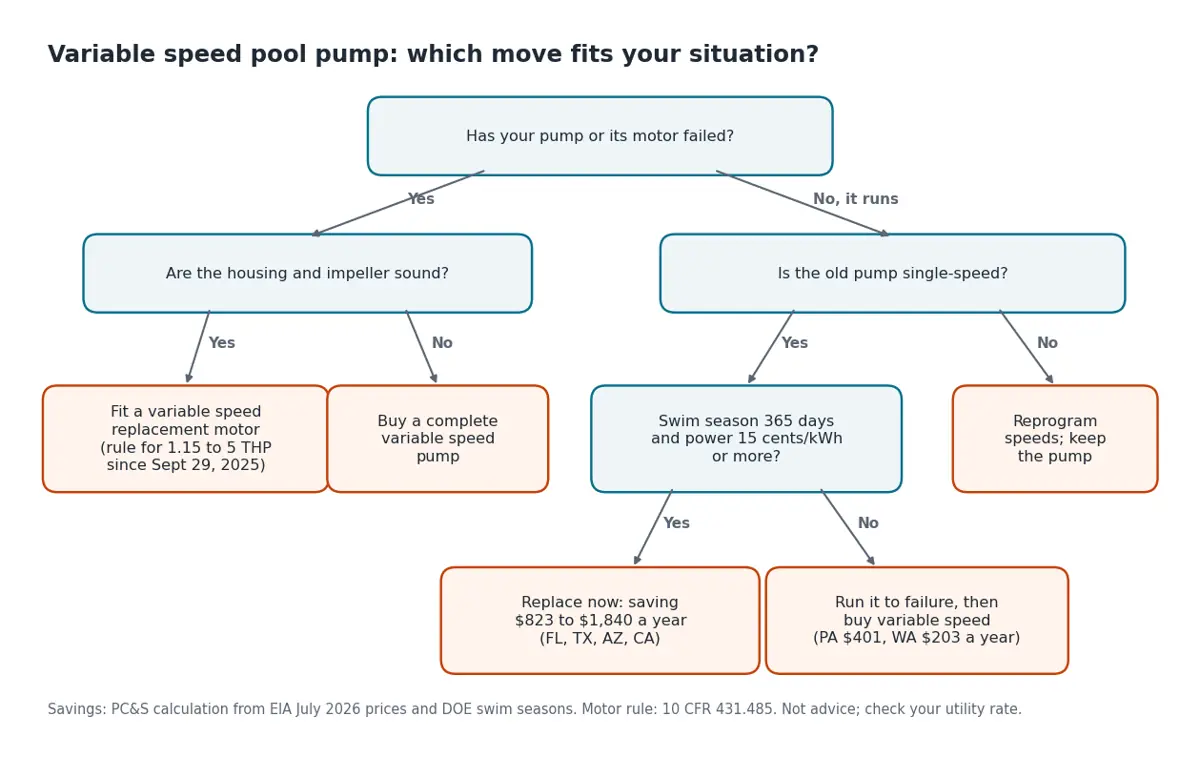
| If your situation is | Do this |
|---|---|
| Your old pump is single-speed, still works, and your swim season is 365 days in a state at 15 cents/kWh or more (FL, TX, AZ, CA) | Replace it now: the saving runs $823 to $1,840 a year, so the $1,739 median list price pays back in 0.9 to 2.1 years |
| Single-speed pump still works and your DOE swim season is 123 days or less (PA, WA, NY) | Keep it until it fails, then buy variable speed: the saving is $203 to $552 a year |
| Pump has failed and the pool needs a standard-size pump (0.711 hhp or more) | Buy variable speed: new standard-size pumps made since July 19, 2021 must meet a WEF that single-speed motors cannot reach |
| Motor has failed but the housing and impeller are sound | A variable speed replacement motor is the like-for-like option: 1.15 to 5 THP motors made since Sept 29, 2025 must be variable speed |
| Only a 115 V circuit at the pad | Pick a dual-voltage model and expect lower output: the TriStar VS is 2.7 THP at 230 V but 1.5 at 115 V |
| Your utility offers a rebate (LADWP, NHSaves, Dominion, DTE) | Buy an ENERGY STAR listed model and keep the itemized invoice: rebates run $100 to $750 in 2026 |
| Spa, cleaner or water feature needs high flow for part of the day | Program a short high-speed window: DOE assumes 2 hours a day at high speed for two-speed and variable-speed pumps |
Sources: PC&S pool pump running cost report (EIA, DOE); 10 CFR 431.465; 10 CFR 431.485; Hayward; utility pages in the rebate table. Download CSV
What are the disadvantages of a variable speed pool pump? Price comes first: $1,739 median against $849 for a small single-speed pump. The drive electronics add failure modes: CPSC recall 17-174 covered about 16,000 Nidec variable speed pool motors for a shock hazard in 2017 (CPSC), and our pool product recall tracker lists other pump recalls. On 115 V, dual-voltage models lose output, as the TriStar VS figures above show.
How long does a variable speed pool pump last? DOE’s rulemaking used a mean lifetime of 7 years for residential self-priming pool pumps of all types (82 FR 5650). Over 7 years at the median-state saving of $487, a variable speed pump avoids about $3,409 of electricity, before any price increase. For repairs and failure symptoms, see our pool repair guide.
Which electrical rules apply to a variable speed pump install?
Under the 2020 National Electrical Code, outlets supplying pool pump motors on branch circuits of 150 volts or less to ground and 60 amps or less need Class A GFCI protection under 680.21(C); a replaced pump motor must get GFCI protection under 680.21(D); and pump motors must be bonded under 680.26(B)(6). Your locally adopted code edition governs.
The 2020 NEC text, as reproduced by the Town of Woodbury, CT building department, requires the GFCI on a replacement motor even where the original installation had none (680.21(D)), and requires metal parts of circulation equipment, including pump motors, to be bonded (680.26(B)(6)). Pentair’s guide specifies a solid copper bonding conductor of at least 8 AWG and connection to metal within 5 ft of the pool walls (Pentair install guide).
Drives add one twist. Temporary Interim Amendment 70-26-1, effective April 30, 2025, says a GFCI is not to be installed between a variable speed drive output and the pool motor; protection goes on the supply side (NESPA 2026 Article 680 handout). The 2026 NEC also extends GFCI protection to reconditioned pump motors. Electrical incidents at pools are tracked in our pool electrocution statistics.
How we compiled this
We compiled this page from 25 primary documents and 10 dated retailer listings: the eCFR text of 10 CFR 431.465, 431.485 and the Subpart Y test appendix, two DOE rulemaking records and a DOE enforcement policy, the ENERGY STAR certified pool pump dataset (423 models, updated Oct 2, 2026), three manufacturer spec pages and one install guide, six utility rebate pages, EIA price tables, California’s Title 20, two NEC Article 680 references, a CPSC recall notice and a USGS conversion, all accessed in October 2026. We did not test any pump; every cost is arithmetic from the stated inputs. Forum posts were read for question wording only.
Frequently Asked Questions
Is it worth getting a variable speed pool pump?
Usually. At July 2026 electricity prices, switching saves a median $487 a year across 51 jurisdictions, and replacing a working single-speed pump pays back in under 2 years in 15 of them, using DOE’s $1,206 installed cost in 2026 dollars (PC&S calculation). Washington, with a 92-day season and 14.71 cents per kWh, is the slowest at 5.9 years.
What are the disadvantages of a variable speed pool pump?
Higher price ($1,739 median in 2026 against $849 for a small single-speed pump), drive electronics that can fail or be recalled (CPSC recall 17-174 covered about 16,000 Nidec variable speed motors in 2017), reduced output on 115 V for dual-voltage models, and a GFCI that must not sit between the drive and motor (TIA 70-26-1).
Should I leave my variable speed pool pump on all the time?
You can. Pentair ships the IntelliFlo3 VSF to run 24 hours a day at 30 GPM by default. Because energy per gallon falls with speed squared, a long low-speed run moves the same water for less energy than a short fast one. Keep enough flow for skimmers and for the minimum your heater or salt cell needs.
Which is better, a 2-speed pool pump or a variable speed pool pump?
Variable speed, on energy. DOE’s model has two-speed pumps at 1,971 to 2,443 kWh a year against 1,390 for a federal-standard variable speed pump (DOE). At 18.31 cents per kWh that gap is $106 to $193 a year. New standard-size pumps made since July 19, 2021 must reach the variable-speed WEF level anyway.
Will a variable speed pool pump save me money?
Yes, if you run it at low speed. At the July 2026 US average of 18.31 cents per kWh, DOE’s model pump costs $121 a month single-speed and $37 as variable speed on a 10-hour day. Running a variable speed pump at high speed all day erases most of that gap, because power rises with the cube of speed.
What is the average lifespan of a variable speed pool pump?
DOE used a mean lifetime of 7 years for residential self-priming pool pumps in its 2017 standard (82 FR 5650); it did not publish a separate figure for variable speed models. Warranty terms vary by channel: Hayward lists a 1-year parts warranty for its Open Line TriStar VS.
Do I really need a variable speed pool pump?
For a standard-size in-ground pump, effectively yes: pumps of 0.711 to under 2.5 hhp made since July 19, 2021 must meet a WEF only variable speed designs reach, and replacement motors of 1.15 to 5 THP made since Sept 29, 2025 must be variable speed. Smaller single-speed pumps under 0.711 hhp are still legal.
Sources
- eCFR, U.S. Government Publishing Office. 10 CFR 431.465, Pumps energy conservation standards. Accessed 2026-10-19.
- eCFR, U.S. Government Publishing Office. 10 CFR 431.485, Dedicated-purpose pool pump motor standards. Accessed 2026-10-19.
- eCFR. 10 CFR 431 Subpart Y, Appendix C, test procedure for dedicated-purpose pool pumps. Accessed 2026-10-03.
- U.S. Department of Energy. Energy conservation standards for dedicated-purpose pool pumps, 82 FR 5650 (Jan 18, 2017). Accessed 2026-10-03.
- U.S. Department of Energy. DPPP technical support document. Accessed 2026-10-03.
- U.S. Department of Energy. Dedicated-purpose pool pump motor enforcement policy (Apr 24, 2026). Accessed 2026-10-03.
- U.S. EPA ENERGY STAR. ENERGY STAR certified pool pumps dataset. Accessed 2026-10-19.
- U.S. EPA ENERGY STAR. Pool pumps product page. Accessed 2026-10-19.
- U.S. EPA ENERGY STAR. Pool pumps fact sheet (2022). Accessed 2026-10-03.
- U.S. Energy Information Administration. Electric Power Monthly, Table 5.6.A (Sept 24, 2026 release). Accessed 2026-10-03.
- Cornell Legal Information Institute. 20 CCR 1605.3, California appliance efficiency standards. Accessed 2026-10-03.
- Engineering ToolBox. Affinity laws for pumps. Accessed 2026-10-19.
- Pentair. IntelliFlo3 VSF pool pump specifications. Accessed 2026-10-19.
- Pentair. IntelliFlo3 VSF installation and maintenance guide. Accessed 2026-10-19.
- Hayward. TriStar VS 2.7 HP W3SP3206VSP listing. Accessed 2026-10-19.
- Jandy (Fluidra). VS FloPro 1.85 HP product page. Accessed 2026-10-19.
- Town of Woodbury, CT. 2020 National Electrical Code in-ground pool requirements. Accessed 2026-10-19.
- Northeast Spa & Pool Association / Pool & Spa Show. Changes in Article 680: 2020, 2023 and 2026 NEC (handout). Accessed 2026-10-19.
- U.S. Consumer Product Safety Commission. Recall 17-174, Nidec pool motors. Accessed 2026-10-04.
- Los Angeles Department of Water and Power. Consumer Rebate Program. Accessed 2026-10-19.
- NHSaves. Variable-speed pool pumps rebate. Accessed 2026-10-19.
- Dominion Energy Virginia. Water Energy Rebates. Accessed 2026-10-19.
- Wright-Hennepin Cooperative Electric Association. 2026 variable speed pool pump rebate application. Accessed 2026-10-19.
- DTE Energy. Pool pump rebates. Accessed 2026-10-19.
- Rochester Public Utilities. 2026 variable speed pool pump rebate application. Accessed 2026-10-19.
- U.S. Geological Survey. Water science glossary (7.48 gallons per cubic foot). Accessed 2026-10-19.
- Leslie's via Wayback Machine. Hayward MaxFlo VS W3SP2303VSP, Aug 5, 2026 capture. Accessed 2026-10-19.
- Leslie's via Wayback Machine. Pentair IntelliFlo3 VSF 011075, Sept 16, 2026 capture. Accessed 2026-10-19.
- Leslie's via Wayback Machine. Hayward TriStar VS W3SP3206VSP, Aug 7, 2026 capture. Accessed 2026-10-19.
- Leslie's via Wayback Machine. Hayward Super Pump VS W3SP2603VSP, Sept 16, 2026 capture. Accessed 2026-10-19.
- Leslie's via Wayback Machine. Pentair SuperFlo VS EC-342001, Sept 16, 2026 capture. Accessed 2026-10-19.
- Pool Supply Express. Jandy VS FloPro 1.85 HP VSFHP185DV2A. Accessed 2026-10-19.
- Benchmark Pool Supply. Jandy VS FloPro VSFHP185DV2A. Accessed 2026-10-19.
- PoolCleaningParts.com. Jandy VS FloPro 1.85 HP, no controller. Accessed 2026-10-19.
- PoolCleaningParts.com. Pentair IntelliFlo3 VSF 1.5 HP 011065. Accessed 2026-10-19.
- Walmart.com. Pentair SuperFlo VS 342001 listing. Accessed 2026-10-14.
- ClearComfort. Variable speed pool pumps guide (claim compared). Accessed 2026-10-19.
Related pages
Get Quotes From Licensed Local Pool Pros
Tell us what you need and your ZIP code. We match you with pool companies that cover your area.