Pool Pump Size Calculator: Flow, Pipe Limits and the Pump Curve Check
This pool pump size calculator divides gallons by turnover minutes: a 20,000 gallon pool on an 8-hour turnover needs 41.7 gpm, which one 2 inch suction pipe carries under the 6 feet per second code limit.
- ✓Sized by flow, not horsepowerGallons divided by turnover minutes, then checked against pipe, filter and pump curve.
- ✓Code velocity limits6 fps suction and 8 fps return from APSP-15, MAHC and California Title 24.
- ✓A real pump curveOperating points read from a published Pentair curve on two code system curves.
Pool pump size calculator: enter gallons, turnover hours and pipe size
Enter your pool’s gallons, the turnover time you want and your Schedule 40 pipe size. The pool pump size calculator returns the flow in gallons per minute and the most that pipe can carry at the 6 fps suction limit and the 8 fps return limit. If the flow fits under the suction figure, one suction line of that size can feed the pump.
Formula source: Velocity limits 6 fps suction and 8 fps return: ANSI/APSP/ICC-15 as summarized in ICC CodeNotes (2024), also MAHC 4.7.1.7.2 and California Title 24 150.0(p); Schedule 40 inside diameters from Charlotte Pipe ASTM D1785 OD and minimum wall. Estimates only.
Default result: 20,000 gallons in 8 hours is 41.7 gpm. A 2 inch Schedule 40 pipe (2.067 inch inside) carries 62.8 gpm at 6 fps and 83.7 gpm at 8 fps, so one 2 inch suction line handles it. The arithmetic is in the table below. Need your gallons first? Use our pool volume calculator.
| Input or output | Value | Arithmetic |
|---|---|---|
| Pool volume | 20,000 gal | Input |
| Turnover time | 8 hours | Input |
| Flow needed | 41.7 gpm | 20,000 / (8 x 60) |
| 2 in Schedule 40 inside diameter | 2.067 in | 2.375 OD minus 2 x 0.154 wall |
| Max flow, 2 in suction at 6 fps | 62.8 gpm | 3.1416 x 2.067^2 / 4 / 144 x 6 x 448.831 |
| Max flow, 2 in return at 8 fps | 83.7 gpm | Same area x 8 x 448.831 |
| Verdict | Fits | 41.7 is under 62.8: one 2 in suction line carries it |
| System head at 41.7 gpm (Title 24 curve, over 17,000 gal) | 14.3 ft | 0.0082 x 41.7^2 |
PC&S arithmetic. Pipe dimensions: Charlotte Pipe ASTM D1785 table; limits: ICC CodeNotes; system curve: Energy Code Ace, Title 24 150.0(p). Download CSV
Key takeaways
- Pump flow needed = gallons / (turnover hours x 60): 41.7 gpm for 20,000 gallons in 8 hours, the formula behind the MAHC definition of turnover (MAHC 4.7.1.10.2).
- Residential filtration pipe is sized for a 6-hour turnover or 36 gpm, whichever is greater, at no more than 8 fps return and 6 fps suction (ANSI/APSP/ICC-15 via ICC CodeNotes, 2024).
- A 2 inch Schedule 40 PVC pipe carries 63 gpm at 6 fps and 84 gpm at 8 fps; 1.5 inch carries 38 and 51 (ICC Table 1).
- The same Pentair IntelliFlo3 1.5 HP pump at full speed delivers about 75 gpm on one Title 24 system curve and 57 gpm on the other (Pentair install guide curve), so horsepower alone does not set flow.
- New self-priming filter pumps of 0.711 to under 2.5 hydraulic hp made since July 19, 2021 must meet a WEF level variable speed designs reach (10 CFR 431.465).
How do you determine the size pool pump you need?
Work in four steps: gallons, turnover, flow, then limits. Divide gallons by turnover hours times 60 to get gpm, check that gpm against your suction pipe at 6 fps, your filter’s rating and any code cap, then pick a pump whose curve delivers that gpm at your plumbing’s head. A 15,000 gallon pool on 8 hours needs 31.3 gpm.
- Find gallonsLength x width x average depth x 7.48 for a rectangle (USGS: 7.48 gallons per cubic foot).
- Pick a turnover8 to 12 hours for most homes; 6 hours is the sizing flow in ANSI/APSP/ICC-15; 12 hours is ENERGY STAR’s minimum-speed setting.
- Compute gpmGallons / (hours x 60). 15,000 gallons: 31.3 gpm at 8 hours, 20.8 gpm at 12.
- Check the pipeCompare gpm with the 6 fps suction figure for your pipe: 38 gpm for 1.5 inch, 63 for 2 inch, 90 for 2.5 inch.
- Check the filterKeep the flow at or below the filter’s rated gpm, for example 62 gpm on a Hayward S244T sand filter.
- Read the pump curveEstimate head (Title 24 uses H = 0.0082 x F^2 over 17,000 gallons, 0.0167 x F^2 at or below), then confirm the pump curve passes above that point.
How many gpm does a pool pump need by pool size?
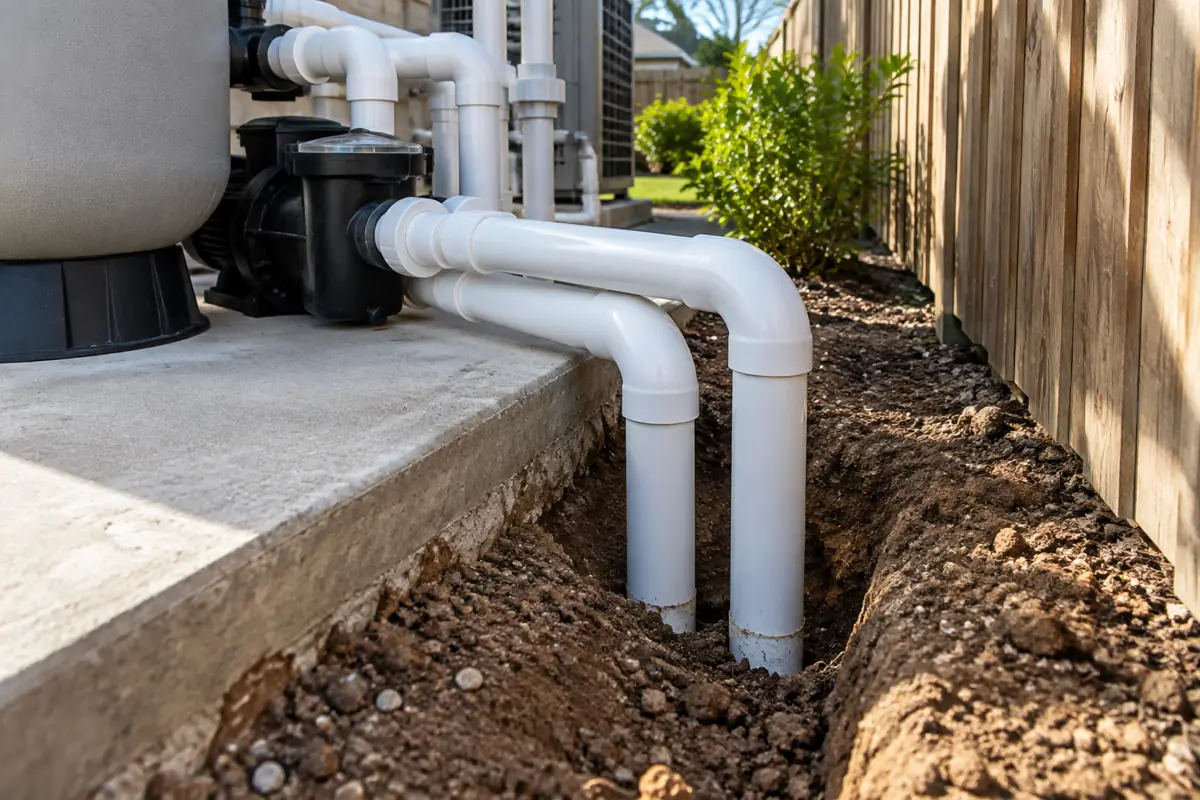
Divide gallons by 480 for an 8-hour turnover, by 600 for 10 hours and by 720 for 12. A 6,000 gallon pool needs 12.5 gpm on 8 hours; a 30,000 gallon pool needs 62.5 gpm, right at the 62.8 gpm a single 2 inch suction line carries at 6 fps. Above about 30,000 gallons on 8 hours, plan 2.5 inch suction or two lines.
12 hours is the ENERGY STAR minimum-speed calibration (ANSI/NSPI-5).
Source: PC&S arithmetic: gpm = gallons / (hours x 60).. Download chart data (CSV)
| Pool volume (gallons) | 8-hour turnover (gpm) | 10-hour turnover (gpm) | 12-hour turnover (gpm) | California Title 24 maximum (gpm) | Smallest single Schedule 40 suction pipe for the 8-hour flow at 6 fps |
|---|---|---|---|---|---|
| 6,000 | 12.5 | 10.0 | 8.3 | 36.0 | 1.5 in |
| 10,000 | 20.8 | 16.7 | 13.9 | 36.0 | 1.5 in |
| 15,000 | 31.3 | 25.0 | 20.8 | 41.7 | 1.5 in |
| 20,000 | 41.7 | 33.3 | 27.8 | 55.6 | 2 in |
| 25,000 | 52.1 | 41.7 | 34.7 | 69.4 | 2 in |
| 30,000 | 62.5 | 50.0 | 41.7 | 83.3 | 2 in |
| 40,000 | 83.3 | 66.7 | 55.6 | 111.1 | 2.5 in |
PC&S arithmetic. Title 24 cap = greater of gallons / 360 and 36 gpm (Energy Code Ace). Pipe at 6 fps from the pipe capacity table on this page. Download CSV
For a 30,000 gallon pool the answer is 62.5 gpm on 8 hours, 50 gpm on 10 and 41.7 gpm on 12. The 8-hour figure leaves 0.3 gpm of headroom in a single 2 inch suction line, so a builder would usually run 2.5 inch suction or split the flow between a main drain line and a skimmer line. Run-time hours by flow and energy per turnover are covered on our how long to run a pool pump page.
How much flow can each pipe size carry?
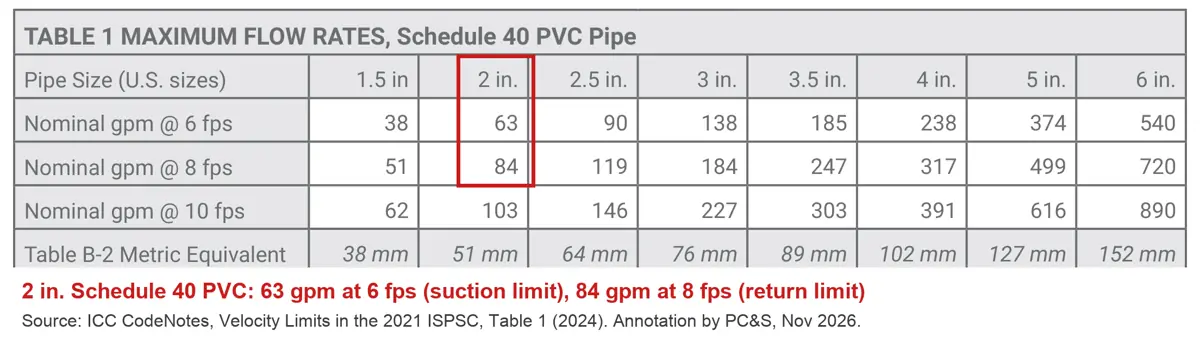
Pipe capacity is area times velocity. A 2 inch Schedule 40 PVC pipe has a 2.067 inch bore, or 0.0233 square feet, so at the 6 fps suction limit it carries 62.8 gpm and at the 8 fps return limit 83.7 gpm. ICC’s own Table 1 prints 63 and 84. The limits come from ANSI/APSP/ICC-15 for home pools and MAHC 4.7.1.7.2 for public pools.
| Nominal size (Schedule 40 PVC) | Average OD (in) | Minimum wall (in) | Inside diameter OD minus 2 walls (in) | Max gpm at 6 fps (suction) | Max gpm at 8 fps (return) | ICC Table 1 at 6 / 8 fps | Hayward ProSeries manual max flow |
|---|---|---|---|---|---|---|---|
| 1.5 in | 1.900 | 0.145 | 1.610 | 38.1 | 50.8 | 38 / 51 | 45 gpm |
| 2 in | 2.375 | 0.154 | 2.067 | 62.8 | 83.7 | 63 / 84 | 80 gpm |
| 2.5 in | 2.875 | 0.203 | 2.469 | 89.5 | 119.4 | 90 / 119 | 110 gpm |
| 3 in | 3.500 | 0.216 | 3.068 | 138.3 | 184.3 | 138 / 184 | 160 gpm |
Charlotte Pipe dimensional catalog (ASTM D1785 average OD and minimum wall); ICC CodeNotes Table 1; Hayward ProSeries manual; PC&S arithmetic (448.831 gpm per cubic foot per second). Download CSV
Matches ICC CodeNotes Table 1 to within 1 gpm.
Source: PC&S arithmetic: pi x ID squared / 4 / 144 x fps x 448.831; IDs from Charlotte Pipe ASTM D1785 dimensions; limits from ANSI/APSP/ICC-15 via ICC CodeNotes (2024), MAHC 4.7.1.7.2 and Title 24 150.0(p).. Download chart data (CSV)
The codes agree on the numbers but not on where they apply. ISPSC 2021 Section 311.3.2 lets residential suction and return piping run at 8 fps, while ANSI/APSP/ICC-15 holds residential filtration suction to 6 fps (ICC CodeNotes). The 2024 MAHC sets 8 fps discharge and 6 fps suction for public pools, Georgia rule 511-3-5-.07(2) does the same (Georgia DPH), and California’s Title 24 150.0(p) applies 8 and 6 fps to new home pools. The calculator uses 6 fps for suction, the strictest.
Hayward’s ProSeries filter manual lists 80 gpm as the maximum for 2 inch pipe, close to the 8 fps return limit (83.7 gpm) but 27% above the 6 fps suction limit (62.8 gpm). Use the 6 fps figure for the suction side.
Why does the pump curve matter more than horsepower?
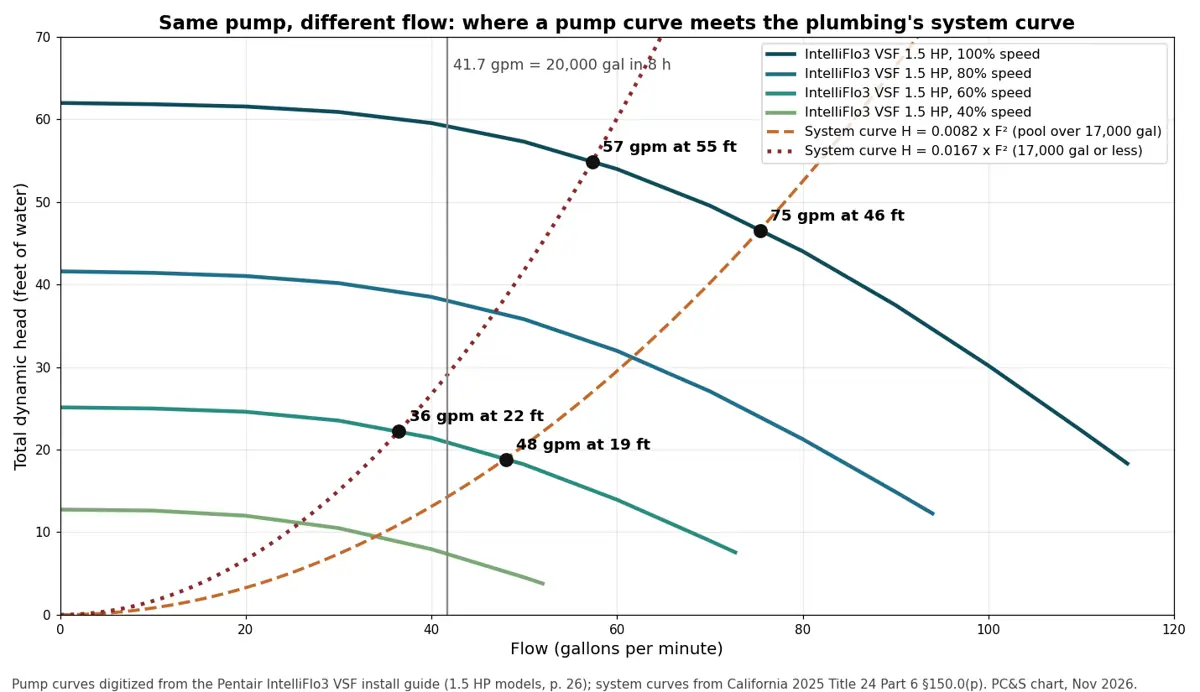
A pump does not have one flow. Its curve trades flow for head, and the plumbing’s system curve rises with flow squared; the pump runs where the two cross. On Pentair’s published curve for the 1.5 HP IntelliFlo3 VSF, full speed gives about 75 gpm against a Title 24 system curve for pools over 17,000 gallons and about 57 gpm against the steeper one.
| Pump speed | Plumbing (Title 24 system curve) | Flow (gpm) | Head (ft) | Hours to turn over 20,000 gal | Inside the 2 in suction limit (62.8 gpm)? |
|---|---|---|---|---|---|
| 100% | Over 17,000 gal: H = 0.0082 x F^2 | 75.4 | 46.5 | 4.4 | No: 7.2 fps |
| 100% | 17,000 gal or less: H = 0.0167 x F^2 | 57.3 | 54.8 | 5.8 | Yes |
| 80% | H = 0.0082 x F^2 | 61.6 | 31.1 | 5.4 | Yes |
| 80% | H = 0.0167 x F^2 | 46.8 | 36.6 | 7.1 | Yes |
| 60% | H = 0.0082 x F^2 | 48.0 | 18.8 | 6.9 | Yes |
| 60% | H = 0.0167 x F^2 | 36.5 | 22.2 | 9.1 | Yes |
| 40% | H = 0.0082 x F^2 | 34.0 | 9.5 | 9.8 | Yes |
| 40% | H = 0.0167 x F^2 | 25.9 | 11.1 | 12.9 | Yes |
Curve: Pentair IntelliFlo3 VSF install guide, p. 26 (digitized, PC&S, file in raw/). System curves: Title 24 150.0(p). Turnover = 20,000 / gpm / 60. Download CSV
Total dynamic head is the pressure the pump must make, in feet of water: lift from the water line to the pump plus friction in pipe, fittings, filter, heater and valves. Friction climbs fast with velocity. On Pentair’s Schedule 40 chart, 2 inch pipe loses 3.13 ft per 100 ft at 40 gpm and 11.28 ft at 80 gpm; 1.5 inch at 40 gpm loses 12.67 ft (Pentair 2025 to 2026 catalog, engineering data).
| Flow (gpm) | 1.5 in: velocity (fps) | 1.5 in: loss per 100 ft (ft) | 2 in: velocity (fps) | 2 in: loss per 100 ft (ft) | 2.5 in: velocity (fps) | 2.5 in: loss per 100 ft (ft) |
|---|---|---|---|---|---|---|
| 30 | 5.34 | 7.44 | 3.01 | 1.83 | 1.92 | 0.62 |
| 40 | 7.13 | 12.67 | 4.01 | 3.13 | 2.57 | 1.06 |
| 50 | 8.91 | 19.16 | 5.01 | 4.72 | 3.21 | 1.60 |
| 60 | 10.69 | 26.85 | 6.01 | 6.62 | 3.85 | 2.24 |
| 80 | n/a | n/a | 8.02 | 11.28 | 5.13 | 3.81 |
Pentair 2025 to 2026 product catalog, section 27, friction/flow chart. Download CSV
Full speed on the flatter curve is a sizing trap: 75.4 gpm in a single 2 inch suction line is 7.2 fps, over the 6 fps limit, and above California’s 55.6 gpm cap for 20,000 gallons. At 60% speed the same pump gives 48 gpm and a 6.9 hour turnover. The affinity laws explain why that saves power: flow follows speed, head follows speed squared and power follows speed cubed.
What does the 2021 DOE pool pump rule mean for sizing?
Since July 19, 2021, self-priming pool filter pumps of 0.711 to under 2.5 hydraulic horsepower must meet a weighted energy factor (WEF) of minus 2.30 x ln(hhp) + 6.59 under 10 CFR 431.465, a level single-speed designs do not reach. Sizing therefore picks a flow to program, not a motor size: the pump runs at the gpm from the calculator.
A separate motor rule, 10 CFR 431.485, requires variable speed control on replacement dedicated-purpose pool pump motors of 1.15 to 5 total horsepower made from September 29, 2025 (eCFR 431.485). California has required variable speed on replacement motors of 0.5 hp or more since July 19, 2021 (20 CCR 1605.3). Model-by-model WEF scores and watts are on our variable speed pool pump guide.
ENERGY STAR asks installers to set the lowest speed to a 12-hour turnover (ENERGY STAR fact sheet); for 20,000 gallons that is 27.8 gpm. The median certified in-ground pump draws 117.3 W at its 31.2 gpm low-flow test point (ENERGY STAR dataset). Monthly cost at state electricity prices is in our cost to run a pool pump report, installed prices are on our pool pump replacement cost page, and retail list prices by pump model are tracked in our pool equipment prices report.
What pool turnover rate do codes require?
Home pools have no single national turnover rule: ANSI/APSP/ICC-15 sizes pipe for a 6-hour turnover or 36 gpm, California caps filtration flow at the same figure, and ENERGY STAR calibrates the lowest speed to 12 hours. Public pools are stricter: 6 hours or less for most pools under the 2024 MAHC, 8 hours in Maricopa County and 30 minutes for hot spas.
| Rule | Turnover or flow | Applies to | Section |
|---|---|---|---|
| ANSI/APSP/ICC-15 via ISPSC 2021 | Size filtration pipe for a 6-hour turnover flow or 36 gpm, whichever is greater | Residential pools under the ISPSC | ISPSC 311.3; APSP-15 |
| California 2025 Title 24, Part 6 | Filtration flow no greater than a 6-hour turnover or 36 gpm, whichever is greater | New residential pools in California | 150.0(p) |
| ENERGY STAR fact sheet (2022) | Lowest pump speed set to a 12-hour turnover | Certified variable speed pump installs | Per ANSI/NSPI-5 2003 |
| CDC 2024 Model Aquatic Health Code | 6 hours or less for most pools; 8 diving; 2 activity, wave, lazy river; 1 wading and plunge; 0.5 spas at 93 to 104 F | Public pools in adopting jurisdictions | Table 4.7.1.10 |
| Georgia DPH rule | 1.5 x average depth in feet, in hours, or 6 hours, whichever is less; spas 30 minutes; wading 60 minutes | Georgia public pools | 511-3-5-.07(1) |
| Maricopa County, Arizona | At least once every 8 hours for pools, 30 minutes for spas, 1 hour for wading pools | Public and semipublic pools in Maricopa County | Ch. VI, Sec. IV, Reg. 1 |
ICC CodeNotes; Energy Code Ace; ENERGY STAR; 2024 MAHC; Georgia DPH 511-3-5-.07; Maricopa County Environmental Health Code. Download CSV
Georgia’s rule ties turnover to depth: 1.5 times the average depth in feet, as hours, capped at 6. A public pool averaging 4 ft must turn over every 6 hours, one averaging 3 ft every 4.5 hours (Georgia DPH). DOE’s rulemaking modeled one turnover a day for 80% of hot-humid home pools (DOE technical support document).
Does the pump have to match the filter?
Yes: the filter’s rated flow is a ceiling. California’s Title 24 sizes filters at 15 gpm per square foot for sand, 0.375 for cartridge and 2 for DE, the same sand and DE factors the MAHC uses for public pools. A 3.14 sq ft sand filter therefore sizes to 47.1 gpm even though Hayward rates the S244T at 62 gpm.
| Filter type | Sizing factor (gpm per sq ft) | Example model and area | Maker rated flow | Flow at the sizing factor | Source |
|---|---|---|---|---|---|
| Sand | 15 (MAHC public; Title 24 residential) | Hayward ProSeries S244T, 3.14 sq ft | 62 gpm (20 gpm per sq ft) | 47.1 gpm | Hayward sell sheet; MAHC 2024; Title 24 150.0(p) |
| Cartridge | 0.375 | Pentair Clean & Clear Plus CCP420, 420 sq ft | 150 gpm | 157.5 gpm | Pentair manual; Title 24 150.0(p) |
| DE (diatomaceous earth) | 2 | Hayward Pro-Grid DE4820, 48 sq ft | 96 gpm | 96 gpm | Hayward manual; MAHC 2024 |
Title 24 150.0(p); 2024 MAHC; maker figures as compiled on our pool filter types page. Download CSV
If the pump’s planned flow is above the filter’s figure, cap the variable speed pump at the filter’s flow or choose a larger filter. Rated flows and areas for 15 sand, cartridge and DE models are compared on our pool filter types page. Speed schedules by time of day can be programmed from a controller, covered in our pool automation system guide.
Which pump size fits your situation?
Use the decision table once you have the calculator’s gpm. If the flow is under your suction pipe’s 6 fps figure and under the filter rating, any curve that reaches that flow at your head works. If it is over, lengthen the turnover before buying a bigger pump: going from 8 to 12 hours cuts the flow by a third.
| If your situation is | Do this |
|---|---|
| Flow needed is under 62.8 gpm and you have one 2 in suction line | Any pump whose curve reaches that flow at your head works; set the variable speed pump to the flow, not the top speed |
| Flow needed is over the suction pipe's 6 fps limit | Lengthen the turnover (10 or 12 hours), add a second suction line, or upsize the pipe |
| New pool in California | Program filtration no higher than gallons / 360 or 36 gpm, whichever is greater (Title 24 150.0(p)) |
| Replacing a single-speed self-priming pump of 0.711 to under 2.5 hhp | Expect a variable speed model: 10 CFR 431.465 WEF levels have applied to pumps made since July 19, 2021 |
| Filter rating is below the pump's top flow | Cap the pump speed at the filter's rated flow, or pick a larger filter |
| Public, HOA or apartment pool | Use the state or MAHC turnover (often 6 hours or less) and have an engineer size the system |
| You cannot find your pipe size | Measure the outside: 1.900 in = 1.5 in pipe, 2.375 in = 2 in, 2.875 in = 2.5 in |
How we compiled this
We worked the flow and pipe math from Charlotte Pipe’s ASTM D1785 dimensions and checked it against ICC’s Table 1, read velocity and turnover rules from the ICC CodeNotes, the 2024 MAHC, California’s Title 24 fact sheet, Georgia’s rule and Maricopa County’s code, and digitized the Pentair IntelliFlo3 curve from its install guide: 15 primary documents, including 3 shared with our run-time and variable speed pump pages, opened between October 22 and November 8, 2026. We did not test any pump.
Frequently Asked Questions
How do I determine the size pool pump I need?
Divide your pool’s gallons by the turnover hours times 60 to get gpm: 20,000 gallons in 8 hours is 41.7 gpm. Check that flow against your suction pipe at 6 fps (63 gpm for 2 inch Schedule 40) and your filter’s rated flow, then choose a pump whose curve delivers it at your plumbing’s head.
How big of a pool pump do I need for a 30000 gallon pool?
A 30,000 gallon pool needs 62.5 gpm for an 8-hour turnover, 50 gpm for 10 hours and 41.7 gpm for 12. The 8-hour flow nearly fills a single 2 inch suction line (62.8 gpm at 6 fps), so plan 2.5 inch suction or two suction lines, and a filter rated above 62.5 gpm.
What size pool pump do I need for a 6000 gallon pool?
A 6,000 gallon pool needs 12.5 gpm for an 8-hour turnover and 8.3 gpm for 12 hours, well inside the 38 gpm a 1.5 inch suction pipe carries at 6 fps. On a new California pool the filtration cap is 36 gpm, because 36 gpm is greater than the 16.7 gpm 6-hour flow.
How do I choose the right size pool pump for my pool?
Choose by flow and head, not horsepower. The same Pentair IntelliFlo3 1.5 HP pump at full speed delivers about 75 gpm on one Title 24 system curve and 57 gpm on a steeper one. Pick a variable speed pump whose curve covers your gpm at your head, then program that flow.
What is a good pool turnover rate?
For a home pool, 8 to 12 hours per turnover is the usual range: ANSI/APSP/ICC-15 sizes pipe for 6 hours, and ENERGY STAR sets the lowest pump speed to 12 hours. Public pools follow the 2024 MAHC, 6 hours or less for most pools, or state rules such as Maricopa County’s 8 hours.
Can a pool pump be too big?
Yes. A pump that pushes more than the suction pipe’s 6 fps flow (62.8 gpm for 2 inch Schedule 40) or more than the filter’s rating wastes power and strains equipment. On a variable speed pump, cap the speed at the flow you need; California’s Title 24 limits filtration flow to a 6-hour turnover or 36 gpm.
Sources
- International Code Council. CodeNotes: Velocity Limits in the 2021 International Swimming Pool and Spa Code (Table 1). Accessed 2026-11-03.
- CDC. 2024 Model Aquatic Health Code, 5th Edition (4.7.1.7.2, Table 4.7.1.10). Accessed 2026-11-03.
- Energy Code Ace (California utilities). 2025 Title 24 Part 6 Pool and Spa fact sheet (150.0(p)). Accessed 2026-11-03.
- Charlotte Pipe and Foundry. Dimensional catalog, PVC Schedule 40 pressure pipe ASTM D1785. Accessed 2026-11-03.
- Pentair. IntelliFlo3 VSF installation and maintenance guide (performance curves p. 26). Accessed 2026-11-03.
- Pentair. 2025 to 2026 product catalog, section 27 engineering data (friction/flow chart). Accessed 2026-11-03.
- eCFR. 10 CFR 431.465 Dedicated-purpose pool pump energy conservation standards. Accessed 2026-10-22.
- eCFR. 10 CFR 431.485 Dedicated-purpose pool pump motor standards. Accessed 2026-10-22.
- Cornell LII. 20 CCR 1605.3 State appliance efficiency standards. Accessed 2026-10-22.
- ENERGY STAR. ENERGY STAR Pool Pumps Fact Sheet (2022). Accessed 2026-10-22.
- ENERGY STAR. ENERGY STAR Certified Pool Pumps dataset. Accessed 2026-10-22.
- Hayward. ProSeries sand filter owner's manual. Accessed 2026-10-22.
- Georgia Department of Public Health via Cornell LII. Ga. Comp. R. & Regs. R. 511-3-5-.07 Circulation Systems. Accessed 2026-11-08.
- Maricopa County. Environmental Health Code Ch. VI Sec. IV Water Circulation. Accessed 2026-11-08.
- U.S. DOE. DOE dedicated-purpose pool pump technical support document. Accessed 2026-10-22.
- Engineering ToolBox. Affinity laws for pumps. Accessed 2026-10-22.
- USGS. Water Science Glossary (7.48 gallons per cubic foot). Accessed 2026-10-22.
Related pages
Get Quotes From Licensed Local Pool Pros
Tell us what you need and your ZIP code. We match you with pool companies that cover your area.