How Long to Run Pool Pump Each Day: Turnover Math, Hours by Pool Size and What Utilities Advise
How long to run pool pump each day: long enough for one turnover, pool gallons divided by pump gpm times 60. A 20,000-gallon pool at 40 gpm needs 8.3 hours.
- ✓Run-time table from turnover mathHours for 10,000 to 40,000 gallons at 20 to 80 gpm, plus code limits.
- ✓Named utility adviceSRP, FPL, TEP, APS and PG&E hours and peak windows, each dated and linked.
- ✓IndependentPC&S sells no pumps. We connect owners with licensed pool service companies.
Key takeaways
- Pool pump run time is one turnover: hours = gallons / (gpm x 60), the same volume-over-flow rule the 2024 Model Aquatic Health Code uses (4.7.1.10.2), and DOE’s pool pump rulemaking records one turnover a day as the industry recommendation for homes (DOE technical support document).
- A 20,000-gallon pool turns over in 4.3 hours at the 77.1 gpm of DOE’s single-speed baseline pump and in 10.7 hours at 31.2 gpm, the median low-flow test point of 320 ENERGY STAR variable speed pumps (ENERGY STAR dataset).
- Public pools under the 2024 Model Aquatic Health Code must turn over in 6 hours or less and run 24 hours a day; California’s 2025 Energy Code caps home filtration flow at a 6-hour turnover or 36 gpm, whichever is greater (Energy Code Ace).
- Utility advice splits: SRP says 8 to 12 hours a day in summer and 6 to 8 in winter, FPL says 4 to 6 hours, and none of the utility pages we read gives an RPM.
- One turnover of 20,000 gallons takes 9.38 kWh on the single-speed baseline and 1.25 kWh at the variable speed low-flow median, about $52.26 against $6.98 a month at the July 2026 US average of 18.31 cents per kWh (EIA).
How many hours a day should you run a pool pump?
Long enough to filter the whole pool once: hours = pool gallons / (pump gpm x 60). A 20,000-gallon pool needs 8.3 hours at 40 gpm and 5.6 hours at 60 gpm. DOE’s pool pump rulemaking records one turnover a day as the industry recommendation for homes, and DOE’s energy model assumes an average 10-hour day for in-ground pumps.
| Number | What it means | Source |
|---|---|---|
| Gallons / (gpm x 60) | Hours for one turnover, the run-time formula every code uses | CDC MAHC 2024 4.7.1.10.2; Energy Code Ace |
| 1 turnover a day | What the pool industry recommends for homes, as recorded in DOE's rulemaking | U.S. DOE technical support document (2016) |
| 6 hours | Longest turnover for most public pools; also the Title 24 flow ceiling for California homes | CDC MAHC 2024; 2025 Title 24 |
| 12 hours | Turnover ENERGY STAR uses to set a variable speed pump's lowest speed | ENERGY STAR fact sheet (2022) |
| 10 hours | DOE's weighted average daily run time for in-ground pumps | DOE, 82 FR 5650 |
| 9.38 vs 1.25 kWh | Energy for one turnover of 20,000 gallons: single-speed baseline vs variable speed low-flow median | PC&S arithmetic from DOE and ENERGY STAR data |
| $52.26 vs $6.98 | Monthly cost of those two schedules at the July 2026 US average of 18.31 cents per kWh | PC&S arithmetic from EIA |
Sources: CDC MAHC 2024; Energy Code Ace (2025 Title 24); DOE technical support document; DOE, 82 FR 5650; ENERGY STAR fact sheet; ENERGY STAR dataset; EIA Table 5.6.A; PC&S arithmetic. Download CSV
| Pool volume (gallons) | 20 gpm | 30 gpm | 40 gpm | 50 gpm | 60 gpm | 80 gpm | Flow for a 12-hour turnover (ENERGY STAR minimum speed) | Highest flow allowed by CA Title 24 (6-hour turnover or 36 gpm) |
|---|---|---|---|---|---|---|---|---|
| 10,000 | 8.3 | 5.6 | 4.2 | 3.3 | 2.8 | 2.1 | 13.9 gpm | 36.0 gpm |
| 15,000 | 12.5 | 8.3 | 6.2 | 5.0 | 4.2 | 3.1 | 20.8 gpm | 41.7 gpm |
| 20,000 | 16.7 | 11.1 | 8.3 | 6.7 | 5.6 | 4.2 | 27.8 gpm | 55.6 gpm |
| 25,000 | 20.8 | 13.9 | 10.4 | 8.3 | 6.9 | 5.2 | 34.7 gpm | 69.4 gpm |
| 30,000 | 25.0 | 16.7 | 12.5 | 10.0 | 8.3 | 6.2 | 41.7 gpm | 83.3 gpm |
| 40,000 | 33.3 | 22.2 | 16.7 | 13.3 | 11.1 | 8.3 | 55.6 gpm | 111.1 gpm |
PC&S arithmetic: hours = gallons / (gpm x 60). 12-hour flow per the ENERGY STAR fact sheet; Title 24 ceiling per Energy Code Ace. Download CSV
Source: PC&S arithmetic; formula per CDC MAHC 2024 4.7.1.10.2. Download chart data (CSV)
Flow is the input most owners do not know. A single-speed pump’s flow depends on the plumbing it pushes against: DOE’s representative 0.95 hhp pump moves 77.1 gpm on its standard test curve (DOE, 82 FR 5650). A variable speed pump’s flow depends on the speed you set, which is why the run-time table starts at 20 gpm.
Pool size comes first; our pool volume calculator gives gallons for rectangle, round, oval and kidney shapes.
How do you calculate your pool's turnover time?
Find the volume in gallons, find the pump’s flow in gallons per minute at your setting, then divide gallons by gpm x 60. For a 16 x 32 ft pool 5 ft deep, about 19,150 gallons, a pump delivering 42 gpm needs 7.6 hours, the same answer California’s Energy Code Ace reaches in its sizing example. Then decide how many turnovers you want.
- Work out the volumeLength x width x average depth in feet x 7.48 gallons per cubic foot (USGS): 16 x 32 x 5 = 2,560 cu ft, about 19,150 gallons.
- Find the flow at your settingRead a flow meter if you have one (the 2024 MAHC requires one accurate to 5% on public pools), or find where your pump’s curve meets your system head; Energy Code Ace estimates head as H = 0.0082 x gpm squared for pools over 17,000 gallons.
- DivideHours = gallons / (gpm x 60). At 42 gpm: 19,150 / 2,520 = 7.6 hours.
- Set the timer for one turnoverProgram at least that many hours a day, outside your utility’s peak window if you are on a time-of-use plan.
- Check the result after a weekClear water, skimmers that pull debris and a steady sanitizer reading mean the run time is enough; cloudy water means more hours or a higher speed.
| Step | Input | Arithmetic | Result |
|---|---|---|---|
| 1. Volume | 16 x 32 ft pool, 5 ft average depth | 16 x 32 x 5 = 2,560 cu ft x 7.48 | 19,149 gallons (about 19,150) |
| 2. Flow | Title 24 worked example: pump on speed 2 meets the system curve at 42 gpm | Read from the pump curve, or a flow meter | 42 gpm |
| 3. Hours per turnover | 19,150 gallons at 42 gpm | 19,150 / (42 x 60) | 7.6 hours |
| 4. Same pool at the ENERGY STAR low-flow median | 31.2 gpm at 117.3 W | 19,150 / (31.2 x 60) | 10.2 hours, 1.20 kWh |
| 5. Same pool, single-speed DOE baseline | 77.1 gpm at 2.17 kW | 19,150 / (77.1 x 60) | 4.1 hours, 8.98 kWh |
| 6. Title 24 ceiling for this pool | 6-hour turnover or 36 gpm, whichever is greater | 19,150 / 360 | 53.2 gpm maximum filtration flow |
Sources: USGS (7.48 gallons per cubic foot); Energy Code Ace Scenario 4; ENERGY STAR dataset; DOE, 82 FR 5650; PC&S arithmetic. Download CSV
One turnover or two? DOE’s rulemaking modeled one turnover a day for 80% of hot-humid residential pools, 60% of warm-climate pools and 35% of cold-climate pools, with most of the rest at two (DOE TSD Table 7.3.9). Pentair’s Triton sand filter guide asks for a system able to turn the water over at least twice daily, so two turnovers is a common upper target, not a rule.
What turnover do codes and standards require?
For public pools, the 2024 Model Aquatic Health Code sets a maximum 6-hour turnover for most pools and 24-hour operation. Home pools have no national run-time rule: California caps filtration flow at a 6-hour turnover or 36 gpm, Herriman, Utah requires a turnover at least every 12 hours, and ENERGY STAR sets a variable speed pump’s lowest speed at a 12-hour turnover.
| Code or standard | Run-time or turnover rule | Applies to | Section |
|---|---|---|---|
| CDC Model Aquatic Health Code 2024 | Turnover of 6 hours or less for most pools (8 for diving, 2 for activity and wave pools, 1 for wading and plunge pools, 0.5 for spas at 93 to 104 F); run 24 hours a day at the design flow; flow may drop at most 25% when unoccupied and turbidity is under 0.5 NTU | Public pools in adopting jurisdictions | Table 4.7.1.10; 4.7.1.10.5; 5.7.1.9 |
| California 2025 Energy Code (Title 24, Part 6) | Filtration flow no greater than a 6-hour turnover or 36 gpm, whichever is greater; a time switch that can run the pump only in off-peak periods and for the minimum time needed | New residential pools in California | 150.0(p); 110.4(b)4 |
| Herriman, Utah plan checklist | Turnover rate not less than every 12 hours | Residential pool permits in Herriman | Cites ISPSC 810 |
| U.S. DOE, 10 CFR 431.465(g) | Integral cartridge and sand filter pumps (above-ground packages) made since July 19, 2021 ship with a pool pump timer | New pumps sold in the U.S. | 431.465(g) |
| U.S. DOE, 10 CFR 431.465(h) | Freeze protection ships off, or set at 40 F or lower, 1 hour or less per check and no more than half of maximum speed | New pumps sold in the U.S. | 431.465(h) |
| ENERGY STAR pool pump fact sheet (2022) | Set the lowest speed to one that gives a 12-hour turnover, per ANSI/NSPI-5 2003 | Contractors installing certified pumps | Fact sheet, p. 1 |
| DOE pool pump rulemaking (2016) | Industry recommends one turnover a day for homes; DOE modeled 6 hours per turnover for residential pools | Federal energy model | TSD Table 7.3.4; p. 3-34 |
| Hayward ProSeries sand filter manual | Run long enough each day for at least one complete turnover; the filter is designed for continuous operation | Owners of Hayward ProSeries filters | IS210TS Rev A, p. 11 |
| Pentair Triton sand filter guide | The system must be capable of turning over the total volume at least twice daily | Owners of Pentair Triton filters | Triton guide, p. 1 |
| Pentair IntelliFlo3 VSF pump guide | Factory Program 1 runs 24 hours at 30 GPM | Owners of IntelliFlo3 VSF pumps | Install guide, default schedule |
Sources: CDC MAHC 2024; Energy Code Ace (2025 Title 24); Herriman City checklist; 10 CFR 431.465; ENERGY STAR fact sheet; DOE TSD; Hayward ProSeries manual; Pentair Triton guide; Pentair IntelliFlo3 VSF guide. Download CSV
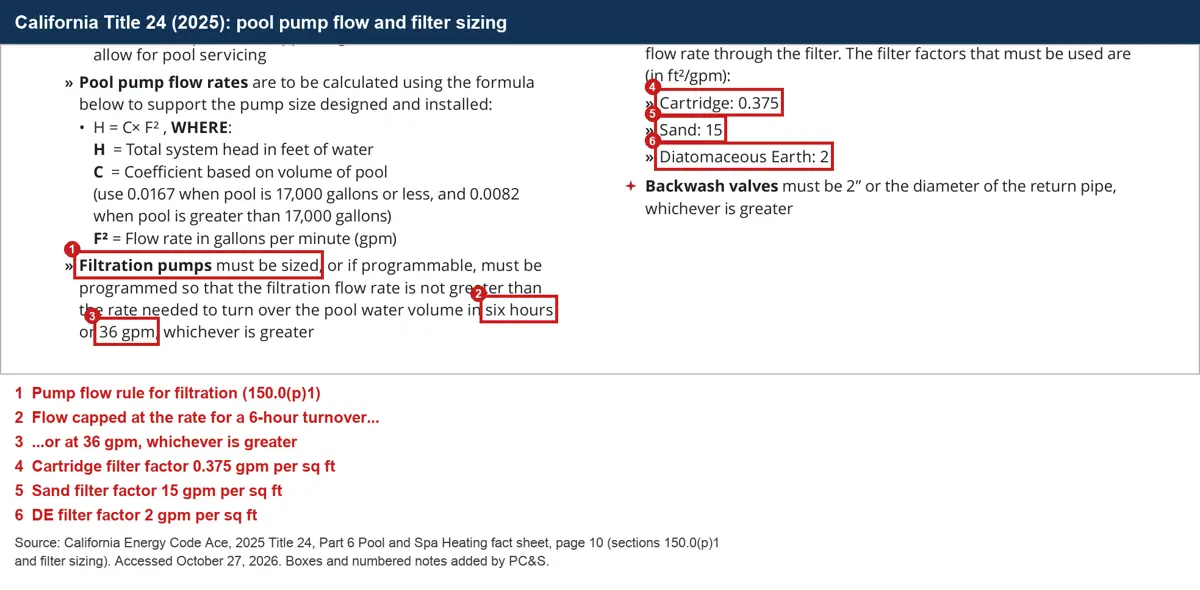
The California cap works against oversizing. For a 20,000-gallon pool the 6-hour rate is 55.6 gpm, so on a new California pool a filtration setting above that flow would not comply, while a variable speed pump run longer at a lower flow would. The same code requires a time switch that can keep the pump to off-peak hours and to the minimum time needed for water quality. Controllers that hold the pump, heater and lights to those hours, from Pentair IntelliCenter to Jandy AquaLink TCX, are compared with November 2026 prices in our pool automation system guide.
Public pools run continuously because bathers keep arriving. MAHC 2024 lets a new public pool cut flow by at most 25% while closed, and only when turbidity is under 0.5 NTU (MAHC 4.7.1.10.5). An HOA or apartment pool falls under the state or county health code, which may adopt these limits.
What do utilities recommend for pool pump run time?
Five utilities we checked publish run hours or peak windows that apply to pool pumps, and they disagree on hours. SRP in Arizona says 8 to 12 hours a day in summer and 6 to 8 in winter, FPL in Florida says 4 to 6, and TEP describes single-speed pumps running 6 to 8 hours. None gives an RPM; APS, PG&E and TEP focus on keeping the pump out of their peak windows.
| Utility (state) | Hours recommended | RPM or speed guidance | Season or time window | Published | Source page |
|---|---|---|---|---|---|
| SRP, Salt River Project (Arizona) | 8 to 12 hours a day in summer; 6 to 8 in winter | Not stated | On a time-of-use plan, run in off-peak hours | May 6, 2022 | SRP blog |
| FPL, Florida Power & Light (Florida) | 4 to 6 hours a day | Not stated | Says this can cut cost to $40 to $45 a month against more than $100 running continuously | July 8, 2024 | FPL newsroom |
| TEP, Tucson Electric Power (Arizona) | Describes single-speed pumps running 6 to 8 hours a day in summer | Not stated; suggests a variable speed ENERGY STAR pump | Run late morning to mid-afternoon; summer on-peak 3 to 7 p.m. weekdays | May 11, 2023 | TEP news and Defeat the Peak page |
| APS, Arizona Public Service (Arizona) | Not stated | Not stated | On the 4pm-7pm plan, set the timer to run before 4 p.m. on weekdays | Page accessed Oct 27, 2026 | APS rate plan page |
| PG&E, Pacific Gas and Electric (California) | Not stated | Not stated | Peak 4 to 9 p.m. every day on E-TOU-C; 5 to 8 p.m. weekdays on E-TOU-D | Page accessed Oct 27, 2026 | PG&E time-of-use page |
| CenterPoint Energy (Texas and other states) | Not stated | Halving pump speed takes about 1/8 of the power | Variable speed pumps use up to 70% less energy than standard pumps | Page accessed Oct 27, 2026 | CenterPoint variable speed pump page |
| ENERGY STAR, U.S. EPA (national) | 6 hours a day instead of 24 cuts filter energy 75%; several short cycles if debris builds up | Halving speed uses 1/8 of the energy; lowest speed set to a 12-hour turnover | Not stated | Page accessed Oct 27, 2026; fact sheet 2022 | ENERGY STAR pool pumps page and fact sheet |
Sources: SRP blog (May 6, 2022); FPL newsroom (July 8, 2024); TEP (May 11, 2023); TEP Defeat the Peak; APS Time-of-Use 4pm-7pm; PG&E Time-of-Use plans; CenterPoint Energy; ENERGY STAR pool pumps; ENERGY STAR fact sheet. Accessed Oct 27, 2026. Download CSV
The hour ranges only make sense against a flow. FPL’s 4 to 6 hours turns a 20,000-gallon pool over once only if the pump delivers about 56 gpm or more; SRP’s 8 to 12 hours fits a pump near 31 gpm, which needs 10.7 hours. FPL adds that 4 to 6 hours can bring the bill to $40 to $45 a month, against more than $100 for a pump left running continuously (FPL).
ENERGY STAR’s figure is the cleanest rule of thumb: running a filter 6 hours instead of 24 cuts its energy use 75% on a fixed-speed pump, and short cycles spread through the day keep debris from settling (ENERGY STAR). Cost by state, season and pump type is broken out in our pool pump running cost report.
Is it better to run your pool pump at night or during the day?
On cost, run it outside your utility’s peak window, which is late afternoon and evening for the plans we checked: 4 to 9 p.m. daily on PG&E E-TOU-C, 4 to 7 p.m. on APS weekdays and 3 to 7 p.m. on TEP summer weekdays. TEP and APS point owners to morning and midday. About 11.1% of US households were on a dynamic pricing program in 2024.
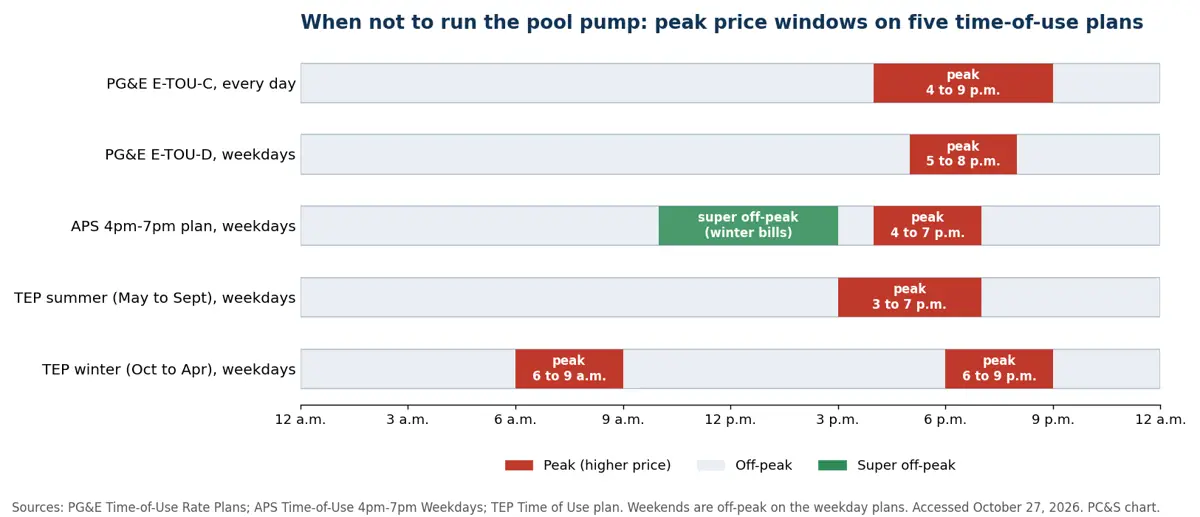
| Utility and plan | Days | Peak (higher price) | Off-peak | Season |
|---|---|---|---|---|
| PG&E E-TOU-C (California) | Every day | 4 to 9 p.m. | All other hours | Year-round |
| PG&E E-TOU-D (California) | Weekdays | 5 to 8 p.m. | All other hours and weekends | Year-round |
| APS Time-of-Use 4pm-7pm (Arizona) | Weekdays | 4 to 7 p.m. | All other hours; super off-peak 10 a.m. to 3 p.m. on winter weekdays | Super off-peak on Nov to Apr bills |
| TEP Time-of-Use, summer (Arizona) | Weekdays | 3 to 7 p.m. | All other hours and weekends | May to September |
| TEP Time-of-Use, winter (Arizona) | Weekdays | 6 to 9 a.m. and 6 to 9 p.m. | All other hours and weekends | October to April |
Sources: PG&E; APS; TEP Time of Use. Accessed Oct 27, 2026. Download CSV
If your plan is flat-rate, timing barely changes the bill; EIA’s 2024 survey counted 15.8 million of 143.1 million US residential customers, about 11.1%, on dynamic pricing such as time-of-use (EIA-861). Check your bill for a plan name before moving the timer. On a time-of-use plan, a variable speed pump can run slowest through the peak and faster after it.
Salt chlorine generators make chlorine only while water flows, so their schedule follows the pump’s; the cell settings that go with it are in our salt water pool maintenance guide.
Should a variable speed pump run longer than a single-speed pump?
Yes. Power falls much faster than flow as speed drops, so the same turnover costs less at low speed over more hours. One turnover of 20,000 gallons takes 9.38 kWh on DOE’s single-speed baseline and 1.25 kWh at the median ENERGY STAR low-flow test point, about 7.5 times less, even though it runs 10.7 hours instead of 4.3.
| Operating point | Flow (gpm) | Power (W) | Hours for one turnover of 20,000 gal | kWh per turnover | kWh per month (30.42 days) | Cost per month at 18.31 cents per kWh | Basis |
|---|---|---|---|---|---|---|---|
| Single-speed pump, DOE baseline (0.95 hhp) | 77.1 | 2,170 | 4.32 | 9.38 | 285.4 | $52.26 | DOE 82 FR 5650: 77.1 gpm on curve C; 2.17 kW from WEF 2.13 |
| Variable speed at maximum speed (ENERGY STAR median, 127 models) | 80.5 | 1,533 | 4.14 | 6.35 | 193.1 | $35.36 | ENERGY STAR dataset, curve C |
| Variable speed at the high-flow test point (median, 193 models) | 62.9 | 762.6 | 5.30 | 4.04 | 122.9 | $22.51 | ENERGY STAR dataset |
| Variable speed at the low-flow test point (median, 320 models) | 31.2 | 117.3 | 10.68 | 1.25 | 38.1 | $6.98 | ENERGY STAR dataset |
Sources: DOE, 82 FR 5650; ENERGY STAR certified pool pumps dataset (Oct 2, 2026 update); EIA Table 5.6.A, July 2026; test-point medians from our pool pump running cost report; PC&S arithmetic. Download CSV
Source: DOE 82 FR 5650; ENERGY STAR certified pool pump dataset (Oct 2, 2026 update); PC&S arithmetic. Download chart data (CSV)
ENERGY STAR’s rule is that a pump at half speed uses one-eighth as much energy (ENERGY STAR); CenterPoint Energy states the same one-eighth figure (CenterPoint). Half speed also moves about half the water, so one turnover takes twice the hours on one-quarter of the energy. Real pumps fall short of that ideal, which is why the table uses tested medians rather than the formula.
Pentair ships the IntelliFlo3 VSF with Program 1 set to 24 hours at 30 GPM (Pentair IntelliFlo3 VSF guide), which turns 20,000 gallons over in 11.1 hours, about twice a day. DOE’s model gives variable speed pumps up to 2 hours a day at high speed for cleaners and water features. Speed settings, the median 1,250 RPM at the low-flow test point and model-by-model watts are in our variable speed pool pump guide. Feature flows, pump sizing and what those high-speed hours cost are worked out in our pool water features guide. A lazy river runs a separate current pump on top of filtration; its flow math and hourly cost are in our lazy river pool guide.
What does it cost to run a pool pump per month?
For a 20,000-gallon pool at the July 2026 US average of 18.31 cents per kWh, one turnover a day costs about $52.26 a month on DOE’s single-speed baseline and $6.98 at the variable speed low-flow median. Running the single-speed pump 8 hours costs $96.69. State prices from 12.72 cents in Louisiana to 48 cents in Hawaii move every figure.
| State | Price, July 2026 (cents per kWh) | DOE climate class | DOE pool season (months) | Single-speed, 8 hours a day ($ per month) | Single-speed, one turnover a day ($ per month) | Variable speed low flow, one turnover ($ per month) | Variable speed low flow, 24 hours ($ per month) |
|---|---|---|---|---|---|---|---|
| United States average | 18.31 | $96.69 | $52.26 | $6.98 | $15.68 | ||
| California | 33.61 | Warm | 12 (1/1-12/31) | $177.49 | $95.92 | $12.81 | $28.78 |
| New York | 29.9 | Cold | 4 (5/1-8/31) | $157.90 | $85.33 | $11.40 | $25.61 |
| New Jersey | 25.19 | Cold | 4 (5/1-8/31) | $133.03 | $71.89 | $9.60 | $21.57 |
| Texas | 15.88 | Warm | 12 (1/1-12/31) | $83.86 | $45.32 | $6.05 | $13.60 |
| Georgia | 16.27 | Warm | 7 (4/1-10/31) | $85.92 | $46.43 | $6.20 | $13.93 |
| Arizona | 15.38 | Warm | 12 (1/1-12/31) | $81.22 | $43.89 | $5.86 | $13.17 |
| North Carolina | 15.16 | Warm | 7 (4/1-10/31) | $80.06 | $43.27 | $5.78 | $12.98 |
| Florida | 15.03 | Hot Humid | 12 (1/1-12/31) | $79.37 | $42.89 | $5.73 | $12.87 |
| Nevada | 12.77 | Warm | 12 (1/1-12/31) | $67.44 | $36.44 | $4.87 | $10.94 |
| Louisiana | 12.72 | Warm | 12 (1/1-12/31) | $67.17 | $36.30 | $4.85 | $10.89 |
| Hawaii | 48 | Hot Humid | 12 (1/1-12/31) | $253.48 | $136.99 | $18.30 | $41.11 |
Sources: EIA Electric Power Monthly Table 5.6.A (July 2026); DOE TSD seasons and climate classes; DOE, 82 FR 5650; ENERGY STAR dataset; PC&S arithmetic at 30.42 days a month. Download CSV
Source: EIA Electric Power Monthly Table 5.6.A (July 2026); ENERGY STAR dataset; PC&S arithmetic at 30.42 days a month. Download chart data (CSV)
Multiply by your season. DOE assumes a 12-month pool season in Arizona, California, Florida and Texas but 4 months in New York and New Jersey, so a New York owner pays the monthly figure about 4 times a year. City-level swim seasons are in our pool season length research.
How does pump size change how long you run it?
Size a pool pump by flow, not horsepower. Divide gallons by 480 for an 8-hour turnover or by 360 for a 6-hour turnover: a 20,000-gallon pool needs 41.7 to 55.6 gpm. Then check that flow against the pipe (Hayward rates 2 inch pipe to 80 gpm), the filter’s rating and, in California, the Title 24 ceiling of a 6-hour turnover or 36 gpm.
| Pool volume (gallons) | Flow for an 8-hour turnover (gpm) | Flow for a 6-hour turnover (gpm) | Title 24 maximum filtration flow (gpm) | System head at that flow, Title 24 curve (ft) | Smallest pipe that carries the 6-hour flow (Hayward maximum) |
|---|---|---|---|---|---|
| 10,000 | 20.8 | 27.8 | 36.0 | 21.6 | 1-1/2 inch (up to 45 gpm) |
| 15,000 | 31.2 | 41.7 | 41.7 | 29.0 | 1-1/2 inch (up to 45 gpm) |
| 20,000 | 41.7 | 55.6 | 55.6 | 25.3 | 2 inch (up to 80 gpm) |
| 25,000 | 52.1 | 69.4 | 69.4 | 39.5 | 2 inch (up to 80 gpm) |
| 30,000 | 62.5 | 83.3 | 83.3 | 56.9 | 2-1/2 inch (up to 110 gpm) |
| 40,000 | 83.3 | 111.1 | 111.1 | 101.2 | 3 inch (up to 160 gpm) |
Sources: Energy Code Ace (Title 24 flow rule and head formula); Hayward ProSeries manual (maximum flow by pipe size); PC&S arithmetic. Download CSV
Horsepower is a poor guide because federal rules now set efficiency by hydraulic horsepower: new self-priming pumps of 0.711 to under 2.5 hhp made since July 19, 2021 must meet a WEF that only variable speed designs reach (10 CFR 431.465(f)). A variable speed pump covers a range of flows, so the question becomes whether its curve reaches your target gpm at your system head.
Match the filter too. A filter rated below the pump’s top flow limits what you can run; rated flows for 15 sand, cartridge and DE models are in our pool filter types comparison. Installed prices for pumps, motors and the electrical work are in our pool pump replacement cost guide.
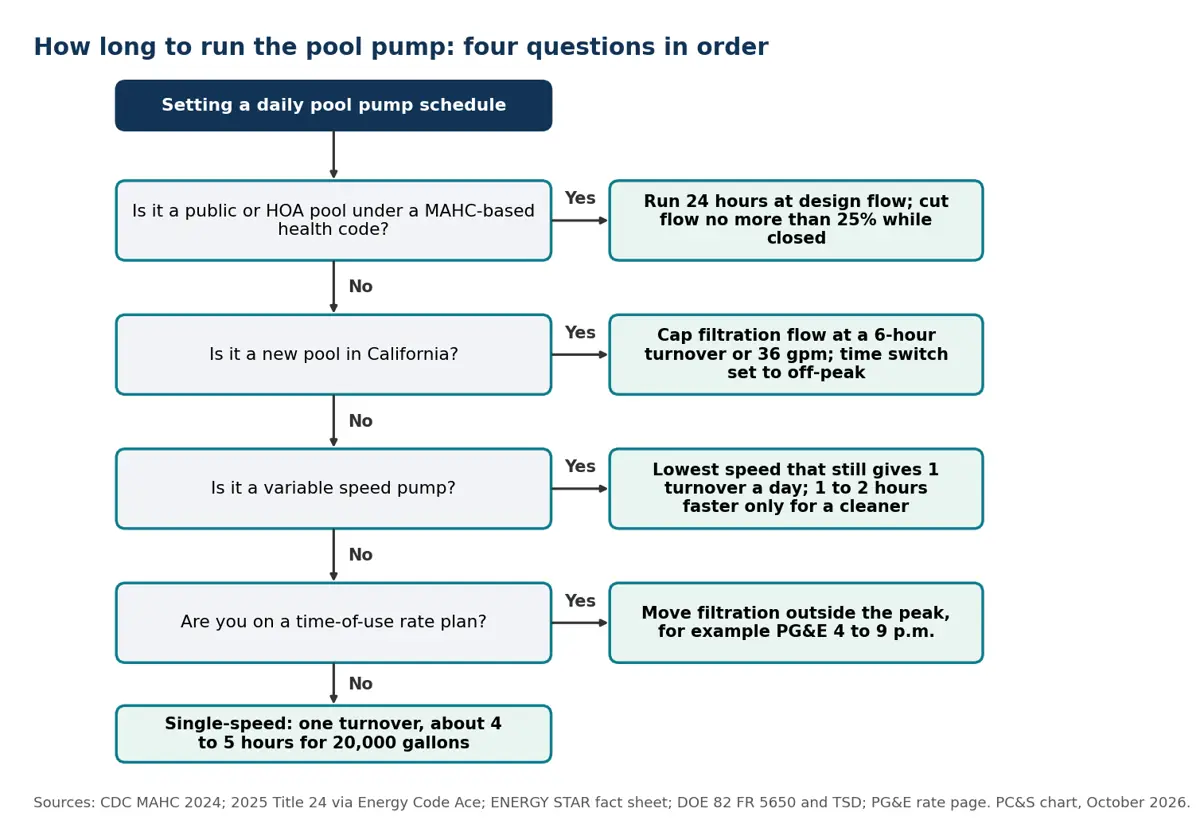
How long should you run your pool pump in your situation?
Start from one turnover a day, then adjust for pump type, rate plan and code. A single-speed pump runs about 4 to 5 hours for 20,000 gallons at 70 to 80 gpm. A variable speed pump runs longer at its lowest speed that still completes the turnover. Public pools run 24 hours, and California homes cap flow at a 6-hour turnover.
| If your situation is | Do this | Why (source) |
|---|---|---|
| Single-speed pump | Run one turnover a day: gallons / (gpm x 60), about 4 to 5 hours for 20,000 gallons at 70 to 80 gpm, outside your utility's peak window | Industry one-turnover benchmark (DOE TSD); flow at 77.1 gpm gives 4.3 hours |
| Variable speed pump | Run the lowest speed that still turns the pool over once in 24 hours, and add 1 to 2 hours at higher speed only for a cleaner or heater | ENERGY STAR minimum speed = 12-hour turnover; DOE assumes up to 2 hours at high speed |
| Time-of-use rate plan | Schedule filtration outside the peak: before 4 p.m. on APS weekdays, outside 4 to 9 p.m. on PG&E E-TOU-C, outside 3 to 7 p.m. on TEP summer weekdays | APS, PG&E and TEP rate pages |
| New pool in California | Program flow at or below a 6-hour turnover or 36 gpm and install a time switch set to off-peak | 2025 Title 24, Part 6, 150.0(p) and 110.4(b)4 |
| Public or HOA pool under a MAHC-based code | Run 24 hours a day at the design flow; turn flow down no more than 25% when closed | CDC MAHC 2024 5.7.1.9 and 4.7.1.10.5 |
| Above-ground pool with a packaged sand or cartridge pump | Use the shipped timer; DOE expects one turnover in 8 hours or less from a matched pump | 10 CFR 431.465(g); DOE TSD p. 3-34 |
| Freezing nights | Leave freeze protection on; federal defaults are 40 F or lower and half speed | 10 CFR 431.465(h) |
Sources: DOE TSD; ENERGY STAR fact sheet; DOE, 82 FR 5650; APS; PG&E; TEP; Energy Code Ace; CDC MAHC 2024; 10 CFR 431.465. Download CSV
| What several guides say | Who says it | What the primary sources show |
|---|---|---|
| Run 1 hour for every 10 F of temperature | EcoFlow (air temperature, 2026); Vita Filters (water temperature) | No code or maker manual we read ties run time to temperature; MAHC 2024, Title 24 and DOE all compute turnover as volume divided by flow |
| Run 8 to 12 hours a day | EcoFlow; Vita Filters; SRP | Right for a pump near 31 gpm: 20,000 gallons takes 10.7 hours at the ENERGY STAR low-flow median but 4.3 hours at DOE's 77.1 gpm single-speed baseline |
| Running the pump 24/7 is wasteful | PVC Fittings Online | MAHC 2024 requires public pools to run 24 hours; Pentair ships the IntelliFlo3 VSF at 24 hours and 30 GPM; 24 hours at the low-flow median costs $15.68 a month at 18.31 cents |
| Variable speed pumps use up to 80 to 90% less electricity at low speed | EcoFlow | DOE's national model puts a federal-standard variable speed pump 69% below the single-speed baseline over a full season |
| Run 4 to 6 hours a day | FPL (2024) | Enough for one turnover of 20,000 gallons only above about 56 gpm (6 hours); a pump at 31.2 gpm needs 10.7 hours |
Sources: EcoFlow (Apr 29, 2026); Vita Filters; PVC Fittings Online (May 6, 2025); SRP; FPL; CDC MAHC 2024; Pentair; DOE TSD; PC&S arithmetic. Download CSV
When should you call a pro? When you cannot find the pump’s flow, when a heater or salt cell keeps reporting low flow at your chosen speed, or when filter pressure climbs 8 to 10 psi over the clean reading within days of the new schedule, the backwash trigger in Hayward’s ProSeries manual. Ask the technician to measure flow at your filtration speed and to set a schedule that reaches one turnover of your gallons, then write both numbers on the timer.
How we compiled this
In October 2026 we read 9 code and federal documents (CDC’s 2024 Model Aquatic Health Code, California’s Energy Code Ace pool fact sheet, Herriman’s plan checklist, 10 CFR 431.465, DOE’s 2016 rule and technical support document, the ENERGY STAR fact sheet, pool pump dataset and EIA price tables), 3 maker manuals (Hayward ProSeries, Pentair Triton and IntelliFlo3 VSF) and 7 utility and ENERGY STAR pages, and checked 4 competitor guides for claims. Every hour, kWh and dollar figure is arithmetic from those inputs; we measured no pumps.
Frequently Asked Questions
How long should you run a pool pump per day?
Long enough for one turnover: gallons / (gpm x 60). A 20,000-gallon pool needs 4.3 hours at 77.1 gpm, 8.3 hours at 40 gpm and 10.7 hours at 31.2 gpm. DOE’s rulemaking records one turnover a day as the industry recommendation for homes, and DOE’s energy model averages 10 hours a day (DOE).
What happens if you run your pool pump too long?
Mostly a higher bill and more motor hours. DOE’s single-speed baseline draws 2.17 kW, so 24 hours a day costs about $290.08 a month at 18.31 cents per kWh. FPL puts a continuously running pump above $100 a month. At the ENERGY STAR low-flow median, 24 hours costs about $15.68 (FPL).
Is it better to run your pool pump overnight or during the day?
On a time-of-use plan, run it outside the peak window, which on the plans we checked is late afternoon and evening: 4 to 9 p.m. on PG&E E-TOU-C, 4 to 7 p.m. on APS weekdays, 3 to 7 p.m. on TEP summer weekdays. APS tells pool owners to set timers before 4 p.m., and TEP suggests morning or midday (TEP).
Is it expensive to run a pool pump 24 hours a day?
On a single-speed pump, yes: about 52 kWh a day and $290.08 a month at the July 2026 US average of 18.31 cents per kWh, using DOE’s 2.17 kW baseline. A variable speed pump at the ENERGY STAR low-flow median of 117.3 W uses 2.8 kWh a day, about $15.68 a month (ENERGY STAR).
Should I run my pool pump on high or low speed?
Low for filtration, high only for jobs that need it. ENERGY STAR says half speed uses one-eighth the energy and sets the lowest speed at a 12-hour turnover (ENERGY STAR fact sheet). DOE’s model allows up to 2 hours a day at high speed for cleaners and water features. In California, filtration flow may not exceed a 6-hour turnover or 36 gpm.
What is the recommended pump size for a 20,000 gallon pool?
Size by flow: 41.7 gpm for an 8-hour turnover or 55.6 gpm for 6 hours, which is also California’s Title 24 ceiling for that pool. At 55.6 gpm, Hayward’s pipe table points to 2 inch plumbing (up to 80 gpm), and the Title 24 curve estimates 25.3 feet of head (Energy Code Ace). Pick a variable speed pump whose curve reaches that point.
How many hours a day to run a pool pump in winter?
Fewer than in summer, unless freezing is a risk. SRP suggests 6 to 8 hours a day in winter against 8 to 12 in summer (SRP). DOE assumes year-round pool use in Arizona, California, Florida and Texas but 4 months in New York. On freezing nights, keep freeze protection on; federal defaults are 40 F or lower at no more than half speed.
Sources
- CDC. Model Aquatic Health Code, 5th Edition (2024). Accessed 2026-10-27.
- California Energy Code Ace. 2025 Title 24, Part 6 Pool and Spa Heating fact sheet. Accessed 2026-10-27.
- Herriman City, Utah. Swimming Pool Checklist (rev. 4/2023). Accessed 2026-10-27.
- eCFR. 10 CFR 431.465, Pumps energy conservation standards. Accessed 2026-10-27.
- U.S. Department of Energy. Energy conservation standards for dedicated-purpose pool pumps, 82 FR 5650. Accessed 2026-10-27.
- U.S. Department of Energy. DPPP technical support document (Dec 2016). Accessed 2026-10-27.
- U.S. EPA ENERGY STAR. ENERGY STAR Pool Pumps fact sheet (2022). Accessed 2026-10-27.
- U.S. EPA ENERGY STAR. ENERGY STAR Pool Pumps page. Accessed 2026-10-27.
- U.S. EPA ENERGY STAR. ENERGY STAR Certified Pool Pumps dataset (Oct 2, 2026 update). Accessed 2026-10-27.
- U.S. Energy Information Administration. Electric Power Monthly, Table 5.6.A (Sept 24, 2026 release). Accessed 2026-10-27.
- U.S. Energy Information Administration. Form EIA-861 (2024). Accessed 2026-10-27.
- U.S. Geological Survey. Water Science Glossary. Accessed 2026-10-27.
- Hayward. ProSeries High Rate Sand Filters Owner's Manual (IS210TS Rev A). Accessed 2026-10-27.
- Pentair. Triton Side Mount Sand Filter Installation and User's Guide. Accessed 2026-10-27.
- Pentair. IntelliFlo3 VSF installation guide. Accessed 2026-10-27.
- Salt River Project. How to lower your pool energy costs (May 6, 2022). Accessed 2026-10-27.
- Florida Power & Light. Summer savings: FPL energy expert shares four decades of energy saving tips (July 8, 2024). Accessed 2026-10-27.
- Tucson Electric Power. Nine Steps to Get Ready for Summer (May 11, 2023). Accessed 2026-10-27.
- Tucson Electric Power. Time of Use pricing plan. Accessed 2026-10-27.
- Tucson Electric Power. Defeat the Peak. Accessed 2026-10-27.
- Arizona Public Service. Time-of-Use 4pm-7pm Weekdays. Accessed 2026-10-27.
- Pacific Gas and Electric. Time-of-Use Rate Plans. Accessed 2026-10-27.
- CenterPoint Energy. Variable speed pool pump benefits. Accessed 2026-10-27.
- PC&S. Cost to Run a Pool Pump by State (PC&S research). Accessed 2026-10-27.
- EcoFlow. How Long Should You Run a Pool Pump Daily? (claims checked). Accessed 2026-10-27.
- Vita Filters. What happens if you run your pool pump 24/7 (claims checked). Accessed 2026-10-27.
- PVC Fittings Online. How Often Should I Run My Pool Pump? (claims checked). Accessed 2026-10-27.
Related pages
Get Quotes From Licensed Local Pool Pros
Tell us what you need and your ZIP code. We match you with pool companies that cover your area.