Mustard Algae: How to Identify It and Get Rid of It
Mustard algae is a chlorine-tolerant yellow pool alga that brushes off and returns: brush it, shock the pool, then add an EPA-registered algaecide labeled for mustard algae, such as Algon 60 at 12 to 18 fl oz per 10,000 gallons.
- ✓Doses from EPA-stamped labelsEvery dose here is quoted from a label in EPA's Pesticide Product Label System, with its registration number.
- ✓Identify before you buyA brush test and a vitamin C test separate mustard algae from dirt, pollen and metal stains.
- ✓IndependentPC&S sells no pool chemicals. We connect owners with licensed pool service companies.
Key takeaways
- Mustard algae is a trade name for a yellow, chlorine-tolerant pool alga, not one species: the Maricopa County Environmental Health Code lists green, blue-green and mustard algae as the 3 types most common to swimming pools.
- Algaecides whose EPA labels list mustard algae call for 8 to 36 fl oz per 10,000 gallons for visible growth, depending on strength (EPA labels, accessed October 2026).
- Under EPA’s 2021 Inorganic Halides decision (issued April 23, 2021, amended September 7, 2021), sodium bromide pool labels must say ‘This product is not for use in outdoor pools’ (EPA docket EPA-HQ-OPP-2009-0168-0037).
- The BioGuard Calcium Hypochlorite 73 label kills algae at 1 lb per 16,500 gallons, about 5.4 ppm of free chlorine by PC&S arithmetic, and bars swimming until chlorine is 4 ppm or less.
- CDC’s floor for home pools is 1 ppm free chlorine, or 2 ppm with cyanuric acid, at pH 7.0 to 7.8, tested at least twice a day (CDC, May 2024).
What is mustard algae?
Mustard algae is the pool trade’s name for a yellow to yellow-brown alga that clings to shaded walls and floors and tolerates normal chlorine levels. Regulators treat it as a category, not a species: Maricopa County’s pool code names green, blue-green and mustard algae as the three most common in pools, and EPA-registered algaecide labels list mustard algae as a separate claim.
BioGuard, a pool chemical maker, describes mustard algae as a chlorine-resistant form of green algae that often resembles dirt or sand, brushes away very easily and returns quickly (BioGuard). The EPA-accepted label for BioGuard Algae Complete (EPA Reg. No. 5185-513) adds three claims: mustard algae is a ‘yellowish dust/slime’, it ‘usually grows in shade’, and it ‘can form even with proper sanitation and filtration’ (label dated July 15, 2025).
No peer-reviewed paper we could open names one organism behind the trade name, so choose products by label: the EPA label must list mustard (or yellow) algae, and its dose is the dose.
| Number | What it is | Source |
|---|---|---|
| 3 | Algae types Maricopa County's pool code calls most common in pools: green, blue-green (often called black) and mustard | Maricopa County Environmental Health Code, Ch. VI, Sec. I, Reg. 1(e) |
| 1 lb per 16,500 gal | Kill-algae dose on the BioGuard Calcium Hypochlorite 73 label (EPA Reg. No. 5185-515) | EPA-stamped label, March 2024 |
| About 5.4 ppm | Free chlorine that dose adds, by the Virginia health department's 1.3 oz per ppm rule | PC&S arithmetic from VDH and the label |
| 8 to 36 fl oz per 10,000 gal | Visible-algae doses across 8 algaecides whose labels list mustard algae | EPA Pesticide Product Label System |
| 4 ppm | Highest free chlorine at which the cal hypo label allows anyone back in the pool | EPA Reg. No. 5185-515 |
| 1 ppm (2 ppm with cyanuric acid) | CDC minimum free chlorine for home pools, at pH 7.0 to 7.8 | CDC, page updated May 10, 2024 |
| April 23, 2021 (amended September 7, 2021) | EPA decision requiring sodium bromide pool labels to say 'This product is not for use in outdoor pools' | EPA docket EPA-HQ-OPP-2009-0168-0037 |
| 1 quart per 5 gallons for 1 hour | Bleach soak the Model Aquatic Health Code uses to sanitize a filter cartridge | MAHC 2024, 5.7.2.4.3.3.7 |
Sources: Maricopa County; EPA label 5185-515; VDH; EPA labels; CDC; EPA amended decision; MAHC 2024. Download CSV
Is it harmful? EPA notes that, unlike some cyanobacteria, green algae are not generally known to produce toxins (EPA). The practical risk is chlorine demand: BioGuard says the compounds that protect mustard algae can create a large chlorine demand, which can pull free chlorine below the 1 ppm minimum CDC sets for home pools. If the whole pool has turned green rather than yellow in the shade, start with our guide on how to clear a green pool.
Is it mustard algae, dirt, pollen or a stain?
Run two free tests before buying anything. Brush the patch: mustard algae lifts into a yellow cloud and settles back in the same shady spots within days, while dirt and pollen vacuum away for good. Then hold a vitamin C tablet on any flat stain for 2 minutes: if the stain lightens, it is metal, and no algaecide will fix it.
| If your situation is | It is most likely | Do this next | Source |
|---|---|---|---|
| Yellow, green-brown or brown powder on shaded walls or floor that brushes into a cloud and settles back in the same spots within days | Mustard algae | Brush, shock, then dose an algaecide whose label lists mustard algae | BioGuard (mustard algae 'returns quickly' after brushing); Algae Complete label 5185-513 ('usually grows in shade') |
| Yellow or tan material that vacuums away and does not come back after brushing and normal chlorine | Dirt, sand or pollen | Vacuum, empty the skimmer, clean the filter; skip the algaecide | Leslie's (mustard algae is often mistaken for sand, dirt or pollen) |
| Green slime on walls or green-tinted water | Green algae | Shock and brush; see the cloudy water guide if the water is hazy | Algae Complete label 5185-513 (green algae 'can tint water green') |
| Raised blue-black spots that a nylon brush barely moves | Black algae (cyanobacteria) | Use the black algae steps; stainless steel brush on plaster only | Maricopa County code; MSA Algicide II label 5185-382 ('blue-green, frequently called black') |
| Flat brown, reddish or dark stain that lightens under a vitamin C tablet within 2 minutes | Metal stain (iron or copper) | Treat it as a stain, not algae | Natural Chemistry staining guide |
Sources: BioGuard; EPA label 5185-513; EPA label 5185-382; Maricopa County code; Natural Chemistry; Leslie‘s. Download CSV
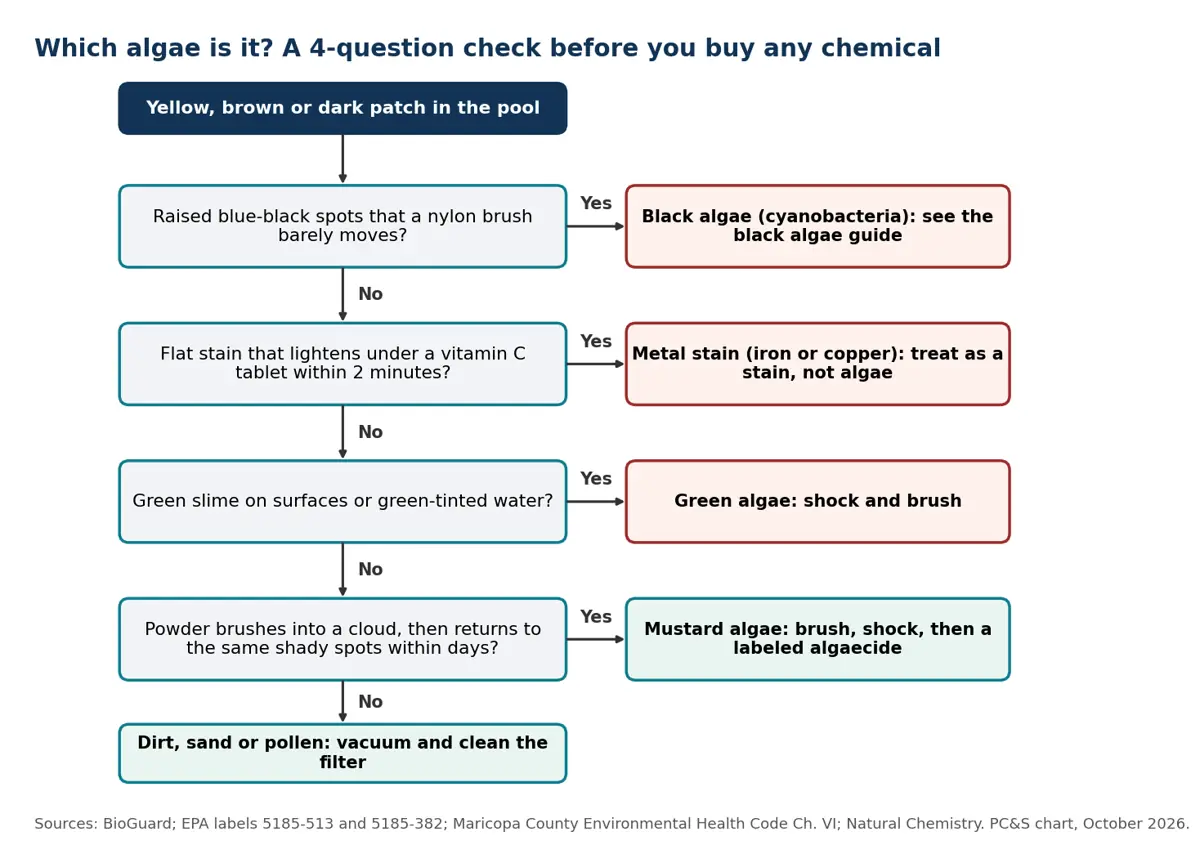
The brush test works because live algae regrows from what stays attached, while debris does not. The vitamin C test comes from Natural Chemistry, a pool chemical maker: a stain unchanged after 2 minutes is most likely non-living organic, and one that lightens points to metal (Natural Chemistry). If the yellow layer floats and rings the waterline instead, it is more likely pollen; our guide to pollen in pool water compares the two side by side.
What causes mustard algae in pools?
Mustard algae takes hold where free chlorine runs low, light is low and water moves slowly: shaded walls, corners and steps. The label claims and health guidance point to the same drivers, starting with free chlorine below CDC’s 1 ppm minimum (2 ppm with cyanuric acid), plus warm water and walls that never get brushed.
- Low free chlorine CDC’s minimum is 1 ppm in pools, or 2 ppm when cyanuric acid is used, with pH 7.0 to 7.8 (page updated May 10, 2024).
- Shade and slow water The Algae Complete label (5185-513) says mustard algae usually grows in shade and clings to walls.
- Warm water The Yellowtrine label (8959-52) starts weekly prevention when water is over 80 degrees, and the cal hypo label (5185-515) asks for weekly shocking above 80 F.
- Rare testing In a 2020 Water Quality and Health Council survey, 23% of do-it-yourself pool owners said they test chlorine and pH no more often than once every two weeks.
- Carried in on gear Leslie’s says mustard algae can travel on toys, floats and swimsuits. We found no primary study that measures this, so treat it as a precaution.
The testing figure comes from our pool hygiene statistics report (WQHC 2020 release). Warm months are also when neglected pools turn: in PC&S’s count of 3,082 green pool complaints across 7 Sun Belt open-data sources, 81% arrived April to October, as our neglected green pool research shows.
How do you get rid of mustard algae? Step by step
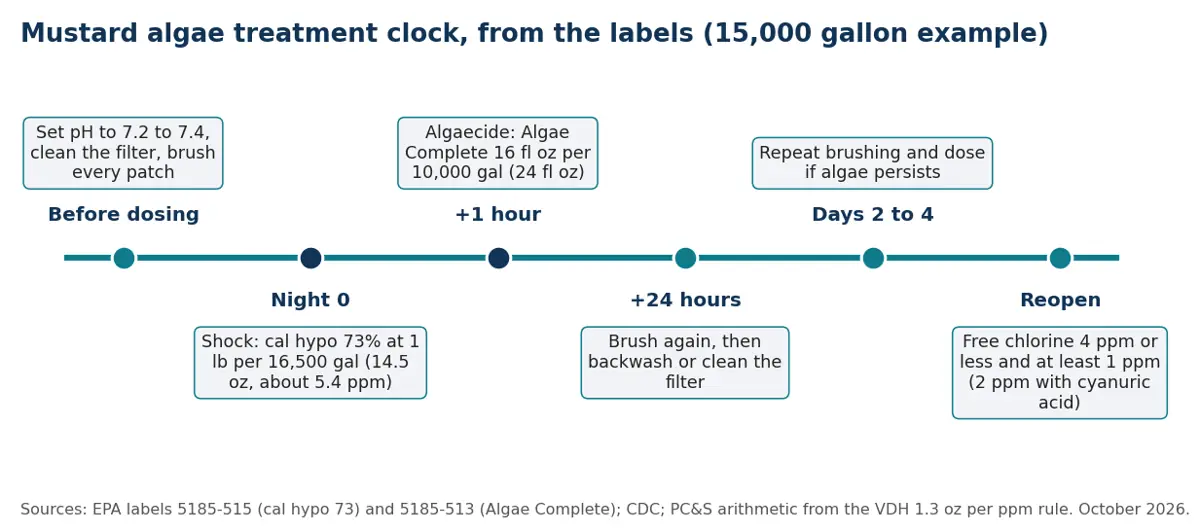
Kill mustard algae with brushing, a full shock and a labeled algaecide on the same day, then clean everything it touched. The sequence below follows the BioGuard Calcium Hypochlorite 73 label (EPA Reg. No. 5185-515) and the Algae Complete label (5185-513), with the waits each label sets, worked for a 15,000 gallon pool.
- Set pH firstBring pH to 7.2 to 7.4 before shocking, as the cal hypo label directs; the Algae Complete label accepts 7.2 to 7.6.
- Clean the filter and run the pumpBackwash or rinse the filter, then keep the pump on: the cal hypo kill-algae direction asks for 24 hours of continuous circulation.
- Brush every patchBrush walls, steps and floor just before dosing: stainless steel bristles on plaster only, nylon on vinyl and fiberglass.
- Shock at nightBroadcast cal hypo 73% at 1 lb per 16,500 gallons in the deep end when nobody is swimming: 14.5 oz for 15,000 gallons, about 5.4 ppm.
- Add a labeled algaecideAfter 1 hour of circulation, add Algae Complete at 16 fl oz per 10,000 gallons (24 fl oz here), or Algon 60 at 12 to 18 fl oz per 10,000 gallons.
- Brush again the next dayThe Algae Complete label calls for brushing the next day and repeating the dose after 2 to 4 days if algae persists.
- Clean the filter and gearBackwash or clean the filter after 24 hours, then sanitize brushes, toys and cartridges (checklist further down).
- Swim only in the label windowRe-enter when free chlorine reads 4 ppm or less and at least CDC’s 1 ppm (2 ppm with cyanuric acid).
| Step | Input | Calculation | Result |
|---|---|---|---|
| Pool volume | 15,000 gallons (measure yours with a volume calculator) | Given | 15,000 gal |
| Ounces of cal hypo per 1 ppm | VDH: 1.3 oz of 100% available chlorine per 10,000 gal; label: 73% calcium hypochlorite | 1.3 / 0.73 | 1.78 oz per ppm per 10,000 gal |
| Label kill-algae dose | 1 lb (16 oz) per 16,500 gal (EPA Reg. No. 5185-515) | 16 x 15,000 / 16,500 | 14.5 oz (0.91 lb) |
| Free chlorine added | 14.5 oz in 15,000 gal = 9.7 oz per 10,000 gal | 9.7 / 1.78 | About 5.4 ppm |
| Algaecide, option A | BioGuard Algae Complete, 16 fl oz per 10,000 gal | 16 x 1.5 | 24 fl oz |
| Algaecide, option B | Algon 60, 12 to 18 fl oz per 10,000 gal | 12 x 1.5 to 18 x 1.5 | 18 to 27 fl oz |
| Swim again | Label bars re-entry above 4 ppm; CDC minimum 1 ppm (2 ppm with cyanuric acid) | DPD test; dilute if above 10 ppm | Free chlorine between 1 (or 2) and 4 ppm |
Sources: EPA label 5185-515; EPA label 5185-513; EPA label 3525-117; Virginia Department of Health; CDC. Chlorine increase is PC&S arithmetic. Download CSV
The chlorine arithmetic uses the Virginia Department of Health rule that 1.3 oz of 100% available chlorine raises 10,000 gallons by 1 ppm (VDH operators guide, 2018). Divide by the product’s strength, 0.73 for the label’s 73% calcium hypochlorite, and you get 1.78 oz per ppm. Our pool volume calculator gives the gallons, and the how to shock a pool guide covers liquid chlorine and dichlor options.
Algae Complete gives a 1 to 4 ppm window; the chart shows its upper limit.
Source: Source: EPA Pesticide Product Label System labels 7616-68, 45337-16, 7616-73, 5185-515, 5185-513; CDC (page updated May 10, 2024).. Download chart data (CSV)
Which algaecides are labeled for mustard algae, and how much?
Eight EPA-registered algaecides we read list mustard algae and give a visible-algae dose, from 8 fl oz (BioGuard MSA Algicide II) to 36 fl oz (the 30% polyquats) per 10,000 gallons. The spread reflects strength more than quality: Combat 30 and Pro Algaecide, at 30% polyquat, call for exactly twice the volume Algon 60 does at 60%.
| Product | EPA Reg. No. | Active ingredient | Visible-algae dose per 10,000 gal | Maintenance dose per 10,000 gal | Swim again when | EPA label file | Source |
|---|---|---|---|---|---|---|---|
| BioGuard Algae Complete | 5185-513 | Copper sulfate pentahydrate 13.07% + polyquat 6.5% | 16 fl oz, 1 hour after a shock | 1.5 fl oz weekly | Free chlorine 1 to 4 ppm | July 15, 2025 | EPA PPLS |
| BioGuard MSA Algicide II | 5185-382 | Copper triethanolamine 23.6% + quat 2.5% | 8 fl oz, diluted in 3 to 4 gallons of water | 2 fl oz every two weeks | 15 minutes after a preventive dose | August 4, 2026 | EPA PPLS |
| Algon 60 Algaecide | 3525-117 | Polyquat 60% | 12 to 18 fl oz | 2 to 4 fl oz every 5 to 7 days | Not stated on label | March 11, 2015 | EPA PPLS |
| Kem Tek Algaecide | 7616-73 | Polyquat 60% | 16 oz after shocking to 5 ppm | 2 to 4 oz weekly | Free chlorine down to 3 ppm | May 20, 2026 | EPA PPLS |
| Combat 30 | 57787-2 | Polyquat 30% | 24 to 36 fl oz | 4 to 9 fl oz every 5 to 7 days | Not stated on label | January 21, 2026 | EPA PPLS |
| Pro Algaecide | 3432-31 | Polyquat 30% | 24 to 36 oz | 4 1/2 oz every 5 to 7 days | Not stated on label | July 17, 2025 | EPA PPLS |
| Algy Cop | 7616-68 | Copper ethanolamine complex 10.9% (3.5% metallic copper) | 10 oz after 1 lb of shock | 5 oz every two weeks | Free chlorine down to 3.0 ppm | February 11, 2020 | EPA PPLS |
| Silver Algaedyn | 68161-1 | Colloidal silver 0.80% | 1/2 quart (16 fl oz), fed 8 oz every 10 minutes | 4 oz weekly | Not stated on label | June 3, 2010 | EPA PPLS |
| Yellow Treat 2 (indoor pools only) | 45337-16 | Sodium bromide 68.99% | 5 oz, then superchlorinate | Not listed | Free chlorine down to 3 ppm | August 9, 2024 | EPA PPLS |
| Yellowtrine (indoor pools only) | 8959-52 | Sodium bromide 98% | 4 oz, then 1 lb dry chlorine | 4 oz weekly above 80 F | A few hours after treatment | April 15, 2025 | EPA PPLS |
Sources: EPA Pesticide Product Label System: 5185-513, 5185-382, 3525-117, 7616-73, 57787-2, 3432-31, 7616-68, 68161-1, 45337-16, 8959-52. Download CSV
The 30% polyquats need about twice the volume of the 60% polyquats for the same job. Sodium bromide labels are excluded because they are not for outdoor pools.
Source: Source: EPA Pesticide Product Label System labels 5185-382, 7616-68, 3525-117, 5185-513, 7616-73, 68161-1, 57787-2, 3432-31 (accessed October 19, 2026).. Download chart data (CSV)
Copper products can stain. The BioGuard MSA Algicide II label recommends a stain and scale control 2 days after the final treatment to remove residual copper, and the Algae Complete label warns that full-strength product will stain porous pool surfaces (label 5185-382). On light plaster or a vinyl liner, a 60% polyquat such as Algon 60 sidesteps the copper question. Every algaecide type, with 13 EPA labels, swim waits and copper limits, is compared in our pool algaecide guide.
Silver is the slowest to apply. Silver Algaedyn (EPA Reg. No. 68161-1, colloidal silver 0.80%) lists black and mustard algae and calls for 1/2 quart per 10,000 gallons, fed through the skimmer 8 oz every 10 minutes, with the filter running at least 72 hours (label, 2010). Its label also says the concentrate can stain pools, equipment or clothing.
Can you still use sodium bromide on mustard algae in an outdoor pool?
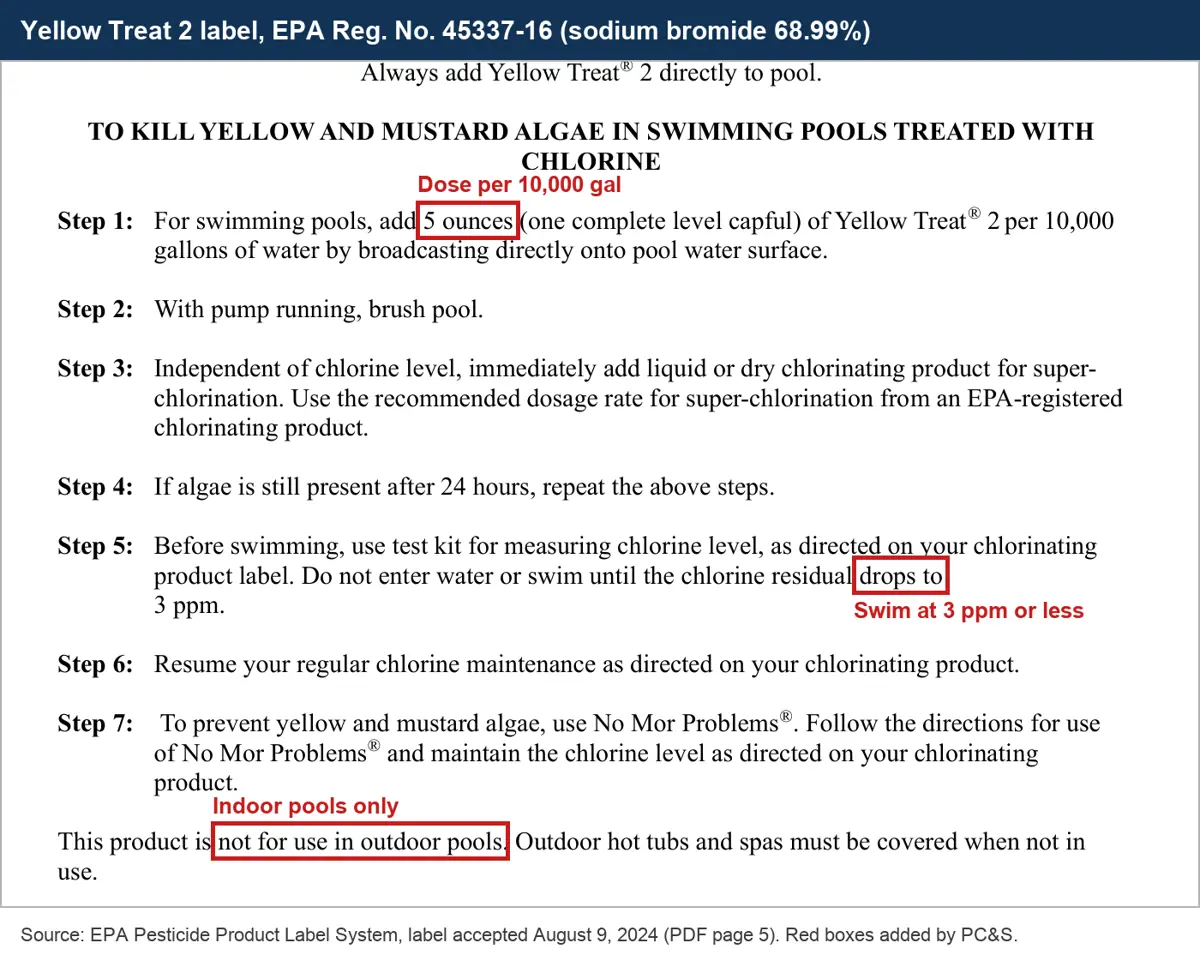
Not under current EPA labeling. EPA’s Inorganic Halides decision of April 2021, amended on September 7, 2021, requires sodium bromide pool products to state ‘This product is not for use in outdoor pools’, because sunlight can break the product down into bromate. The Yellow Treat 2 label EPA accepted on August 9, 2024 carries that sentence.
| What several guides say | What the label or regulator says | Source |
|---|---|---|
| Leslie's: add 2 lb of Yellow Out per 15,000 gallons, then shock | EPA's label system lists no active registration named Yellow Out (3 results, all inactive, October 19, 2026). The active sodium bromide labels we read (45337-8, 45337-16, 8959-52) all say 'This product is not for use in outdoor pools.' | EPA PPLS; EPA amended Inorganic Halides decision, September 7, 2021 |
| Leslie's: shock three times, 2 lb of 73% cal hypo per 15,000 gallons each, 12 hours apart | That is about 12 ppm per dose by the VDH rule. The BioGuard Calcium Hypochlorite 73 label's kill-algae direction is 1 lb per 16,500 gallons (about 5.4 ppm), repeated 'as necessary', with re-entry only at 4 ppm or less. | EPA Reg. No. 5185-515; VDH; PC&S arithmetic |
| Leslie's: run pH at 7.8 or higher during treatment | The cal hypo label says to bring pH to 7.2 to 7.4 before shocking, and CDC's range for home pools tops out at 7.8. | EPA Reg. No. 5185-515; CDC |
Sources: Leslie‘s mustard algae guide (opened via the Wayback Machine); EPA PPLS name search; EPA amended decision; EPA label 5185-515; CDC. Download CSV
The rule is about where, not whether. EPA’s memo keeps sodium bromide for indoor pools and for outdoor hot tubs that are covered when not in use, because covers block the sunlight that drives bromate formation (EPA, September 7, 2021). For an outdoor pool, use the chlorine-plus-algaecide route above. The older Yellow Treat label (45337-8) adds a handling warning: mixing it with acids or oxidizers may release hydrogen bromide or bromine gas.
How do you get rid of mustard algae in an above-ground pool?
Use the same brush, shock and algaecide sequence, but protect the surface: nylon brush only, broadcast shock in the deep end and brush any settled granules off the liner, and pick an algaecide that does not bring copper. Doses scale down with volume, so a 7,500 gallon pool takes three quarters of each per-10,000-gallon dose.
| If your situation is | Do this | Why |
|---|---|---|
| Outdoor plaster or gunite pool | Stainless steel brush, cal hypo shock per label, then a mustard-labeled polyquat, copper or silver algaecide | Sodium bromide labels exclude outdoor pools (EPA, 2021) |
| Vinyl liner or above-ground pool | Nylon brush only; broadcast shock in the deep end and brush settled granules off the liner; a polyquat avoids copper staining | Cal hypo label: never let undissolved product rest on vinyl; Pentair: stainless brushes are not for vinyl liner pools |
| Fiberglass pool | Soft nylon brush; same chemistry as vinyl | Thursday Pools: wire brushes damage gelcoat |
| Indoor pool or covered spa | A sodium bromide label such as Yellow Treat 2 (5 oz per 10,000 gal) is allowed, followed by a labeled superchlorination | EPA amended decision; label 45337-16 |
| Free chlorine reads 0 right after shocking | Retest a diluted sample before adding more chlorine | CDC: a DPD test can bleach out above 10 ppm |
| Copper algaecide used in the last few days | Add a stain and scale control 2 days after the final treatment | MSA Algicide II label 5185-382 |
| Patches return after two full rounds | Deep-clean the filter, sanitize all gear, and have a pool service retest the water | Algae Complete label: repeat after 2 to 4 days; MAHC filter cleaning rules |
Sources: EPA; EPA label 5185-515; EPA label 45337-16; EPA label 5185-382; EPA label 5185-513; Pentair brush catalog; Thursday Pools; CDC; MAHC 2024. Download CSV
Granules matter on liners. The BioGuard Calcium Hypochlorite 73 label (EPA Reg. No. 5185-515) tells owners to brush settled granules so they dissolve, never to let undissolved product rest on vinyl, fiberglass, paint or colored plaster, and to take care not to tear an above-ground liner while brushing. For a 7,500 gallon pool, that label’s dose works out to about 7.3 oz of cal hypo, and Algae Complete to 12 fl oz.
How do you keep mustard algae from coming back?
Mustard algae returns when a treatment clears the water but leaves survivors in the filter, on gear or in shaded corners, or when chlorine slides back under CDC’s 1 ppm minimum. The labels expect this: Algae Complete says repeat after 2 to 4 days if algae persists, and every mustard-labeled algaecide we read lists a weekly or biweekly maintenance dose.
- Cartridge filter Soak overnight in a cartridge cleaner, rinse, then sanitize 1 hour in 1 quart of household bleach per 5 gallons of water and rinse again (MAHC 2024, 5.7.2.4.3.3). No pressure washer, and no acid before degreasing.
- Filter housing Drain it, brush with mild detergent to remove biofilms and algae, rinse, and mist the walls with chlorine bleach at a 1:10 dilution (MAHC 5.7.2.4.3.2).
- Sand or DE filter Backwash or clean it after the first 24 hours of treatment, as the cal hypo label’s kill-algae direction requires.
- Brushes, poles, nets, toys and floats Clean them during the treatment, not after. We use the MAHC 1:10 bleach mist as the reference strength; it is an operator rule for filter housings, not a home-use label.
- Swimsuits and towels Leslie’s recommends a full machine wash after an outbreak. We found no primary source with a tested protocol for fabric.
Then hold the line weekly. Label maintenance doses per 10,000 gallons run 1.5 fl oz weekly for Algae Complete, 2 to 4 fl oz every 5 to 7 days for Algon 60 and 2 fl oz every two weeks for MSA Algicide II (EPA labels). Keep free chlorine at CDC’s 1 ppm minimum or higher, and test it at least twice a day, as CDC recommends. Pools using stabilized chlorine need more; our cyanuric acid guide explains the link between stabilizer and free chlorine.
If patches return after two full rounds, ask a pool service which labeled product (and EPA Reg. No.) it will use, what chlorine reading it reopens at, and whether it will clean the filter media. Our pool service cost guide covers what visits include. If the water is hazy rather than spotted, start with the cloudy pool water guide. Phosphate removers do not kill algae; when one is worth using is covered in our phosphates in pool guide.
Safety rules for shock, algaecide and sodium bromide
Pool chemical injuries account for about 4,500 U.S. emergency department visits each year, and at least one third of the patients are under 18, according to CDC. The labels used on this page set the rules: add each product to water separately, never mix products, keep people out until chlorine falls to the label limit, and store everything dry.
How we compiled this
We read 12 EPA-stamped pesticide labels from EPA’s Pesticide Product Label System and EPA’s amended Inorganic Halides decision, plus the 2024 Model Aquatic Health Code, CDC and EPA guidance, the Maricopa County pool code, and manufacturer and retailer pages, all accessed in October 2026. Doses are quoted from labels; chlorine increases are PC&S arithmetic using the Virginia Department of Health rule. We did not test products, and we excluded forum posts as a source of facts.
Frequently Asked Questions
What kills mustard algae in pools?
A three-part attack: hard brushing, a full shock and an algaecide whose EPA label lists mustard algae. The BioGuard Calcium Hypochlorite 73 label kills algae at 1 lb per 16,500 gallons, then labels such as Algae Complete (16 fl oz per 10,000 gallons) or Algon 60 (12 to 18 fl oz) finish the job. Sodium bromide products now carry an EPA line saying they are not for outdoor pools.
Does mustard algae ever go away?
Not on its own. BioGuard says it brushes away easily but returns quickly, and the Algae Complete label expects a repeat dose after 2 to 4 days if it persists. It goes away when the shock, the algaecide and a clean filter work together, and stays away when free chlorine holds at CDC’s 1 ppm minimum (2 ppm with cyanuric acid) with a weekly maintenance algaecide.
What causes mustard algae in pools?
Low free chlorine, shade and slow water. The Algae Complete label says mustard algae usually grows in shade and can form even with proper sanitation and filtration, and the Yellowtrine label starts prevention when water passes 80 degrees. Infrequent testing helps it along: in a 2020 survey, 23% of do-it-yourself owners tested chlorine and pH no more than once every two weeks.
How can I get rid of mustard algae in my above-ground pool?
Follow the brush, shock and algaecide sequence with liner-safe tools. Use a nylon brush, since Pentair marks its stainless algae brushes not for vinyl liner pools, and brush settled shock granules so they never rest on the liner. Scale the doses: a 7,500 gallon pool takes about 7.3 oz of 73% cal hypo and 12 fl oz of Algae Complete.
How much chlorine to kill mustard algae?
The BioGuard Calcium Hypochlorite 73 label uses 1 lb per 16,500 gallons for algae, which adds about 5.4 ppm of free chlorine by the Virginia health department’s 1.3 oz per ppm rule. The Kem Tek Algaecide label asks for shocking to 5 ppm before its algaecide. Leslie’s guide calls for three doses of about 12 ppm each; the cal hypo label repeats only as needed.
What is the most effective chemical to kill mustard algae in a pool?
No label or study we found ranks them, so match the product to the pool. Outdoor plaster pools can use a polyquat, copper or silver algaecide labeled for mustard algae after a cal hypo shock. Vinyl and light plaster favor a 60% polyquat such as Algon 60 to avoid copper staining. Sodium bromide is limited to indoor pools under EPA’s 2021 decision.
Sources
- U.S. Environmental Protection Agency (EPA), Pesticide Product Label System. BioGuard Calcium Hypochlorite 73, EPA Reg. No. 5185-515 (label notification, March 2024). Accessed 2026-10-19.
- U.S. Environmental Protection Agency (EPA), Pesticide Product Label System. BioGuard Algae Complete (BioLab T-0041), EPA Reg. No. 5185-513 (label dated July 15, 2025). Accessed 2026-10-19.
- U.S. Environmental Protection Agency (EPA), Pesticide Product Label System. BioGuard MSA Algicide II, EPA Reg. No. 5185-382 (label dated August 4, 2026). Accessed 2026-10-19.
- U.S. Environmental Protection Agency (EPA), Pesticide Product Label System. Algon 60 Algaecide, EPA Reg. No. 3525-117 (label dated March 11, 2015). Accessed 2026-10-19.
- U.S. Environmental Protection Agency (EPA), Pesticide Product Label System. Kem Tek Algaecide, EPA Reg. No. 7616-73. Accessed 2026-10-19.
- U.S. Environmental Protection Agency (EPA), Pesticide Product Label System. Combat 30, EPA Reg. No. 57787-2. Accessed 2026-10-19.
- U.S. Environmental Protection Agency (EPA), Pesticide Product Label System. Pro Algaecide, EPA Reg. No. 3432-31. Accessed 2026-10-19.
- U.S. Environmental Protection Agency (EPA), Pesticide Product Label System. Algy Cop, EPA Reg. No. 7616-68 (label accepted February 11, 2020). Accessed 2026-10-19.
- U.S. Environmental Protection Agency (EPA), Pesticide Product Label System. Silver Algaedyn, EPA Reg. No. 68161-1 (label dated June 3, 2010). Accessed 2026-10-19.
- U.S. Environmental Protection Agency (EPA), Pesticide Product Label System. Yellow Treat 2, EPA Reg. No. 45337-16 (label accepted August 9, 2024). Accessed 2026-10-19.
- U.S. Environmental Protection Agency (EPA), Pesticide Product Label System. Yellow Treat Algicide, EPA Reg. No. 45337-8 (label dated December 20, 2023). Accessed 2026-10-19.
- U.S. Environmental Protection Agency (EPA), Pesticide Product Label System. Yellowtrine, EPA Reg. No. 8959-52 (label revised April 2, 2025). Accessed 2026-10-19.
- U.S. Environmental Protection Agency (EPA), Pesticide Product Label System. Pesticide Product Label System, product name search 'Yellow Out' (October 19, 2026). Accessed 2026-10-19.
- U.S. Environmental Protection Agency. Amendment to Inorganic Halides Interim Registration Review Decision, Case 4051 (September 7, 2021), EPA-HQ-OPP-2009-0168-0037. Accessed 2026-10-19.
- Centers for Disease Control and Prevention (CDC). 2024 Model Aquatic Health Code, 5th Edition, Code Language. Accessed 2026-10-19.
- CDC. Home Pool and Hot Tub Water Treatment and Testing (page updated May 10, 2024). Accessed 2026-10-19.
- CDC. Pool Chemical Emergencies (page updated May 28, 2025). Accessed 2026-10-19.
- U.S. Environmental Protection Agency. Learn about Harmful Algae, Cyanobacteria and Cyanotoxins. Accessed 2026-10-19.
- Elsevier (peer-reviewed; abstract read). Christie-Oleza et al., Black Algae biofilms in recreational swimming pools: Causes and solutions, Environmental Technology & Innovation 40:104664 (2025). Accessed 2026-10-19.
- Maricopa County, Arizona. Environmental Health Code, Chapter VI, Section I, Regulation 1 (Definitions). Accessed 2026-10-19.
- Virginia Department of Health. Pool Operation and Maintenance Guide (Portsmouth Health Department, 2018). Accessed 2026-10-19.
- BioGuard (manufacturer guidance). Yellow (Mustard) Algae. Accessed 2026-10-19.
- Leslie's (retailer guidance). How to Treat Mustard Algae in Your Pool (opened via the Wayback Machine). Accessed 2026-10-19.
- Natural Chemistry (manufacturer guidance). Staining: stain identification and removal. Accessed 2026-10-19.
- Pentair (manufacturer). Brushes and scrubbers catalog. Accessed 2026-10-19.
- Thursday Pools (manufacturer). Fiberglass Pool Maintenance Tools and Cleaning Equipment (updated September 17, 2026). Accessed 2026-10-19.
- Water Quality & Health Council. 2020 Healthy Pools survey release, reprinted by Swimmer's Daily (via PC&S pool hygiene research). Accessed 2026-10-19.
Related pages
Get Quotes From Licensed Local Pool Pros
Tell us what you need and your ZIP code. We match you with pool companies that cover your area.