Pool Deck Crack Repair: Diagnose the Crack, Pick the Filler, Price the Job
Pool deck crack repair depends on movement and offset: seal moving cracks with a flexible ASTM C920 sealant 1/4 to 1/2 inch deep, fill dormant ones rigidly, and lift or replace slabs offset over 1/4 inch.
- ✓Crack-type tableSeven crack types with width markers, causes and fixes from NRMCA and ACI sheets.
- ✓Maker limitsWidth, temperature and cure rules from six product data sheets and pages.
- ✓Dated costsDIY and pro prices with publisher and date, worked for a 600 sq ft deck.
Key takeaways
- Epoxy injection fills cracks from 0.002 in wide, but ACI RAP-1 warns it may not apply if the crack keeps moving; most pool deck cracks open and close with the seasons.
- Moving cracks take a flexible ASTM C920 sealant 1/4 to 1/2 in deep at a 2:1 width to depth ratio, per the Sikaflex SL 1 data sheet (October 2025) and QUIKRETE’s sealant sheets.
- Craze cracks are rarely deeper than 1/8 in and do not affect structural integrity, according to NRMCA CIP 3; seal or resurface them instead of filling each one.
- A 10.1 oz tube of QUIKRETE Advanced Polymer Self-Leveling Sealant cost $14.49 at Zoro on November 10, 2026, and seals about 24 ft of crack routed to 1/4 x 1/4 in.
- Pro crack repair starts at $14.97 to $17.90 per linear foot (Homewyse, January 2026); lifting a settled 100 sq ft section runs $500 to $1,700 (Fixr).
- Replace, do not patch, any section that drains toward the pool: ISPSC 2024 Section 306.5.1 requires decks to slope away from the pool or to deck drains.
What kind of crack is in your pool deck?
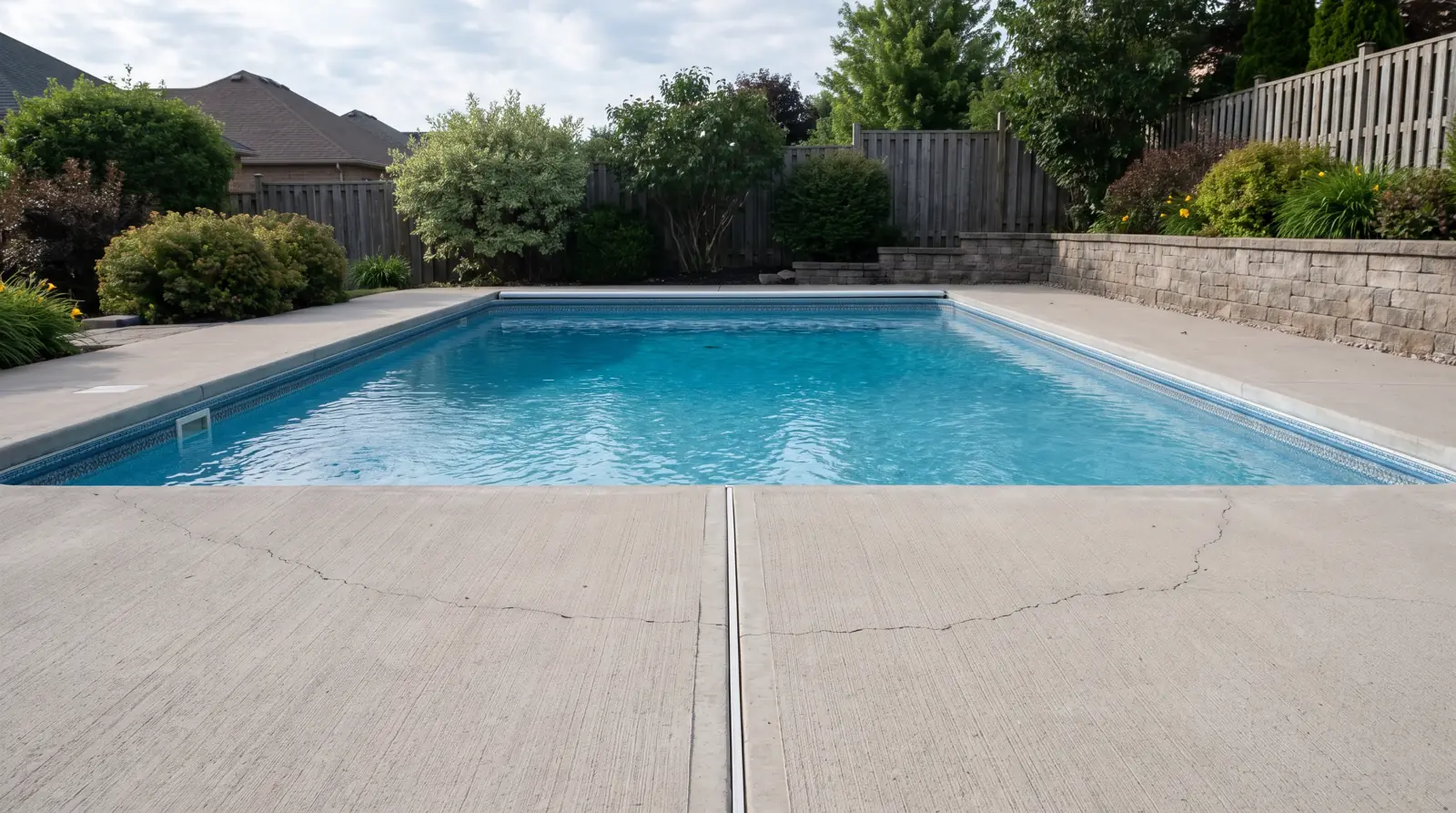
Pool deck cracks fall into seven types, and the type decides the fix: craze, plastic shrinkage, drying shrinkage between joints, the coping isolation joint, settlement with an offset, heave or slope toward the pool, and freeze-thaw D-cracks. Only the first two are cosmetic. Moving cracks need a flexible sealant, and any vertical offset over 1/4 inch needs lifting.
| Crack type | What it looks like | Width or depth marker | Cause | Still moving? | Fix | Product type | DIY materials (Nov 2026) | Source |
|---|---|---|---|---|---|---|---|---|
| Craze (map) cracks | Network of fine cracks, cells up to 1.5 in across, most visible as a wet deck dries | Under 1/8 in deep | Surface paste shrinks; poor curing or overworked finish | No | Clean and seal, or resurface the deck | Penetrating or film sealer; resurfacer | Sealer only; see the resurfacing cost guide | NRMCA CIP 3 |
| Plastic shrinkage | Short parallel cracks 1 to 3 ft apart that rarely reach the slab edge | Shallow, appear while concrete was fresh | Surface dried faster than bleed water rose | No | Leave, or fill rigid if they catch dirt | Epoxy (ASTM C881) or hybrid polyurethane; cement patch on textured decks | $25.28 per 50 ml epoxy cartridge; $36.25 per 1 lb E-Z Patch 2 kit | NRMCA CIP 5; AquaBond; E-Z Patch |
| Drying shrinkage between joints | One crack across a panel, often mid-way between joints | Hairline to 1/4 in, widens in cold weather | Joints spaced over 24 to 36 x slab thickness, or cut late | Yes, seasonally | Rout to at least 1/4 x 1/4 in, seal flexible | ASTM C920 polyurethane or polymer sealant, Class 25 or 35 | $14.49 per 10.1 oz tube | NRMCA CIP 6; QUIKRETE; Sikaflex SL 1; Zoro |
| Coping isolation joint | Gap, cracked or missing sealant where the deck meets the coping | Joint at least 1/4 in wide | Deck movement against the pool beam | Yes | Cut out and reseal on backer rod | Two-part or one-part joint sealant | See pool coping repair; pro reseal $8 to $20 per ft | ISPSC 306.7; Beltway Pools (Oct 2026) |
| Settlement with offset | One side of the crack sits lower; trip edge | Offset over 1/4 in (ADA 303.2 benchmark) | Washed-out or poorly compacted base, leaks, roof water | Often | Lift (mudjack or foam) or grind; replace over 1/2 in offset | Contractor slab lifting | Not DIY; $500 to $1,700 per 100 sq ft lifted | NRMCA CIP 4; ADA 303; Fixr (Jan 2025) |
| Heave, breakup or slope to pool | Intersecting cracks, rocking pieces, water running toward the pool | Any width | Soil movement, tree roots, failed base, wrong slope | Yes | Replace the section | New concrete or pavers | Not DIY; $8 to $24+ per sq ft remove and re-pour | ISPSC 306.5.1; ConcreteNetwork (Feb 2026) |
| Freeze-thaw D-cracks | Closely spaced cracks that appear years later, often near joints and edges | Pattern widens with each winter | Freezing and thawing of saturated concrete | Yes | Have it evaluated; usually replace | None that lasts | Not DIY | NRMCA CIP 4 |
Sources: NRMCA CIP 3, CIP 4, CIP 5, CIP 6, ISPSC 2024, ADA 2010 Standards, Zoro, AquaBond, E-Z Patch, Fixr, ConcreteNetwork, Beltway Pools. Download CSV
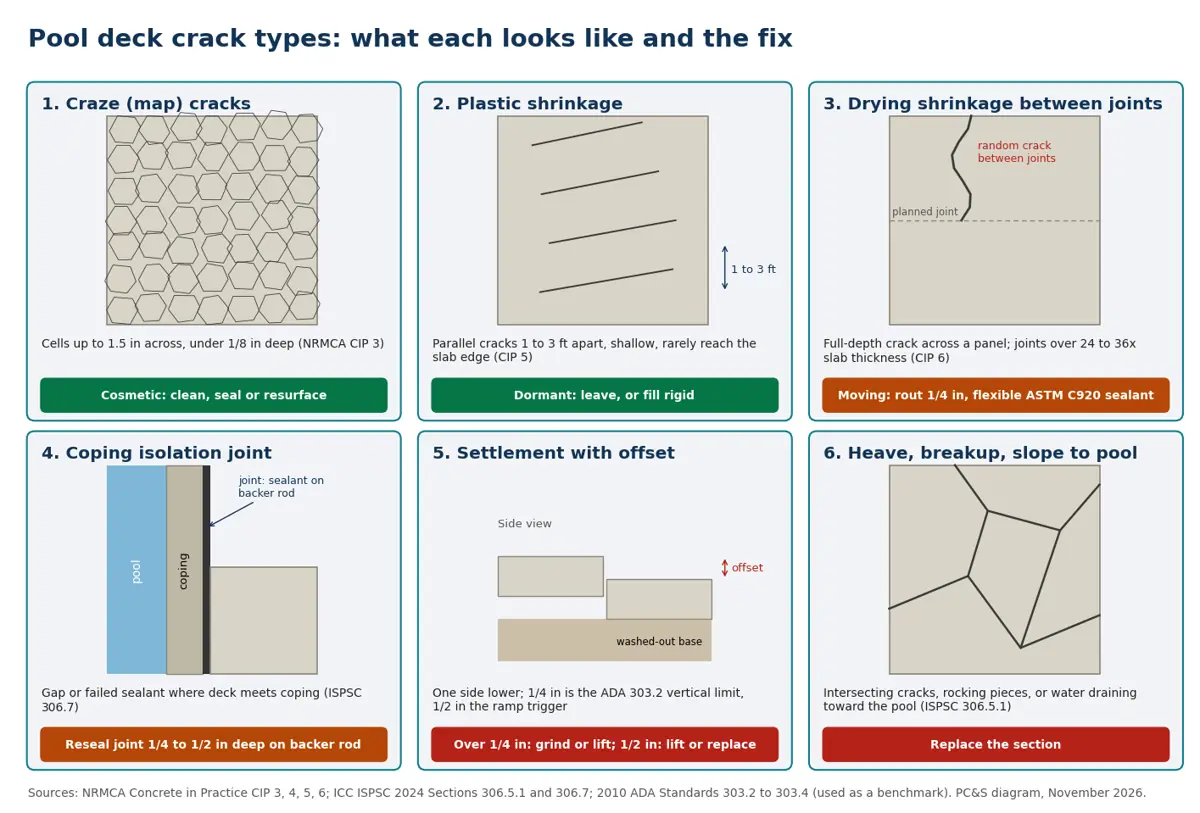
How do you tell craze from shrinkage cracks? Craze cracks form a closed web of cells no more than 1.5 in across and show up within the first week, often only when a wet deck is drying, per NRMCA CIP 3. Plastic shrinkage cracks run roughly parallel, 1 to 3 ft apart, and generally stop short of the slab edge (NRMCA CIP 5). Neither type moves much after the first year.
| Number | What it means | Source |
|---|---|---|
| 0.002 in | Narrowest crack epoxy injection can fill | ACI RAP-1 |
| 0.010 in | Cracks this narrow or narrower take low-viscosity epoxy (500 cps or less) | ACI RAP-1 |
| 1/8 in | Craze cracks are rarely deeper than this | NRMCA CIP 3 |
| 1/4 to 1/2 in | Sealant depth range for a moving crack or joint, 2:1 width to depth | Sikaflex SL 1 PDS (Oct 2025); QUIKRETE data sheet (Mar 2023) |
| 1 in | Widest crack QUIKRETE Advanced Polymer Self-Leveling Sealant and FastSet are rated for | QUIKRETE data sheets |
| 40F to 95F | Application window for QUIKRETE polymer sealants, measured at the surface above 85F air | QUIKRETE data sheet (Mar 2023) |
| 3 days / 7 days | Sealant cure before foot traffic / before water immersion | QUIKRETE data sheet (Mar 2023) |
| 1/4 in | Vertical offset the ADA allows without a bevel (benchmark, not a residential code) | 2010 ADA Standards 303.2 |
| 24 to 36 x | Maximum control joint spacing as a multiple of slab thickness, 15 ft cap | NRMCA CIP 6 |
Sources: ACI RAP-1, NRMCA CIP 3, CIP 6, Sikaflex SL 1, QUIKRETE, ADA 2010 Standards. Download CSV
A crack that runs edge to edge across a panel, or one side that has dropped, is a different problem. NRMCA CIP 4 lists improper jointing, poor subgrade preparation, high-slump concrete and missing curing as the usual causes, and singles out closely spaced freeze-thaw D-cracks as the one early-life pattern that leads to deterioration.
Is it common for pool decks to crack?
Yes. NRMCA CIP 6 says cracks in concrete cannot be prevented entirely, only controlled with joints, and ISPSC 2024 Section 306.7.2 requires deck control joints for that reason. Cracks between joints usually mean the joints sit more than 24 to 36 times the slab thickness apart, more than about 10 feet on a 4 inch deck.
| Slab thickness | 24 x thickness | 36 x thickness | Spacing to use (15 ft cap) | Minimum groove depth (1/4 thickness, 1 in min) |
|---|---|---|---|---|
| 4 in | 8 ft | 12 ft | 8 to 12 ft (CIP 6 example: about 10 ft) | 1 in |
| 5 in | 10 ft | 15 ft | 10 to 15 ft | 1 1/4 in |
| 6 in | 12 ft | 18 ft | 12 to 15 ft | 1 1/2 in |
Source: NRMCA CIP 6, Joints in Concrete Slabs on Grade; PC&S arithmetic. Download CSV
Use the table to read your own deck. Measure the distance between tooled or saw-cut joints and the slab thickness at a drain or edge. CIP 6 also wants panels no longer than 1.5 times their width and joint grooves at least 1/4 of the slab depth, never under 1 in; L-shaped panels and shallow grooves crack at the inside corner.
Pool decks add two loads a driveway does not see. Splash-out and leaks soak the base, and NRMCA CIP 4 ties settlement cracks to a base that was not compacted or that moves. Deck surfaces also get hot: the EPA cool pavements chapter puts peak summer surface temperatures of conventional pavement at 120F to 150F, which sets limits on some repair products.
A crack that reopens after sealing can mean a leak under the deck; our pool leak detection guide covers the bucket test.
How wide is too wide for a pool deck crack?
Width tells you the repair method, not whether the deck is failing. ACI RAP-1 says epoxy injection works from 0.002 inch, sealants start at a 1/4 inch wide joint, and consumer sealants top out at 1 inch. Vertical offset matters more: the ADA allows 1/4 inch unbeveled and calls for a ramp above 1/2 inch.
| Threshold | What it tells you | Source |
|---|---|---|
| 0.002 in (0.05 mm) | Narrowest crack epoxy injection can restore | ACI RAP-1 |
| 0.004 in | ACI 224R-01 Table 4.1 guide width, water-retaining structures | ACI 224R-01 via ASPIRE (Winter 2018) |
| 0.007 in | Guide width with deicing chemicals | ACI 224R-01 via ASPIRE |
| 0.010 in (0.3 mm) | At or below this, injection epoxy must be low viscosity, 500 cps or less | ACI RAP-1 |
| 0.012 in | Guide width for humidity, moist air or soil exposure | ACI 224R-01 via ASPIRE |
| 0.016 in | Guide width in dry air | ACI 224R-01 via ASPIRE |
| 1/8 in deep | Craze cracks rarely go deeper; they are a surface defect | NRMCA CIP 3 |
| 1/4 in wide | Narrowest joint Sikaflex SL 1 is sized for; rout narrower moving cracks up to this | Sikaflex SL 1 PDS Table 1 |
| 1/4 to 1/2 in deep | Sealant depth window; never deeper than 1/2 in | Sikaflex SL 1; QUIKRETE |
| 1 in wide | Upper limit for QUIKRETE Advanced Polymer sealants and FastSet | QUIKRETE data sheets |
| 1 1/2 in wide | Upper limit for Sikaflex SL 1; wider joints take SL 2 | Sikaflex SL 1 PDS |
| 1/4 in offset | Largest vertical change the ADA allows without a bevel | 2010 ADA Standards 303.2 |
| 1/2 in offset | Above this the ADA calls for a ramp, so treat it as a lift-or-replace line | 2010 ADA Standards 303.3, 303.4 |
Sources: ACI RAP-1; ACI 224R-01 Table 4.1 as reproduced in ASPIRE, Winter 2018; NRMCA CIP 3; Sikaflex SL 1; QUIKRETE; 2010 ADA Standards. Download CSV
The ACI 224R-01 widths are design guides for reinforced concrete under load, reproduced in ASPIRE magazine: 0.016 in in dry air, 0.012 in for soil or moist air, 0.004 in for water-retaining structures. ACI notes a portion of cracks will exceed them. A residential deck is not a water-retaining structure, so treat these as a scale for how fine a hairline really is.
How do you measure a crack? Slide a feeler gauge, marked in thousandths of an inch, into the widest point; a 0.010 in blade that will not enter means a hairline. Then mark both crack ends and the width with a pencil and a date. If the width or length changes between January and July, treat the crack as moving and seal it flexibly.
Offset is the safety line. The 2010 ADA Standards allow a change in level of 1/4 in vertical (303.2), require a 1:2 bevel up to 1/2 in (303.3) and a ramp above that (303.4). Private residential decks are not covered by the ADA, but a 1/2 in lip on a wet, barefoot surface is the point to lift or replace.
Should you use flexible sealant or epoxy on a pool deck crack?
Use flexible sealant on any crack that moves, which is most pool deck cracks. ACI RAP-1 says an epoxy repair may not be applicable when a crack will move again, and QUIKRETE’s FastSet sheet forbids moving cracks outright. Save epoxy and rigid hybrid polyurethane for dormant cracks and spalls, and cement patches for textured decks.
| Product | Type | Standard | Crack or joint width | Movement | Apply at | Wait before traffic / water | Price (date) | Source |
|---|---|---|---|---|---|---|---|---|
| QUIKRETE Advanced Polymer Self-Leveling Sealant (8660-10) | One-part polymer, self-leveling | ASTM C920 Type S, Grade P, Class 25 | Up to 1 in; depth 1/4 to 1/2 in | +/- 25% | 40F to 95F | 3 days / 7 days | $14.49 per 10.1 oz tube (Zoro, Nov 10, 2026) | QUIKRETE data sheet, rev. Mar 2023 |
| QUIKRETE Advanced Polymer Concrete Crack Sealant (8620-17) | One-part polymer, textured, non-sag | ASTM C920 Type S, Grade NS, Class 25 | Up to 1 in | +/- 25% | 40F to 95F | 3 days / 7 days | Not priced | QUIKRETE data sheet, rev. Jul 2018 |
| Sikaflex SL 1 | One-part polyurethane, self-leveling | ASTM C920 Type S, Grade P, Class 35 | 1/4 to 1 1/2 in | +/- 35% | Not stated; skins overnight at 75F | Full cure about 1 week; not for continuous immersion | Not priced | Sika PDS, Oct 2025, v02.03 |
| QUIKRETE FastSet Concrete Crack Repair (8650-69) | Two-part hybrid polyurethane, rigid | Not stated | Hairline to 1 in, horizontal only | Not for moving cracks | 0F to 100F; dry crack | 1 hour at 75F | Not priced | QUIKRETE FastSet data sheet |
| AquaBond CR-2000 / CR-2100 | Epoxy, self-leveling / non-sag | Not stated | Spalls and cracks | Rigid | Not stated | Hardens in 30 minutes | $25.28 per 50 ml; $111.72 starter kit with gun (Nov 10, 2026) | AquaBond pool deck repair page |
| E-Z Patch 2 Pool Deck Repair | Acrylic-modified cement, 24 colors | Not stated | Cracks and textured patches | Rigid | Store 40F to 90F | 24 h foot traffic, 3 days furniture, 28 days full cure | $36.25 (1 lb) to $475.56 (50 lb) (Nov 10, 2026) | E-Z Patch product page |
Sources: QUIKRETE Self-Leveling Sealant data sheet, QUIKRETE Concrete Crack Sealant data sheet, Sikaflex SL 1 PDS, QUIKRETE FastSet data sheet, AquaBond, E-Z Patch, Zoro; prices read November 10, 2026. Download CSV
Movement class is the number to compare. Sikaflex SL 1 is rated ASTM C920 Class 35, plus or minus 35% joint movement, with 800% elongation; the QUIKRETE Advanced Polymer Self-Leveling Sealant is Class 25 with 400% to 500% elongation. Self-leveling grades suit flat decks; the non-sag QUIKRETE crack sealant, Grade NS, holds on a sloped edge.
What epoxy can you use on a pool deck crack? For a dormant crack or a chipped edge, a concrete repair epoxy such as AquaBond CR-2000 (self-leveling) or CR-2100 (non-sag) hardens in 30 minutes; a 50 ml cartridge cost $25.28 on November 10, 2026. ACI RAP-1 points to ASTM C881 for epoxy grades and calls for 500 cps or thinner resin on cracks of 0.010 in and less.
Heat is the hidden limit. The QUIKRETE FastSet sheet bars use where service temperatures reach 140F, inside the 120F to 150F range the EPA gives for sunlit pavement, and QUIKRETE’s polymer sealants must go on at a surface temperature of 95F or less. Work in the morning shade, and check the surface, not the air.
Cold or dry weather lengthens every time on this chart.
Source: QUIKRETE data sheets (2023, FastSet); Sika Sikaflex SL 1 PDS (Oct 2025); E-Z Patch 2 instructions (read Nov 10, 2026). Download chart data (CSV)
How do you fix cracks in a pool deck, step by step?
For a moving crack: check the weather, rout it to at least 1/4 inch wide and deep, clean and dry it, set backer rod where it is deeper than 1/2 inch, fill from the bottom with an ASTM C920 sealant, broadcast sand for grip, then keep traffic off for 3 days and water off for 7 days, per QUIKRETE.
- Check the windowAir and surface between 40F and 95F, no rain before the sealant skins, no frost (QUIKRETE). New concrete must cure first: 21 days for FastSet; Sika calls for fully cured concrete.
- Rout the crackOpen hairline moving cracks with a crack chaser or grinder blade to at least 1/4 in wide and 1/4 in deep, the smallest joint in the Sikaflex SL 1 table. ACI RAP-1 also uses a V-groove to reach sound concrete.
- Clean and dryWire brush, then vacuum or blow out with oil-free air (ACI RAP-1). Remove any old sealant mechanically; QUIKRETE polymer sealants must not go over silicone.
- Set the depthWhere the crack is deeper than 1/2 in, press in closed-cell backer rod about 1/8 in wider than the crack, without stretching it (Sika). Shallow cracks get polyethylene bond-breaker tape instead.
- Fill from the bottomHold the nozzle at the bottom of the joint and fill to a sealant depth of 1/4 to 1/2 in at a 2:1 width to depth ratio. One 10.1 oz tube covers about 12 ft at 1/2 x 1/4 in (QUIKRETE).
- Add gripWhile wet, broadcast kiln-dried silica sand over the bead; the FastSet sheet says the texture reduces slipping on a wet repair and helps it match concrete.
- CureKeep foot traffic off for at least 3 days and water off for 7 days; full cure takes 3 to 7 days, longer in cool, dry weather (QUIKRETE). Sikaflex SL 1 needs about 1 week.
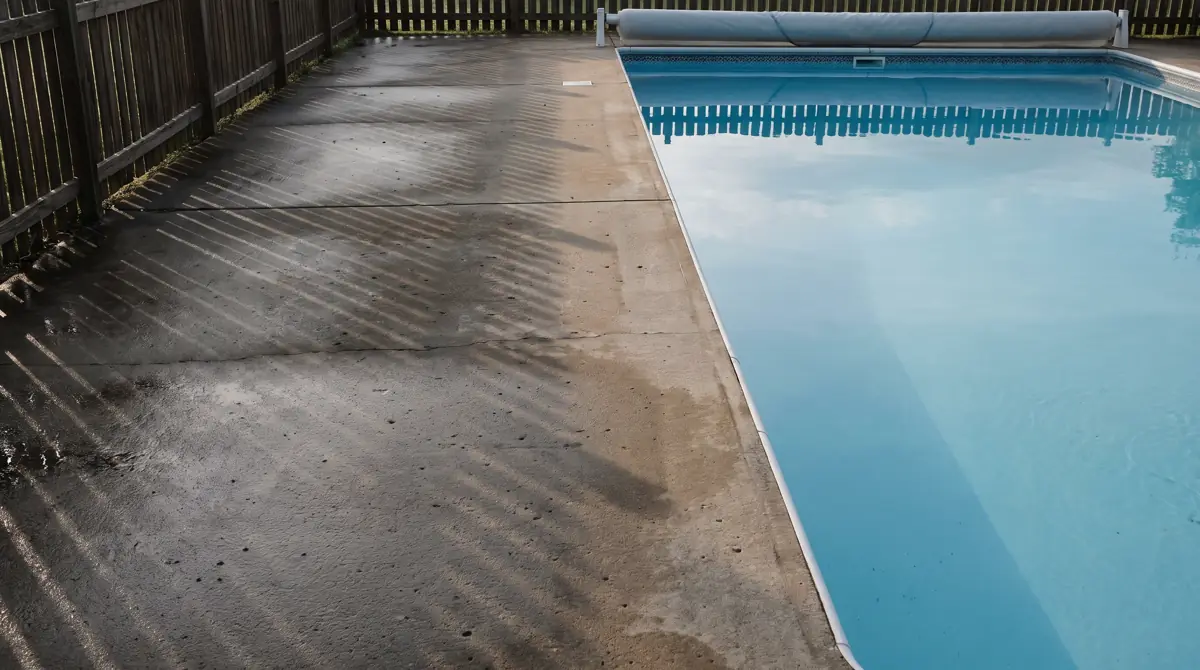
Textured decks need a color match, not a gray bead. E-Z Patch 2 comes in 24 colors with the liquid bonder in the kit: mix 1 part bonder to 3 parts water, work it into the crack, sponge off the excess, and keep foot traffic off for 24 hours and furniture for 3 days. For delaminating cool deck topping, our cool deck guide covers the maker’s repair kit.
The joint at the coping uses the same sealant rules but has its own code clause, ISPSC 306.7; resetting loose stones and resealing that joint are covered step by step in our pool coping repair guide.
Get quotes for pool deck crack repair
How much does it cost to repair a cracked pool deck?
DIY pool deck crack repair costs $14.49 to about $213 in materials for 20 feet of cracks at November 2026 prices. A contractor charges $14.97 to $17.90 per linear foot (Homewyse, January 2026), $768 to $1,920 to reseal a 96 foot coping joint, and $500 to $1,700 to lift a settled 100 square foot section.
Planning ranges from published rates, not a quote. Replacement can run higher than $24 per sq ft.
Source: Zoro, AquaBond (Nov 10, 2026); Homewyse (Jan 2026); Beltway Pools (Oct 2026); Fixr (Jan 2025); ConcreteNetwork (Feb 2026); PC&S arithmetic. Download chart data (CSV)
| Line (600 sq ft deck, 20 ft of cracks, 96 ft coping joint) | Quantity | Rate | Total | Source of rate |
|---|---|---|---|---|
| DIY: seal 20 ft routed to 1/4 x 1/4 in | 1 tube (about 24 ft per tube) | $14.49 per tube | $14.49 | Zoro, Nov 10, 2026; QUIKRETE yield |
| DIY: seal 20 ft at 1/2 x 1/4 in | 2 tubes (12 ft per tube) | $14.49 per tube | $28.98 | Zoro; QUIKRETE yield |
| DIY: epoxy-fill 20 ft at 1/4 x 1/4 in | Starter kit + 4 cartridges (about 4 ft each) | $111.72 + $25.28 each | $212.84 | AquaBond, Nov 10, 2026 |
| DIY: cement patch on a textured deck, 20 ft at 1/4 x 1/4 in | 1 lb kit (about 48 ft) | $36.25 | $36.25 | E-Z Patch, Nov 10, 2026 |
| Pro: repair 20 ft of cracks | 20 ft | $14.97 to $17.90 per ft | $299.40 to $358.00 | Homewyse, Jan 2026 |
| Pro: reseal 96 ft coping joint | 96 ft | $8 to $20 per ft | $768 to $1,920 | Beltway Pools, Oct 2026 |
| Pro: cracks + coping joint | $1,067.40 to $2,278.00 | PC&S sum | ||
| Pro: mudjack one settled 100 sq ft section | 100 sq ft | flat range | $500 to $1,700 | Fixr, Jan 2025 |
| Pro: foam-lift the same section | 100 sq ft | $20 to $25 per sq ft | $2,000 to $2,500 | Fixr, Jan 2025 |
| Pro: resurface the whole deck | 600 sq ft | $4 to $8 per sq ft | $2,400 to $4,800 | ConcreteNetwork, Feb 2026 |
| Pro: tear out and re-pour | 600 sq ft | $8 to $24+ per sq ft | $4,800 to $14,400+ | ConcreteNetwork, Feb 2026 |
Rates: Zoro, AquaBond, E-Z Patch (Nov 10, 2026); Homewyse (Jan 2026); Beltway Pools (Oct 2026); Fixr (Jan 2025); ConcreteNetwork (Feb 2026). Totals are PC&S arithmetic. Download CSV
| Job | Rate | Who published it | Date | Geography |
|---|---|---|---|---|
| Concrete crack repair, cracks up to 1/4 in | $14.97 to $17.90 per linear ft | Homewyse (cost estimator) | Jan 2026 | US default ZIP |
| Coping expansion joint reseal | $8 to $20 per linear ft | Beltway Pools (remodeler) | Oct 15, 2026 | VA, MD, DC |
| Mudjacking a 100 sq ft slab | $500 to $1,700 | Fixr | Jan 31, 2025 | US |
| Slab jacking | $3 to $17 per sq ft | Fixr | Jan 31, 2025 | US |
| Poly (foam) leveling | $20 to $25 per sq ft | Fixr | Jan 31, 2025 | US |
| Pool and patio restoration (lift, seal, joints, cracks) | $3 to $5 per sq ft | LevelUp Concrete Solutions (contractor) | Sep 6, 2024 | Indiana |
| Basic deck resurfacing | $4 to $8 per sq ft | ConcreteNetwork | Feb 13, 2026 | US |
| Remove deck and pour new concrete | $2 to $6 removal + $6 to $18+ new per sq ft | ConcreteNetwork | Feb 13, 2026 | US |
Sources: Homewyse, Beltway Pools, Fixr, LevelUp Concrete Solutions, ConcreteNetwork. Download CSV
Three things move the bill. Crack length is linear: Homewyse prices basic repair of cracks up to 1/4 in per foot with a 2 hour minimum labor charge, so one short crack costs nearly as much as several. The coping joint is the second line, and most pool decks need it every 5 to 10 years, which is the mastic life Anthony & Sylvan gives on our pool coping page.
Offset is the third, and the jump is large: foam lifting at $20 to $25 per square foot costs more than resurfacing a deck at $4 to $8 (Fixr; ConcreteNetwork). An Indiana contractor, LevelUp Concrete Solutions, quoted $3 to $5 per square foot in September 2024 for a combined lift, seal and crack package, against $20 to $30 to replace.
When should you resurface or replace instead of sealing cracks?
Seal when cracks are few and flat; resurface when the slab is sound but cracked and stained across most panels; replace when sections have dropped more than 1/2 inch, rock, or drain toward the pool. Resurfacing runs $4 to $8 per square foot and tear-out with new concrete $8 to $24 or more (ConcreteNetwork, February 2026).
| If your situation is | Do this | Why (source) |
|---|---|---|
| One side of the crack is more than 1/4 in higher than the other | Grind or bevel up to 1/2 in; above 1/2 in, lift the slab or replace it | ADA 303.2 to 303.4 as a trip benchmark; lifting $500 to $1,700 per 100 sq ft (Fixr) |
| The deck drains toward the pool, or pieces rock underfoot | Replace that section and fix the slope | ISPSC 306.5.1: decks drain away from the pool or to deck drains |
| Fine map pattern, under 1/8 in deep, nothing offset | Clean and seal, or resurface if you want a new color | Crazing is a surface defect (NRMCA CIP 3) |
| Gap or failed sealant at the coping | Cut out and reseal the isolation joint on backer rod | ISPSC 306.7 wants it watertight; $8 to $20 per ft pro (Beltway Pools) |
| A crack between joints that opens in winter and closes in summer | Rout to at least 1/4 x 1/4 in and seal with an ASTM C920 sealant | Epoxy may not be applicable if the crack moves (ACI RAP-1) |
| A dormant hairline crack on a smooth broom finish | Leave it, or fill with low-viscosity epoxy or hybrid polyurethane | Low viscosity for 0.010 in and under (ACI RAP-1) |
| Cracks in a textured or cool deck topping | Patch with a matching cement repair; strip and re-top if it is hollow | E-Z Patch 2 instructions; see our cool deck guide |
| Cracks keep returning in the same place after sealing | Find the water source: pool leak, downspout, splash-out; then re-seal | Water under a slab washes out the base (NRMCA CIP 4) |
| More than about a third of the panels are cracked, or the deck is due for a new look | Price resurfacing against replacement | $4 to $8 per sq ft resurfacing vs $8 to $24+ replacement (ConcreteNetwork) |
Sources: ADA 2010 Standards 303, ISPSC 2024 Section 306, NRMCA CIP 3, CIP 4, ACI RAP-1, E-Z Patch, Fixr, Beltway Pools, ConcreteNetwork. Download CSV
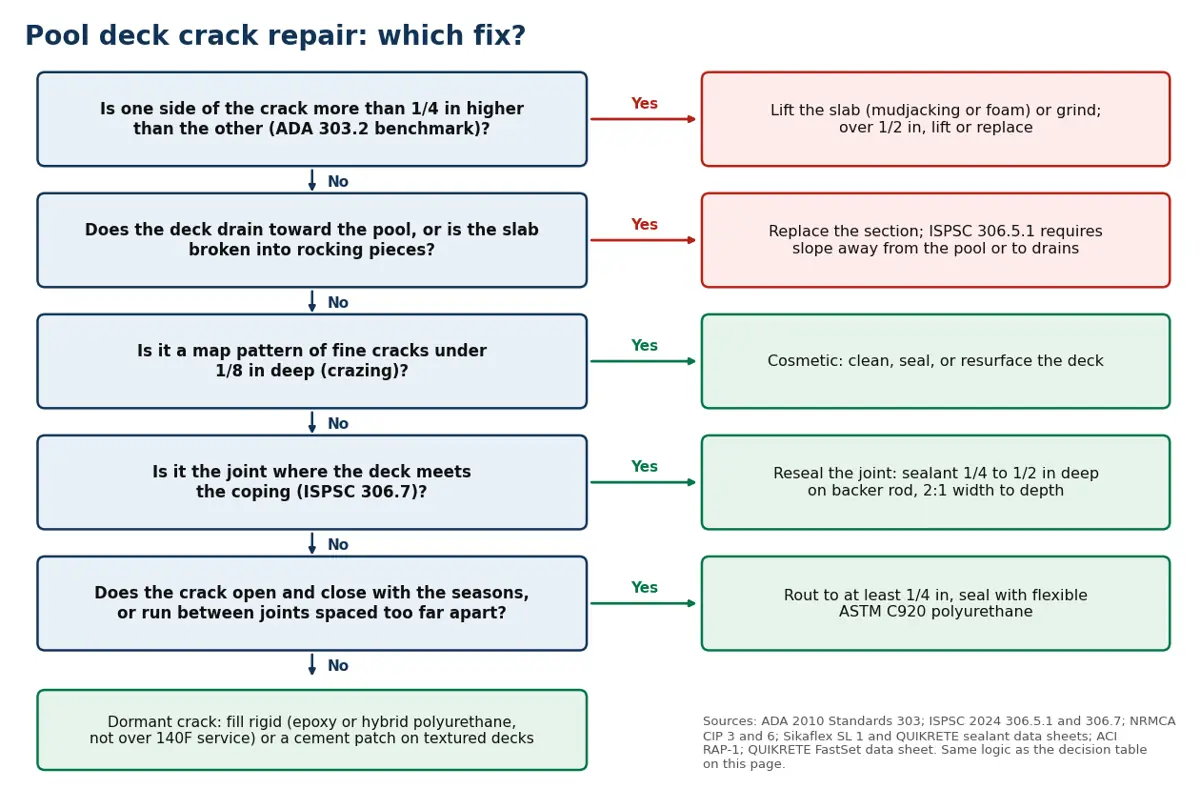
An overlay only bonds to a sound slab, so seal or lift first and resurface after at $4 to $8 per square foot (ConcreteNetwork); option-by-option prices and cure times are in our pool deck resurfacing cost guide. If you are replacing, compare slip, heat and freeze data before re-pouring the same broom finish in our pool deck materials comparison.
When should you call a pro? Call when an offset passes 1/4 in, the crack runs into the coping or tile line, the deck slopes toward the water, or cracks return within a season. Ask the contractor what caused the crack, which ASTM C920 class sealant they will use, and whether a re-pour needs a permit; our pool deck contractors page lists licensing questions, and our pool contractor license requirements study covers state rules.
How we compiled this
PC&S compiled this guide in November 2026 from 21 documents: 6 standards and practice sheets (ACI RAP-1, ACI 224R-01 as reproduced in ASPIRE, NRMCA CIP 3, 4, 5 and 6), 2 code texts (ISPSC 2024 Chapter 3 and the 2010 ADA Standards), 4 maker data sheets, 3 maker or seller product pages, 5 published cost sources and 1 EPA report. We did not test products or inspect decks; prices are list prices as of the dates shown.
Frequently Asked Questions
How do you fix cracks in a pool deck?
Rout a moving crack to at least 1/4 inch wide and deep, clean and dry it, fill it from the bottom with an ASTM C920 polyurethane or polymer sealant 1/4 to 1/2 inch deep, and keep traffic off for 3 days and water for 7 (QUIKRETE data sheet). Dormant hairlines can take low-viscosity epoxy instead, per ACI RAP-1.
How much does it cost to repair a cracked pool deck?
DIY sealant cost $14.49 per 10.1 oz tube at Zoro on November 10, 2026, enough for about 24 feet of routed crack. Contractors charge $14.97 to $17.90 per linear foot (Homewyse, January 2026). Lifting a settled 100 square foot section runs $500 to $1,700, and replacing a 600 square foot deck $4,800 to $14,400 or more.
Is it common for pool decks to crack?
Yes. NRMCA CIP 6 states that cracks in concrete cannot be prevented entirely, only controlled with joints spaced no more than 24 to 36 times the slab thickness, capped at 15 feet. ISPSC 2024 Section 306.7.2 requires control joints in pool decks for that reason. Fine craze cracks under 1/8 inch deep are a surface defect (CIP 3).
What epoxy can I use to repair cracks in my swimming pool deck?
For dormant cracks and spalls, use a concrete repair epoxy meeting ASTM C881, such as AquaBond CR-2000 self-leveling or CR-2100 non-sag at $25.28 per 50 ml cartridge (November 2026). ACI RAP-1 calls for 500 cps or thinner resin on cracks of 0.010 inch and less, and warns epoxy may not suit cracks that keep moving.
Can you caulk cracks in a pool deck?
Yes, with a sealant rated for traffic and movement, not bathroom caulk. Look for ASTM C920 Use T: Sikaflex SL 1 (Class 35) and QUIKRETE Advanced Polymer Self-Leveling Sealant (Class 25) both carry it. Keep the bead 1/4 to 1/2 inch deep at twice that width, and never apply polyurethane over old silicone.
How long does pool deck crack filler take to cure?
QUIKRETE’s polymer sealants need 3 days before foot traffic, 7 days before water immersion, and 3 to 7 days to full cure at 77F. Sikaflex SL 1 skins overnight and fully cures in about 1 week at 75F. QUIKRETE FastSet opens to traffic in 1 hour, and E-Z Patch 2 cement patch takes foot traffic after 24 hours.
Sources
- American Concrete Institute. Field Guide to Concrete Repair Application Procedures: Structural Crack Repair by Epoxy Injection (RAP-1). Accessed 2026-11-10.
- ASPIRE magazine, Winter 2018. Safety and Serviceability (reproduces ACI 224R-01 Table 4.1). Accessed 2026-11-10.
- NRMCA (copy hosted by Prairie Materials). CIP 3: Crazing Concrete Surfaces. Accessed 2026-11-10.
- NRMCA (copy hosted by Prairie Materials). CIP 4: Cracking Concrete Surfaces. Accessed 2026-11-10.
- NRMCA (copy hosted by Prairie Materials). CIP 5: Plastic Shrinkage Cracking. Accessed 2026-11-10.
- NRMCA (copy hosted by Prairie Materials). CIP 6: Joints in Concrete Slabs on Grade. Accessed 2026-11-10.
- International Code Council via UpCodes. International Swimming Pool and Spa Code 2024, Chapter 3, Sections 306.5 and 306.7. Accessed 2026-11-10.
- U.S. Access Board. 2010 ADA Standards for Accessible Design, Section 303. Accessed 2026-11-10.
- QUIKRETE. Advanced Polymer Self-Leveling Sealant data sheet (rev. March 2023). Accessed 2026-11-10.
- QUIKRETE. Advanced Polymer Concrete Crack Sealant data sheet (rev. July 2018). Accessed 2026-11-10.
- QUIKRETE via BuildSite. FastSet Concrete Crack Repair product data. Accessed 2026-11-10.
- Sika USA. Sikaflex SL 1 Product Data Sheet (October 2025, v02.03). Accessed 2026-11-10.
- E-Z Patch. E-Z Patch 2 Pool Deck Repair product page and instructions. Accessed 2026-11-10.
- AquaBond. Pool Deck Repair Products. Accessed 2026-11-10.
- Zoro. QUIKRETE Gray Polymer Concrete Self-Leveling Sealant 10.1 oz listing. Accessed 2026-11-10.
- Homewyse. Cost to Repair Cracked Concrete (January 2026). Accessed 2026-11-10.
- Fixr. Concrete Leveling Cost (updated January 31, 2025). Accessed 2026-11-10.
- ConcreteNetwork. Pool Deck Cost (updated February 13, 2026). Accessed 2026-10-27.
- Beltway Pools. Pool Renovation Cost: What to Budget in VA, MD and DC (modified October 15, 2026). Accessed 2026-11-02.
- U.S. Environmental Protection Agency. Reducing Urban Heat Islands: Cool Pavements chapter. Accessed 2026-10-26.
- LevelUp Concrete Solutions. Best Pool Deck Repair Options (September 6, 2024). Accessed 2026-11-10.
Related pages
Get Quotes From Licensed Local Pool Pros
Tell us what you need and your ZIP code. We match you with pool companies that cover your area.