How Much Shock to Add to Pool Water, by Pool Size, Product and Goal
How much shock to add to pool water: for a 10 ppm shock, 100 fl oz of 12.5% liquid chlorine or 1.14 lb of 73% cal-hypo per 10,000 gallons (EPA labels). Halve it for a routine 5 ppm shock.
- ✓10 ppm per 10,000 gal100 fl oz of 12.5% liquid or 18.29 oz of 73% cal-hypo, the top of the 5 to 10 ppm label range.
- ✓One bag = 8.75 ppmA 1 lb bag of 73% cal-hypo in 10,000 gallons, per the HTH Granular 73 label chart.
- ✓Breakpoint = 10 x CCRaise free chlorine to 10 times combined chlorine, never below 5 ppm (2024 MAHC).
Key takeaways
- A standard shock is 10 ppm free chlorine: 100 fl oz of 12.5% liquid chlorine or 18.29 oz of 73% calcium hypochlorite per 10,000 gallons, the top of the 5 to 10 ppm range on the HTH Granular 73 label (EPA Reg. No. 1258-1239).
- One 1 lb bag of 73% cal-hypo adds 8.75 ppm to 10,000 gallons, 4.38 ppm to 20,000 and 2.19 ppm to 40,000; the chart on the HTH Granular 73 label prints the 8.75 figure.
- For a breakpoint shock, raise free chlorine to about 10 times the combined chlorine and never below 5 ppm, the rule in the 2024 Model Aquatic Health Code.
- The strongest label rate we found for a green pool is 2.6 lb of 52% cal-hypo per 10,000 gallons, about 16 ppm, on EPA label 1258-1250; community SLAM levels run higher, 20 ppm at 50 ppm cyanuric acid (Trouble Free Pool).
- Swim again at 4 ppm or less, the re-entry limit on the Hasachlor 12.5% label (10897-26); above 10 ppm a DPD test can read 0, per CDC.
How much shock per gallon of pool water?
A 10 ppm shock takes 10 fl oz of 12.5% liquid chlorine, 1.83 oz of 73% cal-hypo, 2 oz of 65% cal-hypo or 2.4 oz of 56% dichlor per 1,000 gallons, scaled from the 10,000 gallon label charts. Per single gallon of water that is about 0.1 fl oz of liquid. Halve every figure for a routine 5 ppm shock.
| Product (label, EPA Reg. No.) | 5,000 gal | 10,000 gal | 15,000 gal | 20,000 gal | 25,000 gal | 30,000 gal | 40,000 gal |
|---|---|---|---|---|---|---|---|
| Liquid chlorine 12.5% (Hasachlor, 10897-26) | 50 fl oz (0.39 gal) | 100 fl oz (0.78 gal) | 150 fl oz (1.17 gal) | 200 fl oz (1.56 gal) | 250 fl oz (1.95 gal) | 300 fl oz (2.34 gal) | 400 fl oz (3.12 gal) |
| Liquid chlorine 10% (Hasachlor chart scaled) | 62 fl oz (0.49 gal) | 125 fl oz (0.98 gal) | 188 fl oz (1.46 gal) | 250 fl oz (1.95 gal) | 312 fl oz (2.44 gal) | 375 fl oz (2.93 gal) | 500 fl oz (3.91 gal) |
| Cal-hypo 73% (HTH Granular 73, 1258-1239) | 0.57 lb (9.1 oz) | 1.14 lb (18.3 oz) | 1.71 lb (27.4 oz) | 2.29 lb (36.6 oz) | 2.86 lb (45.7 oz) | 3.43 lb (54.9 oz) | 4.57 lb (73.2 oz) |
| Cal-hypo 65% available (Scorch, 3432-76) | 0.62 lb (10.0 oz) | 1.25 lb (20.0 oz) | 1.88 lb (30.0 oz) | 2.50 lb (40.0 oz) | 3.12 lb (50.0 oz) | 3.75 lb (60.0 oz) | 5.00 lb (80.0 oz) |
| Dichlor 56% (Pace, 1258-984) | 0.75 lb (12.0 oz) | 1.50 lb (24.0 oz) | 2.25 lb (36.0 oz) | 3.00 lb (48.0 oz) | 3.75 lb (60.0 oz) | 4.50 lb (72.0 oz) | 6.00 lb (96.0 oz) |
| Non-chlorine shock, MPS (routine label rate, adds no chlorine) | 0.5 lb | 1.0 lb | 1.5 lb | 2.0 lb | 2.5 lb | 3.0 lb | 4.0 lb |
Source: Hasachlor 10897-26, HTH Granular 73 1258-1239, Scorch 3432-76, Pace 1258-984 (EPA PPLS); Leslie‘s and Doheny‘s MPS directions. Other sizes are PC&S linear scaling. Download CSV
Every number in that table comes from one line printed on a label and the fact that dose scales in a straight line with gallons. The HTH Granular 73 label shows its own math: 1 lb in 10,000 gallons gives 8.75 ppm, which is 1 x 0.73 x 1,000,000 / (10,000 x 8.34). Flip it for any product: lb = ppm x gallons x 8.34 / (1,000,000 x available chlorine). The Virginia Department of Health guide uses the same scaling, 1.3 oz of pure available chlorine per ppm per 10,000 gallons.
The 10% liquid row uses 12.5 fl oz per ppm per 10,000 gallons, the Hasachlor chart scaled by 12.5 / 10. Jugs sold as 10 to 12.5% carry a range, and Florida DOH lists 10 to 12% for pool-grade liquid, so a jug of unknown age deserves the 10% row. Non-chlorine shock (potassium monopersulfate, MPS) is dosed by weight, 1 lb per 10,000 gallons, and adds no free chlorine at all, per the 2024 MAHC Annex.
| Reading | Current | Target | What to add |
|---|---|---|---|
| Free chlorine, shock target (ppm) | … |
Formula source: Rates per 1 ppm per 10,000 gal from EPA labels: Hasachlor 10897-26 (12.5% liquid, 10 fl oz), HTH Granular 73 1258-1239 (1.83 oz), Scorch 3432-76 (2 oz), Pace 1258-984 (2.4 oz); 10% liquid scaled 12.5 / 10. Estimates only.
The shock calculator above defaults to a 20,000 gallon pool going from 1 to 10 ppm, which needs 180 fl oz (1.41 gal) of 12.5% liquid chlorine or 2.06 lb of 73% cal-hypo. To dose pH, alkalinity and stabilizer in the same session, use our pool chemical calculator.
How many bags of shock does your pool need?
Divide the ppm you want by the ppm one bag adds to your pool. A 1 lb bag of 73% cal-hypo adds 8.75 ppm to 10,000 gallons, so a 20,000 gallon pool needs 2 bags for 5 ppm and 3 bags for 10 ppm. Weaker bags need more: a 45% bag adds only 5.40 ppm per 10,000 gallons.
| 1 lb bag (strength) | ppm one bag adds to 10,000 gal | 5,000 gal: bags for 5 / 10 ppm | 10,000 gal: bags for 5 / 10 ppm | 15,000 gal: bags for 5 / 10 ppm | 20,000 gal: bags for 5 / 10 ppm | 25,000 gal: bags for 5 / 10 ppm | 30,000 gal: bags for 5 / 10 ppm |
|---|---|---|---|---|---|---|---|
| Cal-hypo 73% (HTH Granular 73) | 8.75 | 1 / 1 | 1 / 2 | 1 / 2 | 2 / 3 | 2 / 3 | 2 / 4 |
| Cal-hypo 65% available (Scorch) | 7.79 | 1 / 1 | 1 / 2 | 1 / 2 | 2 / 3 | 2 / 4 | 2 / 4 |
| Dichlor 56% (Pace) | 6.71 | 1 / 1 | 1 / 2 | 2 / 3 | 2 / 3 | 2 / 4 | 3 / 5 |
| Cal-hypo, 45% minimum available (HTH Pool Shock 1258-1237) | 5.40 | 1 / 1 | 1 / 2 | 2 / 3 | 2 / 4 | 3 / 5 | 3 / 6 |
Source: label strengths from HTH Granular 73, Scorch, Pace and HTH Pool Shock 1258-1237; bags = ppm x gallons / 10,000 / ppm per bag, PC&S arithmetic. Download CSV
Source: PC&S arithmetic from label strengths: HTH Granular 73 (1258-1239), Scorch (3432-76), Pace (1258-984), HTH Pool Shock (1258-1237); EPA PPLS, opened November 2026. Download chart data (CSV)
Read the strength on the front of the bag before you count. The HTH Pool Shock label (1258-1237) lists calcium hypochlorite at 47.6% with 45% minimum available chlorine and doses 1 lb per 12,500 gallons, which works out to about 4.3 ppm. That is just under the 5 ppm floor the stronger labels use, which is why one bag of a weak product can leave a busy pool short.
Rounding up is fine for a routine shock: one extra 73% bag in a 15,000 gallon pool lands at about 11.7 ppm instead of 10. At Leslie’s September 2026 prices a 1 ppm dose in 10,000 gallons cost $1.03 from 1 lb bags of 73% cal-hypo against $0.59 from 12.5% liquid, as our pool equipment price index tracks; cost per ppm, shelf life and storage are compared in our guide to liquid chlorine vs shock.
How many gallons of liquid shock for a 10,000 gallon pool?
For 10,000 gallons, 0.39 gallon (50 fl oz) of 12.5% liquid chlorine gives a 5 ppm shock and 0.78 gallon (100 fl oz) gives 10 ppm, per the Hasachlor label chart. With 10% liquid it is 0.49 and 0.98 gallon. One 1 gallon jug of 12.5% adds 12.8 ppm to 10,000 gallons.
| Pool size | 12.5% liquid for 5 ppm | 12.5% liquid for 10 ppm | 10% liquid for 5 ppm | 10% liquid for 10 ppm | 1 gal jugs of 12.5% for 10 ppm (rounded up) |
|---|---|---|---|---|---|
| 5,000 gal | 25 fl oz (0.20 gal) | 50 fl oz (0.39 gal) | 31 fl oz (0.24 gal) | 62 fl oz (0.49 gal) | 1 |
| 10,000 gal | 50 fl oz (0.39 gal) | 100 fl oz (0.78 gal) | 62 fl oz (0.49 gal) | 125 fl oz (0.98 gal) | 1 |
| 15,000 gal | 75 fl oz (0.59 gal) | 150 fl oz (1.17 gal) | 94 fl oz (0.73 gal) | 188 fl oz (1.46 gal) | 2 |
| 20,000 gal | 100 fl oz (0.78 gal) | 200 fl oz (1.56 gal) | 125 fl oz (0.98 gal) | 250 fl oz (1.95 gal) | 2 |
| 25,000 gal | 125 fl oz (0.98 gal) | 250 fl oz (1.95 gal) | 156 fl oz (1.22 gal) | 312 fl oz (2.44 gal) | 2 |
| 30,000 gal | 150 fl oz (1.17 gal) | 300 fl oz (2.34 gal) | 188 fl oz (1.46 gal) | 375 fl oz (2.93 gal) | 3 |
| 40,000 gal | 200 fl oz (1.56 gal) | 400 fl oz (3.12 gal) | 250 fl oz (1.95 gal) | 500 fl oz (3.91 gal) | 4 |
Source: Hasachlor label chart (10897-26): 10 fl oz per ppm per 10,000 gal; 10% row scaled by 12.5 / 10. 128 fl oz = 1 gal. Download CSV
The jug count matters because liquid chlorine loses strength in storage: the Hasachlor label says the product degrades with age, sunlight and heat. If last month’s jugs fail to reach the target, step down to the 10% column rather than adding a third dose blind. Pour it slowly in front of a return jet with the pump running; the full pour-and-wait sequence is in our guide on how to shock a pool.
How much shock for cloudy water, algae or opening a pool?
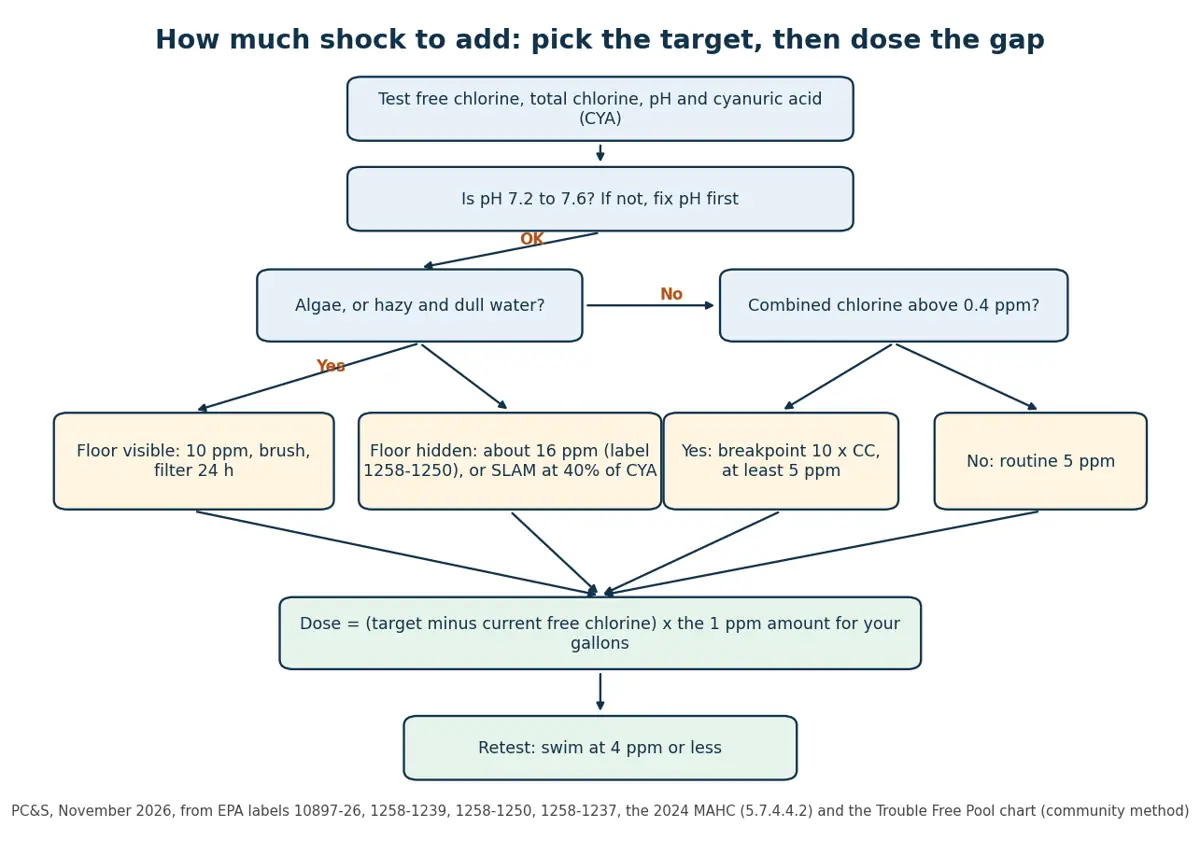
Pick the target from your goal, then multiply the 10 ppm table. Routine weekly shocks use 5 ppm, hazy water and light algae 10 ppm, winterizing 15 ppm, and a green pool you cannot see into about 16 ppm on the strongest label we found. Subtract the free chlorine already in the water before dosing.
| Goal | Target free chlorine | Multiply the 10 ppm dose by | Source |
|---|---|---|---|
| Routine weekly shock, combined chlorine 0.4 ppm or less | 5 ppm (low end of the label range) | 0.5 | EPA labels 10897-26, 1258-1239, 3432-76, 1258-984 |
| After a party, storm or chlorine smell | 10 x combined chlorine, never below 5 ppm | (target minus current free chlorine) / 10 | 2024 MAHC glossary and 5.7.4.4.2; EPA labels |
| Hazy or dull water, or light green with the floor visible | 10 ppm (top of the label range) | 1.0 | HTH Pool Shock label 1258-1237 (hazy or dull water); HTH Granular 73 label |
| Visible algae, Scorch algae rate | About 9.7 ppm (1 oz per 500 gal of 65% product) | 1.0 | Scorch label 3432-76 |
| Winterizing a clear pool | 15 ppm (27 oz of 73% per 10,000 gal) | 1.5 | HTH Granular 73 label 1258-1239 |
| Green pool, floor not visible | About 16 ppm (2.6 lb of 52% per 10,000 gal) | 1.6 | Arch 52% label 1258-1250 |
| SLAM (pool owner community method, not a label rate) | About 40% of cyanuric acid, e.g. 20 ppm at 50 ppm | CYA x 0.04 | Trouble Free Pool chart (2019) |
| Diarrheal incident (public pool code), no cyanuric acid | 20 ppm held 12.75 hours | 2.0 | 2024 MAHC 6.5.3.2 |
Source: EPA labels 10897-26, 1258-1239, 3432-76, 1258-1250, 1258-1237; 2024 MAHC; Trouble Free Pool (community method). Download CSV
Two of those rows are not label rates. The diarrheal row comes from the 2024 MAHC, written for public pools, and the SLAM row comes from a pool owner community chart. Treat both as reference points, not as a reason to pour 30 ppm on a hunch. For a green pool, the per-round routine with brushing and filter cleaning is in our guide on how to clear a green pool, and haze that lingers once chlorine holds is covered in our guide to a cloudy pool after shock.
How much shock do you need at your cyanuric acid level?
More stabilizer means more shock. The community SLAM chart sets the target at about 40% of cyanuric acid: 12 ppm at 30 ppm CYA, 20 ppm at 50 and 39 ppm at 100. A 10,000 gallon pool at 50 ppm CYA needs about 1.56 gallons of 12.5% liquid chlorine to reach 20 ppm from zero.
| Cyanuric acid (ppm) | SLAM free chlorine (Trouble Free Pool) | 12.5% liquid, 10,000 gal | 12.5% liquid, 20,000 gal | 73% cal-hypo, 10,000 gal | Above the 10 ppm label top? |
|---|---|---|---|---|---|
| 20 | 10 ppm | 100 fl oz (0.78 gal) | 200 fl oz (1.56 gal) | 1.14 lb (18.3 oz) | No |
| 30 | 12 ppm | 120 fl oz (0.94 gal) | 240 fl oz (1.88 gal) | 1.37 lb (21.9 oz) | Yes |
| 40 | 16 ppm | 160 fl oz (1.25 gal) | 320 fl oz (2.50 gal) | 1.83 lb (29.3 oz) | Yes |
| 50 | 20 ppm | 200 fl oz (1.56 gal) | 400 fl oz (3.12 gal) | 2.29 lb (36.6 oz) | Yes |
| 60 | 24 ppm | 240 fl oz (1.88 gal) | 480 fl oz (3.75 gal) | 2.74 lb (43.9 oz) | Yes |
| 70 | 28 ppm | 280 fl oz (2.19 gal) | 560 fl oz (4.38 gal) | 3.20 lb (51.2 oz) | Yes |
| 80 | 31 ppm | 310 fl oz (2.42 gal) | 620 fl oz (4.84 gal) | 3.54 lb (56.7 oz) | Yes |
| 90 | 35 ppm | 350 fl oz (2.73 gal) | 700 fl oz (5.47 gal) | 4.00 lb (64.0 oz) | Yes |
| 100 | 39 ppm | 390 fl oz (3.05 gal) | 780 fl oz (6.09 gal) | 4.46 lb (71.3 oz) | Yes |
Source: SLAM levels from the Trouble Free Pool FC/CYA chart (community method, not an EPA label); doses from the Hasachlor and HTH Granular 73 label charts, PC&S arithmetic. Download CSV
Source: Trouble Free Pool FC/CYA chart (2019, opened November 2026); EPA labels 10897-26 and 1258-1239. Download chart data (CSV)
The reason is chemistry, not opinion: cyanuric acid holds most free chlorine in a bound reserve, and the 2024 MAHC Annex shows active chlorine holding steady only when free chlorine rises in step with CYA. Above 50 ppm CYA every SLAM level exceeds the 10 ppm label top, which is why high stabilizer makes algae expensive. Shock with liquid or cal-hypo in that case: each 10 ppm from dichlor adds about 9.1 ppm more CYA (PubChem molar masses). Our cyanuric acid guide covers testing and targets.
How do you calculate a breakpoint shock dose?
Subtract free chlorine from total chlorine to get combined chlorine, multiply by 10, and use the larger of that and 5 ppm as the target. Subtract the free chlorine you already have, then convert the gap with the label rate. A 20,000 gallon pool at 0.8 ppm combined chlorine needs 140 fl oz of 12.5% liquid.
- Find your gallonsLength x width x average depth x 7.5 for a rectangle, the formula on the HTH Granular 73 label.
- Test free and total chlorineUse a DPD kit; combined chlorine = total minus free. The free vs total split is explained in our guide to free vs total chlorine.
- Set the target10 x combined chlorine, never below 5 ppm (2024 MAHC; EPA labels).
- Find the gapTarget minus current free chlorine, in ppm.
- ConvertGap x the 1 ppm amount x gallons / 10,000: 10 fl oz of 12.5% liquid, 1.83 oz of 73% cal-hypo, 2.4 oz of 56% dichlor.
- Retest after 30 minutes of mixingThe HTH Granular 73 label allows 30 minutes to disperse; swim only at 4 ppm or less.
| Step | Value | Arithmetic | Source |
|---|---|---|---|
| 1. Pool volume | 20,000 gal | 32 ft x 16 ft x 5.2 ft average depth x 7.5 = 19,968 gal, rounded | Volume formula on the HTH Granular 73 label |
| 2. Free chlorine (FC) | 1.0 ppm | DPD test | CDC |
| 3. Total chlorine (TC) | 1.8 ppm | DPD test | CDC |
| 4. Combined chlorine (CC) | 0.8 ppm | 1.8 minus 1.0 | 2024 MAHC glossary |
| 5. Breakpoint target | 8.0 ppm | 10 x 0.8 = 8.0, above the 5 ppm label floor | 2024 MAHC; EPA labels |
| 6. ppm to add | 7.0 ppm | 8.0 minus 1.0 | PC&S arithmetic |
| 7a. 12.5% liquid chlorine | 140 fl oz (1.09 gal) | 10 fl oz x (20,000 / 10,000) x 7 | Hasachlor chart, 10 fl oz per ppm per 10,000 gal |
| 7b. 73% cal-hypo | 1.60 lb (25.6 oz) | 7 x 20,000 x 8.34 / (1,000,000 x 0.73) | Formula; strength from HTH Granular 73 |
| 7c. 56% dichlor | 2.10 lb (33.6 oz) | 2.4 oz x 2 x 7 | Pace label, 12 to 24 oz per 10,000 gal = 5 to 10 ppm |
| 8. Side effect (dichlor) | About 6.4 ppm cyanuric acid | 7 x 0.91 ppm CYA per ppm chlorine | PC&S arithmetic from PubChem molar masses |
Source: 2024 MAHC glossary and 5.7.4.4.2; Hasachlor, HTH Granular 73 and Pace labels; PubChem molar masses. Download CSV
Can you put too much shock in your pool?
Yes, in two ways. A dose far above the 5 to 10 ppm label range keeps swimmers out until chlorine falls to 4 ppm, and it can bleach a DPD test to a false 0, per CDC. Repeated dichlor or cal-hypo shocks also build up cyanuric acid or calcium. Several popular dose rules overshoot the labels.
| Guide claim | Who says it | What the label math shows | Source for the check |
|---|---|---|---|
| 1 lb of shock per 10,000 gal for routine shock | Swim University | 1 lb gives 8.75 ppm (73%), 7.79 ppm (65%) or 6.71 ppm (56% dichlor): inside the 5 to 10 ppm label range for all three | HTH Granular 73 chart; ppm formula |
| 2, 3 or 4 lb per 10,000 gal for light green, dark green or black-green water | Swim University | 4 lb of 73% cal-hypo is 35 ppm, more than twice the strongest label green-water rate we read (about 16 ppm) | Arch 52% label 1258-1250; ppm formula |
| Breakpoint chlorination is reached at 30 ppm | Swim University | Breakpoint is about 10 x combined chlorine: 5 ppm at 0.5 ppm combined chlorine, not a fixed 30 ppm | 2024 MAHC glossary; Florida DOH |
| Shock to 20 ppm for light green and 30 ppm for dark green | The Pool Nerd calculator | No EPA label we read sets more than about 16 ppm; the 20 to 30 ppm figures match the community SLAM chart at 50 to 80 ppm cyanuric acid | EPA labels; Trouble Free Pool chart |
| Opening shock target of 15 ppm | The Pool Nerd calculator | Matches the HTH Granular 73 winterizing rate: 27 oz per 10,000 gal gives 15 ppm | HTH Granular 73 label |
| 1 lb per 10,000 to 13,500 gal | HTH blog | 1 lb of 73% in 13,500 gal gives 6.5 ppm; the HTH Pool Shock label rate (1 lb per 12,500 gal, 45% minimum available) gives about 4.3 ppm, just under the 5 ppm floor | HTH Pool Shock label 1258-1237; ppm formula |
| About 2 lb per 10,000 gal raises chlorine 5 ppm | Carlton Pools | 2 lb of 73% cal-hypo gives 17.5 ppm; 5 ppm takes 9.15 oz (0.57 lb) | HTH Granular 73 chart |
| It is tough to add too much shock | HTH blog | Labels bar swimming above 4 ppm, and DPD tests can bleach out and read 0 above 10 ppm | EPA labels; CDC |
Source: claims from Swim University, The Pool Nerd, HTH and Carlton Pools (opened November 10, 2026); checks against EPA labels and the 2024 MAHC. Download CSV
The practical risk of a big overdose is downtime, not damage to plaster: the labels set re-entry at 4 ppm, and the time to get there depends on sun, stabilizer and swimmers. Our guide on how long after shocking a pool you can swim gives wait estimates by starting dose. Undissolved granules are the exception for vinyl: the Scorch label says to pre-dissolve 1 oz in 2 quarts of water for vinyl pools.
Which shock dose fits your test result?
Match your reading to a row. The table turns the 5 to 10 ppm label range, the 10 times combined chlorine breakpoint rule, the 1258-1250 severe-bloom rate and the CDC bleach-out warning into if-then steps, and the key numbers under it list every figure the doses on this page use, with its source.
| If your situation is | Do this | Source |
|---|---|---|
| Combined chlorine 0.4 ppm or less, routine week | Dose 5 ppm: half the 10 ppm column | EPA labels |
| Combined chlorine above 0.4 ppm | Raise free chlorine to 10 x combined chlorine, at least 5 ppm | 2024 MAHC 5.7.4.4.2 |
| Hazy, dull or smelly water with low free chlorine | Dose 10 ppm, run the pump, retest next morning | HTH Pool Shock label 1258-1237 |
| Green, floor visible | Dose 10 ppm, brush, filter 24 hours, repeat | BioGuard 73 and HTH Granular 73 labels |
| Green, floor not visible | About 16 ppm (2.6 lb of 52% cal-hypo per 10,000 gal), floc, vacuum to waste | Arch 52% label 1258-1250 |
| Cyanuric acid above 50 ppm and algae | Expect a SLAM level above 10 ppm; use liquid or cal-hypo, not dichlor | Trouble Free Pool chart; PubChem arithmetic |
| Cyanuric acid above 100 ppm | Lower it by partial drain before shocking | 2024 MAHC Annex example ratio; PC&S CYA guide |
| Vinyl liner | Liquid chlorine, or cal-hypo pre-dissolved at 1 oz per 2 qt of water | Scorch label 3432-76 |
| Free chlorine still above 4 ppm | Add nothing, keep swimmers out, retest | EPA labels |
| Test reads 0 right after shocking | Do not add more; dilute the sample 1:1 and retest | CDC |
Source: EPA labels; 2024 MAHC; CDC; Trouble Free Pool (community method). Download CSV
| Key number | Value | Source |
|---|---|---|
| Label shock range | 5 to 10 ppm free chlorine, every 7 days or as needed | EPA labels 10897-26, 1258-1239, 3432-76, 1258-984 |
| 12.5% liquid per 1 ppm in 10,000 gal | 10 fl oz | Hasachlor chart |
| One 1 lb bag of 73% cal-hypo in 10,000 gal | 8.75 ppm | HTH Granular 73 chart |
| ppm formula | ppm = lb x strength x 1,000,000 / (gallons x 8.34) | HTH Granular 73 chart; Virginia DOH |
| Breakpoint | About 10 x combined chlorine | 2024 MAHC; Florida DOH |
| Swim again | 4 ppm or less (1.0 to 3.0 ppm on Scorch) | EPA labels |
| Test bleach-out | Above 10 ppm DPD can read falsely low or 0 | CDC |
| Cyanuric acid from dichlor | About 0.91 ppm per 1 ppm chlorine | PubChem molar masses |
Source: Hasachlor, HTH Granular 73, Scorch labels; Virginia DOH; Florida DOH; CDC; PubChem. Download CSV
How we compiled this
We re-read 6 EPA-registered pool chlorine labels from the EPA Pesticide Product and Label System on November 10, 2026, and took targets from the 2024 Model Aquatic Health Code, CDC and the Florida and Virginia health departments. Doses for unprinted pool sizes, bag counts and ppm figures are PC&S arithmetic shown in the tables. Four consumer guides and one community chart appear only where we compare their numbers with label math; we did not test water or products.
Frequently Asked Questions
How many gallons of shock for a 10,000 gallon pool?
For liquid chlorine at 12.5%, 0.39 gallon (50 fl oz) gives a routine 5 ppm shock and 0.78 gallon (100 fl oz) gives 10 ppm, per the Hasachlor label chart (EPA Reg. No. 10897-26). For 10% liquid use 0.49 and 0.98 gallon. One full 1 gallon jug of 12.5% adds about 12.8 ppm to 10,000 gallons.
How much shock per gallon of water?
For a 10 ppm shock, about 0.1 fl oz of 12.5% liquid chlorine or 0.0018 oz of 73% calcium hypochlorite per gallon. That is easier to use per 10,000 gallons: 100 fl oz of liquid or 18.29 oz (one 1 lb bag plus 2.29 oz) of 73% cal-hypo, per the Hasachlor and HTH Granular 73 labels.
Can I put too much shock in my pool?
Yes. Most EPA labels bar swimming above 4 ppm, so a heavy dose means a longer wait, and CDC warns a DPD test can read 0 above 10 ppm, which tempts owners to add even more. Repeated dichlor shocks add about 9.1 ppm cyanuric acid per 10 ppm; cal-hypo adds calcium. Stay within the label range unless your stabilizer level calls for more.
What is the proper way to add shock to a pool?
Test free chlorine, total chlorine and pH, set pH to 7.2 to 7.6, then add the dose for your target at dusk with the pump running. Pour liquid in front of a return; broadcast granules over the deep end and brush any that settle (HTH Granular 73 label). Retest after 30 minutes and swim at 4 ppm or less.
How long after shocking a pool will it clear up?
Often 24 to 72 hours once chlorine holds overnight, because the filter has to catch the dead material. The BioGuard 73 label calls for 24 hours of continuous pump time after an algae dose, and the 1258-1250 severe-bloom label promises clear water within 24 hours only with flocculant and vacuuming to waste.
How many bags of shock do I need for a 20,000 gallon pool?
Two 1 lb bags of 73% cal-hypo for a routine 5 ppm shock and three for 10 ppm: each bag adds 4.38 ppm to 20,000 gallons, from the HTH Granular 73 chart. With 65% product it is 2 and 3 bags; with 56% dichlor 2 and 3; with a 45% bag 2 and 4.
Sources
- Hasa, Inc. label on file with U.S. EPA (PPLS). Hasachlor (sodium hypochlorite 12.5%), EPA Reg. No. 10897-26, label accepted April 24, 2026. Accessed 2026-11-10.
- Innovative Water Care label on file with U.S. EPA (PPLS). HTH Granular 73, EPA Reg. No. 1258-1239, label file dated February 24, 2025. Accessed 2026-11-10.
- N. Jonas & Co. label on file with U.S. EPA (PPLS). Scorch (65% available chlorine), EPA Reg. No. 3432-76, label notification September 22, 2025. Accessed 2026-11-10.
- Innovative Water Care label on file with U.S. EPA (PPLS). Pace dichlor dihydrate (56% available chlorine), EPA Reg. No. 1258-984, label dated June 21, 2018. Accessed 2026-11-10.
- Arch label on file with U.S. EPA (PPLS). Arch 52% Calcium Hypochlorite, EPA Reg. No. 1258-1250, draft label dated July 12, 2021. Accessed 2026-11-10.
- Innovative Water Care label on file with U.S. EPA (PPLS). HTH Pool Shock (calcium hypochlorite 47.6%), EPA Reg. No. 1258-1237, label file dated April 12, 2018. Accessed 2026-11-10.
- CDC. 2024 Model Aquatic Health Code, 5th Edition, Code Language. Accessed 2026-10-27.
- CDC. 2024 Model Aquatic Health Code, 5th Edition, Annex. Accessed 2026-10-27.
- CDC. Home Pool and Hot Tub Water Treatment and Testing (page dated May 10, 2024). Accessed 2026-10-27.
- Florida Department of Health in Collier County. Swimming Pool Operators' Manual, 2016 Version. Accessed 2026-10-27.
- Virginia Department of Health. Pool Operation and Maintenance Guide (2018). Accessed 2026-10-27.
- NIH National Library of Medicine. PubChem compound records (molar masses). Accessed 2026-10-27.
- U.S. EPA. Chemical Safety Alert: Safe Storage and Handling of Swimming Pool Chemicals (EPA 550-F-01-003). Accessed 2026-10-27.
- Leslie's (retail listing). Leslie's Fresh 'N Clear Non-Chlorine Oxidizing Pool Shock (Wayback capture July 19, 2026). Accessed 2026-10-27.
- Doheny's (retailer). Doheny's Non-Chlorine Oxi-Shock, 12 lb. Accessed 2026-10-27.
- Trouble Free Pool (pool owner community site; method compared, not a label rate). The Free Chlorine and Cyanuric Acid Relationship (FC/CYA chart, January 18, 2019). Accessed 2026-11-10.
- HTH. How Much Shock Do I Add to My Swimming Pool (claims compared). Accessed 2026-11-10.
- Swim University. How Much Pool Shock to Add (claims compared). Accessed 2026-11-10.
- The Pool Nerd. Pool Shock Calculator (claims compared). Accessed 2026-11-10.
- Carlton Pools. How Much Shock to Open a Pool (claims compared). Accessed 2026-11-10.
- PC&S research. Pool Equipment Prices (PC&S research; Leslie's listed prices). Accessed 2026-10-27.
Related pages
Get Quotes From Licensed Local Pool Pros
Tell us what you need and your ZIP code. We match you with pool companies that cover your area.