How Long Does It Take to Heat a Hot Tub? Hours by Size, Voltage and Fill Temperature
How long does it take to heat a hot tub? About 8 to 24 hours from a fresh fill on 240 V, at 3 to 4 F an hour; a 120 V plug-in needs 24 to 48 hours.
- ✓Hours table200 to 600 gallons, 1.0 to 5.5 kW heaters, 50, 60 and 70 F fills, with heat loss included.
- ✓The formulagallons x 8.34 x degrees / (kW x 3,412), checked against 6 maker documents.
- ✓120 V vs 240 VA 1,000 W plug-in heater against 4,000 W hard-wired: about four times the wait.
Key takeaways
- Master Spas says a 240 V tub heats about 3 to 4 F per hour with the cover on, and a 120 V tub about 1 F per hour.
- Hot Spring and Caldera both say a fresh fill normally reaches 100 F within 18 to 24 hours.
- The California Energy Commission found start-up heating of standard spas to 102 F took 5 to more than 24 hours.
- Heat-up hours = gallons x 8.34 x degrees / (kW x 3,412): 10.3 hours for 400 gallons from 60 F to 102 F on 4.0 kW, before losses (EIA).
- A 5.5 kW element moved to 120 V gives only 1.375 kW, a quarter of the heat, per the VersaTherm BX5950AT listing.
- On a 40 A breaker, Jacuzzi J-300 tubs heat only with jets pumps 1 and 2 off, and setting 104 F does not heat faster.
How long does it take to heat a hot tub after filling?
About 8 to 24 hours on 240 V and 24 to 48 hours or more on a 120 V plug-in, measured from a 50 to 70 F fill to 102 F with the cover on. The table below runs the heat math for 200 to 600 gallon tubs on 1.0 to 5.5 kW heaters, three fill temperatures and the last 4 F from 100 F to 104 F.
| Tub size | Heater | From 50 F fill (hours) | From 60 F fill (hours) | From 70 F fill (hours) | 100 to 104 F (hours) | Rate at 100 F (F per hour) |
|---|---|---|---|---|---|---|
| 200 gal | 1.0 kW (120 V plug-in) | 27.3 | 22.5 | 17.5 | 2.4 | 1.7 |
| 200 gal | 1.375 kW (5.5 kW element on 120 V) | 19.4 | 15.9 | 12.3 | 1.6 | 2.5 |
| 200 gal | 4.0 kW (240 V) | 6.5 | 5.2 | 4.0 | 0.5 | 7.9 |
| 200 gal | 5.5 kW (240 V) | 4.7 | 3.8 | 2.9 | 0.4 | 10.9 |
| 300 gal | 1.0 kW (120 V plug-in) | 41.6 | 34.5 | 26.9 | 3.7 | 1.1 |
| 300 gal | 1.375 kW (5.5 kW element on 120 V) | 29.5 | 24.2 | 18.8 | 2.5 | 1.6 |
| 300 gal | 4.0 kW (240 V) | 9.7 | 7.9 | 6.1 | 0.8 | 5.2 |
| 300 gal | 5.5 kW (240 V) | 7.0 | 5.7 | 4.4 | 0.6 | 7.2 |
| 400 gal | 1.0 kW (120 V plug-in) | 56.4 | 46.9 | 36.8 | 5.1 | 0.8 |
| 400 gal | 1.375 kW (5.5 kW element on 120 V) | 39.8 | 32.8 | 25.5 | 3.4 | 1.2 |
| 400 gal | 4.0 kW (240 V) | 13.0 | 10.6 | 8.1 | 1.0 | 3.9 |
| 400 gal | 5.5 kW (240 V) | 9.4 | 7.6 | 5.8 | 0.7 | 5.4 |
| 500 gal | 1.0 kW (120 V plug-in) | 71.9 | 60.1 | 47.5 | 6.8 | 0.6 |
| 500 gal | 1.375 kW (5.5 kW element on 120 V) | 50.4 | 41.7 | 32.6 | 4.5 | 0.9 |
| 500 gal | 4.0 kW (240 V) | 16.3 | 13.3 | 10.2 | 1.3 | 3.1 |
| 500 gal | 5.5 kW (240 V) | 11.8 | 9.6 | 7.3 | 0.9 | 4.3 |
| 600 gal | 1.0 kW (120 V plug-in) | 87.7 | 73.6 | 58.3 | 8.5 | 0.5 |
| 600 gal | 1.375 kW (5.5 kW element on 120 V) | 61.1 | 50.7 | 39.7 | 5.5 | 0.7 |
| 600 gal | 4.0 kW (240 V) | 19.7 | 16.0 | 12.3 | 1.6 | 2.5 |
| 600 gal | 5.5 kW (240 V) | 14.2 | 11.5 | 8.8 | 1.1 | 3.6 |
PC&S model: hours = (C / k) x ln[(P minus k(T0 minus Ta)) / (P minus k(T1 minus Ta))], with C = gallons x 8.34 / 3,412 kWh per F (Pentair, EIA) and k = CEC certified median standby watts / 37 F (MAEDbS listings). Cover on, jets off, 60 F air. Download CSV
Maker manuals report longer real fills: 18 to 24 hours to 100 F (Hot Spring, Caldera).
Source: PC&S model: EIA (3,412 Btu per kWh), Pentair (8.34 lb per gallon), CEC MAEDbS median standby watts. Download chart data (CSV)
Read the row for your tub’s gallons and heater. Gallons by model are in our hot tub dimensions table, and the heater rating is printed on the equipment label or in the manual’s electrical section. Hot Spring tells owners to refill with 50 to 70 F water, which is why the table stops at those three fill temperatures.
How is hot tub heat-up time calculated?
Hours = gallons x 8.34 x degrees of rise / (heater kW x 3,412). Water weighs 8.34 lb per gallon (Pentair), one Btu warms one pound by 1 F, and 1 kWh delivers 3,412 Btu (EIA). A resistance heater turns about 98 percent of its power into heat, per the California Energy Commission, so the heater’s kW rating is close to its output.
| Step | Arithmetic | Result |
|---|---|---|
| 1. Water weight, 400 gal | 400 x 8.34 lb (Pentair) | 3,336 lb |
| 2. Heat for 1 F | 3,336 lb x 1 Btu per lb per F (EIA) | 3,336 Btu = 0.98 kWh |
| 3. Heat for 60 F to 102 F | 3,336 x 42 | 140,112 Btu = 41.1 kWh |
| 4. Hours on a 4.0 kW heater, no loss | 41.1 / 4.0 | 10.3 hours |
| 5. Heat loss, cover on | 210 W certified standby / 37 F gap (CEC MAEDbS median, 351 to 450 gal) | 5.7 W per F; 227 W at 100 F water in 60 F air |
| 6. Hours with loss | (C / k) x ln[(P minus k(T0 minus Ta)) / (P minus k(T1 minus Ta))] | 10.6 hours |
| 7. Electricity used | 4.0 kW x 10.6 h, at 18.16 cents per kWh (EIA, Aug 2026) | 42.3 kWh, about $7.69 |
| 8. What the manuals allow | Hot Spring and Caldera: 18 to 24 hours to 100 F | About 1.7 to 2.3 times the model |
Inputs: Pentair; EIA; CEC MAEDbS; EIA Electric Power Monthly, Aug 2026; Hot Spring 2026. PC&S arithmetic. Download CSV
| Number | Value | Source |
|---|---|---|
| Heat to raise 1 gallon 1 F | 8.34 Btu | EIA (1 Btu per lb per F); Pentair (8.34 lb per gal) |
| Btu in 1 kWh | 3,412 | EIA |
| Normal rate, 240 V tub | 3 to 4 F per hour | Master Spas 2025 |
| Normal rate, 120 V tub | About 1 F per hour | Master Spas 2025 |
| Fresh fill to 100 F | 18 to 24 hours | Hot Spring 2026; Caldera 2025 |
| Standard spa start-up to 102 F | 5 to more than 24 hours | California Energy Commission, 2018 |
| Recommended refill water | 50 to 70 F | Hot Spring 2026 |
Sources: Master Spas Getaway 2025; Hot Spring Highlife 2026; Caldera Paradise 2025; Bullfrog 2018; Jacuzzi 110v vs 220v; California Energy Commission TN 222413. Constants: EIA; Pentair. Download CSV
Step 5 is what sets this table apart from a plain rate chart. The CEC certifies each portable spa’s standby watts with 102 F water and the cover on, and the median for 351 to 450 gallon tubs is 210 W. Dividing by the 37 F test gap gives about 5.7 W of loss per degree, so a 4.0 kW heater keeps about 94 percent of its output at 100 F in 60 F air. The certified figures come from our hot tub electricity cost study of 1,133 spas.
What do hot tub makers say about heat-up time?
Makers print 3 to 4 F per hour on 240 V, about 1 F per hour on 120 V, and 18 to 24 hours for a fresh fill. Those figures sit close to the physics for the hourly rate but run longer for a full fill, because a real tub loses heat at the cover seal and pauses its heater for filter and jet cycles.
| Source | What it says | Conditions printed | PC&S model for a comparable tub |
|---|---|---|---|
| Master Spas Getaway manual (2025) | About 3 to 4 F per hour on 240 V | Cover on; size and air temperature change it | 3.9 F per hour (400 gal, 4.0 kW, 100 F water, 60 F air) |
| Master Spas Getaway manual (2025) | About 1 F per hour on 120 V | Model and temperature change it | 1.1 F per hour (300 gal, 1.0 kW) |
| Hot Spring Highlife manual (2026) | Preset 100 F normally reached within 18 to 24 hours of filling | Cover on and locked | 10.1 to 12.5 hours (400 gal, 4.0 kW, 60 F or 50 F fill) |
| Caldera Paradise manual (2025) | 100 F normally within 18 to 24 hours; about 24 hours to stabilize | Cover on with locks | Same model result as Hot Spring |
| Bullfrog manual (2018) | Raise the set point about 4 hours before use to go from 80 F to 100 F | After 2 to 6 weeks at the low setting | 5.1 hours (400 gal, 4.0 kW) |
| Jacuzzi 110v vs 220v page | 2 to 5 degrees per hour on 220/240 V; up to 24 hours or more on 110/120 V | Size of tub | 2.5 to 7.9 F per hour (200 to 600 gal, 4.0 kW) |
| California Energy Commission staff report (2018) | Start-up to 102 F took 5 to more than 24 hours for standard spas | Cover on, 2012 Cal Poly tests | 2.9 to 19.7 hours (all 240 V rows of the main table) |
| California Energy Commission, citing Bestway SaluSpa manual | 9 to 32 hours to 104 F, or 2 to 3 F per hour at 77 F air | Inflatable spa | Not modeled: heater wattage not published |
Sources: Master Spas Getaway 2025; Hot Spring Highlife 2026; Caldera Paradise 2025; Bullfrog 2018; Jacuzzi 110v vs 220v; California Energy Commission TN 222413. Download CSV
The CEC upper bound is printed as more than 24 hours.
Source: Hot Spring 2026 and Caldera 2025 manuals; California Energy Commission TN 222413 (2018); PC&S model. Download chart data (CSV)
Some dealer blogs promise 5 to 10 F per hour. At 10 F per hour, a 400 gallon tub would need about 9.8 kW of net heat, which is more than the 4.0 kW Hot Spring heater and the 5.5 kW VersaTherm element in our source pack. Treat any rate above about 5.6 F per hour for a 400 gallon tub as a claim to check against your heater’s kW.
How long does it take to heat a hot tub from 80 to 100, or 100 to 104?
On 240 V, 80 F to 100 F takes about 4 to 6 hours and 100 F to 104 F about 1 hour for 300 to 500 gallons. On a 1.0 kW 120 V heater, the same jumps take about 17 to 24 hours and 4 to 5 hours. Bullfrog’s manual says to raise the set point about 4 hours before use after the 80 F low setting.
| Top-up | 300 gal, 1.0 kW (120 V) | 400 gal, 1.0 kW (120 V) | 300 gal, 4.0 kW | 400 gal, 4.0 kW | 500 gal, 4.0 kW | 400 gal, 5.5 kW |
|---|---|---|---|---|---|---|
| 80 F to 100 F | 17.2 h | 23.6 h | 3.8 h | 5.1 h | 6.4 h | 3.7 h |
| 90 F to 100 F | 8.8 h | 12.2 h | 1.9 h | 2.6 h | 3.2 h | 1.8 h |
| 100 F to 104 F | 3.7 h | 5.1 h | 0.8 h | 1.0 h | 1.3 h | 0.7 h |
PC&S model: hours = (C / k) x ln[(P minus k(T0 minus Ta)) / (P minus k(T1 minus Ta))], with C = gallons x 8.34 / 3,412 kWh per F (Pentair, EIA) and k = CEC certified median standby watts / 37 F (MAEDbS listings). Cover on, jets off, 60 F air. Download CSV
For a planned soak, work back from the clock. If the water reads 80 F and guests arrive at 7 PM, a 400 gallon 240 V tub needs its set point raised by about 2 PM; a 120 V tub needed it the day before. Jacuzzi‘s manual adds that the heater restarts only when water falls about 2 F below the set point, so small top-ups start late.
Do 120 V plug-and-play hot tubs heat slower than 240 V tubs?
Yes, about four times slower. Hot Spring’s Hot Spot manual lists about 1,000 W of heat on 115 V against 4,000 W on 230 V, and a resistive element run at half voltage gives a quarter of its power. A 120 V tub also pauses heating on a 15 or 20 A plug while the jets run on high.
| Supply or setting | Heater output | What changes | Source |
|---|---|---|---|
| 115 V plug, 15 or 20 A (Hot Spring Hot Spot) | About 1,000 W | Heater runs only while the pump is on low | Hot Spring Hot Spot manual |
| 115 V hard-wired, 30 A (same models converted) | About 1,000 W | Heater keeps running with jets on | Hot Spring Hot Spot manual |
| 230 V, 50 A (Hot Spring Hot Spot) | About 4,000 W | Heats with jets on low or high | Hot Spring Hot Spot manual |
| 5.5 kW element moved from 240 V to 120 V | 1.375 kW (a quarter) | Resistive power scales with voltage squared | VersaTherm BX5950AT listing |
| 4.0 kW element on 208 V service | About 3.0 kW (75%) | (208 / 240) squared = 0.75; heat-up about a third longer | PC&S arithmetic from the same square law |
| 240 V tub on a 40 A breaker (Jacuzzi J-300) | Full output only with jets pumps 1 and 2 off | Running jets pauses heating | Jacuzzi J-300 manual; Jacuzzi 110v vs 220v page |
| Set point raised to 104 F | No change | Does not heat faster | Jacuzzi J-300 manual |
Sources: Hot Spring Hot Spot owner manual; VersaTherm BX5950AT listing (Spa Depot); Jacuzzi J-300 manual 2025; Jacuzzi 110v vs 220v page. 208 V row: PC&S arithmetic. Download CSV
If you are choosing between the two, the wiring decides the wait. A 240 V tub needs a 2-pole breaker and a GFCI disconnect, which our hot tub wiring guide sizes by model. Homes on 208 V service, common in apartment buildings, get about 75 percent of a 240 V element’s rated heat, since output scales with the square of the voltage. CPSC knows of 33 electrocution deaths in US pools and spas from 2002 to 2018, per our pool electrocution statistics report, which is why the manuals require a licensed electrician.
Does a hot tub heat up faster with jets on?
No, and on some wiring it heats slower. A Jacuzzi J-300 on a 40 A breaker heats only with jets pumps 1 and 2 off, and a Hot Spring Hot Spot on a 15 or 20 A plug heats only while the pump runs on low. Jacuzzi’s and Sundance’s no-heat steps both say to keep the cover in place while heating.
Leave the jets off and the cover locked until the water reaches the set point. Master Spas prints its 3 to 4 F per hour rate for a covered tub, and Hot Spring asks owners to lock the cover during the first 18 to 24 hours. Jets on high with the cover open mix the warm surface layer into open air, and the manuals give no rate for that case.
How much longer does a hot tub take to heat in winter?
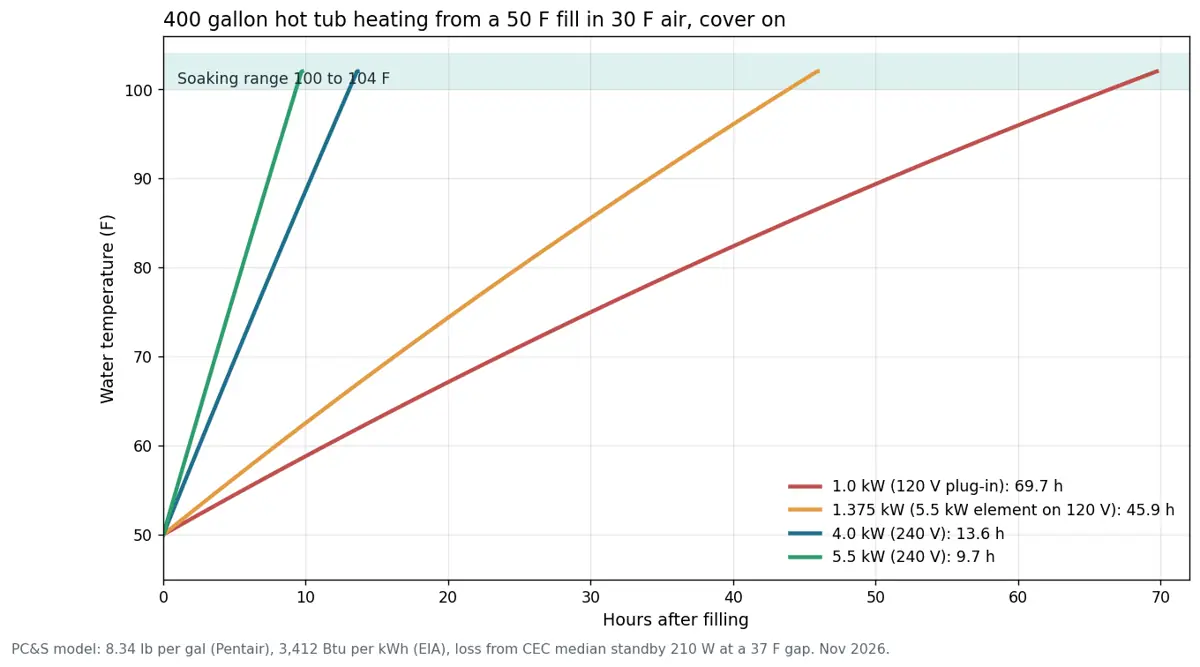
On 240 V, only about 5 percent longer, but on 120 V about 23 percent longer at 30 F air and 47 percent at 10 F, because heat loss eats a larger share of a 1.0 kW heater. A 400 gallon tub loses about 409 W at 102 F in 30 F air, using CEC certified standby scaled to the gap.
| Air temperature | 1.0 kW (120 V) | 1.375 kW (120 V) | 4.0 kW (240 V) | 5.5 kW (240 V) | Heat loss at 102 F water |
|---|---|---|---|---|---|
| 60 F | 56.4 h | 39.8 h | 13.0 h | 9.4 h | 238 W |
| 30 F | 69.7 h | 45.9 h | 13.6 h | 9.7 h | 409 W |
| 10 F | 82.9 h | 51.2 h | 14.0 h | 9.9 h | 522 W |
PC&S model: hours = (C / k) x ln[(P minus k(T0 minus Ta)) / (P minus k(T1 minus Ta))], with C = gallons x 8.34 / 3,412 kWh per F (Pentair, EIA) and k = CEC certified median standby watts / 37 F (MAEDbS listings). Cover on, jets off, air temperature as shown. Download CSV
Cold fills add more time than cold air on 240 V. Master Spas warns that in below-freezing weather, water entering the lines during a slow fill can freeze and seize the pumps, so start the pumps as soon as the water reaches the fill line. Our guide on how to drain a hot tub says to wait for air above 50 F when the schedule allows.
Buying or wiring a new hot tub?
Heat-up time is fixed when you buy the tub and wire it: a 120 V plug-in gives about 1,000 W of heat and a 240 V tub about 4,000 W, per Hot Spring’s Hot Spot manual. Our hot tub cost guide lists tub prices and Jacuzzi’s $800 to $2,000 range for 220 V electrical work.
How much does it cost to heat a hot tub from cold?
About $3.73 to $11.19 in electricity for a 200 to 600 gallon fill from 60 F to 102 F, at the August 2026 US residential average of 18.16 cents per kWh (EIA). The heat needed is fixed by the water, so a 120 V tub uses about the same kWh as a 240 V tub; it just spreads them over more hours.
| Tub size | Heat for 60 F to 102 F (kWh) | Cost at 18.16 cents per kWh | Cost at 30 cents per kWh |
|---|---|---|---|
| 200 gal | 20.5 | $3.73 | $6.16 |
| 300 gal | 30.8 | $5.59 | $9.24 |
| 400 gal | 41.1 | $7.46 | $12.32 |
| 500 gal | 51.3 | $9.32 | $15.40 |
| 600 gal | 61.6 | $11.19 | $18.48 |
PC&S arithmetic: gallons x 8.34 x 42 / 3,412. Prices: EIA Electric Power Monthly Table 5.6.A, August 2026; 30 cents is a comparison rate. Download CSV
The fill is a one-time cost; keeping the water hot is the monthly bill. EIA’s survey puts an average electric-heated tub at 1,997 kWh a year, about $30.22 a month at 18.16 cents, which our hot tub electricity cost guide breaks down by state. About 10.1 million US homes had a hot tub in 2024, and 31% of those tubs sat unused for the year, per our homes with hot tubs study of EIA survey data.
Is my hot tub heating too slowly?
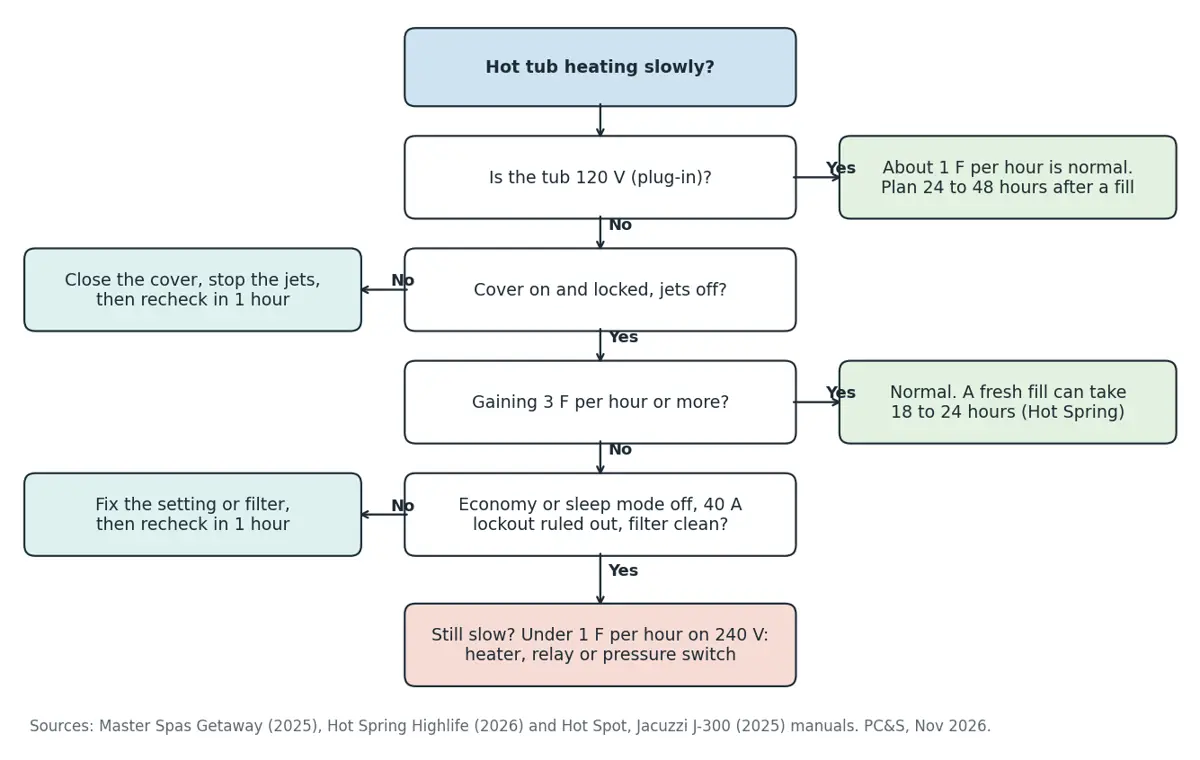
It is too slow if a 240 V tub gains under 1 F per hour with the cover on, jets off and a clean filter. Between 1 and 3 F per hour, check economy mode, breaker lockouts and the cover first. Master Spas says to wait at least 1 hour on 240 V or 3 to 4 hours on 120 V before judging.
| If your situation is | Do this | Why (source) |
|---|---|---|
| 240 V tub gains 3 F or more per hour with the cover on | Wait; it is heating normally | Master Spas: 3 to 4 F per hour |
| 120 V plug-in tub gains about 1 F per hour | Wait; plan 1 to 2 days after a fill | Master Spas: about 1 F per hour; Jacuzzi: up to 24 hours or more |
| Fresh fill still cold after 24 hours on 240 V | Check the cover, set point and economy mode, then the filter | Hot Spring and Caldera: 100 F within 18 to 24 hours |
| Jets pause the heater or heating stops while you soak | Check the breaker size: 40 A and 15 or 20 A plugs lock out heat with jets | Jacuzzi J-300; Hot Spring Hot Spot |
| Party in 4 hours, water at 80 F | Raise the set point now; a 240 V tub needs about 4 to 5 hours | Bullfrog: about 4 hours from 80 F to 100 F |
| Winter refill below 32 F air | Fill fast with 50 to 70 F water and start the pumps right away | Master Spas freeze note; Hot Spring refill range |
| Under 1 F per hour on 240 V with a clean filter | Treat it as a fault and use the not-heating checks | Model: 2.5 F per hour or more for 600 gal at 4.0 kW |
Sources: Master Spas Getaway 2025; Hot Spring Highlife 2026; Caldera Paradise 2025; Bullfrog 2018; Jacuzzi 110v vs 220v; California Energy Commission TN 222413. Download CSV
If the checks point to a fault, our hot tub not heating guide maps the error codes from 7 maker manuals. Set the final temperature with our hot tub temperature guide, which explains why 104 F is the maximum.
How we compiled this
We read heat-up statements in 6 maker documents (Master Spas, Hot Spring, Caldera, Bullfrog and two Jacuzzi sources) and the California Energy Commission’s 2018 staff report, opened in October and November 2026. The hours tables are our own arithmetic from EIA and Pentair constants plus CEC certified standby watts; we did not test any tub. Forum posts were read for question wording only.
Frequently Asked Questions
How long does it take to heat a hot tub from 80 to 100?
About 4 to 6 hours on a 240 V tub of 300 to 500 gallons with a 4.0 kW heater, and about 17 to 24 hours on a 1.0 kW 120 V heater. Bullfrog‘s manual says to raise the set point about 4 hours before use when coming up from its 80 F low setting. Keep the cover on and jets off.
Does a hot tub heat up faster with jets on?
No. On a 40 A breaker a Jacuzzi J-300 heats only with jets pumps 1 and 2 off, and a Hot Spring Hot Spot on a 15 or 20 A plug heats only with the pump on low. The 3 to 4 F per hour rate Master Spas prints assumes the cover is on.
How long does it take for a hot tub to go from 100 to 104?
About 1 hour on 240 V: 0.8 hours for 300 gallons and 1.3 hours for 500 gallons on a 4.0 kW heater. A 1.0 kW 120 V heater needs about 3.7 to 5.1 hours for 300 to 400 gallons. Setting 104 F does not make the heater work harder, per Jacuzzi’s J-300 manual.
Do hot tubs use a lot of electricity?
An average electric-heated tub used 1,997 kWh a year in EIA’s 2020 survey, about $30.22 a month at 18.16 cents per kWh. Heating a fresh 400 gallon fill from 60 F to 102 F adds about 41.1 kWh, or $7.46. State-by-state figures are in our electricity cost guide.
How long to heat a hot tub after filling?
Plan 18 to 24 hours for a 240 V tub, the window Hot Spring and Caldera give for reaching 100 F, and 24 to 48 hours or more for a 120 V plug-in. The heat math alone gives about 7.9 to 13.3 hours for 300 to 500 gallons from a 60 F fill on 240 V.
How fast does a hot tub heat?
About 3 to 4 F per hour on 240 V and about 1 F per hour on 120 V, per Master Spas. Jacuzzi gives 2 to 5 degrees per hour on 220/240 V. A 5.5 kW heater can add about 5.4 F per hour to 400 gallons; a 1.0 kW heater about 0.8 F.
Sources
- Master Spas. 2025 Getaway Spas Owner's Manual. Accessed 2026-11-08.
- Hot Spring Spas (Watkins Wellness). Highlife Collection Owner's Manual, 2026. Accessed 2026-11-08.
- Hot Spring Spas. Hot Spot owner's manual (Relay, Rhythm, Pace, Stride). Accessed 2026-10-27.
- Caldera Spas (Watkins Wellness). Paradise Series Owner's Manual, 2025. Accessed 2026-11-08.
- Bullfrog Spas. Owner's Manual, 2018 (rev 3.1.8). Accessed 2026-11-08.
- Jacuzzi Hot Tubs. J-300 Collection Owner's Manual, Rev E (2025). Accessed 2026-11-08.
- Jacuzzi. 110v vs 220v hot tub comparison. Accessed 2026-11-09.
- California Energy Commission. Final Staff Report: Analysis of Efficiency Standards and Marking for Spas, TN 222413 (Feb 2, 2018). Accessed 2026-11-09.
- California Energy Commission via NW Regional Technical Forum. MAEDbS portable electric spa listings (standby watts by size). Accessed 2026-10-27.
- U.S. Energy Information Administration. Energy Explained: British thermal units. Accessed 2026-11-01.
- U.S. Energy Information Administration. Electric Power Monthly, Table 5.6.A (August 2026 data). Accessed 2026-10-27.
- Pentair. Pool Product Catalog 2025-2026, Engineering Data. Accessed 2026-10-26.
- Spa Depot (retailer). VersaTherm Universal Spa Heater Assembly BX5950AT. Accessed 2026-11-09.
- Pool Construction & Service. Hot Tub Electricity Cost (CEC and EIA data). Accessed 2026-11-09.
Related pages
Get Quotes From Licensed Local Pool Pros
Tell us what you need and your ZIP code. We match you with pool companies that cover your area.