Hot Tub Electricity Cost: Standby Watts for 1,133 Spas and the Bill in Every State
Hot tub electricity cost averages about $30 a month: EIA's average electric-heated tub used 1,997 kWh a year, $363 at August 2026 prices, and the median certified spa draws 187 W on standby.
- ✓1,133 certified spas comparedCalifornia's appliance database lists tested standby watts by model; the median standard spa draws 187 W, $24.79 a month.
- ✓Every state, August 2026 pricesThe average used electric tub costs $223 a year in Louisiana and $980 in Hawaii at EIA's latest state prices.
- ✓120 V vs 240 V, winter and coversHeater watts from Hot Spring's manual, Title 20 test math for cold air and DOE's insulation steps.
Key takeaways
- An electric-heated US hot tub used an average of 1,997 kWh a year, which is $363 a year or $30.22 a month at the August 2026 residential price of 18.16 cents per kWh (EIA RECS 2020 via PC&S; EIA Table 5.6.A).
- Across 1,133 standard portable spas certified in California from June 2019 to June 2023, median standby power is 187 W (136.5 kWh a month) and the middle 80% run 133 to 241 W (CEC MAEDbS listings).
- Standby is typically 75% of a portable spa’s lifetime energy, and heater cycles in 27 tested spas drew 706 to 4,331 W, median 3,141 W (CEC Final Staff Report, 2018).
- On a 115 V, 15 or 20 A plug, Hot Spring’s Hot Spot spas heat at about 1,000 W and only with the pump on low; on 230 V, 50 A they heat at about 4,000 W (Hot Spring owner's manual).
- Certified watts assume a 37 F gap between 102 F water and the air, so at 35 F outdoors standby heat loss runs 1.81 times the label (Title 20 test method; PC&S arithmetic).
How much does a hot tub cost to run per month?
About $30 a month for an average tub, and $18.54 to $81.70 depending on the state. EIA’s 2020 household survey put an electric-heated hot tub at 1,997 kWh a year, which is $30.22 a month at the August 2026 US average of 18.16 cents per kWh. Standby alone for a median certified spa is $24.79 a month at the same price.
| Number | Value | Source and date |
|---|---|---|
| Average yearly use, electric-heated US hot tub | 1,997 kWh | EIA RECS 2020, via PC&S homes with hot tubs study |
| Same tub at the August 2026 US residential price | $363 a year, $30.22 a month | EIA Electric Power Monthly Table 5.6.A (Aug 2026, 18.16 cents); PC&S calculation |
| Median certified standby, 1,133 standard spas | 187 W, 136.5 kWh a month, $24.79 | CEC MAEDbS listings added June 2019 to June 2023 |
| Middle 80% of standard spas, standby | 133 to 241 W | CEC MAEDbS listings |
| Median certified standby, 136 inflatable spas | 224 W at a median 213 gal | CEC MAEDbS listings |
| Heater cycle demand, 27 tested spas | 706 to 4,331 W, median 3,141 W | Hamill (2012), cited in CEC Final Staff Report (Feb 2018) |
| Share of lifetime energy used in standby | Typically 75% | CEC Final Staff Report (Feb 2018), citing Davis Energy Group (2004) |
| State range, average used electric tub | $223 (Louisiana) to $980 (Hawaii) a year | EIA RECS 2020 division use x EIA Aug 2026 state price; PC&S calculation |
Sources: PC&S homes with hot tubs study (EIA RECS 2020); EIA Electric Power Monthly Table 5.6.A (August 2026, released Oct 23, 2026); CEC MAEDbS listings; CEC Final Staff Report (Feb 2, 2018). Download CSV
EIA splits the average into parts: hot tub heaters used 1,479 kWh and hot tub pumps 484 kWh per household that used them in 2020 (EIA RECS 2020 Table CE5.3b). That is why the heater, not the jets, sets most of the bill. A tub run all 12 months averaged 3,004 kWh, about $546 a year at 18.16 cents, as our homes with hot tubs study tabulates. A 240 V tub should gain about 3 to 4 F an hour with the cover on; if yours is slower, our hot tub not heating guide walks through flow, mode and breaker checks. How many hours a fresh fill takes to reach 102 F on each heater size is worked out in our guide on how long it takes to heat a hot tub.
To price your own tub, multiply its watts by 730 hours and divide by 1,000 to get kWh a month, then multiply by your rate. A tub certified at 187 W uses 136.5 kWh a month: $24.79 at 18.16 cents, $40.61 at California’s 29.75 cents and $17.36 at Nevada’s 12.72 cents. Your bill lists your actual rate, which can differ from EIA’s state average.
How many watts does a hot tub use? Certified data for 1,133 spas
A median standard portable spa draws 187 W on standby, rising from 148 W for tubs up to 250 gallons to 270 W for 551 to 900 gallons. These are California Energy Commission certifications measured with the cover on and 102 F water. The middle 80% of 351 to 450 gallon spas span 162 to 240 W, so two tubs of one size can differ by $10 a month.
| Spa size (rated volume) | Models listed | Median volume (gal) | Median standby (W) | Middle 80% of models (W) | Lowest to highest (W) | Median standby kWh per month | Median standby cost per month at 18.16 cents | Median as share of Title 20 cap |
|---|---|---|---|---|---|---|---|---|
| Up to 250 gal | 211 | 210 | 148 | 118 to 173 | 67 to 196 | 108.0 | $19.62 | 89% |
| 251 to 350 gal | 457 | 310 | 180 | 133 to 215 | 40 to 241 | 131.4 | $23.86 | 85% |
| 351 to 450 gal | 352 | 405 | 210 | 162 to 240 | 107 to 268 | 153.7 | $27.91 | 84% |
| 451 to 550 gal | 67 | 484 | 244 | 205 to 270 | 163 to 287 | 178.1 | $32.35 | 90% |
| 551 to 900 gal | 14 | 612 | 270 | 192 to 313 | 168 to 350 | 197.1 | $35.79 | 87% |
| All standard spas | 1133 | 335 | 187 | 133 to 241 | 40 to 602 | 136.5 | $24.79 | 86% |
Sources: California Energy Commission MAEDbS listings added June 5, 2019 to June 22, 2023 (extract published by the Northwest Regional Technical Forum, workbook v1.1, Dec 2023); cap from Title 20 Section 1605.3; price from EIA; PC&S calculation at 730 hours a month. Size bands cover 1,101 spas up to 900 gal; 32 swim-spa-sized units filed as standard spas are in the all-spa row only. Download CSV
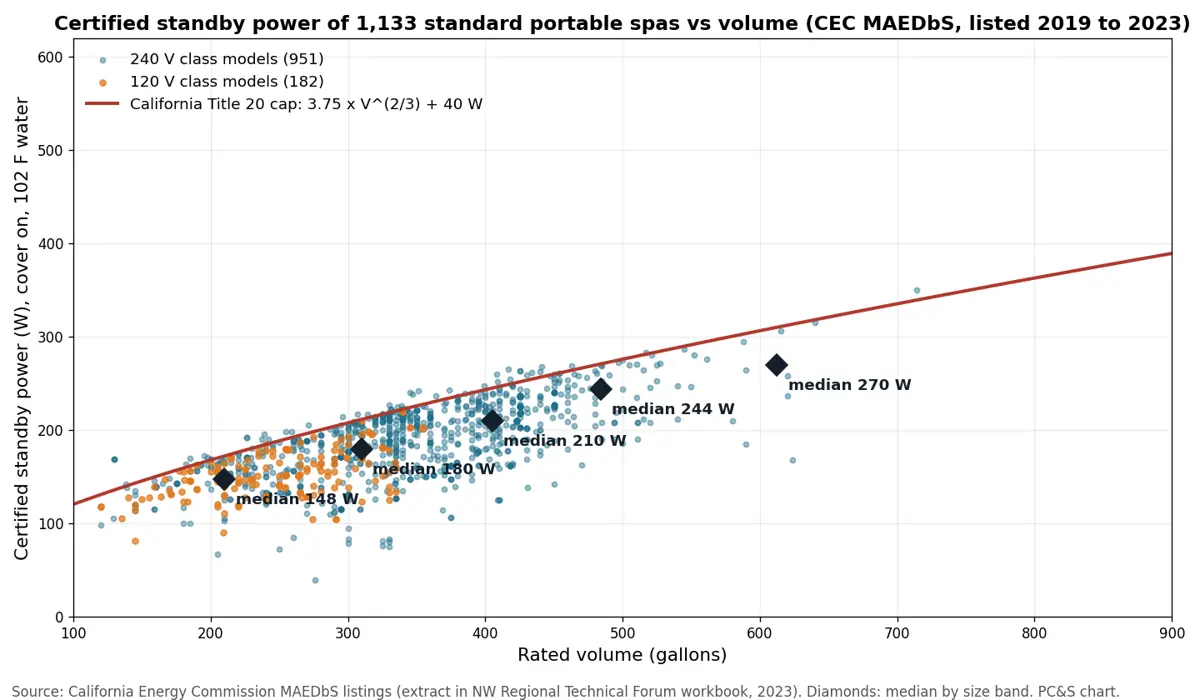
Standby is measured with the cover on, 102 F water and normalized to a 37 F water-to-air gap; use adds to it.
Source: California Energy Commission MAEDbS listings (NW Regional Technical Forum extract, 2023); PC&S calculation. Download chart data (CSV)
The test behind these numbers is set by California’s Title 20: water held at 102 F, the tub’s standard cover on, and the measured watts normalized to a 37 F gap between water and air (Title 20 Section 1604(g), CEC express terms). Every one of the 1,047 listings with a stated cap tested at or under it, and the median spa sits at 86% of its cap. A label figure is therefore a covered, idle tub in mild air, not a winter month with daily soaks. Ask for that label figure when you shop; dated rebates and model-year changeovers are in our best time to buy a hot tub calendar.
| Spa type | Models listed | Median volume (gal) | Median standby (W) | Middle 80% of models (W) | Median standby kWh per month | Median standby cost per month at 18.16 cents |
|---|---|---|---|---|---|---|
| Standard spa (hard shell) | 1133 | 335 | 187 | 133 to 241 | 136.5 | $24.79 |
| Inflatable spa | 136 | 213 | 224 | 198 to 268 | 163.5 | $29.70 |
| Exercise (swim) spa | 141 | 1660 | 432 | 263 to 541 | 315.4 | $57.27 |
Sources: CEC MAEDbS listings (2019 to 2023); EIA August 2026 price; PC&S calculation. Download CSV
Inflatable tubs are small but not frugal: the median of 136 certified inflatable models draws 224 W at 213 gallons, against 148 W for hard tubs up to 250 gallons. Exercise spas draw a median 432 W, which is why our swim spa cost guide treats standby as its own budget line. There is no federal efficiency standard for spas: DOE proposed on April 18, 2025 to withdraw its 2022 coverage determination (Federal Register).
Hot tub electricity cost by state at August 2026 prices
The average used electric hot tub costs $18.54 a month in Louisiana and $81.70 in Hawaii at August 2026 prices. The table pairs each state’s EIA residential price with the yearly kWh EIA measured for hot tubs in that state’s census division, plus a standby-only line for the median certified spa. Michigan ranks high on use, not price.
Michigan ranks high on use, not price: its East North Central division averaged 2,540 kWh a year per tub.
Source: EIA Residential Energy Consumption Survey 2020 (via PC&S homes with hot tubs study) and EIA Electric Power Monthly Table 5.6.A, August 2026; PC&S calculation. Download chart data (CSV)
| State | Residential price, Aug 2026 (cents/kWh) | Median certified spa, standby only ($/month) | EIA RECS division | Average used electric hot tub in division (kWh/year, 2020) | Average used electric hot tub ($/month) | Average used electric hot tub ($/year) |
|---|---|---|---|---|---|---|
| Hawaii | 47.18 | $64.41 | Pacific | 2,078 | $81.70 | $980 |
| Maine | 32.11 | $43.83 | New England | 1,660 | $44.42 | $533 |
| Massachusetts | 30.48 | $41.61 | New England | 1,660 | $42.16 | $506 |
| California | 29.75 | $40.61 | Pacific | 2,078 | $51.52 | $618 |
| Alaska | 29.41 | $40.15 | Pacific | 2,078 | $50.93 | $611 |
| New York | 28.65 | $39.11 | Middle Atlantic | 1,895 | $45.24 | $543 |
| Rhode Island | 28.18 | $38.47 | New England | 1,660 | $38.98 | $468 |
| New Hampshire | 27.64 | $37.73 | New England | 1,660 | $38.24 | $459 |
| District of Columbia | 25.98 | $35.47 | South Atlantic | 1,767 | $38.26 | $459 |
| New Jersey | 24.61 | $33.60 | Middle Atlantic | 1,895 | $38.86 | $466 |
| Connecticut | 24.51 | $33.46 | New England | 1,660 | $33.91 | $407 |
| Vermont | 23.84 | $32.54 | New England | 1,660 | $32.98 | $396 |
| Michigan | 22.99 | $31.38 | East North Central | 2,540 | $48.66 | $584 |
| Pennsylvania | 21.77 | $29.72 | Middle Atlantic | 1,895 | $34.38 | $413 |
| Maryland | 21.40 | $29.21 | South Atlantic | 1,767 | $31.51 | $378 |
| Wisconsin | 19.41 | $26.50 | East North Central | 2,540 | $41.08 | $493 |
| Ohio | 19.38 | $26.46 | East North Central | 2,540 | $41.02 | $492 |
| Illinois | 19.32 | $26.37 | East North Central | 2,540 | $40.89 | $491 |
| Delaware | 18.70 | $25.53 | South Atlantic | 1,767 | $27.54 | $330 |
| Virginia | 17.64 | $24.08 | South Atlantic | 1,767 | $25.97 | $312 |
| Minnesota | 17.20 | $23.48 | West North Central | 2,082 | $29.84 | $358 |
| Colorado | 17.17 | $23.44 | Mountain North | 2,177 | $31.15 | $374 |
| Iowa | 17.06 | $23.29 | West North Central | 2,082 | $29.60 | $355 |
| Indiana | 17.02 | $23.23 | East North Central | 2,540 | $36.03 | $432 |
| New Mexico | 16.51 | $22.54 | Mountain South | 1,896 | $26.09 | $313 |
| Alabama | 16.33 | $22.29 | East South Central | 1,759 | $23.94 | $287 |
| West Virginia | 16.31 | $22.26 | South Atlantic | 1,767 | $24.02 | $288 |
| Missouri | 16.02 | $21.87 | West North Central | 2,082 | $27.79 | $334 |
| Oregon | 15.92 | $21.73 | Pacific | 2,078 | $27.57 | $331 |
| Texas | 15.91 | $21.72 | West South Central | 1,729 | $22.92 | $275 |
| Georgia | 15.90 | $21.71 | South Atlantic | 1,767 | $23.41 | $281 |
| South Carolina | 15.76 | $21.51 | South Atlantic | 1,767 | $23.21 | $278 |
| Montana | 15.57 | $21.25 | Mountain North | 2,177 | $28.25 | $339 |
| Kansas | 15.47 | $21.12 | West North Central | 2,082 | $26.84 | $322 |
| South Dakota | 15.15 | $20.68 | West North Central | 2,082 | $26.29 | $315 |
| Arizona | 15.05 | $20.54 | Mountain South | 1,896 | $23.78 | $285 |
| Florida | 14.99 | $20.46 | South Atlantic | 1,767 | $22.07 | $265 |
| North Carolina | 14.95 | $20.41 | South Atlantic | 1,767 | $22.01 | $264 |
| Oklahoma | 14.82 | $20.23 | West South Central | 1,729 | $21.35 | $256 |
| Washington | 14.63 | $19.97 | Pacific | 2,078 | $25.33 | $304 |
| Mississippi | 14.43 | $19.70 | East South Central | 1,759 | $21.15 | $254 |
| Wyoming | 14.43 | $19.70 | Mountain North | 2,177 | $26.18 | $314 |
| Arkansas | 14.37 | $19.62 | West South Central | 1,729 | $20.70 | $248 |
| Kentucky | 13.80 | $18.84 | East South Central | 1,759 | $20.23 | $243 |
| Nebraska | 13.54 | $18.48 | West North Central | 2,082 | $23.49 | $282 |
| Tennessee | 13.42 | $18.32 | East South Central | 1,759 | $19.67 | $236 |
| Idaho | 13.37 | $18.25 | Mountain North | 2,177 | $24.26 | $291 |
| North Dakota | 13.31 | $18.17 | West North Central | 2,082 | $23.09 | $277 |
| Utah | 13.31 | $18.17 | Mountain North | 2,177 | $24.15 | $290 |
| Louisiana | 12.87 | $17.57 | West South Central | 1,729 | $18.54 | $223 |
| Nevada | 12.72 | $17.36 | Mountain South | 1,896 | $20.10 | $241 |
| United States | 18.16 | $24.79 | National | 1,997 | $30.22 | $363 |
Sources: EIA Electric Power Monthly Table 5.6.A (August 2026, preliminary); EIA RECS 2020 hot tub kWh by division via PC&S homes with hot tubs study; CEC MAEDbS median of 187 W; PC&S calculation. Download CSV
Two forces set the state figures. Price spans 12.72 cents per kWh in Nevada to 47.18 cents in Hawaii in August 2026 (EIA). Use spans 1,660 kWh a year in New England to 2,540 kWh in the East North Central division, so Michigan, at 22.99 cents, lands at $584 a year. EIA’s division figures are 2020 survey averages applied to every state in the division, and August prices run higher than the year-to-date average in some states, so treat each row as an estimate.
Our hot tub cost guide uses the January to July 2026 average price, 18.19 cents, which is why its US figure and this one both round to $363 a year while a few state rows differ. Purchase, delivery and wiring prices are covered there.
How much does it cost to run a hot tub for 1 hour or 24 hours?
A heater cycle costs about $0.57 an hour at 18.16 cents per kWh, based on the 3,141 W median heater-cycle demand of 27 tested spas. A full 24 hours of standby for a median certified spa costs $0.82. The 27 spas ran their heater cycle for an average of 113 minutes a day, about $1.07 a day.
| What is running | Power (W) | Source of the wattage | Cost per hour at 18.16 cents | Cost per day at 18.16 cents |
|---|---|---|---|---|
| Heater cycle, median of 27 tested spas | 3,141 | Hamill 2012 via CEC staff report (2018) | $0.57 | $1.07 (113 minutes a day, the tested average) |
| Hot Spring Hot Spot heater on a 230 V, 50 A circuit | 4,000 | Hot Spring Hot Spot owner's manual | $0.73 | Cycles with the thermostat |
| Same heater on a 115 V, 15 or 20 A plug | 1,000 | Hot Spring Hot Spot owner's manual | $0.18 | Cycles with the thermostat; heats only with the pump on low |
| Standby, median certified standard spa (cover on, 102 F water) | 187 | CEC MAEDbS listings, 1,133 standard spas | $0.034 | $0.82 (24 hours) |
| Standby, median certified inflatable spa | 224 | CEC MAEDbS listings, 136 inflatable spas | $0.041 | $0.98 (24 hours) |
Sources: CEC Final Staff Report (Hamill 2012 tests of 27 spas); Hot Spring Hot Spot owner's manual; CEC MAEDbS; EIA; PC&S calculation. Download CSV
Jets add pump power on top of heat. The CEC staff report puts pumping at 25% to 50% of a spa’s energy, depending on how often the jets and other features run (CEC Final Staff Report, 2018). A soak after a long idle spell also costs a heat-up: the same report cites 5 to more than 24 hours for a standard spa to reach 102 F from a fresh fill. For the drain-and-refill schedule that triggers those heat-ups, see our guide on how to drain a hot tub.
Do 120 V plug-and-play hot tubs use less electricity than 240 V tubs?
Not by design. Among certified spas from 251 to 350 gallons, 120 V models median 165 W of standby and 240 V models 187 W, a gap of about $2.92 a month. The bigger difference is heat: Hot Spring’s manual lists about 1,000 W on a 115 V plug and 4,000 W on 230 V, so a plug-in tub recovers slower in cold air. What each voltage needs in breaker, wire and GFCI protection is set out in our hot tub wiring guide.
| Rated voltage | Models listed | Median volume (gal) | Median standby (W) | Median standby per 100 gal (W) | Median standby kWh per month |
|---|---|---|---|---|---|
| 120 V class (115 to 120 V) | 182 | 255 | 155 | 61.6 | 113.2 |
| 240 V class (220 to 240 V) | 951 | 350 | 196 | 55.5 | 143.1 |
Source: CEC MAEDbS listings (2019 to 2023), 1,133 standard spas; PC&S calculation. Download CSV
| Supply | Heater output | What else changes | Median certified standby (MAEDbS) | Source |
|---|---|---|---|---|
| 115 V, 15 or 20 A plug (Hot Spring TX, Pace, Stride, SX) | About 1,000 W, only while the pump runs on low | Heater pauses when the jets run on high | 155 W at a median 255 gal (182 models) | Hot Spring Hot Spot owner's manual; CEC MAEDbS |
| 115 V, 30 A hard-wired (same models converted) | About 1,000 W on low or high speed | Heater keeps running with the jets on | Not split out in MAEDbS | Hot Spring Hot Spot owner's manual |
| 230 V, 50 A with GFCI subpanel | About 4,000 W on low or high speed | Subpanel at least 5 ft from the spa and within sight | 196 W at a median 350 gal (951 models) | Hot Spring Hot Spot owner's manual; CEC MAEDbS |
| Same 240 V element run on 120 V | 5.5 kW becomes 1.375 kW; 4.0 kW becomes 1.0 kW | Power falls to a quarter at half the voltage (resistive element) | n/a | SpaDepot VersaTherm heater listing BX5950AT |
| Same-size comparison, 251 to 350 gal | n/a | n/a | 120 V class 165 W (92 models) vs 240 V class 187 W (365 models) | CEC MAEDbS |
Sources: Hot Spring Hot Spot owner's manual (Relay, Rhythm, Pace, Stride, SX, TX), printed page 29; SpaDepot VersaTherm BX5950AT listing; CEC MAEDbS. Download CSV
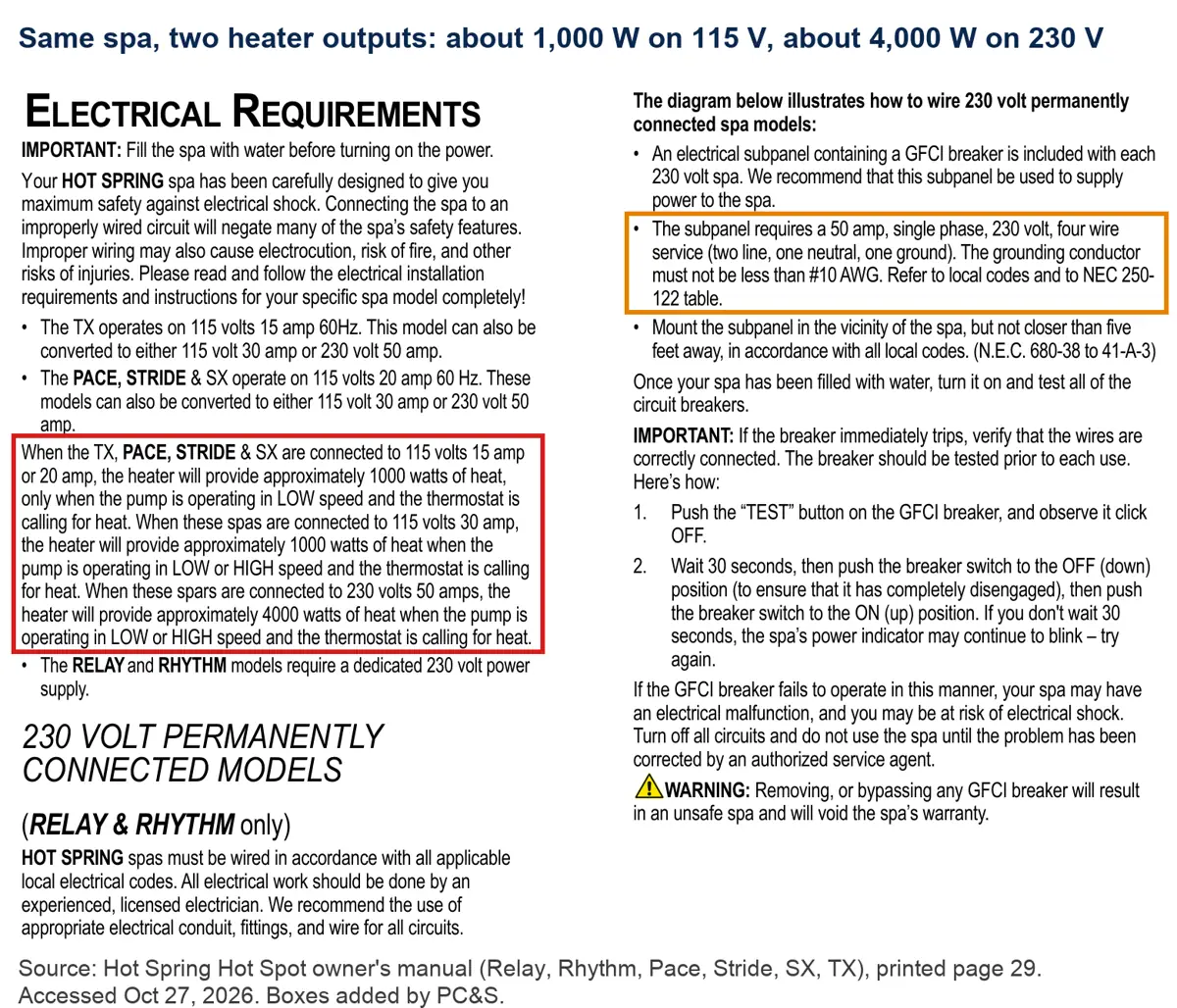
A resistive heater element loses three quarters of its output at half the voltage, which is why one heater listing rates the same element at 5.5 kW on 240 V and 1.375 kW on 120 V (SpaDepot). Wattage per hour matters less than total heat lost, so a 120 V tub’s bill is not lower if it is the same size and insulation; it simply heats slower. Wiring a 240 V circuit is part of the install budget in our hot tub cost guide, and the same subpanel logic applies to pool heat pumps in our pool heater installation cost guide. If a rising bill points to failing foam or an old cover, our hot tub lifespan guide works out when a replacement pays.
How much more does a hot tub cost to run in winter?
Standby heat loss grows with the gap between 102 F water and the air. Certified watts assume a 37 F gap, so a median 251 to 350 gallon tub certified at 180 W draws about 326 W at 35 F air and 472 W at 5 F. At 18.16 cents per kWh that is $43.21 and $62.56 a month for standby alone.
Pumps and controls do not scale with temperature, so these figures lean high; 2004 lab tests of 8 spas found 2.73 times the warm-room demand near 10 F.
Source: CEC MAEDbS median (457 models); Title 20 Section 1604(g) normalization; PC&S calculation. Download chart data (CSV)
| Outdoor air temperature (F) | Water-to-air gap (F) | Heat-loss multiple vs rating (gap / 37) | Standby draw, median 251 to 350 gal spa (W) | Standby kWh per month | Standby cost per month at 18.16 cents |
|---|---|---|---|---|---|
| 65 | 37 | 1.00 | 180 | 131.4 | $23.86 |
| 55 | 47 | 1.27 | 229 | 166.9 | $30.31 |
| 45 | 57 | 1.54 | 277 | 202.4 | $36.76 |
| 35 | 67 | 1.81 | 326 | 237.9 | $43.21 |
| 25 | 77 | 2.08 | 375 | 273.5 | $49.66 |
| 15 | 87 | 2.35 | 423 | 309.0 | $56.11 |
| 5 | 97 | 2.62 | 472 | 344.5 | $62.56 |
Sources: Title 20 Section 1604(g) normalization (Pnorm = Pmeas x 37 / gap); CEC MAEDbS median of 180 W for 457 spas; EIA; PC&S calculation. Download CSV
The scaling is a reasonable upper bound, because pumps and controls do not rise with the cold. Lab data point the same way: in 2004 tests of 8 spas that the Northwest Regional Technical Forum uses, demand near 10 F air averaged 2.73 times demand in a room near 68.5 F. DOE chose 56 F as a nationally representative air temperature for its own spa test, and it said the 63 F industry test reads standby about 15% to 23% lower than a 56 F test would (DOE test procedure, 2023).
Seasonal use cuts the other way. In EIA’s 2024 survey, 31.0% of homes with a hot tub did not use it in the past year and 30.0% used it all 12 months, as our homes with hot tubs study shows. A tub drained for the winter costs nothing to run; a tub kept hot in a 35 F month costs about 1.81 times its label.
Does a better cover or a lower set point cut the bill?
Both help, but insulation helps more than cover thickness. In DOE’s design analysis for a 334 gallon spa, wall and floor foam took standby from 500 W to 249 W, while each extra inch of cover saved 6 to 11 W. Dropping the set point 3 to 5 F trims 8% to 14% of standby heat loss in 65 F air.
| DOE design step (cumulative) | Standby for a 334 gal spa (W) | Change from previous step (W) | kWh per month | Cost per month at 18.16 cents |
|---|---|---|---|---|
| Baseline: R-10 walls and floor, R-14 cover, two-speed pump | 500 | 365.0 | $66.28 | |
| Add R-6 to the walls and R-3.5 to the floor | 299 | -201 | 218.3 | $39.64 |
| Add another R-6 to the walls | 249 | -50 | 181.8 | $33.01 |
| Add an inch of cover (about R-4) | 238 | -11 | 173.7 | $31.55 |
| Switch to separate jet and circulation pumps | 213 | -25 | 155.5 | $28.24 |
| Add another inch of cover (about R-4) | 207 | -6 | 151.1 | $27.44 |
| Replace 2 in of 0.5 lb foam with 2 lb foam | 167 | -40 | 121.9 | $22.14 |
| Add a radiant barrier around the cabinet | 152 | -15 | 111.0 | $20.15 |
| Raise cover foam density from 1 lb to 2 lb | 147 | -5 | 107.3 | $19.49 |
Sources: DOE notice of data availability, 87 FR 69082 (Nov 17, 2022), Tables III.5 and III.7, watts under DOE’s proposed test procedure; EIA; PC&S calculation. Download CSV
DOE built that ladder from a baseline spa with R-10 walls and floor and an R-14 cover, adding the cheapest watt saving first (DOE, 2022). The two cover steps are small because the cover is already the best-insulated surface; the cabinet foam and a dedicated circulation pump in place of a two-speed pump do more. Title 20 requires the tested cover model on the label, so ask which cover a quoted rating used.
| Claim in a top-ranking guide | What the primary source or arithmetic shows | Sources |
|---|---|---|
| Direct Energy: the heater draws around 1,500 W on 120 V or 6,000 W on 240 V, and the pump about 1,500 W | Tests of 27 spas found heater-cycle demand of 706 to 4,331 W, median 3,141 W; Hot Spring lists about 1,000 W on 115 V and 4,000 W on 230 V | Direct Energy; CEC Final Staff Report (Hamill 2012); Hot Spring manual |
| Direct Energy: lowering the thermostat 3 to 5 F cuts heating costs 10% to 20% | Heat loss scales with the water-to-air gap. With 102 F water, 3 to 5 F off removes 8% to 14% of standby heat loss at 65 F air and 4.5% to 7.5% at 35 F air | Direct Energy; Title 20 test method (37 F gap); PC&S arithmetic |
| Jacuzzi: 75% of energy is used while the tub is covered and idle | Consistent: CEC staff report says standby is typically 75% of a spa's lifetime energy | Jacuzzi; CEC Final Staff Report (Davis Energy Group 2004) |
| Jacuzzi: CEC ratings put major brands at $10 to $21 a month | At 18.16 cents per kWh, the middle 80% of 1,133 certified standard spas (133 to 241 W) costs $17.63 to $31.95 a month in standby; the dollar figure depends on the price used | Jacuzzi; CEC MAEDbS; EIA Aug 2026 |
| Mirsky Electric: hot tubs add $15 to $35 a month | The EIA average used electric tub costs $30.22 a month at the Aug 2026 US price; state averages run $18.54 (Louisiana) to $81.70 (Hawaii) | Mirsky Electric; EIA RECS 2020; EIA EPM Aug 2026 |
| Grand Traverse Leisure: a 240 V tub uses 90 to 600 kWh a month | Certified standby medians run 108 to 197 kWh a month by size; the EIA average used tub is 166 kWh a month | Grand Traverse Leisure; CEC MAEDbS; EIA RECS 2020 |
Sources: Direct Energy; Jacuzzi and Jacuzzi electricity guide; Mirsky Electric; Grand Traverse Leisure; CEC Final Staff Report; Title 20 test method; CEC MAEDbS; EIA; PC&S arithmetic. Download CSV
Jacuzzi advises lowering the temperature or using an economy mode when the tub is not in use, and says keeping it running at a lower setting can beat reheating from cold for frequent users (Jacuzzi). Both fit the physics: heat loss tracks the water-to-air gap, so a lower set point saves every hour it holds. Water care for a tub kept running is in our hot tub maintenance schedule. What each set point costs per month, and the safe range to pick from, is laid out in our guide to hot tub temperature.
Which hot tub choices lower your electric bill?
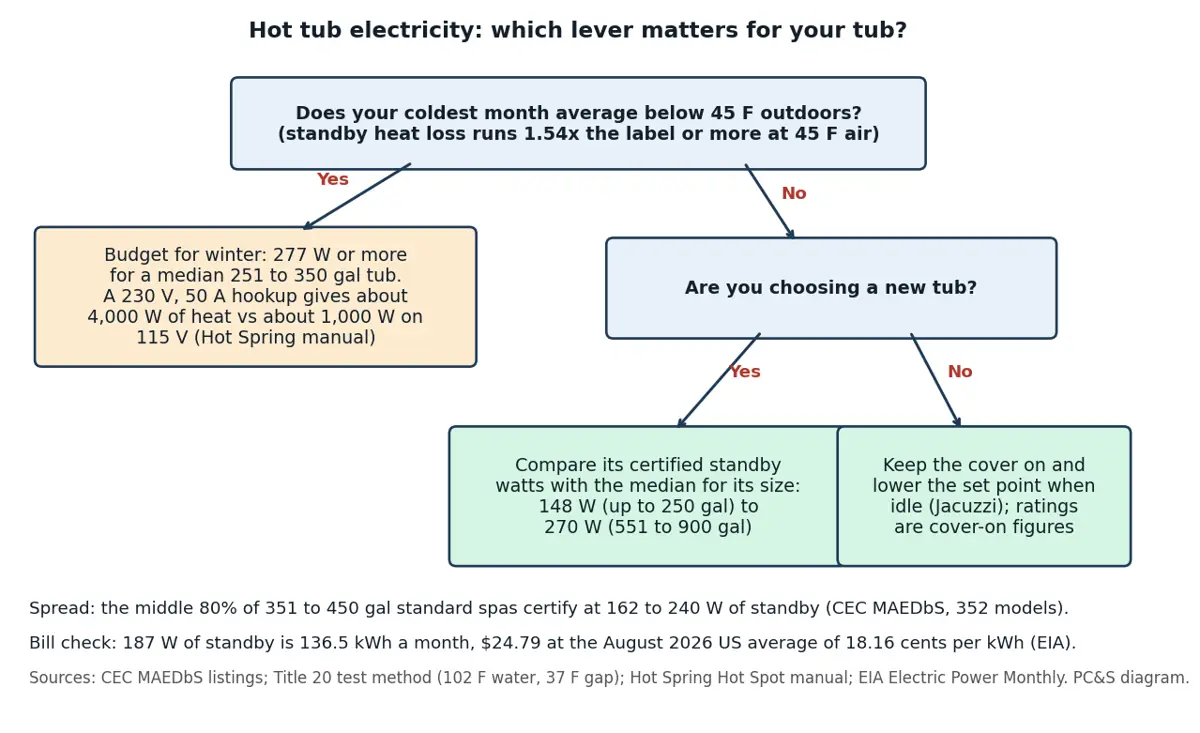
Buy on certified standby watts, wire for the climate and keep the cover on. Every 10 W of certified standby is 7.3 kWh and $1.33 a month at 18.16 cents per kWh. In a 45 F winter, a tub draws 1.54 times its label, so cold-climate owners gain the most from a low-watt model and a 240 V heater.
| If your situation is | Do this | Why (source) |
|---|---|---|
| Your coldest month averages 45 F or colder | Plan on 230 V, 50 A wiring rather than a 115 V plug, and budget for a winter bill well above the label | Standby heat loss is 1.54x the rating at 45 F air (Title 20 gap math); about 4,000 W vs 1,000 W of heat (Hot Spring manual) |
| You are choosing between two tubs of the same size | Pick the lower certified standby watts on the Title 20 label or in MAEDbS | Every 10 W of standby is 7.3 kWh and $1.33 a month at 18.16 cents (EIA Aug 2026) |
| A tub you like certifies above the median for its size | Ask the dealer for the MAEDbS listing and the tested cover model | Medians run 148 W (up to 250 gal) to 270 W (551 to 900 gal); the label lists the cover tested (CEC MAEDbS; Title 20) |
| You want a plug-and-play tub to skip an electrician | Expect slower heat-up and a heater that pauses on high-speed jets | Hot Spring manual: about 1,000 W, heating only with the pump on low at 115 V, 15 or 20 A |
| Your power costs 25 cents per kWh or more | Price the tub on your own rate: 187 W of standby is $0.034 an hour per 18.16 cents, so scale up | Eight states and DC were at 25.98 cents or more in Aug 2026 (EIA Table 5.6.A) |
| The tub sits idle most weeks | Lower the set point or use economy mode, keep the cover on | Jacuzzi and Direct Energy guidance; Title 20 ratings are measured with the cover on |
| You are comparing an inflatable tub on running cost | Compare watts, not price: the median inflatable certifies at 224 W for 213 gal | CEC MAEDbS: 136 inflatable models vs a 148 W median for hard tubs up to 250 gal |
Sources: CEC MAEDbS; Title 20 test method; Hot Spring manual; EIA Table 5.6.A; Jacuzzi; Direct Energy. Download CSV
If you are pricing a built-in spa with a pool instead, it shares the pool’s heater and pump, which changes the math; our spa construction page covers that build, and our cost to heat a pool study prices gas and heat pump heat by state.
How we compiled this
We analyzed 1,442 California Energy Commission MAEDbS listings for portable electric spas (1,133 standard, 136 inflatable, 141 exercise and 32 combination), added June 2019 to June 2023, from the extract the Northwest Regional Technical Forum published with its 2023 spa measure; the CEC’s own search tool did not load for our scripts, so we could not pull a 2026 export. Prices come from EIA’s August 2026 Electric Power Monthly and use from EIA’s 2020 household survey. We also opened the Title 20 test rules, the CEC 2018 staff report, two DOE spa rulemakings and Hot Spring’s manual. We did not test any tub; every figure is a listing, a published test or our arithmetic.
Frequently Asked Questions
How much does your electricity bill go up with a hot tub?
About $30 a month on average. EIA’s 2020 survey put an electric-heated hot tub at 1,997 kWh a year, which is $363 a year at the August 2026 US price of 18.16 cents per kWh. By state the average used tub runs from $223 a year in Louisiana to $980 in Hawaii, and a tub kept hot all 12 months averaged 3,004 kWh.
Does a hot tub use a lot of electricity?
It uses about as much as a small appliance running all day. The median of 1,133 certified standard spas draws 187 W on standby, or 136.5 kWh a month, with the middle 80% at 133 to 241 W (California Energy Commission listings, 2019 to 2023). EIA’s average used tub, 1,997 kWh a year, is about 166 kWh a month including heat-ups and jets.
How much does it cost to run a hot tub for 1 hour?
About $0.57 while the heater runs, using the 3,141 W median heater-cycle demand from tests of 27 spas and the August 2026 US price of 18.16 cents per kWh. A Hot Spring tub on 230 V heats at about 4,000 W, $0.73 an hour; on a 115 V plug it heats at about 1,000 W, $0.18 an hour. Idle standby costs about $0.034 an hour.
How much does it cost to run a hot tub for 24 hours?
About $0.82 for 24 hours of standby for a median certified spa drawing 187 W, at 18.16 cents per kWh. In tests of 27 spas the heater cycle ran an average of 113 minutes a day, about $1.07 at 3,141 W. Cold air raises the figure: at 35 F outdoors, standby heat loss runs 1.81 times the certified rating.
Is it cheaper to keep a hot tub on all the time?
For frequent use, keeping it running at a lowered set point is the usual advice: Jacuzzi says that can beat reheating from cold, and recommends economy mode when the tub is idle. Heat loss tracks the gap between water and air, so every degree lower saves about 2.7% of standby heat loss in 65 F air. A tub drained for a whole season uses nothing.
How much does it cost to run a 220V hot tub?
Standby is about the same as a 120 V tub of the same size: certified 240 V class spas median 196 W at 350 gallons, $25.98 a month at 18.16 cents per kWh. The 240 V supply buys faster heat, about 4,000 W against 1,000 W in Hot Spring’s manual, which matters most in cold months when heat loss is highest.
Sources
- California Energy Commission, via Northwest Regional Technical Forum. Modernized Appliance Efficiency Database System (MAEDbS), portable electric spa listings, extract of listings added 2019-06-05 to 2023-06-22. Accessed 2026-10-27.
- Regional Technical Forum, Northwest Power and Conservation Council. Efficient Portable Electric Spas measure, workbook v1.1 (Dec 5, 2023). Accessed 2026-10-27.
- U.S. Energy Information Administration. Electric Power Monthly, Table 5.6.A, data for August 2026 (released Oct 23, 2026). Accessed 2026-10-27.
- U.S. Energy Information Administration. Residential Energy Consumption Survey 2020, Table CE5.3b. Accessed 2026-10-27.
- California Energy Commission. Final Staff Report: Analysis of Efficiency Standards and Marking for Spas (TN 222413, Feb 2, 2018). Accessed 2026-10-27.
- California Energy Commission. Final Express Terms for Portable Electric Spas, Title 20 Sections 1604 and 1605.3 (TN 224255). Accessed 2026-10-27.
- Cornell Law School LII. Cal. Code Regs. tit. 20, sec. 1605.3. Accessed 2026-10-27.
- U.S. Department of Energy. Energy Conservation Standards for Portable Electric Spas, notice of data availability, 87 FR 69082 (Nov 17, 2022). Accessed 2026-10-27.
- U.S. Department of Energy. Test Procedure for Portable Electric Spas, final rule, 88 FR 38600 (June 13, 2023). Accessed 2026-10-27.
- U.S. Department of Energy. Proposed Withdrawal of Determination of Portable Electric Spas as a Covered Product (Apr 18, 2025). Accessed 2026-10-27.
- Hot Spring Spas (Watkins Wellness). Hot Spot owner's manual: Relay, Rhythm, Pace, Stride (2023). Accessed 2026-10-27.
- SpaDepot.com. VersaTherm Universal Spa Heater Assembly BX5950AT listing. Accessed 2026-10-27.
- Direct Energy. How much electricity does a hot tub use. Accessed 2026-10-27.
- Jacuzzi. How much does it cost to keep a hot tub running all the time?. Accessed 2026-10-27.
- Jacuzzi. How much electricity does a hot tub use per month?. Accessed 2026-10-27.
- Mirsky Electric. How Much Electricity Does a Hot Tub Use and What's The Cost. Accessed 2026-10-27.
- Grand Traverse Leisure. How Much Electricity Does a Plug and Play Hot Tub Really Use?. Accessed 2026-10-27.
- Pool Construction & Service. How Many Homes Have a Hot Tub? (EIA RECS tabulation). Accessed 2026-10-27.
Related pages
Get Quotes From Licensed Local Pool Pros
Tell us what you need and your ZIP code. We match you with pool companies that cover your area.