Lazy River Pool: Channel Size, Pump Flow Math, Code Rules and Backyard Cost
A lazy river pool is a looped channel about 6 ft wide and 3.5 ft deep where pumps push water at 2 to 3 ft per second; backyard concrete loops run about $120,000 to $300,000 (The Pricer, 2026).
- ✓Channel flow calculatorWidth, depth and current turned into gallons per foot, jet flow and motor size, with every step shown.
- ✓Code rules quotedCDC MAHC 2024 section 4.12.5 for public rivers, ISPSC 2024 for backyard pools.
- ✓A 150 ft loop pricedLine-by-line build-up from dated published unit prices, set against builder ranges.
Key takeaways
- The CDC defines a lazy river as a channeled flow of near constant depth moved by pumps that carries bathers over a defined path, and caps public lazy river turnover at 2 hours (MAHC 2024, Table 4.7.1.10).
- Designers aim for a current of 1 to 2 mph, about 2 to 3 ft per second, with nozzles no faster than 20 ft per second (Pool & Spa News).
- An 8 ft wide channel with 3.5 ft of water holds 209 gallons per foot, so a 150 ft loop holds 31,416 gallons and needs at least 1,683 gpm of jet flow to hold 2.5 ft per second (PC&S arithmetic, Chow Manning n table).
- Lucas Lagoons lists entry-level custom lazy rivers at $300,000 to $500,000 and its Designer Series at $250,000 to $750,000 (Lucas Lagoons, July 2026).
- Our 150 ft concrete loop build-up from dated unit prices lands at $142,751 to $254,361 before an electrical service upgrade, fencing and planting (California BOE AH 531).
- The viral 200 ft inflatable “Costco” lazy river was AI-generated; no such product was on sale in June 2026 (Popular Science).
What is a lazy river pool?
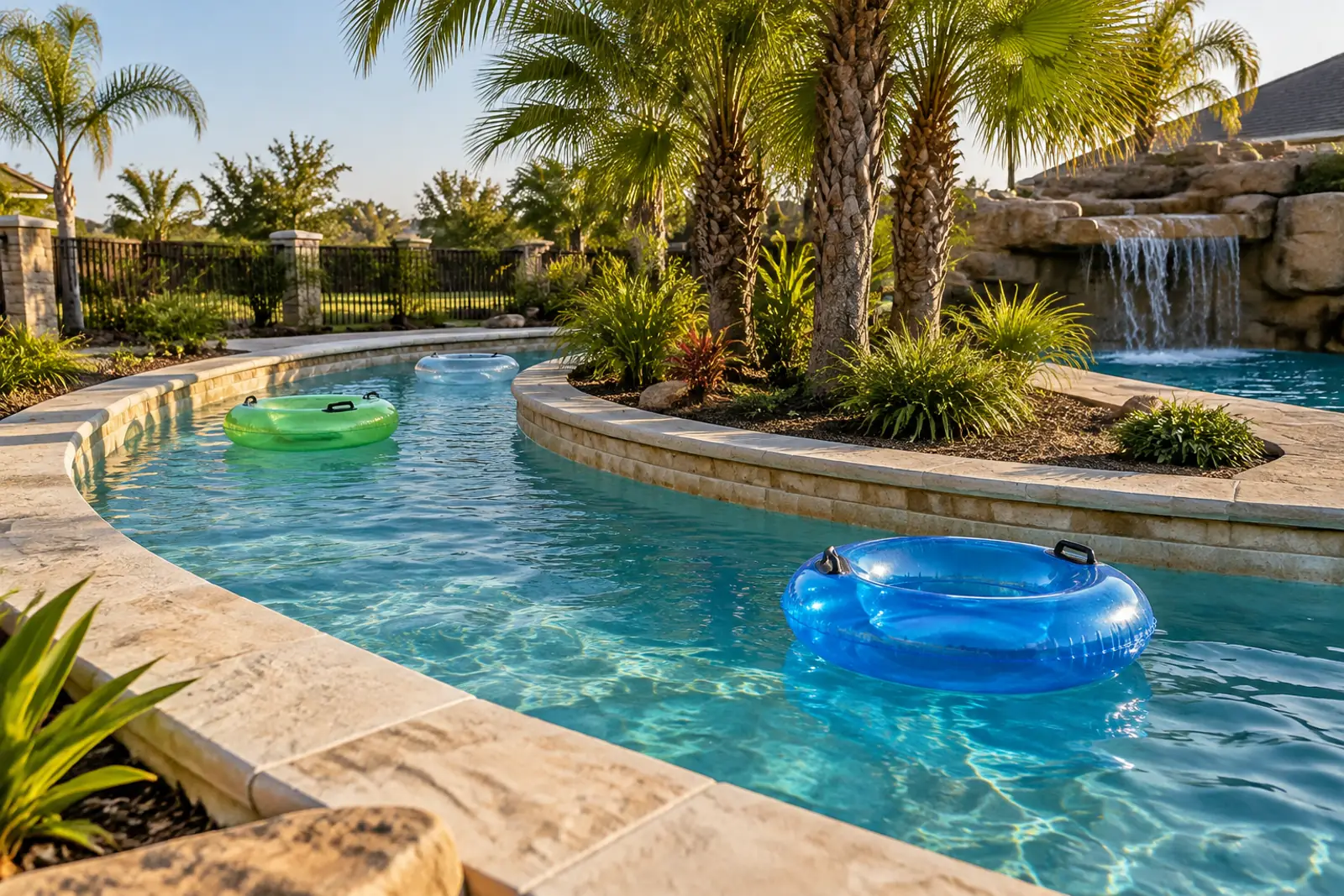
A lazy river pool is a closed loop of water, usually 3 to 4 ft deep, that pumps push in one direction so people float without swimming. The 2024 Model Aquatic Health Code calls it a channeled flow of near constant depth and lists tubing pool, leisure river and current channel as other names for the same thing.
| Measure | Value | Source |
|---|---|---|
| Current speed designers aim for | 2 to 3 ft per second (1 to 2 mph) | Pool & Spa News, 2017 |
| Minimum residential channel width | 6 ft | Pool & Spa News (republished by Riverflow, 2023) |
| Typical water depth | 3 to 4 ft | Lucas Lagoons, 2026 |
| Turn radius for a 90 degree bend | 8 to 10 ft | Peter Davidson, Current Systems, in Pool & Spa News |
| Gallons per foot, 8 ft wide x 3.5 ft deep | 209 | PC&S arithmetic (7.48 gal per cu ft) |
| Public lazy river turnover, maximum | 2 hours | CDC MAHC 2024 Table 4.7.1.10 |
| Public lazy river exits, maximum spacing | 150 ft | CDC MAHC 2024 4.12.5.2.1 |
| Nozzle exit speed, maximum | 20 ft per second | Pool & Spa News, 2017 |
| Custom residential lazy river, entry level | $300,000 to $500,000 | Lucas Lagoons, July 2026 |
Sources: CDC MAHC 2024; Pool & Spa News; Pool & Spa News via Riverflow; Lucas Lagoons. Download CSV
The current comes from a motive pump that is separate from the filter pump. Water leaves the channel through suction outlets, passes the pump and returns through jets set in the wall or floor, angled 30 to 45 degrees and often made of 2 in pipe in clusters of three or more, according to engineer Terry Brannon in Pool & Spa News. Axial current systems such as Riverflow by Current Systems use 10 to 12 in plumbing instead.
Residential lazy rivers are rare but real. Peter Davidson, president of Current Systems, told Pool & Spa News his company fielded 30 residential lazy river requests in one year, and the same article notes that no design standard exists for backyard rivers (PSN, republished by Riverflow). Public rivers follow the CDC Model Aquatic Health Code where a state adopts it; backyard rivers are permitted as residential pools.
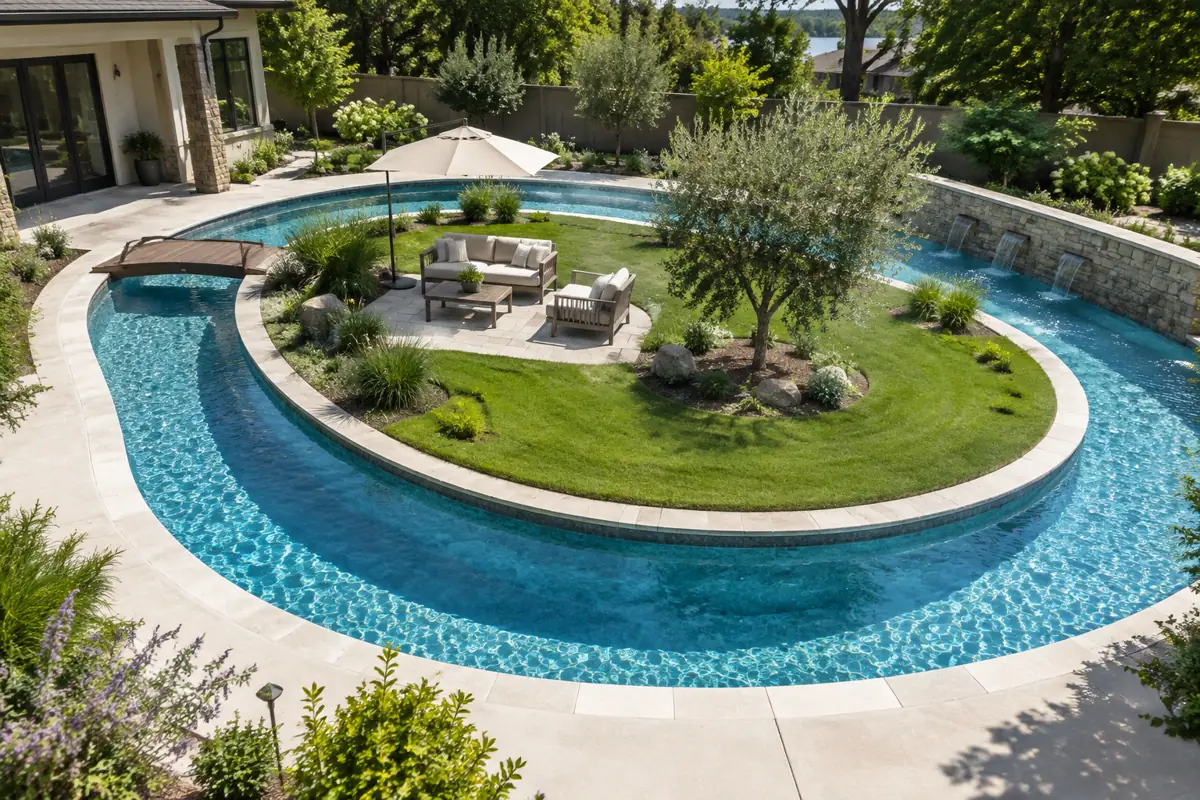
Shape is the main difference from a lagoon or freeform pool. A loop needs sweeping curves so tubes do not hang up, which is why freeform layouts and their extra coping are covered in our pool shapes guide.
How wide, deep and long does a backyard lazy river need to be?
Plan on at least 6 ft of width, about 3.5 ft of water, 90 degree turns on an 8 to 10 ft radius and a loop of 50 to 60 ft or more. Current Systems says a full loop can fit a 30 x 45 to 30 x 50 ft plot; Red Rock Pools rarely proposes one shorter than 50 ft.
- Pick the float device firstTruck inner tubes need wider channels and broader turns than pool noodles. Paolo Benedetti of Aquatic Technology warns tight turns hang tubes up in corners (Pool & Spa News).
- Set width and depthStart at 6 ft wide and 3.5 ft deep, the minimums designers quoted to Pool & Spa News. An 8 ft channel lets two tubes pass side by side.
- Draw the loopKeep 90 degree turns to an 8 to 10 ft radius, and never interrupt the river near a bend, which kills momentum (Terry Brannon).
- Add a loading bump-outA calm side pocket 12 to 18 in deep lets riders board tubes out of the current; deeper than 18 in may make children nervous (Benedetti).
- Place steps on a straight runSteps on corners absorb energy and create turbulence that can knock bathers off their feet, Peter Davidson writes in Pool & Spa Marketing. Recess them.
- Leave room for the pump vaultLow-head current pumps sit near water level, sometimes in a vault. Riverflow says its pump can sit up to 80 ft away with under 10% flow loss.
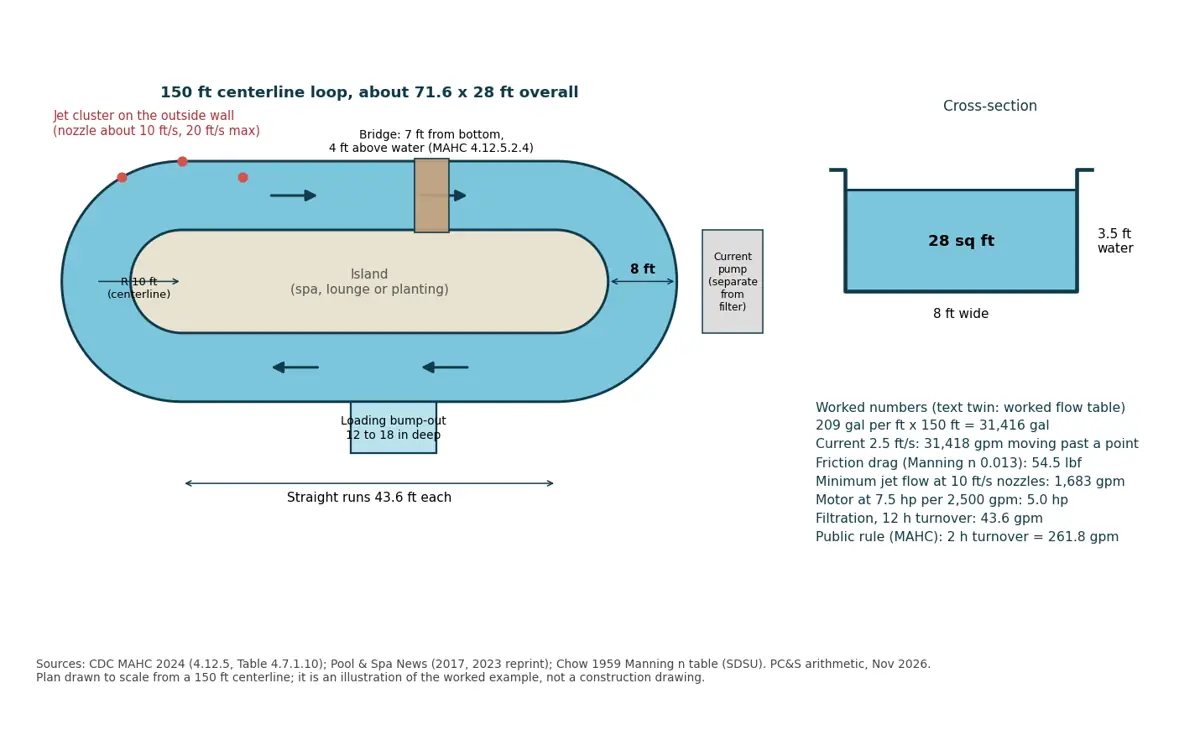
The plan uses a 10 ft centerline radius, so the inside wall turns on 6 ft and the outside on 14 ft. Its outer edge measures about 175 ft and the inner about 125 ft, 300 linear ft of coping in all, against 96 ft for a 16 x 32 ft rectangle in our pool shapes comparison. Edge length, not water area, drives much of a river’s premium.
Depth has a public benchmark. The MAHC Annex says most lazy rivers are closer to 3.5 ft deep, and Lucas Lagoons gives 3 to 4 ft for its residential designs (MAHC 2024 Annex 4.12.5.2.4; Lucas Lagoons). Shallower water saves gallons but drags tubes on the floor.
What pump does a lazy river need? The flow math
A lazy river needs a motive pump that delivers roughly 1,224 to 2,215 gpm through jets for a 150 ft loop, on top of a normal filter pump. The channel itself carries far more: an 8 x 3.5 ft river at 2.5 ft per second moves 31,418 gpm past any point, because jets push the water mass rather than pump all of it.
| Channel width (ft) | Water depth (ft) | Gallons per foot of channel | Current (ft per second) | Water moving past a point (gpm) | Friction drag, 150 ft loop (lbf) | Minimum jet flow at 4x nozzle speed (gpm) | Motor at 7.5 hp per 2,500 gpm (hp) |
|---|---|---|---|---|---|---|---|
| 6 | 3.5 | 157 | 2.0 | 18,851 | 31.7 | 1,224 | 3.7 |
| 6 | 3.5 | 157 | 2.5 | 23,564 | 49.6 | 1,530 | 4.6 |
| 6 | 3.5 | 157 | 3.0 | 28,276 | 71.4 | 1,836 | 5.5 |
| 8 | 3.5 | 209 | 2.0 | 25,134 | 34.9 | 1,346 | 4.0 |
| 8 | 3.5 | 209 | 2.5 | 31,418 | 54.5 | 1,683 | 5.0 |
| 8 | 3.5 | 209 | 3.0 | 37,702 | 78.5 | 2,019 | 6.1 |
| 10 | 3.5 | 262 | 2.0 | 31,418 | 38.3 | 1,476 | 4.4 |
| 10 | 3.5 | 262 | 2.5 | 39,273 | 59.8 | 1,846 | 5.5 |
| 10 | 3.5 | 262 | 3.0 | 47,127 | 86.2 | 2,215 | 6.6 |
| 8 | 3.0 | 180 | 2.0 | 21,544 | 33.5 | 1,292 | 3.9 |
| 8 | 3.0 | 180 | 2.5 | 26,930 | 52.4 | 1,616 | 4.8 |
| 8 | 3.0 | 180 | 3.0 | 32,316 | 75.4 | 1,939 | 5.8 |
Source: PC&S arithmetic, November 2026. Manning n 0.013 for troweled concrete (Chow (1959) via San Diego State University); nozzle speed 4 times the current and 7.5 hp per 2,500 gpm (Pool & Spa News). Download CSV
Read the table as a floor, not a pump order. It counts only straight-channel friction; bends, steps, tubes and the mixing loss at each jet all add drag that no simple formula captures. That is why David Schwartz of Waters Edge Aquatic Design puts commercial motive flow at 1,000 to 1,500 gpm, and why Current Systems specifies a 7.5 hp pump that moves 2,500 gpm.
| Step | Formula | Inputs | Result |
|---|---|---|---|
| 1. Cross-section | width x depth | 8 ft x 3.5 ft | 28 sq ft |
| 2. Gallons per foot | area x 7.48 | 28 x 7.48 | 209 gal per ft |
| 3. Loop volume | gallons per foot x length | 209.44 x 150 ft | 31,416 gal |
| 4. Water moving past a point | current x area x 448.83 | 2.5 x 28 x 448.83 | 31,418 gpm |
| 5. Hydraulic radius | area / (width + 2 x depth) | 28 / 15 | 1.867 ft |
| 6. Friction slope (Manning) | (n x v / (1.486 x R^(2/3)))^2 | n 0.013, v 2.5, R 1.867 | 0.000208 ft per ft |
| 7. Friction drag on the loop | 62.4 x area x slope x length | 62.4 x 28 x 0.000208 x 150 | 54.5 lbf |
| 8. Nozzle speed | 4 x current | 4 x 2.5 | 10 ft per second |
| 9. Jet flow that offsets the drag | drag / (1.94 x (nozzle speed minus current)) | 54.5 / (1.94 x 7.5) | 3.75 cu ft per second = 1,683 gpm |
| 10. Motor size by the trade ratio | gpm x 7.5 / 2,500 | 1,683 x 0.003 | 5.0 hp |
| 11. Filtration flow for a 12 hour turnover | volume / 720 minutes | 31,416 / 720 | 43.6 gpm |
| 12. Filtration flow for a 2 hour public turnover | volume / 120 minutes | 31,416 / 120 | 261.8 gpm |
Source: PC&S arithmetic; constants 7.48 gal per cu ft, 448.83 gpm per cu ft per second, 62.4 lb per cu ft; MAHC 2024 Table 4.7.1.10; ENERGY STAR fact sheet. Download CSV
Source: PC&S arithmetic: Manning n 0.013 for troweled concrete (Chow 1959, via San Diego State University); nozzle speed rule from Current Systems in Pool & Spa News. Download chart data (CSV)
Why does nozzle speed matter? Jets add momentum equal to their flow times the gap between nozzle speed and river speed. Davidson aims nozzles at 3 to 4 times the river speed, about 10 ft per second for a 2.5 ft per second current, and Schwartz caps them at 20 ft per second for rider safety (Pool & Spa News). A slower nozzle needs more gallons for the same push.
Can the filter pump run the river? No. Pool & Spa News reports the river system moves far more water than filtration needs and should run only when the river is in use. Filtration for the 31,416 gallon loop needs about 43.6 gpm for the 12 hour turnover ENERGY STAR cites, sized with our pool pump size calculator.
How much does a lazy river pool cost?
Published 2026 prices put a backyard lazy river at $120,000 to $300,000 or more for a custom concrete loop (The Pricer) and $300,000 to $500,000 for an entry-level Lucas Lagoons design. Above-ground lazy river kits list at $7,699.99 to $44,999.99 before installation at Paradise Pools Mart.
| Option | Price | Date | Source |
|---|---|---|---|
| Above-ground lazy river pool kit, 21 ft round to 40 x 80 ft | $7,699.99 to $44,999.99 | Read Nov 3, 2026 | Paradise Pools Mart listings |
| Short current channel added to a pool | $60,000 to $150,000+ | Updated June 27, 2026 | The Pricer |
| Small backyard lazy river loop | $120,000 to $250,000+ | Updated June 27, 2026 | The Pricer |
| Lazy river plus pool and spa | $200,000 to $400,000+ | Updated June 27, 2026 | The Pricer |
| 150 ft concrete loop, PC&S build-up | $142,751 to $254,361 | Nov 2026 | PC&S arithmetic from BOE AH 531, River Pools, Nashville fee schedule, The Pricer |
| Lucas Lagoons Designer Series (design plus authorized contractor) | $250,000 to $750,000 | Modified July 30, 2026 | Lucas Lagoons |
| Entry-level custom lazy river | $300,000 to $500,000 | Modified July 30, 2026 | Lucas Lagoons |
| High-end resort-style lazy river | $750,000 to $1,500,000+ | Modified July 30, 2026 | Lucas Lagoons |
Sources: Paradise Pools Mart; The Pricer; Lucas Lagoons; PC&S build-up below. Download CSV
Source: Paradise Pools Mart (read Nov 3, 2026); The Pricer (June 27, 2026); Lucas Lagoons (July 30, 2026); PC&S build-up from California BOE AH 531 and others. Download chart data (CSV)
| Line item | Quantity | Unit price | Low | High | Source |
|---|---|---|---|---|---|
| Concrete channel shell and finish | 1,200 sq ft of water (150 ft x 8 ft) | $94 to $173 per sq ft | $112,800 | $207,600 | California BOE AH 531 (Jan 2026), concrete pools |
| Coping, inner and outer edge | 300 linear ft | $6 to $60 per linear ft | $1,800 | $18,000 | River Pools (Aug 2025): cantilevered concrete to stone |
| Concrete deck walk, outer edge | 700 sq ft (175 ft x 4 ft) | $13.35 per sq ft | $9,345 | $9,345 | California BOE AH 531 (Jan 2026), concrete decking |
| Pumps, filtration, automation and electrical | 1 package | The Pricer example line | $18,000 | $18,000 | The Pricer (June 2026) |
| Building permit at Nashville rates | fee on total value | $5 per $1,000 plus 10% plus $25 | $806 | $1,416 | Metro Nashville Codes fee schedule (Dec 2025) |
| Total before electrical service upgrade, fence and landscaping | $142,751 | $254,361 | PC&S arithmetic |
Sources: California BOE AH 531, January 2026; River Pools, August 2025; The Pricer, June 2026; Metro Nashville fee schedule. Download CSV
The shell line is the soft spot. California’s assessors price concrete pools at $94 to $173 per sq ft of water, but a river has about 300 ft of edge for 1,200 sq ft of water, far more wall and coping per square foot than a typical pool, so expect bids near or above the top of that range (BOE AH 531).
What moves a lazy river pool cost most: length, which adds shell, coping and deck by the foot; rock work, which Lucas Lagoons calls labor intensive; and electrical service, since Pool & Spa News says a river likely needs a power upgrade. Permit fees are small by comparison; Nashville charges $5 per $1,000 of value plus 10% and $25, about $806 to $1,416 here, and other cities’ formulas are in our pool permit cost study.
What does a lazy river cost to run?
Mostly current pump electricity. A 7.5 hp current pump at nameplate draws about 5.6 kW, or $1.02 an hour at the August 2026 US average of 18.16 cents per kWh. Run 312 hours a season, that is $159 to $317 depending on how far the pump is turned down once the water is moving.
| Scenario | Power | Cost per hour | 312 hours a year (4 h, 3 days a week, 26 weeks) | Source |
|---|---|---|---|---|
| 7.5 hp current pump at nameplate | 5.595 kW | $1.02 | $317 | Current Systems via Pool & Spa News; EIA Aug 2026 18.16 cents per kWh |
| Same pump turned down 25% once the river is moving | 4.196 kW | $0.76 | $238 | Pool & Spa News (25% to 50% reduction) |
| Same pump turned down 50% once the river is moving | 2.798 kW | $0.51 | $159 | Pool & Spa News (25% to 50% reduction) |
| Filtration pump, ENERGY STAR median VS at 62.9 gpm | 762.6 W | $0.14 | not included (runs on its own schedule) | ENERGY STAR dataset Oct 2026 |
Sources: Pool & Spa News; EIA Electric Power Monthly, August 2026; ENERGY STAR pool pump dataset. Download CSV
Momentum does part of the work. Pool & Spa News reports that once the river reaches speed, pump power can drop 25% to 50%, and that long rivers can take up to 30 minutes to reach full momentum. Nameplate horsepower overstates real draw at reduced speed, so treat the $317 line as a ceiling for that schedule.
The filter pump runs on its own clock. ENERGY STAR’s median certified variable speed pump draws 762.6 W at 62.9 gpm, about 14 cents an hour at the same price; state prices and seasons are in our pool pump running cost study and run-time rules in our guide on how long to run a pool pump. The Pricer puts total upkeep at $4,000 to $12,000 or more a year.
Which code applies to a lazy river, and do you need a permit?
A backyard lazy river is permitted as a residential swimming pool: building, electrical and barrier permits under the local code, often based on the 2024 ISPSC. The CDC Model Aquatic Health Code section 4.12.5 governs public lazy rivers only, but its numbers are the best published design benchmark for exits, bridges and turnover.
| Rule | What the 2024 MAHC requires | Section | Source |
|---|---|---|---|
| Definition | Channeled flow of near constant depth, moved by pumps or other propulsion, transporting bathers over a defined path | 1.2 Definitions (Aquatic Venue) | CDC MAHC 2024 Code |
| Turnover | 2 hours or less | Table 4.7.1.10 | CDC MAHC 2024 Code, p. 73 |
| Protrusions | Handrails, steps, stairs and propulsion jets shall not protrude into the river | 4.12.5.1.2 | CDC MAHC 2024 Code, p. 118 |
| Exits | Means of access or egress at 150 ft intervals | 4.12.5.2.1 | CDC MAHC 2024 Code, p. 118 |
| Handhold | On at least one side, no horizontal bars or recessed handholds; not required where bathers must ride a tube | 4.12.5.2.2 | CDC MAHC 2024 Code, p. 118 |
| Deck | Along the entire length, may alternate sides | 4.12.5.2.3 | CDC MAHC 2024 Code, p. 118 |
| Bridges | At least 7 ft from the river bottom and 4 ft above the water surface | 4.12.5.2.4 | CDC MAHC 2024 Code, p. 118 |
| Depth markers | On a sign at points of entry | 4.5.19.7 | CDC MAHC 2024 Code |
| Rinse shower | At least one at each entrance | 4.10.4.3.6 | CDC MAHC 2024 Code |
| Pipe velocity | 8 ft per second discharge, 6 ft per second suction | 4.7.1.7.2 | CDC MAHC 2024 Code |
Source: CDC MAHC 2024 Code, 5th Edition, sections as listed; MAHC 2024 Annex. Download CSV
The MAHC Annex explains the 150 ft exit spacing: at 1 to 4 ft per second of current, a rider is never more than 75 ft or 2.5 minutes from a way out (MAHC Annex 4.12.5.2.1). It also drops handholds where riders must be on tubes, because tubes jam and can flip riders out.
For a backyard river, the 2024 ISPSC sets a 48 in barrier (305.2.1), entrapment avoidance per APSP 7 (311.1) and listed suction fittings to APSP 16 (312.4.4) (ISPSC 2024 via UpCodes). Fence costs by material are in our pool fence cost guide, and the permit sequence is in our pool permit guide. Lucas Lagoons budgets 1 to 3 months for permits and 6 to 10 months to build.
Is a backyard lazy river safe for children and tubes?
The main hazards are suction entrapment at high-flow outlets, collisions at bends and boarding tubes in moving water. Designers answer them with collector tanks or dual outlets, smooth walls with no protruding jets or rocks, and a calm loading area 12 to 18 in deep.
- Suction: Ken Martin of Aquatic Design & Engineering sends river water to a collector tank before the pump so no one can be held against an outlet (Pool & Spa News). CPSC counted 11 circulation entrapment victims in 2014 to 2018, all under 15 (CPSC 2019 report); drain rules are in our pool main drain guide.
- Protrusions: MAHC 4.12.5.1.2 bars jets, steps and handrails from protruding into a public river, and Pool & Spa News advises keeping rocks from overhanging the coping.
- Nozzle speed: keep jets at or below 20 ft per second at the outlet, the limit Schwartz gives for rider safety.
- Depth for children: 3.5 ft of water is over the head of many young children; the 12 to 18 in loading pocket is the place for them to board.
- Electrical: Davidson notes a 5 ft setback from the water edge for electrical equipment under the NEC, and current pumps may need submerged-rated wiring in a vault.
Are inflatable and above-ground lazy rivers real?
Above-ground lazy river pools are real: Paradise Pools Mart lists 52 in deep kits from a 21 ft round at $7,699.99 to 40 x 80 ft at $44,999.99. The viral 200 ft inflatable lazy river sold at Costco under the Coleman name was not; Popular Science traced the June 2026 video to AI.
The Popular Science report says the clip passed 15 million views after June 4, 2026, and that no such product existed; a June 24 update quotes Coleman saying it was neither confirming nor ruling out a real version (Popular Science). Small inflatable kiddie pools with a ring channel are sold, but none produce a pumped current like a built river.
Which lazy river option fits your yard and budget?
Use the yard and the budget first. Under about 30 ft of clear space, or under $60,000, a full concrete loop is unlikely; a current channel beside a pool or an above-ground kit fits better. Over $120,000 with a 30 x 50 ft plot, a backyard lazy river loop is realistic.
| If your situation is | Do this | Why |
|---|---|---|
| Yard narrower than about 30 ft in both directions | Skip a full loop; ask for a current channel on one side of a pool or a swim current system | A loop needs about a 30 x 45 to 30 x 50 ft plot (Current Systems) |
| Budget under $60,000 | Look at an above-ground lazy river kit ($7,700 to $45,000 listed) or a swim current in a standard pool | Custom concrete rivers start near $60,000 for a short channel (The Pricer) |
| Children under 5 will use it | Ask for a calm loading bump-out 12 to 18 in deep and a top current near 2 ft per second | Boarding a tube in moving water is the hardest step (Pool & Spa News) |
| Builder plans to drive the current through the filter pump | Ask for a separate motive pump and a separate filtration system | The river pump moves far more water than filtration needs (Pool & Spa News) |
| Pump will pull straight from the river | Ask for dual or unblockable suction outlets to ANSI/APSP-16 or a collector tank between river and pump | Entrapment rules: ISPSC 311 and 312.4.4; designers prefer a collector tank |
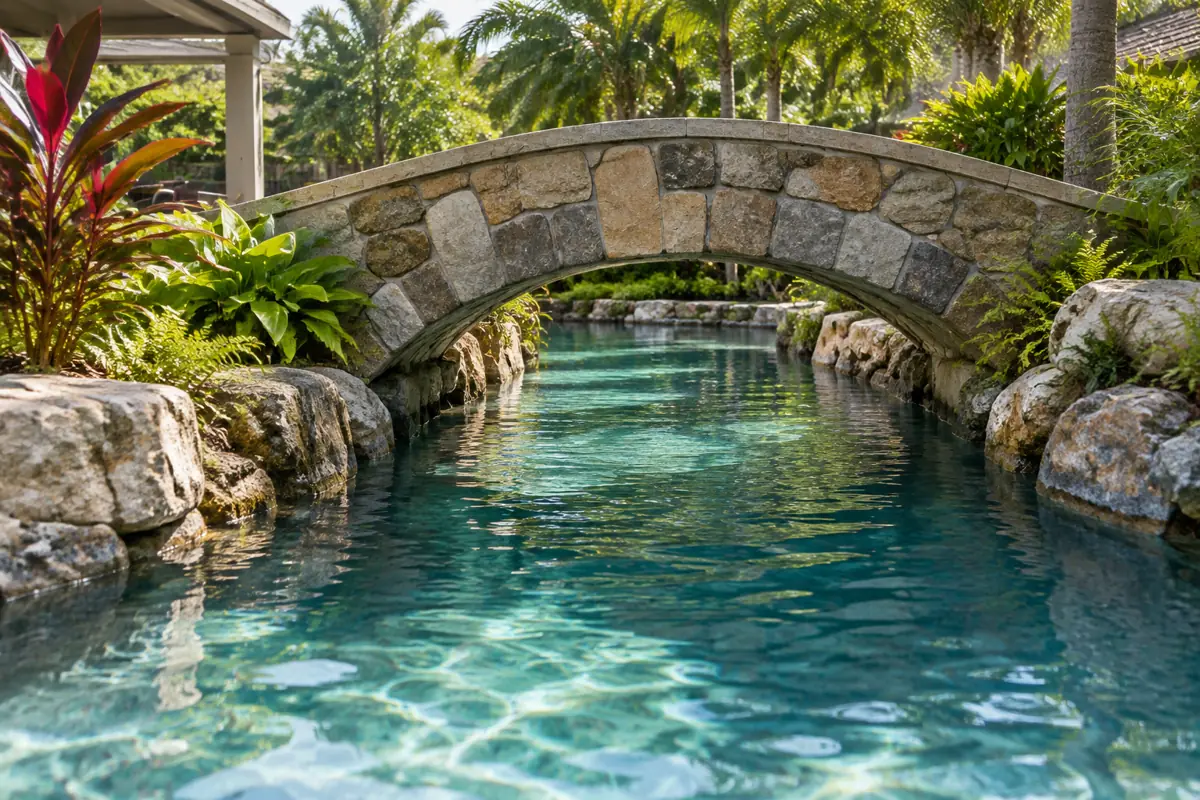
| Bridge or island planned | Keep at least 7 ft from river bottom and 4 ft above water under the bridge | MAHC 4.12.5.2.4 sets that clearance for public rivers |
| Steps planned at a bend | Move the steps to a straight run, recessed out of the current | Steps on corners absorb energy and add turbulence (Davidson, Pool & Spa Marketing) |
| HOA, rental or club will open it to others | Check whether your state treats it as a public pool under its MAHC-based code | Public rules add 2 hour turnover, 150 ft exits and rinse showers |
Sources: Pool & Spa News via Riverflow; The Pricer; Paradise Pools Mart; MAHC 2024; ISPSC 2024; Pool & Spa Marketing. Download CSV
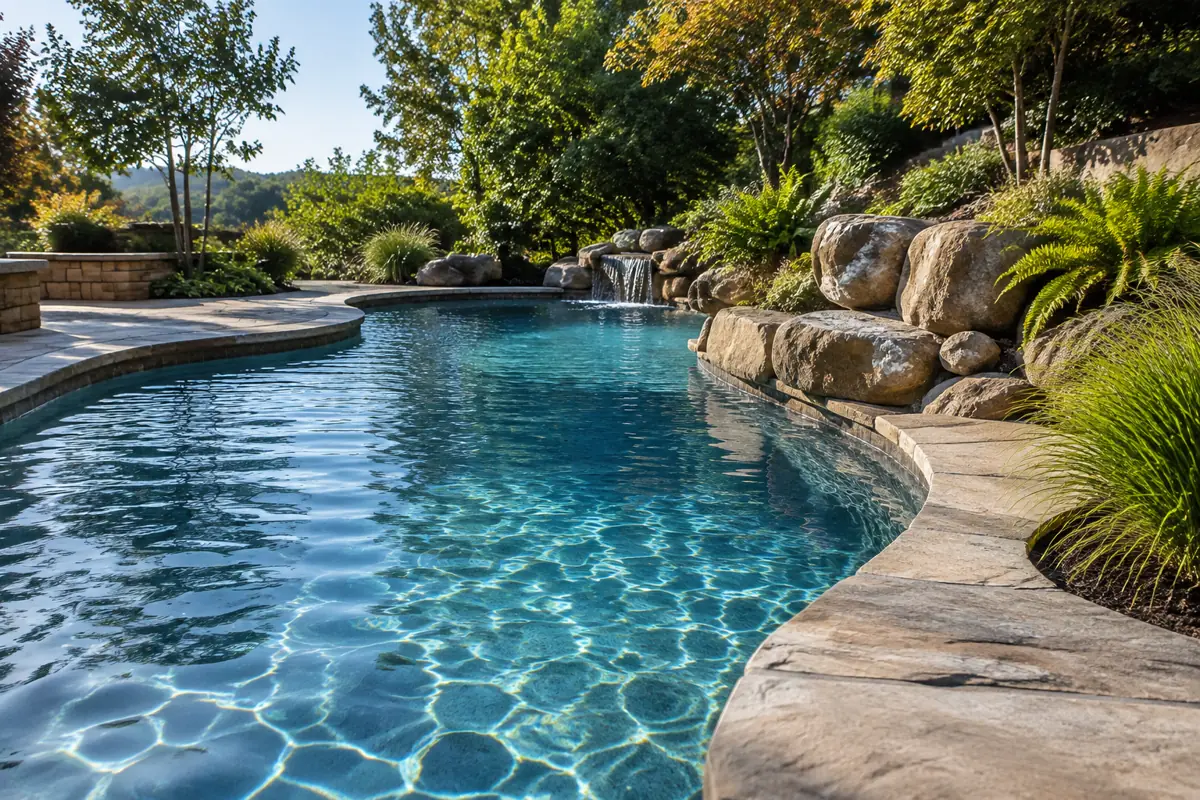
Waterfalls and grottos often ride along with a river; flow and cost for each are in our pool water features guide.
How we compiled this
In November 2026 we read the CDC 2024 Model Aquatic Health Code and its Annex, the 2024 ISPSC sections via UpCodes, 3 trade articles (two in Pool & Spa News, one in Pool & Spa Marketing), Riverflow’s maker pages, Chow’s Manning n table hosted by San Diego State University, California’s AH 531 cost handbook and 4 dated price sources. The flow, cost and running figures are our own arithmetic from those inputs; we did not build, test or measure any river.
Frequently Asked Questions
Does a lazy river pool exist?
Yes. Lazy rivers are common at water parks and resorts, and custom builders such as Lucas Lagoons in Florida build backyard versions. The CDC Model Aquatic Health Code defines one as a channeled flow of near constant depth, moved by pumps, that carries bathers over a defined path. Above-ground lazy river kits are also sold, listed at $7,699.99 to $44,999.99 in November 2026.
How much does a lazy river pool cost?
A custom backyard lazy river runs about $120,000 to $300,000 or more (The Pricer, June 2026), and Lucas Lagoons prices entry-level custom designs at $300,000 to $500,000. Our build-up for a 150 ft concrete loop, 8 ft wide, came to $142,751 to $254,361 before an electrical upgrade, fencing and planting. Above-ground kits start at $7,699.99.
Is the Coleman lazy river pool real or fake?
The viral 200 ft inflatable lazy river shown as a Coleman product at Costco was fake. Popular Science reported on June 8, 2026 that the video was AI-generated and that no such product existed, after it passed 15 million views. A June 24 update quoted Coleman saying it was not confirming or ruling out a real version.
How to build a lazy river pool?
Start with the float device and a 6 ft minimum channel width, set about 3.5 ft of water, draw a loop with 8 to 10 ft turn radii, add a 12 to 18 in deep loading pocket, then size a separate current pump. For a 150 ft loop at 2.5 ft per second, our math gives at least 1,683 gpm of jet flow.
How deep is a lazy river pool?
Most lazy rivers are about 3 to 4 ft deep. The MAHC 2024 Annex says most public rivers are closer to 3.5 ft, and Lucas Lagoons gives 3 to 4 ft for its residential designs. Designers quoted by Pool & Spa News start depths at 3.5 ft, with a separate loading area 12 to 18 in deep for boarding tubes.
How much space do you need for a backyard lazy river?
Peter Davidson of Current Systems told Pool & Spa News a lazy river loop can fit a 30 x 45 ft or 30 x 50 ft plot. Our to-scale plan of a 150 ft loop, 8 ft wide with 10 ft centerline turns, measures about 71.6 x 28 ft. Red Rock Pools rarely proposes a river shorter than 50 to 60 ft.
Sources
- CDC. 2024 Model Aquatic Health Code, Code Language, 5th Edition. Accessed 2026-11-03.
- CDC. Annex to the 2024 Model Aquatic Health Code, 5th Edition. Accessed 2026-11-03.
- Pool & Spa News. Makings of a River: A Look at Lazy River Hydraulic Systems. Accessed 2026-11-03.
- Pool & Spa News via Riverflow. PSN: More Than a Rivulet: Backyard Lazy Rivers (Rebecca Robledo), republished. Accessed 2026-11-03.
- Pool & Spa Marketing. Understanding the concepts of moving water (Peter Davidson). Accessed 2026-11-03.
- Riverflow Pools LLC. Riverflow answers to frequently asked questions. Accessed 2026-11-03.
- Lucas Lagoons. Lazy River Pool Guide: Cost, Design, and What to Expect. Accessed 2026-11-03.
- The Pricer. How Much Does It Cost to Build a Lazy River. Accessed 2026-11-03.
- Paradise Pools Mart. Lazy River Pools category listings. Accessed 2026-11-03.
- California State Board of Equalization. Assessors' Handbook Section 531, Residential Building Costs (January 2026). Accessed 2026-11-03.
- River Pools and Spas. Inground Pool Coping Idea and Cost Guide. Accessed 2026-11-02.
- Metro Nashville Codes. Building Permit Fee Schedule (December 2025). Accessed 2026-10-07.
- San Diego State University (V. M. Ponce). Manning's n table (after Chow, 1959), Open Channel Hydraulics. Accessed 2026-11-03.
- U.S. Energy Information Administration. Electric Power Monthly Table 5.6.A. Accessed 2026-11-02.
- U.S. EPA ENERGY STAR. ENERGY STAR Certified Pool Pumps dataset. Accessed 2026-11-02.
- U.S. EPA ENERGY STAR. ENERGY STAR Pool Pumps Fact Sheet (2022). Accessed 2026-10-27.
- International Code Council via UpCodes. 2024 ISPSC Chapter 3. Accessed 2026-11-01.
- U.S. CPSC. 2014 to 2018 Reported Circulation/Suction Entrapment Incidents (2019). Accessed 2026-11-01.
- Popular Science. That Costco 200-foot, inflatable lazy river is AI slop. Accessed 2026-11-03.
Related pages
Get Quotes From Licensed Local Pool Pros
Tell us what you need and your ZIP code. We match you with pool companies that cover your area.