Pollen in Pool Water: How to Identify It, Get Rid of It and Keep It Out
Pollen in pool water floats as a yellow-green film and waterline ring that never regrows: skim it daily, run the filter longer, clean the filter at a 10 psi rise and keep free chlorine at 1 ppm or more.
- ✓Pollen or algae, in one tableWhere it sits, the brush test and what a test shows.
- ✓Grain size vs filter ratingUNLV pollen sizes against EPA filter microns.
- ✓Regional pollen calendarSeason dates from 31 National Allergy Bureau stations.
Key takeaways
- Pollen is 2.5% to 61% protein across 377 plant species (Roulston, Cane and Buchmann, Ecological Monographs, 2000), organic nitrogen that uses up chlorine, so free chlorine falls faster in heavy pollen weeks.
- Ragweed grains measure 15 to 28 microns and mulberry 14 to 22 (UNLV pollen program), while a sand filter removes particles of 20 to 40 microns and up (EPA WaterSense, 2022), so part of the fine pollen passes a sand filter.
- Oak pollen season starts on average Feb 11 in Houston and May 2 in Rochester, NY, across 31 National Allergy Bureau stations counted from 2003 to 2017 (Lo et al., Aerobiologia, 2019).
- Backwash or clean the filter when its pressure rises 10 psi over clean (EPA WaterSense), and use a clarifier at 2 fl oz per 10,000 gallons for haze (HTH Clarifier Advanced).
- Only 15% of pool owners have and regularly use a cover, according to the 2016 Residential End Uses of Water study cited by EPA WaterSense; a cover is the one barrier that keeps pollen out.
What does pollen look like in a pool?
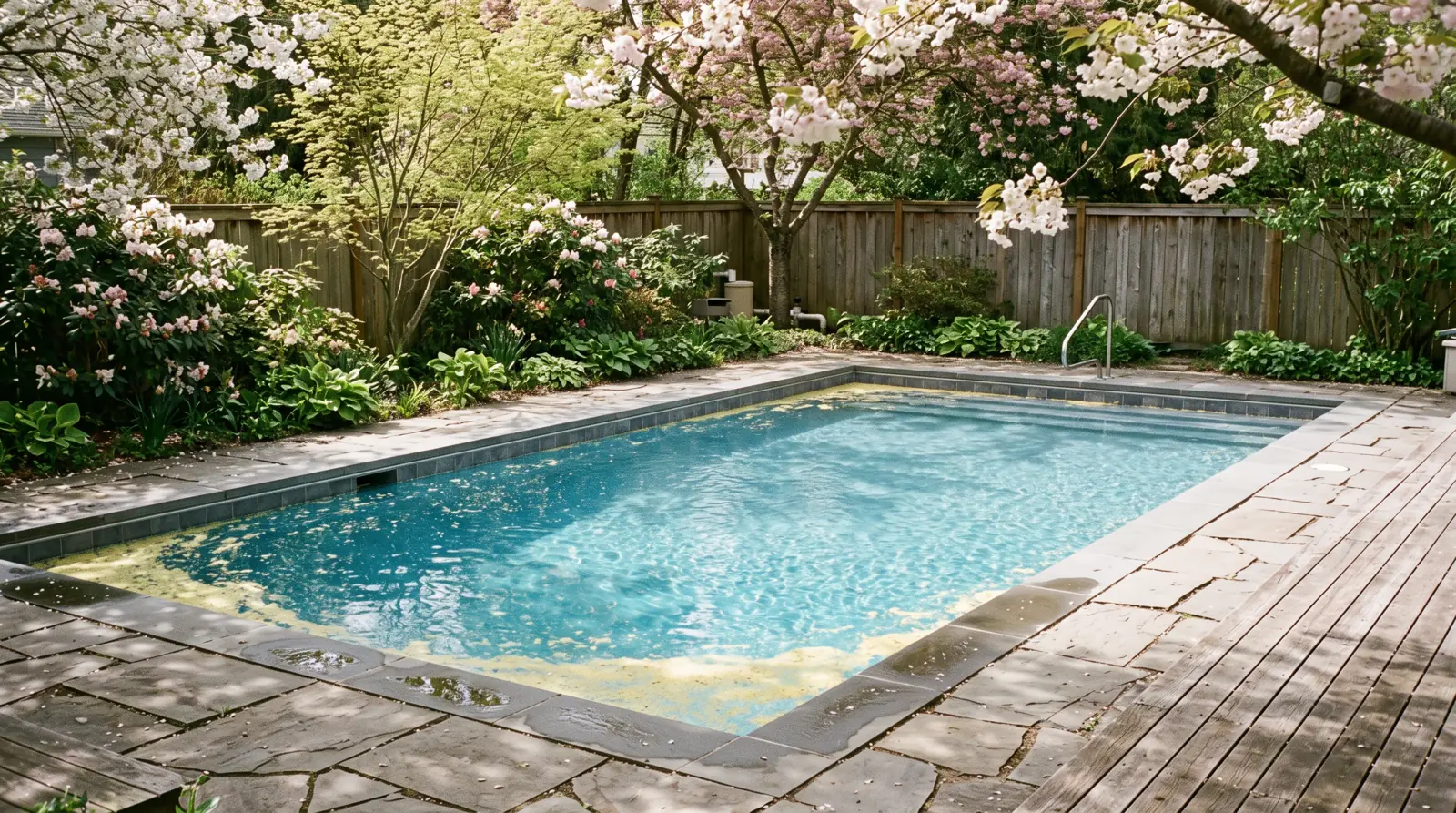
Pollen floats as a yellow or yellow-green film, collects in a ring at the waterline, piles into the skimmer and drifts to one corner when the wind blows. Pine grains measure 50 to 150 microns, and some settle as a thin powder on the floor. Brush it and it swirls, then settles back down; it never grows back once it is skimmed and filtered out.
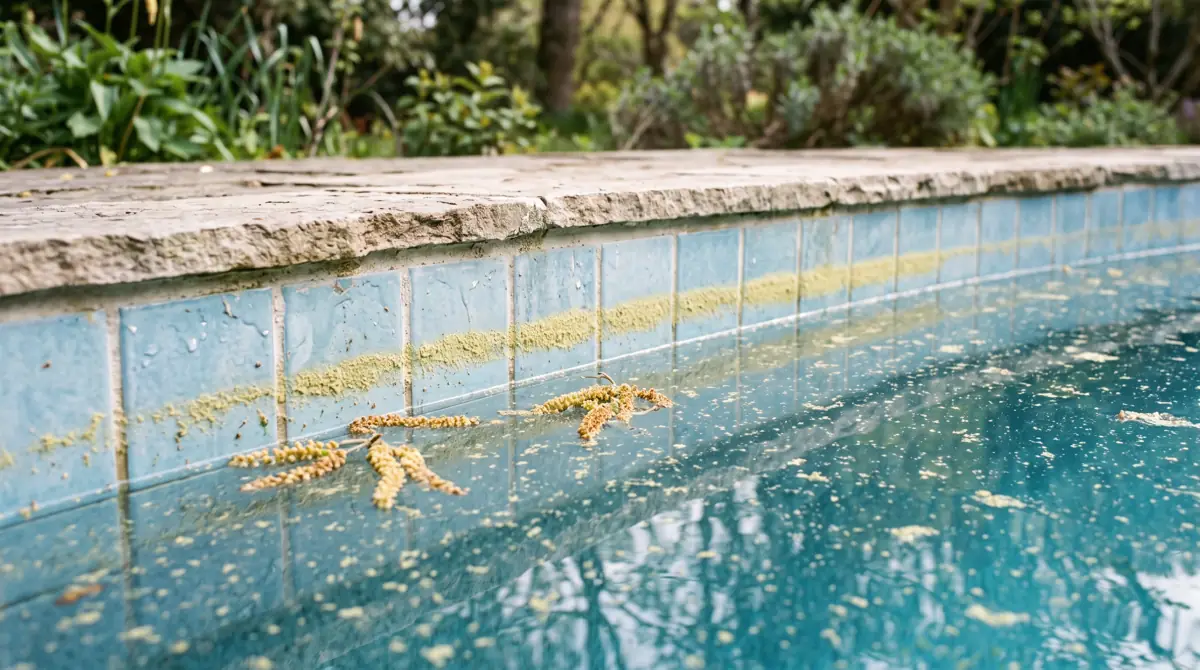
Swim University (updated April 13, 2026) puts the difference in one line: pollen floats on the surface or forms a thin powdery layer on the floor, while mustard algae clings to walls and shady surfaces. Poolonomics adds the other places it ends up: stuck to the walls at the waterline, built up in the skimmer, or blown off the surface into one corner of the pool.
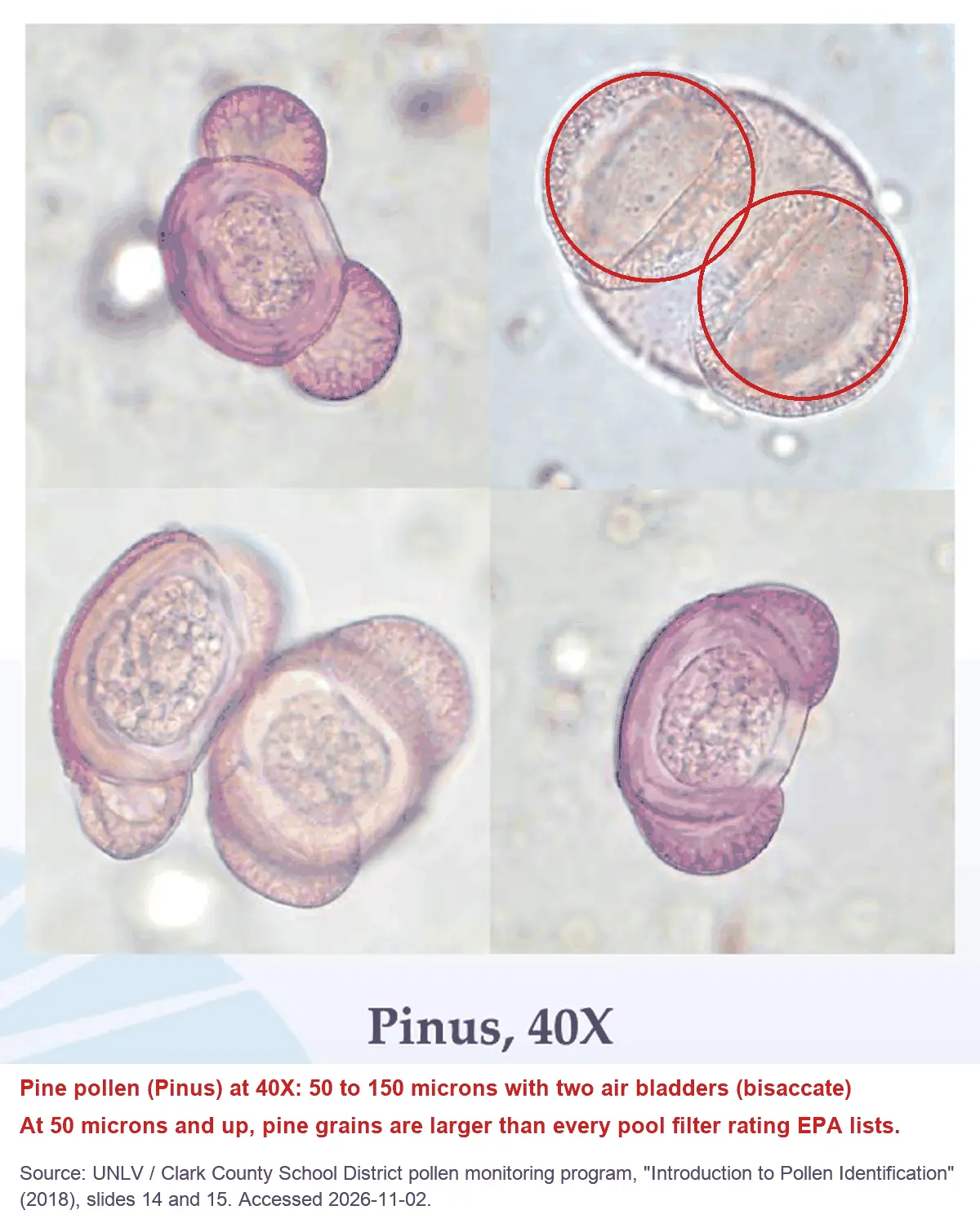
Grain size explains the film. The UNLV and Clark County School District pollen program, run by a certified National Allergy Bureau counter, lists pine pollen at 50 to 150 microns with two air bladders (bisaccate), the largest of the five common Las Vegas valley pollens. Grass runs 30 to 66 microns, ash 19 to 33, ragweed 15 to 28 and mulberry 14 to 22.
Is it pollen or algae in my pool?
Check where it sits and brush it. Pollen floats and rings the waterline, swirls when brushed and does not come back once removed. Mustard algae sits on shaded walls, clouds up when brushed and returns to the same spots within days. Dirt sinks and vacuums away, and a metal stain lightens under a vitamin C tablet held on it for 2 minutes.
| What it is | Where it sits | When you brush it | Over the next 1 to 3 days | What a test shows | Source |
|---|---|---|---|---|---|
| Pollen | Floats as a yellow or yellow-green film; rings the waterline; drifts to one corner in wind; a thin powder on the floor | Swirls and settles back down | Does not regrow once skimmed and filtered out; more arrives on windy, high-count days | Free chlorine falls faster than usual: pollen is organic and adds chlorine demand | Swim University (Apr 2026); Hasa; Poolonomics |
| Mustard algae | Yellow to brown dust or slime on shaded walls, corners and floor | Lifts into a cloud, then settles back in the same shady spots | Returns within days even after brushing | Can form even with proper sanitation and filtration (label) | BioGuard; Algae Complete label, EPA Reg. No. 5185-513 |
| Dirt, sand or dust | Settles on the floor, heaviest near the deep end and steps | Clouds briefly, then sinks | Vacuums away for good | No change in chlorine demand from the debris itself | Mustard algae guide decision table (Leslie's) |
| Green algae | Green slime on walls; green tint through the water | Smears green; water stays tinted | Spreads in warm water; BioGuard says it can bloom overnight above 85F | Free chlorine low, often under CDC's 1 ppm minimum | Algae Complete label 5185-513; BioGuard; CDC |
| Metal stain | Flat brown, reddish or dark stain on the surface | Does not brush off | Stays put | Lightens under a vitamin C tablet within 2 minutes | Natural Chemistry |
Sources: Swim University (April 13, 2026); Poolonomics; Hasa; BioGuard mustard algae; Algae Complete label, EPA Reg. No. 5185-513; BioGuard green algae; CDC; Natural Chemistry. Download CSV
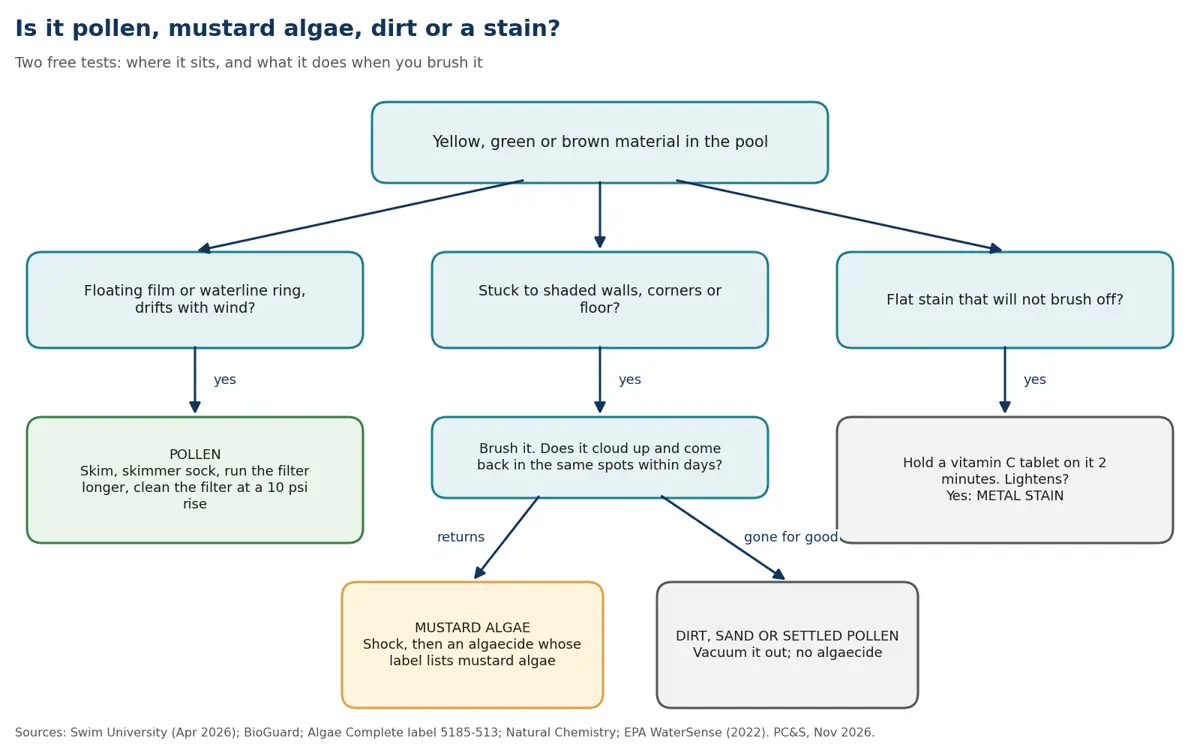
The label behind the mustard algae row matters. The EPA-accepted Algae Complete label (EPA Reg. No. 5185-513) says mustard algae usually grows in shade and can form even with proper sanitation and filtration, so a normal chlorine reading does not rule it out. BioGuard says it resembles dirt or sand, brushes away very easily and returns quickly. If the patches return, the label doses are in our mustard algae guide.
When is pollen season where you live?
Earlier and longer the farther south you are. Across 31 National Allergy Bureau stations from 2003 to 2017, oak pollen season started on average Feb 11 in Houston and May 2 in Rochester, NY. Tree pollen leads in spring, grass can run March to November, and ragweed comes in late summer and fall.
| NAB station | What 2003 to 2017 counts show | Main months | Source |
|---|---|---|---|
| Houston, TX | Oak (Quercus) main season starts Feb 11 on average, the earliest of the stations | Feb onward | Lo et al. 2019 |
| Waco, TX | Three peaks: cedar family (Cupressaceae) in January; oak, hickory, maple and elm late March to late April; ragweed mid-September through October. Lowest counts in July | Jan; late Mar to late Apr; mid-Sep to Oct | Lo et al. 2019 |
| San Jose, CA | Pollen in the air all year; oak season averages 103 days, the longest; trees are 94% of the pollen | Year-round | Lo et al. 2019 |
| Seattle, WA | Cedar family is earliest and 37% of the pollen; very little after July; oak season 23 days, the shortest | Late Jan to Jul | Lo et al. 2019 |
| London, ON (Great Lakes) | Main season March through September; tree season ends as grass begins in late May; ragweed mid-August to mid-September | Mar to Sep | Lo et al. 2019 |
| Rochester, NY | Oak main season starts May 2 on average, the latest of the stations | May onward | Lo et al. 2019 |
| All 31 stations | Grass season can run March to November; ragweed start varies least year to year (8.4 days), elm most (32.2 days) | Mar to Nov (grass) | Lo et al. 2019 |
Source: Lo, Bitz, Battisti and Hess, Pollen calendars and maps of allergenic pollen in North America, Aerobiologia 35: 613 to 633 (2019), open-access PDF. Accessed 2026-11-02. Download CSV
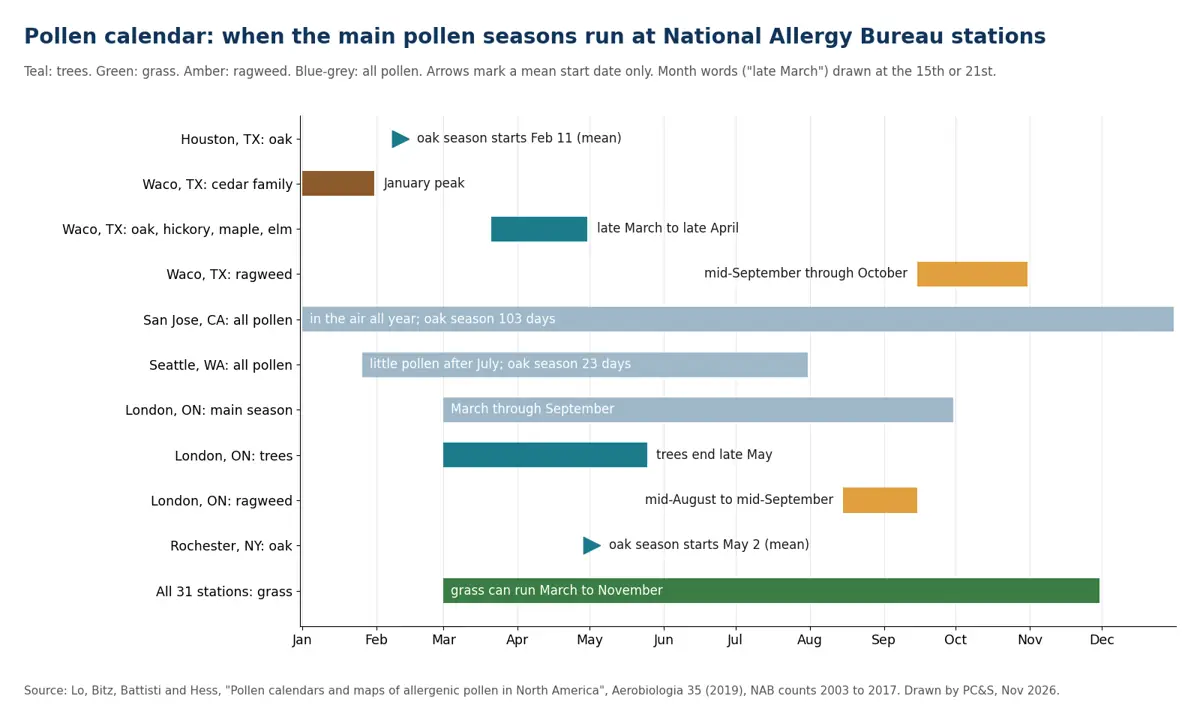
Latitude drives most of it. Lo and colleagues found that every major tree pollen starts later and runs shorter at higher latitudes; oak season averaged 103 days in San Jose, CA and 23 days in Seattle, WA. Ragweed is the exception: it flowers as days shorten, so its start date varies least from year to year, and the first frost ends it.
Only station-years with reliable start dates are included.
Source: Lo et al., Aerobiologia 35 (2019), Table 3. Download chart data (CSV)
| Pollen | Standard deviation of season start (days) | Station-years counted |
|---|---|---|
| Ragweed (Ambrosia) | 8.4 | 292 |
| Mulberry (Morus) | 10.6 | 228 |
| Oak (Quercus) | 11.8 | 232 |
| Ash (Fraxinus) | 12.2 | 214 |
| Cottonwood and poplar (Populus) | 12.3 | 174 |
| Grass (Poaceae) | 12.3 | 258 |
| Pine family (Pinaceae) | 13 | 230 |
| Birch (Betula) | 13.4 | 201 |
| Maple (Acer) | 16.2 | 103 |
| Cedar family (Cupressaceae) | 25 | 63 |
| Elm (Ulmus) | 32.2 | 112 |
Source: Lo et al. 2019, Table 3 (31 NAB stations, 2003 to 2017). Download CSV
Read it as a planning window. Ragweed starts within about 8.4 days of its usual date in most years, so a fall cover plan can run off the calendar; elm swings by 32.2 days and oak by 11.8, so watch local counts and the first yellow film instead of a fixed date.
In the Sun Belt the pollen and swim seasons overlap. Our pool season length by city study counts 193 days a year in Houston with a normal daily high of 80F or more, against 29 in Buffalo, so a Houston pool is open and uncovered when the oak season starts there, on Feb 11 on average.
Why is pollen bad for a pool?
It uses up chlorine and slips through filters. Pollen is 2.5% to 61% protein, and protein nitrogen reacts with chlorine as it breaks down. The finest grains, ragweed at 15 to 28 microns and mulberry at 14 to 22, are near or below the 20 to 40 micron rating EPA gives sand filters, so part of them passes back to the pool.
The protein figure comes from Roulston, Cane and Buchmann, who measured or compiled crude protein for 377 plant species from 93 families (Ecological Monographs 70(4), 2000). Hasa, a pool chlorine maker, explains the pool side: the organic nitrogen in pollen does not react with chlorine at once but has to break down first, so chlorine demand rises slowly over days rather than in one drop. Removing pollen early leaves less to break down.
| Pollen (common name) | Grain size (microns) | Season (Las Vegas program) | Sand filter (20 to 40 microns) | Cartridge (about 10 microns) | DE (about 5 microns) |
|---|---|---|---|---|---|
| Pine (Pinus) | 50 to 150 | Spring | Caught | Caught | Caught |
| Grass (Poaceae) | 30 to 66 | Spring to summer | Mostly caught | Caught | Caught |
| Ash (Fraxinus) | 19 to 33 | Spring | Partly passes | Caught | Caught |
| Ragweed (Ambrosia) | 15 to 28 | Mid summer to fall | Partly passes | Caught | Caught |
| Mulberry (Morus) | 14 to 22 | Spring | Mostly passes | Caught | Caught |
Sources: grain sizes from the UNLV / CCSD pollen program (2018); filter ratings from EPA WaterSense, Table 2 (2022); comparison by PC&S. Download CSV
Filter ratings are nominal; EPA notes cartridge ratings can vary.
Source: UNLV / Clark County School District pollen program (NAB-certified counter, 2018); EPA WaterSense pool guide Table 2 (2022). Download chart data (CSV)
Every filter catches pine pollen. The fine grains are where filter type shows: EPA rates DE at about 5 microns and cartridges at about 10 microns, both below the smallest pollen in the table, while a sand filter rated 20 to 40 microns lets part of the ragweed and mulberry range through. Our pool filter types guide compares the three on cost and water use.
How do you get rid of pollen in a pool?
Take it out physically, then let the chemistry catch up. Skim every morning, fit a skimmer sock, run the pump longer, brush the waterline, clean the filter when pressure rises 10 psi, clarify any haze, and keep free chlorine at 1 ppm or more. Shock helps only after the pollen is out, because chlorine does not remove it.
- Skim every morningPollen builds up overnight, so skim before it sinks (Swim University). Airborne counts in a 2022 Atlanta study were lowest from 4 a.m. to noon and highest from 2 to 9 p.m. (ACAAI).
- Fit a skimmer sockA fine mesh sock over the skimmer basket catches grains the basket lets through; empty and rinse it when it clogs.
- Run the pump longer in peak weeksOne turnover takes gallons / (gpm x 60) hours: 8.3 hours for 20,000 gallons at 40 gpm. Swim University runs the filter around the clock in peak pollen season.
- Brush the waterline and wallsBrushing lifts settled pollen back into the water where the filter can take it (Swim University).
- Clean the filter at a 10 psi riseEPA WaterSense says a 10 psi rise over clean usually means a backwash is due; rinse cartridges instead.
- Clarify fine hazeHTH Clarifier Advanced: 2 fl oz per 10,000 gallons, 4 fl oz if very cloudy, filter at least 8 hours.
- Hold chlorine, then shockKeep free chlorine at 1 ppm or more, 2 ppm with stabilizer (CDC). Shock after the pollen is out, in the evening, and skim again the next morning (Swim University).
| Product type (example) | What it does | Label or maker dose per 10,000 gal | Filter or wait | Source |
|---|---|---|---|---|
| Clarifier (HTH Clarifier Advanced) | Clumps fine particles so the filter catches them | 2 fl oz; 4 fl oz for very cloudy water | Run the filter at least 8 hours | HTH product directions |
| Chitosan clarifier (SeaKlear) | Natural polymer that clumps fine particles | 1 oz weekly | Run the filter at least 6 hours | SeaKlear product page |
| Enzyme clarifier (Orenda CE-Clarifier) | Clumps particles; enzymes lower surface tension | 4 fl oz first dose, then 1 fl oz weekly | Vacuum what drops to the floor | Orenda pollen procedure |
| Enzyme (Orenda CV-600 or CV-700) | Breaks down oils and non-living organics | 32 fl oz purge, then 2 to 5 fl oz weekly | n/a | Orenda pollen procedure |
| Flocculant (HTH Drop Out) | Sinks particles to the floor overnight | 8 fl oz | Vacuum to waste; needs a WASTE port | Our pool flocculant guide (HTH) |
Sources: HTH Clarifier Advanced; SeaKlear Chitosan Clarifier; Orenda pollen and small debris procedure; HTH Drop Out. Accessed 2026-11-02. Download CSV
Pick the product by your filter. A clarifier works through any filter; a flocculant such as HTH Drop Out (8 fl oz per 10,000 gallons) drops the pollen to the floor overnight and needs a filter valve with a WASTE port, and HTH tells owners without vacuum-to-waste to use clarifier instead. Settling times, pH windows and water loss are in our pool flocculant guide, and the hose-off and soak steps for cartridges are in our guide on how to clean a pool filter.
Does chlorine get rid of pollen? No. Swim University says chlorine does not physically remove pollen; it spends itself breaking pollen down, which leaves less for sanitizing and can pull free chlorine under the 1 ppm CDC minimum. Run times by pool size and pump speed are in our guide on how long to run a pool pump, and shock doses by product are in our guide on how to shock a pool.
How can I prevent pollen from getting in my pool?
Cover the pool when no one is swimming, plant away from wind-pollinated trees and weeds, and keep the skimmer and pump working through the peak weeks. EPA’s WaterSense guide says solid covers keep debris out while mesh lets some through, and only 15% of pool owners have and regularly use a cover.
- Cover it when idle A solid cover keeps debris and precipitation out; a mesh cover lets some through (EPA WaterSense, 2022).
- Avoid wind-pollinated plants near the water Allergenic plants tend to be wind-pollinated and make large amounts of pollen, such as poplar trees, ragweed and stinging nettles; pollen is highest near the plant, so keep them away from patios (City of Victoria guide).
- Choose insect-pollinated or female plants Insect-pollinated plants make less pollen, and it is heavier and stickier; since male flowers make pollen, female plants of dioecious species cut airborne pollen (City of Victoria).
- Put a lower-allergen hedge or fence on the windward side The City of Victoria guide says it can help trap airborne pollen before it reaches the area behind it.
- Keep grass cut low Short grass produces less pollen; the City of Victoria guide also says to mow when the grass is wet.
- Keep the skimmer sock on through the season It costs a rinse a day; the alternative is pollen in the filter.
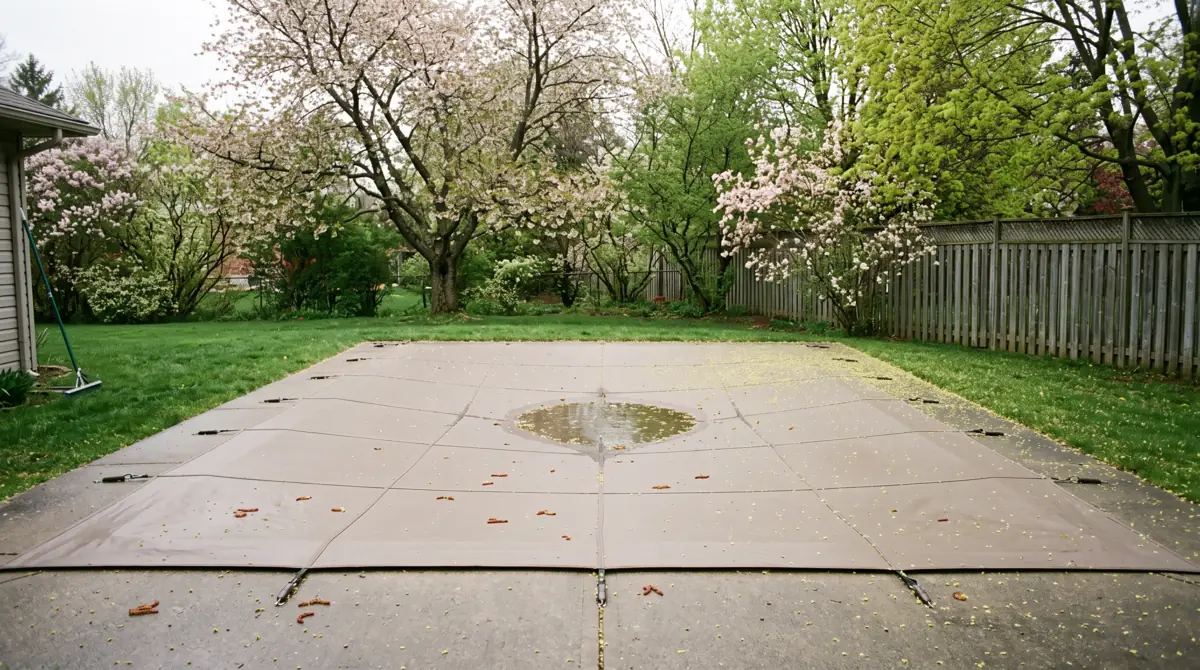
A cover also pays for itself in water. Our pool evaporation study puts an uncovered 15 x 30 ft pool at 37.4 inches of evaporation a year in Nashville to 83.6 inches in Las Vegas, and EPA WaterSense says solid covers cut evaporation by more than 90% when in use. Mesh, solid and automatic options are compared in our pool safety cover guide.
Without a cover, the skimmer does the work, as our pool skimmer guide explains.
Can pollen in the pool make allergies worse?
Pollen allergy is common: 25.2% of U.S. adults had a diagnosed seasonal allergy in 2024, according to CDC’s National Center for Health Statistics. We found no study measuring reactions to pollen floating in pool water; the documented exposure is pollen in the air, which a 2022 Atlanta study found was lowest from 4 a.m. to noon.
The prevalence figure is from NCHS Data Brief No. 545 (January 2026), which found one quarter of adults had a seasonal allergy in 2024. The timing study, presented at the 2022 American College of Allergy, Asthma and Immunology meeting, monitored hourly counts at three Atlanta sites for one week and found higher levels from 2 to 9 p.m., so one city and one week, not a national rule.
Which pollen fix fits your pool?
Match what you see to a row. A floating film calls for skimming and a sock, a 10 psi filter rise for a backwash or cartridge rinse, fine haze for clarifier at 2 fl oz per 10,000 gallons, and patches that return in the shade for an algaecide labeled for mustard algae. Flocculant only makes sense with a WASTE port.
| If your situation is | Do this | Source |
|---|---|---|
| Yellow film on the surface, worse after windy days | Skim every morning, fit a skimmer sock, run the filter longer during the season | Swim University; ACAAI 2022 |
| Yellow patches in shade that come back within days | Treat as mustard algae with an algaecide labeled for it | BioGuard; label 5185-513 |
| Filter pressure up 10 psi from clean | Backwash a sand or DE filter or clean the cartridge | EPA WaterSense (2022) |
| Hazy water, floor visible, any filter | Clarifier: 2 fl oz per 10,000 gal (4 fl oz if very cloudy), filter at least 8 hours | HTH Clarifier Advanced label directions |
| Heavy settled pollen, sand or DE filter with a WASTE port | Flocculant (8 fl oz per 10,000 gal for HTH Drop Out), settle overnight, vacuum to waste | HTH; our pool flocculant guide |
| Cartridge filter with no WASTE port | Use clarifier, not flocculant | HTH cloudy water guide |
| Free chlorine under 1 ppm (2 ppm with stabilizer) | Raise chlorine; shock after the pollen is out of the water | CDC; Swim University |
| Scum line of pollen and oil at the tile | Brush the waterline; an enzyme product breaks down oils (Orenda weekly dose 2 to 5 fl oz per 10,000 gal) | Orenda |
| Peak tree pollen weeks where you live | Keep a cover on when the pool is not in use | EPA WaterSense; Lo et al. 2019 |
Sources: Swim University; ACAAI; BioGuard; label 5185-513; EPA WaterSense; HTH; HTH cloudy water guide; CDC; Orenda; Lo et al. 2019. Download CSV
| Number | What it means | Source |
|---|---|---|
| 2.5% to 61% | Protein content of pollen across 377 plant species from 93 families: organic nitrogen that uses up chlorine | Roulston, Cane and Buchmann, Ecological Monographs (2000) |
| 15 to 28 microns | Ragweed pollen grain size; mulberry is 14 to 22, pine 50 to 150 | UNLV / Clark County pollen program (NAB counter) |
| 20 to 40 microns | Smallest particle a sand filter removes; cartridge about 10, DE about 5 | EPA WaterSense (2022) |
| 10 psi | Pressure rise over clean that usually means backwash | EPA WaterSense (2022) |
| Feb 11 to May 2 | Mean start of oak pollen season, Houston to Rochester, NY | Lo et al. 2019 (NAB data 2003 to 2017) |
| 15% | Share of pool owners who have and regularly use a cover (2016 REU study) | EPA WaterSense (2022) |
| 25.2% | U.S. adults with a diagnosed seasonal allergy, 2024 | CDC NCHS Data Brief No. 545 (January 2026) |
| 4 a.m. to noon | Lowest hourly pollen counts in a 2022 Atlanta study; highest 2 to 9 p.m. | ACAAI (November 10, 2022) |
Sources: Roulston et al. 2000; UNLV; EPA WaterSense; Lo et al. 2019; NCHS; ACAAI. Download CSV
How we compiled this
We read 9 primary sources in November 2026: the 2019 Aerobiologia pollen calendar study built on 31 National Allergy Bureau stations, the UNLV pollen identification lecture, the Roulston pollen protein study record, the EPA WaterSense pool guide, NCHS Data Brief 545, the ACAAI 2022 study release, the City of Victoria planting guide, the Algae Complete EPA label and CDC’s home pool page. Product doses come from HTH, SeaKlear and Orenda directions, and pool-care descriptions from Swim University, Hasa, BioGuard and Poolonomics, named where used. Filter-versus-grain comparisons are PC&S arithmetic. We did not test water or products, and forum threads were used only for question wording.
Frequently Asked Questions
What does pollen look like in a pool?
A yellow or yellow-green film on the surface, a ring at the waterline and a thin powder on the floor, often blown into one corner. Pine pollen, at 50 to 150 microns with two air bladders (UNLV pollen program), is the coarse yellow dust most owners see. It swirls when brushed and does not regrow once removed.
Is it pollen or algae in my pool?
Look at where it sits and brush it. Pollen floats or rings the waterline and does not come back after skimming and filtering. Mustard algae sits on shaded walls, clouds when brushed and returns to the same spots within days; the Algae Complete label (EPA Reg. No. 5185-513) says it can form even with proper sanitation.
How do I get rid of pollen in my pool?
Skim every morning, fit a skimmer sock, brush the waterline, run the pump longer and clean the filter when pressure rises 10 psi over clean (EPA WaterSense). For fine haze, add a clarifier such as HTH Clarifier Advanced at 2 fl oz per 10,000 gallons. Keep free chlorine at 1 ppm or more (2 ppm with stabilizer), per CDC.
Does chlorine get rid of pollen?
No. Chlorine does not physically remove pollen; Swim University notes that it spends itself breaking the pollen down. Pollen is 2.5% to 61% protein (Roulston et al., 2000), and that organic nitrogen raises chlorine demand. Remove the pollen first, then shock in the evening if free chlorine has fallen below 1 ppm.
Does a pool filter catch pollen?
Mostly. EPA WaterSense rates sand filters at 20 to 40 microns, cartridges at about 10 and DE at about 5. Pine (50 to 150 microns) and grass (30 to 66) are caught by all three, but part of the ragweed (15 to 28) and mulberry (14 to 22) range passes a sand filter. A clarifier clumps fine grains so sand can hold them. Which clarifier types suit that job, and how far to space them from a shock, is set out in our pool clarifier guide.
How can I prevent pollen from getting in my pool?
Cover the pool when it is not in use: EPA WaterSense says solid covers keep debris out, yet only 15% of owners have and regularly use one. Plant insect-pollinated or female plants rather than wind-pollinated trees and weeds near the water, keep grass cut low and keep a skimmer sock in place through the peak weeks.
Sources
- Lo, Bitz, Battisti and Hess (University of Washington). Pollen calendars and maps of allergenic pollen in North America, Aerobiologia 35: 613-633 (2019). Accessed 2026-11-02.
- UNLV / Clark County School District pollen monitoring program. Introduction to Pollen Identification (2018). Accessed 2026-11-02.
- Roulston, Cane and Buchmann via FAO AGRIS. What governs protein content of pollen? Ecological Monographs 70(4): 617-643 (2000), abstract record. Accessed 2026-11-02.
- U.S. EPA. Jump Into Pool Water Efficiency (WaterSense outdoor pool guide, 2022). Accessed 2026-11-02.
- CDC National Center for Health Statistics. Diagnosed Allergic Conditions in Adults: United States, 2024 (NCHS Data Brief No. 545). Accessed 2026-11-02.
- American College of Allergy, Asthma and Immunology. Lowest Pollen Counts Occur Between 4:00 a.m. and Noon (November 10, 2022). Accessed 2026-11-02.
- City of Victoria. Pollinator and Allergy Aware Gardening. Accessed 2026-11-02.
- BioGuard via EPA PPLS. Algae Complete label, EPA Reg. No. 5185-513 (July 15, 2025). Accessed 2026-10-19.
- CDC. Home Pool and Hot Tub Water Treatment and Testing. Accessed 2026-10-27.
- Swim University. How to Remove Pollen From Your Pool (updated April 13, 2026). Accessed 2026-11-02.
- Hasa. Understanding and Managing Pollen in Swimming Pools (May 20, 2026). Accessed 2026-11-02.
- Orenda. Pollen, Ash, and other Small Debris Removal. Accessed 2026-11-02.
- Poolonomics. How To Get Pollen Out Of Your Pool. Accessed 2026-11-02.
- HTH Pools. HTH Pool Care Clarifier Advanced. Accessed 2026-11-02.
- HTH Pools. HTH Pool Care Drop Out Flocculant. Accessed 2026-11-01.
- HTH Pools. Why Is My Pool Cloudy?. Accessed 2026-11-01.
- SeaKlear. Chitosan Clarifier. Accessed 2026-11-02.
- BioGuard. Yellow (Mustard) Algae. Accessed 2026-10-19.
- BioGuard. Green Algae. Accessed 2026-10-27.
- Natural Chemistry. Staining. Accessed 2026-10-19.
Related pages
Get Quotes From Licensed Local Pool Pros
Tell us what you need and your ZIP code. We match you with pool companies that cover your area.