Liquid Chlorine vs Shock: Which Should You Use?
Liquid chlorine vs shock: liquid chlorine is a shock at 5 to 10 ppm. Fresh 12.5% jugs cost about $0.59 per ppm in 10,000 gallons against $1.03 for 73% cal-hypo, but lose strength within months.
- ✓Same chlorine, different carrierEPA-registered liquid and granular labels both shock to 5 to 10 ppm; only the strength and leftovers differ.
- ✓$0.59 vs $1.03 per ppmCost of 1 ppm in 10,000 gallons at Leslie's September 2026 prices, 12.5% liquid vs 73% cal-hypo bags.
- ✓Heat eats liquid chlorineAbout 68% strength left after 90 days at 80 F, by the Chlorine Institute equation; cal-hypo keeps about 24 months (EPA).
Key takeaways
- Liquid chlorine is a chlorine shock: the Hasachlor label (EPA Reg. No. 10897-26) directs 50 to 100 fl oz per 10,000 gallons every 7 days to super-chlorinate, the same 5 to 10 ppm target the granular shock labels use.
- At Leslie’s September 2026 prices, 1 ppm in 10,000 gallons costs about $0.59 with 12.5% liquid chlorine, $1.03 with 73% cal-hypo in 1 lb bags and $1.14 with 55% dichlor (PC&S price research).
- Each 10 ppm from dichlor adds about 9.1 ppm cyanuric acid and from cal-hypo about 7.1 ppm calcium hardness, while liquid chlorine adds neither (PubChem molar masses).
- Liquid chlorine decays: by the Chlorine Institute estimating equation, 12.5% product keeps about 83% of its strength after 90 days at 60 F but only 68% at 80 F.
- Calcium hypochlorite keeps about 24 months when stored cool and dry, per the EPA calcium hypochlorite supply chain profile (2023), against about 1 month for bulk sodium hypochlorite.
- Cal-hypo above 50% strength is an NFPA 400 Class 3 oxidizer (BioGuard NFPA summary); never store or mix it with acid, trichlor or dichlor (Florida DOH).
Is chlorinating liquid the same as shock?
Yes, when you dose it high enough. Shock means raising free chlorine to 5 to 10 ppm, and the EPA-registered liquid chlorine labels we read give exactly that dose: 50 to 100 fl oz of 12.5% product per 10,000 gallons. Bags sold as shock are usually calcium hypochlorite or dichlor; non-chlorine shock is a different chemical.
| Number | Value | Source |
|---|---|---|
| Shock (superchlorination) target on EPA labels | 5 to 10 ppm free chlorine | Hasachlor 10897-26; HTH Granular 73 1258-1239; Scorch 3432-76 |
| Liquid chlorine super-chlorination dose | 50 to 100 fl oz per 10,000 gal every 7 days | Hasachlor label 10897-26 |
| Liquid chlorine for 1 ppm, 10,000 gal | 10 fl oz of 12.5% | Hasachlor label chart |
| 73% cal-hypo for 1 ppm, 10,000 gal | 1.83 oz (1 lb = 8.75 ppm) | HTH Granular 73 label chart |
| Liquid chlorine equal to one 1 lb bag of 73% cal-hypo | 87.5 fl oz (0.68 gal) of 12.5% | PC&S arithmetic from the two labels |
| Cost per 1 ppm, 10,000 gal, Sept 2026 | $0.59 liquid (12.5%) to $1.14 dichlor | Leslie's listed prices; PC&S arithmetic |
| Strength left in 12.5% liquid after 90 days | 83% at 60 F; 68% at 80 F | Chlorine Institute Pamphlet 96, Eq. 12 and 13 |
| Calcium hypochlorite shelf life, stored cool and dry | About 24 months | EPA supply chain profile (2023) |
Sources: Hasachlor 10897-26; HTH Granular 73 1258-1239; Scorch 3432-76; Leslie's prices (Sept 2026); Chlorine Institute Pamphlet 96; EPA (2023); PC&S arithmetic. Download CSV
The word shock describes a dose, not a product. The HTH Granular 73 label uses one bag for both jobs: 5 to 7 oz per 10,000 gallons for daily chlorination in an unstabilized pool, 9 to 18 oz to shock. The Comal 12.5% sodium hypochlorite label (EPA Reg. No. 103607-1) does the same with liquid, 52 to 104 oz per 10,000 gallons for 5 to 10 ppm. So the real choice is the carrier: a liquid at 10 to 12.5%, or a granule at 55 to 73%.
Non-chlorine shock is the exception. Potassium monopersulfate oxidizes sweat and other waste but adds no free chlorine, and the 2024 MAHC Annex warns it reads as false high combined chlorine on a DPD test. Our guide on how to shock a pool covers when each dose level is needed.
How do liquid chlorine, cal-hypo, dichlor and non-chlorine shock compare?
By label strength, liquid chlorine carries 10 to 12.5% available chlorine, cal-hypo 65 to 73%, dichlor 56 to 62% and potassium monopersulfate none. Liquid and cal-hypo raise pH, dichlor is close to neutral and monopersulfate lowers it, according to Florida DOH’s chart and the 2024 MAHC Annex. All six chlorine labels we cite were Active in EPA’s database on October 27, 2026.
| Product | EPA label read (Reg. No.) | Active ingredient | Available chlorine | Form | pH of a 1% solution | Effect on pool pH | Source |
|---|---|---|---|---|---|---|---|
| Liquid chlorine | Hasachlor 10897-26; Comal 103607-1 | Sodium hypochlorite 12.5% | 11.9% (Comal label); 10 to 12% (Florida DOH) | Liquid, about 10 lb per gallon | 9 to 14 (Florida); 11.2 to 11.4 (Hasa SDS) | Raises | EPA PPLS labels; Florida DOH; Hasa SDS |
| Cal-hypo shock | HTH Granular 73 1258-1239; Scorch 3432-76 | Calcium hypochlorite 68 to 73% | 70% minimum (HTH 73); 65% (Scorch); 65 to 78% (Florida) | Granular | 8.5 to 11 | Raises | EPA PPLS labels; Florida DOH |
| Dichlor shock | Dichlor Granules 98507-2; Pace 1258-984 | Sodium dichloro-s-triazinetrione 99% | 62% anhydrous; 56% dihydrate; 56 to 63% (Florida) | Granular | 6.5 to 6.8 | Neutral (Florida); net acidic (MAHC Annex) | EPA PPLS labels; Florida DOH; MAHC Annex |
| Non-chlorine shock | None read; sold as an oxidizer | Potassium peroxymonosulfate (38% in Fresh 'N Clear) | 0% (4% available oxygen, Leslie's) | Granular | 2.1 at 30 g/L (Azure SDS) | Lowers (net acidic) | Leslie's; Azure SDS; MAHC Annex |
Sources: EPA labels 10897-26, 103607-1, 1258-1239, 3432-76, 98507-2, 1258-984, status checked in EPA PPLS; Florida DOH, p. 22; Hasa SDS (2020); Leslie's Fresh 'N Clear; Azure SDS (2014); MAHC Annex. Download CSV
Percentages on liquid chlorine are slippery. The OxyChem Sodium Hypochlorite Handbook separates weight percent sodium hypochlorite, weight percent available chlorine and trade percent, which is why a jug sold as 12.5% sodium hypochlorite lists 11.9% available chlorine on the Comal label. Leslie’s sells its jugs as 10% to 12.5%, so check the label: a 10% jug needs 12.5 fl oz per ppm in 10,000 gallons instead of 10.
Which is cheaper per ppm, liquid chlorine or shock?
Liquid chlorine, when it is fresh. At September 2026 Leslie’s prices, 1 ppm of free chlorine in 10,000 gallons costs $0.59 from 12.5% jugs, $0.80 from a 25 lb bucket of 70% cal-hypo, $1.03 from 1 lb bags of 73% cal-hypo and $1.14 from 55% dichlor. A full 10 ppm shock costs ten times those figures.
Liquid chlorine figures assume fresh product; strength falls in storage.
Source: Prices: Leslie's product pages, Wayback captures of Sept 16 and 22, 2026, logged in PC&S pool equipment price research. Doses: Hasachlor 10897-26 and HTH Granular 73 1258-1239 label charts; Leslie's Power Powder 70 directions; ppm formula for 55% dichlor.. Download chart data (CSV)
| Product (strength) | Retailer, price date | Listed price | Amount for 1 ppm, 10,000 gal | Cost per 1 ppm | Cost per 10 ppm shock | Source |
|---|---|---|---|---|---|---|
| Liquid chlorine 4 x 1 gal (12.5% end of the 10 to 12.5% range) | Leslie's, Sept 22, 2026 | $29.99 | 10 fl oz | $0.59 | $5.86 | Leslie's; Hasachlor chart |
| Same jugs at 10% strength | Leslie's, Sept 22, 2026 | $29.99 | 12.5 fl oz | $0.73 | $7.32 | Leslie's; Hasachlor chart scaled |
| Cal-hypo 73%, 6 x 1 lb bags | Leslie's, Sept 22, 2026 | $53.94 | 1.83 oz | $1.03 | $10.27 | Leslie's; HTH Granular 73 chart |
| Cal-hypo 70%, 25 lb bucket | Leslie's, Sept 16, 2026 (regular; sale $139.99) | $159.99 | 2 oz | $0.80 (sale $0.70) | $8.00 | Leslie's page dose (10 to 20 oz = 5 to 10 ppm) |
| Dichlor 55%, 8 lb | Leslie's, Sept 16, 2026 | $59.99 | 2.43 oz | $1.14 | $11.37 | Leslie's; ppm formula |
| Non-chlorine shock (MPS), 1 lb | Leslie's, July 19, 2026 | $8.99 | Adds no chlorine | Not applicable | $8.99 per weekly 1 lb dose | Leslie's Fresh 'N Clear |
Prices: Leslie's liquid chlorine, Power Powder Plus 73, Power Powder 70, Chlor Brite and Fresh 'N Clear (Wayback captures), logged in PC&S pool equipment price research. Doses: Hasachlor and HTH Granular 73 label charts; PC&S arithmetic. Download CSV
The gap narrows if liquid sits. A jug that has lost 30% of its strength needs 1.43 times the dose, which moves 12.5% liquid from $0.59 to about $0.84 per ppm, still under the 1 lb bag price. Producer prices feed all of these: the PC&S Pool Chemical Price Index, built from BLS producer price data, stood at 124.1 in August 2026 (2019 = 100), 12.7% below its January 2023 peak, as our pool chemical price research shows.
How many gallons of liquid chlorine equal a bag of shock?
About 0.68 gallon of 12.5% liquid chlorine equals one 1 lb bag of 73% cal-hypo. The HTH Granular 73 label says that bag gives 8.75 ppm in 10,000 gallons, and the Hasachlor chart needs 10 fl oz per ppm, so 8.75 x 10 = 87.5 fl oz. A 10% jug needs about 0.85 gallon. Bag and jug counts for every pool size from 5,000 to 40,000 gallons are in our guide on how much shock to add to a pool.
| Job or check | Inputs | Arithmetic | Result |
|---|---|---|---|
| 1 lb bag of 73% cal-hypo, 10,000 gal | HTH Granular 73 chart | 1 lb x 0.73 x 1,000,000 / (10,000 x 8.34) | 8.75 ppm |
| 12.5% liquid for the same 8.75 ppm | 10 fl oz per ppm (Hasachlor) | 8.75 x 10 | 87.5 fl oz = 0.68 gal |
| 10% liquid for the same 8.75 ppm | 12.5 fl oz per ppm | 8.75 x 12.5 | 109 fl oz = 0.85 gal |
| 10 ppm shock, 20,000 gal: 12.5% liquid | 10.00 fl oz per ppm per 10,000 gal | 10.00 x 2 x 10 | 200.0 fl oz = 1.56 gal, about 15.6 lb; $11.71 |
| 10 ppm shock, 20,000 gal: 73% cal-hypo (1 lb bags) | 1.83 oz per ppm per 10,000 gal | 1.83 x 2 x 10 | 36.6 oz = 2.28 lb; $20.54 |
| 10 ppm shock, 20,000 gal: 70% cal-hypo (25 lb bucket) | 2.00 oz per ppm per 10,000 gal | 2.00 x 2 x 10 | 40.0 oz = 2.50 lb; $16.00 |
| 10 ppm shock, 20,000 gal: 55% dichlor (8 lb) | 2.43 oz per ppm per 10,000 gal | 2.43 x 2 x 10 | 48.5 oz = 3.03 lb; $22.74 |
Doses: HTH Granular 73 chart, Hasachlor chart, Leslie's Power Powder 70 directions; 8.34 lb per gallon of water; prices as in the cost table; liquid weight 10 lb per gallon (Hasa SDS). Arithmetic by PC&S. Download CSV
Weight is the hidden cost of liquid. The same 10 ppm shock in 20,000 gallons takes 1.56 gallons of 12.5% liquid, about 15.6 lb to carry at the 10 lb per gallon the Hasa safety data sheet lists, against 2.28 lb of 73% granules. For daily doses, our guide on how much chlorine to add to a pool has the table by pool size.
What does each type of shock leave behind in the water?
Dichlor leaves stabilizer, cal-hypo leaves calcium and liquid chlorine leaves a little salt. Per 10 ppm of chlorine that is about 9.1 ppm cyanuric acid, 7.1 ppm calcium hardness or 16.5 ppm salt, from PubChem molar masses. Over 20 weekly shocks dichlor would add about 182 ppm cyanuric acid, twice the 90 ppm public pool cap.
| Product | Also adds per 10 ppm chlorine | After 20 weekly 10 ppm shocks | pH effect | Basis | Source |
|---|---|---|---|---|---|
| Liquid chlorine | About 16.5 ppm salt; no cyanuric acid, no calcium | About 330 ppm salt | Raises | 2 x 58.44 / 70.90 (NaOCl + NaCl from manufacture) | PubChem; OxyChem handbook; Florida DOH |
| Cal-hypo | About 7.1 ppm calcium hardness | About 141 ppm calcium hardness | Raises | 100.09 / 141.80 | PubChem; Florida DOH |
| Dichlor | About 9.1 ppm cyanuric acid | About 182 ppm cyanuric acid, past the 90 ppm public pool cap | Neutral to slightly acidic | 129.07 / 141.80 | PubChem; MAHC 5.7.3.1.3.2; Florida DOH |
| Non-chlorine shock (MPS) | No chlorine, cyanuric acid or calcium | No chlorine residue; false high combined chlorine on DPD tests | Lowers | Net acidic oxidizer | MAHC Annex; Azure SDS |
Sources: PubChem molar masses; OxyChem (NaOCl manufacture); Florida DOH; MAHC 2024; MAHC Annex; Azure SDS. 20 weekly shocks is a worked example, not a measured season. Download CSV
Those leftovers decide the product more often than price does. Stabilizer only leaves by draining, and our cyanuric acid pool guide shows the drain math; too much of it is what pool owners call chlorine lock. Calcium from cal-hypo matters in plaster pools already near 400 ppm hardness, a limit our calcium hardness pool guide explains. The 16.5 ppm of salt from a liquid shock is small next to normal dissolved solids.
pH moves too. Pennsylvania DOH says sodium and calcium hypochlorite tend to raise pH and alkalinity over time, and the MAHC Annex lists dichlor and potassium monopersulfate among the net acidic products that pull pH and alkalinity down. A pool shocked weekly with monopersulfate may need baking soda; our guide on how to raise alkalinity in a pool gives the dose, 1.4 lb per 10 ppm per 10,000 gallons.
How fast does liquid chlorine lose strength?
Faster in heat. By the Chlorine Institute’s estimating equation, a 12.5% jug keeps about 94% of its strength after 30 days at 60 F, 91% at 70 F and 88% at 80 F; after 90 days at 80 F only about 68% is left. Granular cal-hypo keeps about 24 months stored cool and dry, per EPA.
The equation is valid for 10 to 15.5% solutions stored at 55 to 85 F for 28 to 140 days; hotter storage decays faster than shown.
Source: Source: PC&S calculation with Equations 12 and 13 of The Chlorine Institute Pamphlet 96, Sodium Hypochlorite Manual, Edition 3 (April 2006); starting strength 11.9% available chlorine (Comal 12.5% label, EPA Reg. No. 103607-1).. Download chart data (CSV)
| Storage | Day 0 | 30 days | 60 days | 90 days | 120 days |
|---|---|---|---|---|---|
| 12.5% liquid at 60 F | 100% | 94% | 88% | 83% | 77% |
| 12.5% liquid at 70 F | 100% | 91% | 83% | 76% | 69% |
| 12.5% liquid at 80 F | 100% | 88% | 77% | 68% | 60% |
| 10% liquid at 70 F | 100% | 95% | 90% | 85% | 81% |
PC&S calculation with Equations 12 and 13 of Chlorine Institute Pamphlet 96 (2006), valid for 10 to 15.5% solutions at 55 to 85 F for 28 to 140 days. Starting strength 11.9% available chlorine (Comal label) or 10%. Assumes a sealed, opaque jug. Download CSV
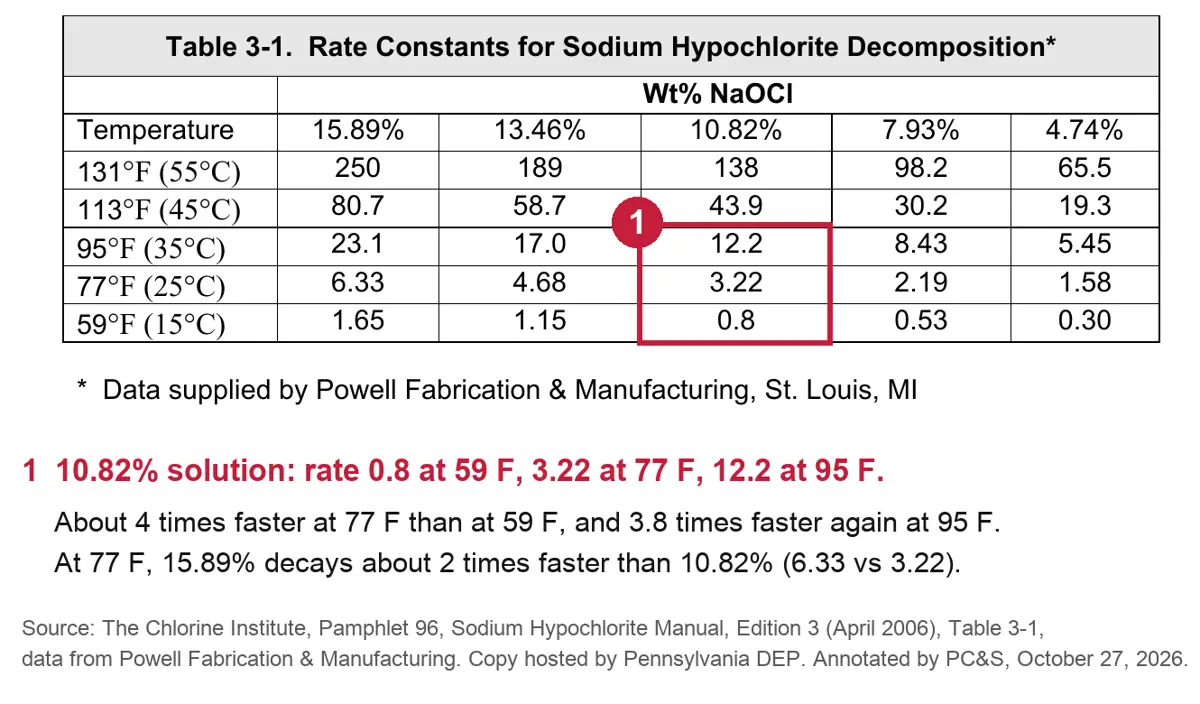
Strength speeds its own decay. The Chlorine Institute says halving concentration cuts the decomposition rate about 5 times, which is why a 10% jug at 70 F keeps about 85% after 90 days against 76% for 12.5%. Heat matters more: the Hasa SDS puts the rise at about 3.5 times per 10 C (18 F). The Hasachlor label says the product degrades with age, sunlight and heat, and the Comal label says it degrades with age.
For granules the picture is calmer. The EPA calcium hypochlorite profile gives about 24 months stored properly, against about 1 month in the EPA sodium hypochlorite profile, a window water utilities use for bulk tanks. We found no published decay figure for dichlor or monopersulfate; the Azure SDS says only that monopersulfate is stable under recommended storage.
Rather have a pro handle the chlorine?
How should you store liquid chlorine and granular shock?
Dry, cool, apart and in the original container. Cal-hypo above 50% is an NFPA 400 Class 3 oxidizer that can react violently with a small splash of water, while 12.5% liquid chlorine is classed as corrosive rather than as an oxidizer on its safety data sheet. CDC says keep every pool chemical below 95 F.
| Product | Hazard class on the SDS (OSHA HazCom, GHS) | NFPA 400 oxidizer class | Label storage rule | Never mix or store with | Source |
|---|---|---|---|---|---|
| Liquid chlorine 12.5% | Skin corrosion 1C; eye damage 1; corrosive to metals 1; no oxidizer class on the SDS (label: strong oxidizing agent) | Not listed in the BioGuard summary | Cool, dry, ventilated, out of direct sun and heat | Acids, ammonia, detergents (chlorine gas) | Hasa SDS (2020); Hasachlor label |
| Cal-hypo, over 50% | Oxidizing solid 2 (H272, may intensify fire); skin corrosion 1B | Class 3 | Dry, tightly closed, cool; a small amount of water can react violently | Trichlor, dichlor, acids, organics; Florida DOH warns of explosion | ProTeam Power 73 SDS; BioGuard; HTH Granular 73 label; Florida DOH |
| Dichlor, anhydrous 62% | Strong oxidizing agent (label) | Class 3 | Dry, tightly closed, away from heat or flame | Remnants of other products in a feeder | Dichlor label 98507-2; BioGuard |
| Dichlor dihydrate 56% | Strong oxidizing agent (label) | Class 1 | Dry, tightly closed, away from heat or flame | Water in small amounts, other products | Pace label 1258-984; BioGuard |
| Non-chlorine shock (MPS) | Skin corrosion 1B; eye damage 1; acute oral toxicity 4 | Not listed in the BioGuard summary | Dry, cool, ventilated, original container | Contamination; keep apart from chlorine products | Azure SDS (2014) |
Sources: Hasa SDS (2020); ProTeam Power 73 SDS (2020); Azure SDS (2014); BioGuard NFPA classification summary (2016); labels 10897-26, 1258-1239, 98507-2, 1258-984; Florida DOH. SDS hazard classes follow OSHA 29 CFR 1910.1200. Download CSV
The injury numbers are real. CDC’s analysis of the Consumer Product Safety Commission’s National Electronic Injury Surveillance System counted an estimated 13,508 emergency department visits for pool chemical injuries in 2015 to 2017, and at least 56.3% happened at a residence (MMWR, 2019). The EPA chemical safety alert names a small amount of water on dry chlorine as a classic cause. Newer counts are in our pool injury statistics report.
Should you use liquid chlorine or shock?
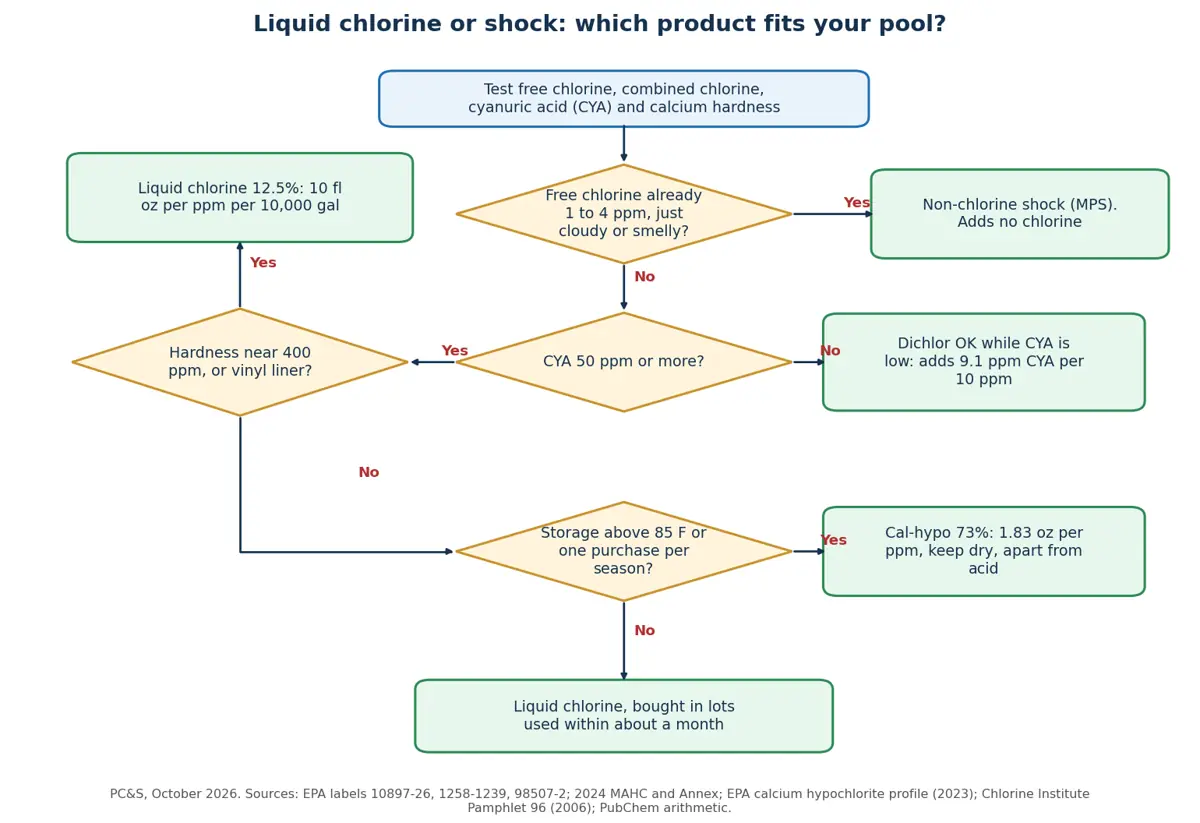
Use liquid chlorine if your stabilizer is 50 ppm or more, your calcium is high, you have a vinyl liner or you want the lowest cost per ppm and use it within about a month. Use granular cal-hypo when storage is hot or you buy once a season. Keep dichlor for new pools with little stabilizer, and monopersulfate for oxidizing between chlorine shocks.
| If your situation is | Do this | Why (source) |
|---|---|---|
| You want the lowest cost per ppm and use a jug within about a month | Liquid chlorine, 12.5% | $0.59 per ppm vs $1.03 for 1 lb bags of cal-hypo (Leslie's, Sept 2026) |
| Cyanuric acid at 50 ppm or more | Liquid chlorine or cal-hypo, not dichlor | Dichlor adds about 9.1 ppm cyanuric acid per 10 ppm, so five 10 ppm shocks take 50 ppm past the 90 ppm MAHC cap |
| Calcium hardness near 400 ppm (plaster) or 200 ppm (vinyl, fiberglass) | Liquid chlorine, not cal-hypo | Cal-hypo adds about 7.1 ppm hardness per 10 ppm (PubChem arithmetic; MAHC Annex ranges) |
| Vinyl liner pool | Liquid chlorine, or cal-hypo pre-dissolved at 1 oz per 2 qt of water | Scorch label 3432-76 |
| Storage spot above 85 F or you buy once a season | Granular cal-hypo, kept dry and apart from acid | About 24 months shelf life (EPA, 2023); liquid decays 3 to 4 times faster per 18 F (Chlorine Institute) |
| Fecal incident or repeated shocks | Unstabilized chlorine: liquid or cal-hypo | MAHC 6.5.3.2 hyperchlorination uses chlorine without cyanuric acid |
| pH already above 7.8 | Lower pH first, then shock; dichlor moves pH least | Florida DOH pH chart; Dichlor 98507-2 label (do not adjust pH and chlorinate together) |
| Cloudy, smelly water but free chlorine already 1 to 4 ppm | Non-chlorine shock (MPS) between chlorine shocks | MAHC Annex: oxidizer, adds no free chlorine; Leslie's: swim after 15 minutes |
| New outdoor pool with cyanuric acid under 30 ppm | Dichlor is fine for the first few shocks | Each 10 ppm adds about 9.1 ppm cyanuric acid (PubChem arithmetic) |
Sources: Leslie's prices (2026); MAHC 2024; MAHC Annex; Scorch label; Dichlor 98507-2 label; EPA (2023); Chlorine Institute; Florida DOH; Leslie's Fresh 'N Clear; PC&S arithmetic. Download CSV
| Product | One 10 ppm shock, 20,000 gal | 20 weekly shocks | Side effect after 20 shocks | Note |
|---|---|---|---|---|
| 12.5% liquid, bought fresh | $11.71 | $234.30 | About 330 ppm salt | Buy in lots you use within about a month |
| 12.5% liquid stored 90 days at 80 F | $17.25 | $345.05 | Same | Needs 1.47 times the fresh dose |
| 73% cal-hypo, 1 lb bags | $20.54 | $410.83 | About 141 ppm calcium hardness | Plaster pools target 200 to 400 ppm hardness |
| 70% cal-hypo, 25 lb bucket | $16.00 | $319.98 | About 141 ppm calcium hardness | Regular price; sale $139.99 |
| 55% dichlor, 8 lb | $22.74 | $454.83 | About 182 ppm cyanuric acid | Not workable for weekly shocks |
Prices as in the cost table (Leslie’s, Sept 2026); decay from Chlorine Institute Eq. 12 and 13; side effects from PubChem molar masses. 20 weekly shocks is a worked example, not a recommendation. Download CSV
How we compiled this
We read 30 primary documents and dated listings in October 2026: six EPA-registered pool chlorine labels and their EPA database records, the Florida and Pennsylvania health department manuals, the 2024 MAHC and its Annex, the Chlorine Institute’s Pamphlet 96, two EPA supply chain profiles, three safety data sheets, the OSHA hazard standard, the BioGuard NFPA summary, CDC’s MMWR and safety page, the EPA alert, NPIC, PubChem, OxyChem, and five Leslie’s product pages. Costs and decay figures are our arithmetic, shown in the tables. We did not test products, and forum threads were used only to find questions.
Frequently Asked Questions
How many gallons of liquid chlorine equals 1 bag of shock?
About 0.68 gallon of 12.5% liquid chlorine, or 0.85 gallon of 10%, matches one 1 lb bag of 73% cal-hypo. The HTH Granular 73 label says that bag gives 8.75 ppm in 10,000 gallons, and the Hasachlor chart needs 10 fl oz of 12.5% liquid per ppm, so 87.5 fl oz does the same job.
Can you shock a pool with just liquid chlorine?
Yes. The Hasachlor label (EPA Reg. No. 10897-26) directs 50 to 100 fl oz of 12.5% liquid per 10,000 gallons to super-chlorinate every 7 days, which reaches the 5 to 10 ppm shock range. Liquid chlorine adds no stabilizer, which suits pools with cyanuric acid at 50 ppm or more.
Is it okay to add liquid chlorine and shock at the same time?
Not mixed together. Pour each product into the pool water separately with the pump running, never into the same bucket or feeder; the Dichlor 98507-2 label forbids adding it to a dispenser holding other products, and Florida DOH warns cal-hypo mixed with trichlor or dichlor can explode. Count both doses toward one target, usually 10 ppm.
What are the downsides of using liquid chlorine?
It is heavy, about 10 lb per gallon (Hasa SDS), and it decays: a 12.5% jug stored at 80 F keeps about 68% of its strength after 90 days by the Chlorine Institute equation. It raises pH, corrodes metal and adds about 16.5 ppm of salt per 10 ppm dose.
Is it better to use shock or liquid chlorine?
For most backyard pools, fresh liquid chlorine: $0.59 per ppm in 10,000 gallons against $1.03 for 1 lb bags of 73% cal-hypo (Leslie’s, September 2026), with no stabilizer or calcium left behind. Granular cal-hypo wins when storage runs hot or you buy once a season, since EPA gives it about 24 months.
Can I just use pool shock instead of chlorine?
Chlorine shock, yes: the HTH Granular 73 label doses the same product at 5 to 7 oz per 10,000 gallons for daily chlorination in an unstabilized pool. Non-chlorine shock, no: the 2024 MAHC Annex notes potassium monopersulfate adds no free chlorine, so it cannot keep the 1 to 4 ppm residual that labels require.
Sources
- HASA, Inc. label on file with U.S. EPA (Pesticide Product and Label System). Hasachlor (sodium hypochlorite 12.5%), EPA Reg. No. 10897-26, label accepted April 24, 2026. Accessed 2026-10-27.
- Comal Chemical label on file with U.S. EPA (Pesticide Product and Label System). Sodium Hypochlorite 12.5% (Comal Chemical), EPA Reg. No. 103607-1, label dated September 28, 2025. Accessed 2026-10-27.
- Innovative Water Care label on file with U.S. EPA (Pesticide Product and Label System). HTH Granular 73 (calcium hypochlorite 73%), EPA Reg. No. 1258-1239, label file dated February 24, 2025. Accessed 2026-10-27.
- N. Jonas & Co. label on file with U.S. EPA (Pesticide Product and Label System). Scorch (calcium hypochlorite 68%, 65% available chlorine), EPA Reg. No. 3432-76, label notification September 22, 2025. Accessed 2026-10-27.
- Swimables Inc. label on file with U.S. EPA (Pesticide Product and Label System). Dichlor Chlorinating Granules (99% sodium dichloro-s-triazinetrione, 62% available chlorine), EPA Reg. No. 98507-2, label dated December 8, 2025. Accessed 2026-10-27.
- Innovative Water Care label on file with U.S. EPA (Pesticide Product and Label System). Pace Concentrated Pool Chlorinating Granules (dichlor dihydrate 99%, 56% available chlorine), EPA Reg. No. 1258-984, label dated June 21, 2018. Accessed 2026-10-27.
- U.S. Environmental Protection Agency (EPA). Pesticide Product and Label System record lookups (all six labels listed as Active). Accessed 2026-10-27.
- Florida Department of Health in Collier County. Swimming Pool Operators' Manual, 2016 Version (disinfectant chart, p. 22). Accessed 2026-10-27.
- Pennsylvania Department of Health. Public Swimming and Bathing Places: Operational and Biological Contamination Protocol Recommendations (November 1, 2016). Accessed 2026-10-27.
- Centers for Disease Control and Prevention (CDC). 2024 Model Aquatic Health Code, 5th Edition, Code Language. Accessed 2026-10-19.
- Centers for Disease Control and Prevention (CDC). 2024 Model Aquatic Health Code, 5th Edition, Annex. Accessed 2026-10-19.
- The Chlorine Institute (copy hosted by Pennsylvania DEP). Pamphlet 96, Sodium Hypochlorite Manual, Edition 3 (April 2006), Table 3-1 and Equations 12 and 13. Accessed 2026-10-27.
- HASA, Inc.. Safety Data Sheet No. 106, HASA 12.5% Sodium Hypochlorite Solution (revised January 9, 2020). Accessed 2026-10-27.
- U.S. Environmental Protection Agency. Water Sector Supply Chain Profile: Sodium Hypochlorite (March 2023). Accessed 2026-10-27.
- U.S. Environmental Protection Agency. Water Sector Supply Chain Profile: Calcium Hypochlorite (March 2023). Accessed 2026-10-27.
- Haviland Consumer Products, Inc.. Safety Data Sheet, ProTeam Power 73 calcium hypochlorite (prepared February 4, 2020). Accessed 2026-10-27.
- NAVA Water Products / Clearon (hosted by Imperial Pools). Safety Data Sheet, Azure Non-Chlorine Shock Oxidizer (revised November 11, 2014). Accessed 2026-10-27.
- BioGuard (BioLab) dealer training sheet. Oxidizing Agents by NFPA Classification (updated March 2016). Accessed 2026-10-27.
- Occupational Safety and Health Administration (OSHA). 29 CFR 1910.1200, Hazard Communication Standard. Accessed 2026-10-27.
- CDC, Morbidity and Mortality Weekly Report. Pool Chemical Injuries in Public and Residential Settings, United States, 2008 to 2017 (MMWR 2019;68(19)), from CPSC's National Electronic Injury Surveillance System. Accessed 2026-10-19.
- Centers for Disease Control and Prevention (CDC). Pool Chemical Safety (page dated June 24, 2025). Accessed 2026-10-19.
- U.S. Environmental Protection Agency. Chemical Safety Alert: Safe Storage and Handling of Swimming Pool Chemicals (EPA 550-F-01-003, March 2001). Accessed 2026-10-27.
- National Pesticide Information Center (Oregon State University and U.S. EPA). Pool and Spa Chemicals Fact Sheet. Accessed 2026-10-27.
- National Library of Medicine, PubChem. PubChem compound records: cyanuric acid (CID 7956), sodium dichloroisocyanurate (CID 517121), calcium hypochlorite (CID 24504), chlorine (CID 24526), calcium carbonate (CID 10112), sodium chloride (CID 5234). Accessed 2026-10-27.
- Occidental Chemical Corporation (hosted by Force Flow). OxyChem Sodium Hypochlorite Handbook. Accessed 2026-10-27.
- Leslie's (retail listing). Leslie's Pool Liquid Chlorine 4-Pack of 1 Gallon Bottles (Wayback capture September 22, 2026). Accessed 2026-10-27.
- Leslie's (retail listing). Leslie's Power Powder Plus 73% Calcium Hypochlorite Pool Shock, 6 x 1 lb (Wayback capture September 22, 2026). Accessed 2026-10-27.
- Leslie's (retail listing). Leslie's Power Powder Granular 70 Calcium Hypochlorite Pool Shock, 25 lbs (Wayback capture September 16, 2026). Accessed 2026-10-27.
- Leslie's (retail listing). Leslie's Chlor Brite Sodium Dichlor Granular Chlorine, 8 lbs (Wayback capture September 16, 2026). Accessed 2026-10-27.
- Leslie's (retail listing). Leslie's Fresh 'N Clear Non-Chlorine Oxidizing Pool Shock, 1 lb (Wayback capture July 19, 2026). Accessed 2026-10-27.
- Pool Construction & Service. Pool Equipment Prices (PC&S research; Leslie's listed prices via Wayback captures). Accessed 2026-10-27.
- Pool Construction & Service, from U.S. Bureau of Labor Statistics data. Pool Chemical Prices (PC&S research; BLS producer price indexes). Accessed 2026-10-27.
Related pages
Get Quotes From Licensed Local Pool Pros
Tell us what you need and your ZIP code. We match you with pool companies that cover your area.