Phosphates in Pool Water: What the ppb Reading Means and When to Remove Them
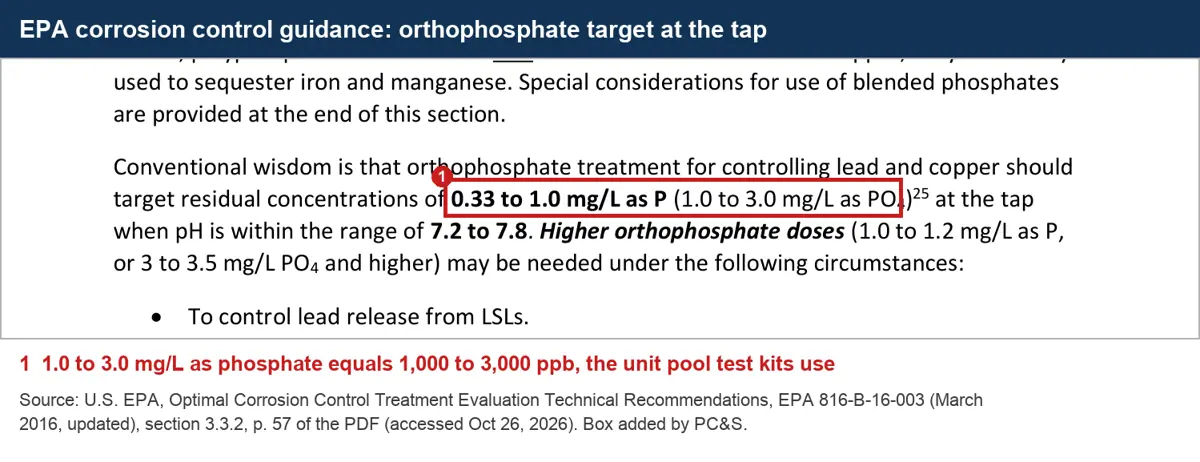
Phosphates in pool water are algae nutrients measured in parts per billion (ppb). Lead-control tap water can carry 1,000 to 3,000 ppb, but no CDC rule limits phosphate: steady free chlorine is the primary algae control.
- ✓Utility data, not guessesFill-water phosphate from named utility reports, converted to the ppb a pool test kit shows.
- ✓Doses from 5 maker labelsRemover doses for 1,000 ppb per 10,000 gallons, quoted from each maker's own directions.
- ✓IndependentPC&S sells no pool chemicals. We connect owners with licensed pool service companies.
Key takeaways
- Pool phosphate tests report orthophosphate in parts per billion; EPA notes that 3 mg/L as phosphate (PO4) is roughly 1 mg/L as phosphorus (P), so check which unit a water report uses (EPA 816-B-16-003).
- Utilities that dose orthophosphate for lead control target 1.0 to 3.0 mg/L as PO4 at the tap, or 1,000 to 3,000 ppb (EPA guidance, 2016); New York City averaged 2.2 mg/L across 2,901 samples in 2025 (NYC DEP).
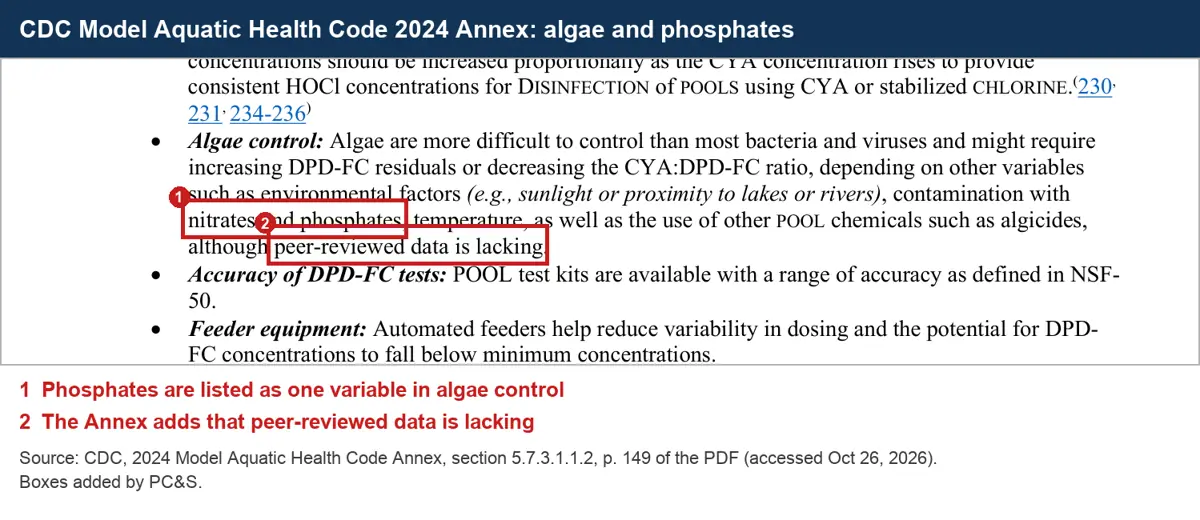
- The 2024 Model Aquatic Health Code sets no phosphate limit; its Annex lists phosphates as one variable in algae control and says peer-reviewed data is lacking (MAHC Annex 5.7.3.1.1.2).
- CDC’s floor for home pools is 1 ppm free chlorine, or 2 ppm with cyanuric acid, at pH 7.0 to 7.8 (CDC, May 2024).
- Remover strength differs about 13-fold: treating 1,000 ppb in 10,000 gallons takes 4 oz of SeaKlear Phosphate Remover but about 53 fl oz of Natural Chemistry PHOSfree, by each maker’s chart.
What does a phosphate reading in ppb mean?
A pool phosphate reading is the orthophosphate in the water, in parts per billion (ppb), which equals micrograms per liter: 1,000 ppb is 1 mg/L. Water utilities often report phosphorus (P) instead of phosphate (PO4). EPA’s corrosion guidance says 3 mg/L as PO4 is roughly 1 mg/L as P, so multiply a utility’s P figure by about 3 before comparing it with a pool test.
| Number | What it means | Source |
|---|---|---|
| 1,000 ppb = 1 mg/L | Pool tests report parts per billion, the same as micrograms per liter | Unit identity; Orenda writes ppb as µg/L |
| 3 mg/L as PO4 = about 1 mg/L as P | Utilities may report phosphate (PO4) or phosphorus (P); multiply a P figure by about 3 | EPA 816-B-16-003, footnote 17 |
| 1,000 to 3,000 ppb | Orthophosphate EPA's guidance targets at the tap for lead and copper control (0.33 to 1.0 mg/L as P) | EPA 816-B-16-003, section 3.3.2 |
| About 31 ppb | FLL fill-water guide value for natural swimming ponds: 0.01 mg/L orthophosphate as P | FLL 2017 via Lovibond |
| 125 ppb | Level HTH and SeaKlear maintenance doses aim to stay under; HTH repeats treatment above it | HTH and SeaKlear directions |
| 500 ppb | Orenda's stated goal for phosphate removal | Orenda PR-10,000 procedure |
| 5 ppm | PHOSfree: chlorine must be under 5 ppm before testing phosphates | Natural Chemistry PHOSfree directions |
| 1 ppm (2 ppm with cyanuric acid) | CDC minimum free chlorine for home pools, at pH 7.0 to 7.8 | CDC, May 10, 2024 |
| None | Phosphate limit in the 2024 Model Aquatic Health Code | MAHC 2024 Code and Annex |
Sources: EPA 816-B-16-003; FLL 2017 via Lovibond; HTH; SeaKlear; Orenda; Natural Chemistry; CDC; MAHC 2024. Download CSV
Most pool test kits read orthophosphate only. HASA, a pool chemical maker, notes that condensed phosphates such as polyphosphates can sit in the water without showing up, and EPA says polyphosphates can revert to orthophosphate in a distribution system, though it is difficult to predict when (p. 23 of the PDF). A low reading after a stain and scale product can therefore rise later.
The strictest number belongs to pools with no chlorine. FLL guide values for natural swimming ponds cap fill-water orthophosphate at 0.01 mg/L as P, about 31 ppb as phosphate (FLL 2017 via Lovibond). One testing rule comes from the PHOSfree directions: chlorine must be under 5 ppm before you test phosphate.
Where do phosphates in a pool come from?
Fill water is the largest predictable source wherever the utility doses orthophosphate for lead and copper control. The others are lawn fertilizer and soil, leaves and plant debris, rain runoff, swimmers, and pool products built on phosphates or phosphonates, such as some metal sequestrants. Evaporation removes water but leaves phosphate behind, so each top-up adds to the total.
- Tap water EPA’s 2016 guidance targets 1.0 to 3.0 mg/L as PO4 where orthophosphate is used; a 2019 Hazen and Sawyer survey of 60 utilities found 56% dosing in that range and 36% below 1.0 mg/L.
- Lawn fertilizer Minnesota Statutes 18C.60 bars phosphorus fertilizer on lawns statewide unless a soil test from the last 3 years shows a need or new turf is being established.
- Leaves and debris Orenda, a pool chemical maker, says leaves, grass clippings, pollen and wildfire ash carry phosphates that reach the water as the debris breaks down.
- Sequestrants and stain products HASA names phosphoric acid and phosphonate sequestrants, and the 2024 MAHC Annex advises against polyphosphate products where granular media filters such as sand are used.
- Evaporation and top-ups Phosphate does not evaporate, so every inch of replacement water adds its phosphate to what is already in the pool.
The fertilizer rule is Minnesota Statutes 18C.60; the tap water survey is Hazen and Sawyer, March 2019. Evaporation drives the top-up math: the Town of Flower Mound, Texas estimates summer loss at about half an inch a day, or 3.5 inches a week (Flower Mound), and our pool evaporation rate report compares cities.
| Fill water | Phosphate in fill water (ppb as PO4) | Added per inch of top-up (ppb) | Added per week at 3.5 inches (ppb) | Weeks of top-ups to add 500 ppb |
|---|---|---|---|---|
| New York City (2025 average) | 2,200 | 36.7 | 128.3 | 3.9 |
| Pittsburgh (median dose, 630 µg/L as P) | 1,932 | 32.2 | 112.7 | 4.4 |
| Brunswick County NC, Northwest plant (2024) | 1,520 | 25.3 | 88.7 | 5.6 |
| Brunswick County NC, 211 plant (2024) | 1,170 | 19.5 | 68.2 | 7.3 |
| Binghamton NY (2024 mean) | 101 | 1.7 | 5.9 | 84.9 |
| EPA tap target, low end | 1,000 | 16.7 | 58.3 | 8.6 |
| EPA tap target, high end | 3,000 | 50.0 | 175.0 | 2.9 |
PC&S arithmetic. Inputs: 7.48 gallons per cubic foot and 3.5 inches a week (Town of Flower Mound); fill-water values from the utility table below and EPA 816-B-16-003. Download CSV
Because the example pool averages 60 inches deep, each inch of top-up adds one sixtieth of the fill water’s phosphate: 319 gallons per inch, 1,117 gallons a week at 3.5 inches. With New York City water at 2,200 ppb that is about 128 ppb a week. Backwashing, splash-out and algae uptake remove some, so read the table as an upper bound.
How much phosphate is in tap water? Utility data
Anywhere from none listed to more than 2,000 ppb. New York City reported an average of 2.2 mg/L orthophosphate in 2025, about 2,200 ppb, and Brunswick County, North Carolina reported 1.52 mg/L at its Northwest plant in 2024. Binghamton, New York averaged 0.101 mg/L. Denver Water raises pH instead of adding orthophosphate, under an EPA variance.
| Utility | Corrosion control named in the report | Orthophosphate reported | ppb as phosphate (PO4) | Year | Source |
|---|---|---|---|---|---|
| NYC Department of Environmental Protection, New York | Phosphoric acid (orthophosphate) | 2.2 mg/L average; range 1.7 to 4.3; 2,901 samples | 2,200 | 2025 | NYC DEP 2025 report, p. 14 |
| Pittsburgh Water, Pennsylvania | Orthophosphoric acid since April 1, 2019 | Median dose 630 µg/L as P | About 1,930 (PC&S conversion) | 2019 onward | Balangoda et al., PLOS Water, 2025 |
| Brunswick County Public Utilities, North Carolina: Northwest plant | Orthophosphate (as PO4) | 1.52 mg/L average; range 1.40 to 1.80 | 1,520 | 2024 | Brunswick County 2024 report, p. 10 |
| Brunswick County Public Utilities: 211 groundwater plant | Orthophosphate (as PO4) | 1.17 mg/L average; range 0.0 to 2.6 | 1,170 | 2024 | Brunswick County 2024 report, p. 12 |
| City of Binghamton, New York | Orthophosphate (as PO4) | 0.101 mg/L mean; range 0.050 to 0.250 | 101 | 2024 | Binghamton 2024 water quality report |
| Washington Aqueduct (DC Water), District of Columbia | Orthophosphate, citywide since August 23, 2004 | Not printed in the 2025 report | Not reported | 2025 | DC Water 2025 report; DC Water 2004 notice |
| Philadelphia Water Department, Pennsylvania | Zinc orthophosphate | Not printed on the 2025 report page | Not reported | 2025 | PWD 2025 report |
| Denver Water, Colorado | pH and alkalinity adjustment (pH target 8.8) instead of orthophosphate, under an EPA variance | None added | None added | Current | Denver Water; EPA |
| Houston Public Works, Texas | No phosphate additive listed | None listed | Not listed | 2025 | Houston 2025 report |
| Tampa Water Department, Florida | No phosphate additive listed | None listed | Not listed | 2024 | Tampa 2024 report |
| Reference: EPA corrosion guidance | Orthophosphate target at the tap | 0.33 to 1.0 mg/L as P (1.0 to 3.0 mg/L as PO4) | 1,000 to 3,000 | 2016 | EPA 816-B-16-003 |
Sources: NYC DEP 2025; Balangoda et al. 2025 and Pittsburgh Water; Brunswick County 2024; City of Binghamton 2024; DC Water 2025 and DC Water 2004 notice; Philadelphia Water Department 2025; Denver Water and EPA; Houston 2025; Tampa 2024; EPA 816-B-16-003. Accessed October 26, 2026. Download CSV
Pool test kits read phosphate (PO4) in ppb. Pittsburgh's figure is a dose, converted from phosphorus at 3.066 times.
Source: Sources: NYC DEP 2025 report; Balangoda et al. 2025 (PLOS Water) for Pittsburgh, converted from 630 µg/L as P; Brunswick County 2024 report; City of Binghamton 2024 report; EPA 816-B-16-003. Accessed October 26, 2026.. Download chart data (CSV)
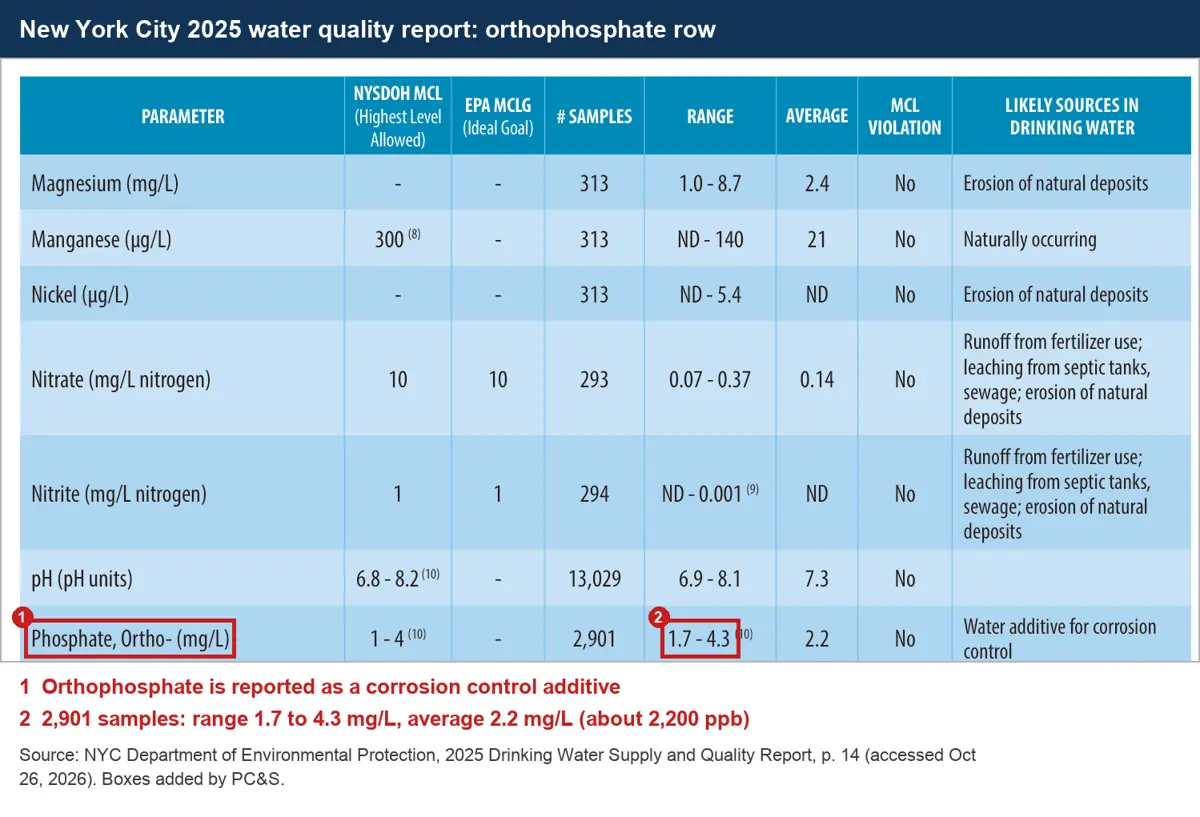
To find your own number, open your utility’s annual water quality report and search for orthophosphate, phosphate or corrosion inhibitor. If it gives mg/L as P, multiply by about 3. Pittsburgh’s median dose of 630 µg/L as P, reported in a 2025 PLOS Water study, works out to about 1,930 ppb as phosphate (Balangoda et al., 2025).
A report that lists no phosphate is not proof of zero: Houston’s 2025 report and Tampa’s 2024 report list no phosphate additive or result, so test a tap sample with the same kit you use on the pool. What a fill costs in 25 cities is in our cost to fill a pool ledger.
Do phosphates cause algae if chlorine is maintained?
Not on their own, by the public-health sources. CDC’s home pool guidance relies on free chlorine of at least 1 ppm, or 2 ppm with cyanuric acid, and the 2024 MAHC sets no phosphate limit. Its Annex says algae control may need more chlorine depending on phosphates and other variables, then adds that peer-reviewed data is lacking. Remover makers argue phosphate raises chlorine demand.
| What many guides say | What the primary source says | Source |
|---|---|---|
| Phosphates cause algae, so removing them stops algae | The MAHC Annex lists phosphates as one variable in algae control and says peer-reviewed data is lacking; CDC relies on free chlorine of at least 1 ppm (2 ppm with cyanuric acid) | MAHC 2024 Annex 5.7.3.1.1.2; CDC |
| 500 ppb is the industry limit | No CDC or MAHC phosphate limit exists; 500 ppb is Orenda's stated goal, and HTH and SeaKlear target 125 ppb | MAHC 2024; Orenda; HTH; SeaKlear |
| Shock gets rid of phosphates | Orenda states chlorine cannot remove phosphates because the two do not react directly | Orenda PR-10,000 page |
| Phosphates get in from landscaping, fertilizer and rain runoff (Pool Operation Management) | Where utilities dose orthophosphate, tap water carries it too: EPA guidance targets 1.0 to 3.0 mg/L as PO4, New York City averaged 2.2 mg/L in 2025, and 56% of 60 utilities in a 2019 survey dosed in the EPA range | EPA 816-B-16-003; NYC DEP 2025; Hazen and Sawyer 2019 survey |
| A zero reading means no phosphate | Most pool tests read orthophosphate only, and EPA says polyphosphates can revert to orthophosphate later | HASA; EPA 816-B-16-003, p. 23 |
| PR-10,000 is EPA-registered (Grey Shark Pools) | Orenda's cut sheet lists NSF/ANSI 50 certification and shows no EPA registration number | Orenda PR-10,000 cut sheet |
Sources: MAHC 2024 Annex; CDC; Orenda; HTH; SeaKlear; EPA; Hazen and Sawyer; HASA; Orenda cut sheet; claims from Grey Shark Pools and Pool Operation Management. Download CSV
The case for removal comes from the makers. Orenda says phosphates indirectly increase chlorine demand and sets 500 ppb as its removal goal, and HTH says removal deprives algae of a food source. The cautious view comes from HASA, a chlorine maker whose blog also points readers to PR-10,000: a phosphate reading by itself does not tell you whether a pool is properly sanitized. Both camps agree a remover never replaces chlorine.
Natural pools show the other model. With no chlorine, FLL guide values hold swim-water phosphorus at 0.01 to 0.03 mg/L, and our natural swimming pool guide explains why tap water at the EPA target is 33 to 100 times the fill-water value. A chlorinated pool cannot get that low on tap water, so chlorine does the algae control. Yellow or dark patches that survive normal chlorine have their own treatments in our mustard algae guide and black algae guide.
How do you get rid of phosphates in a pool?
Use a lanthanum or rare earth phosphate remover, dosed from its own label, with a clean filter and the pump running. The remover binds orthophosphate into a fine solid the filter catches, which is why the water can cloud for 24 to 48 hours. The steps below follow the HTH, Natural Chemistry PHOSfree, SeaKlear and Orenda PR-10,000 directions.
- Clear algae and confirm chlorineTreat any algae first and hold free chlorine at 1 ppm or more (CDC); PHOSfree says test phosphate only with chlorine under 5 ppm.
- Test the pool and the tapRead phosphate in ppb on the pool and on a tap sample, so you know whether top-ups will bring it back.
- Clean or backwash the filterHTH, SeaKlear and PHOSfree all start with a clean filter.
- Measure the label doseHTH: 16 fl oz per 10,000 gallons at 1,000 ppb. Orenda: no more than 8 fl oz per 10,000 gallons per treatment.
- Add it with the pump runningHTH and SeaKlear go over a wide area of the surface; PHOSfree goes into the skimmer.
- Filter without stoppingRun 24 hours (HTH, SeaKlear) or 48 hours without backwashing (PHOSfree). Clean the filter if pressure rises 10 psi over normal (SeaKlear).
- Clean the filter and the floorBackwash after 24 hours (HTH) or 48 hours (PHOSfree); Orenda says allow 12 to 24 hours for clouding to clear, then vacuum to waste.
- Retest at 48 hoursHTH says repeat the treatment if phosphate is still above 125 ppb.
| Product | Active ingredient (label or SDS) | Dose for 1,000 ppb per 10,000 gal | Single-dose limit or repeat rule | Maintenance dose | Dose for the 19,149 gal example pool at 800 ppb (PC&S arithmetic) | Source |
|---|---|---|---|---|---|---|
| HTH Pool Care Phosphate Remover | Lanthanum chloride | 16 fl oz | Not stated; repeat if still over 125 ppb after 48 hours | 2 fl oz per 10,000 gal weekly | 24.5 oz | HTH product directions |
| Natural Chemistry PHOSfree | Lanthanum (rare earth) compounds | About 53 fl oz (label: 32 oz at 600 ppb, 67.6 oz at 1,200 ppb) | 48 oz per dose on DE and cartridge filters | Not on this label | 81.7 oz (over the 48 oz cap: split into 2 doses) | Natural Chemistry PHOSfree directions |
| SeaKlear Phosphate Remover | Not stated on the product page | 4 oz | 32 oz per 10,000 gal removes up to 9,000 ppb | 1 oz per 5,000 gal weekly | 6.1 oz | SeaKlear directions |
| SeaKlear PhosKlear 4000 | Phosphate remover plus chitosan clarifier | 8 oz | 32 oz per 10,000 gal removes up to 4,000 ppb | 2 oz per 10,000 gal weekly | 12.3 oz | SeaKlear directions |
| Orenda PR-10,000 | Proprietary rare earth chloride (SDS) | 4 fl oz (500 to 1,000 ppb row); 8 fl oz for 1,000 to 2,000 ppb | 8 fl oz per 10,000 gal per treatment unless you vacuum and clean the filter next day | Use as needed | 7.7 oz | Orenda PR-10,000 procedure |
Sources: HTH; Natural Chemistry PHOSfree; SeaKlear Phosphate Remover; SeaKlear PhosKlear 4000; Orenda PR-10,000 procedure and SDS. Accessed October 26, 2026. Worked doses are PC&S arithmetic. Download CSV
Orenda's 4 fl oz is its 500 to 1,000 ppb row; its next row (1,000 to 2,000 ppb) is 8 fl oz.
Source: Sources: Natural Chemistry, HTH, SeaKlear and Orenda dosing directions, accessed October 26, 2026. PHOSfree value is PC&S arithmetic from its 600 ppb row (32 oz).. Download chart data (CSV)
Strength is the trap. Treating 1,000 ppb in 10,000 gallons takes 4 oz of SeaKlear Phosphate Remover or Orenda PR-10,000 but about 53 fl oz of PHOSfree, which coats the filter media instead of clouding the water. Convert each dose from its own label; the PHOSfree figure is PC&S arithmetic from the label’s 600 ppb row of 32 oz per 10,000 gallons.
Does shocking a pool get rid of phosphates?
No. Orenda, a maker of phosphate removers, states that chlorine cannot remove phosphates because the two do not react directly. Shock can even push a reading up, since Orenda notes that phosphates in leaves reach the water as the debris is oxidized. Only a remover, or a partial drain and refill with water that tests lower than the pool, brings the number down.
What are signs of phosphates in a pool? None you can see. HASA notes that a pool can hold high phosphate while staying clear and properly sanitized, so the only check is a test kit, such as Taylor’s K-1106 phosphate kit. Orenda’s capful cloud test is, by Orenda’s own description, reliable but not accurate. Haze and fast chlorine loss have other causes too, sorted in our cloudy pool water guide.
Do you really need to remove phosphates from a pool? Decision table
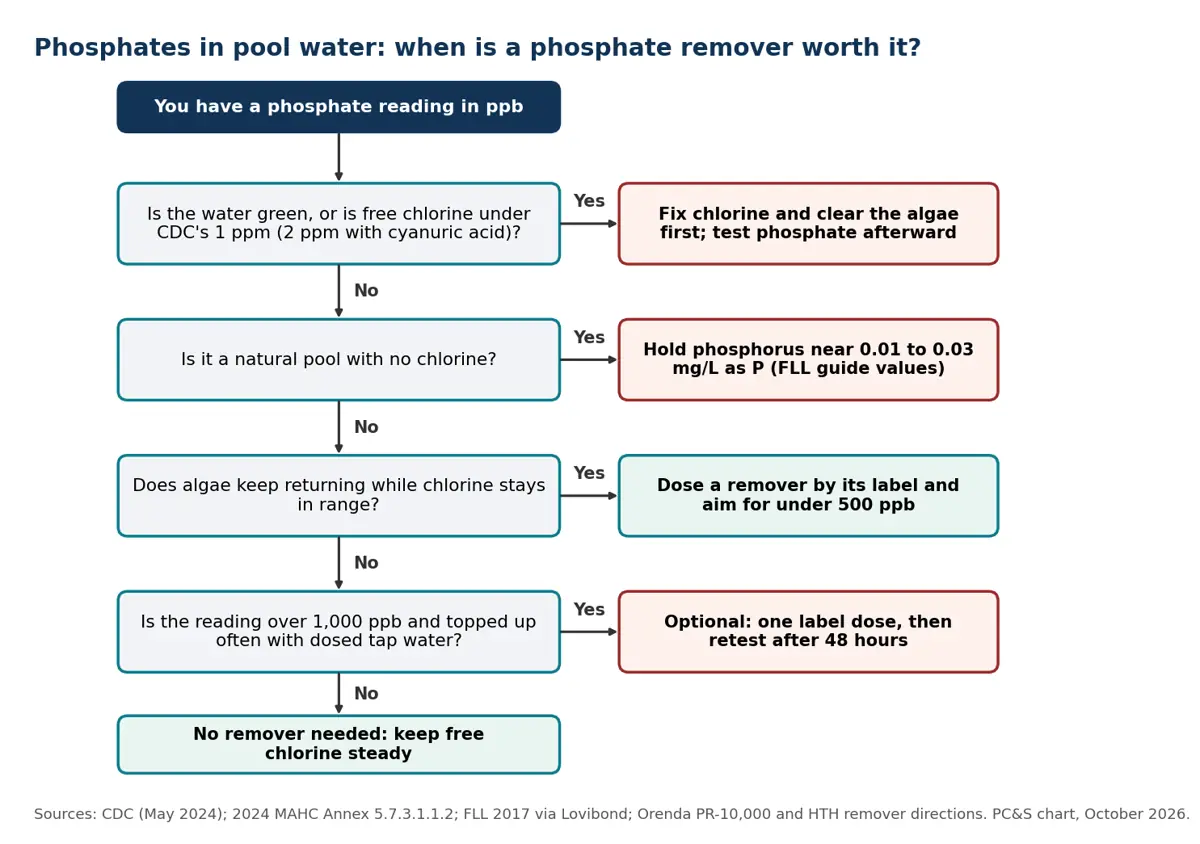
Only in a few situations. Fix chlorine first, then treat when algae keeps returning while free chlorine stays in range, or when the reading passes 1,000 ppb and your fill water keeps adding more. In a natural pool with no chlorine, phosphate control is the algae control. In a chlorinated pool with clear water and steady chlorine, a remover is optional.
| If your situation is | Do this | Why (source) |
|---|---|---|
| Water is green, or free chlorine is under 1 ppm (2 ppm with cyanuric acid) | Fix chlorine and clear the algae first; test phosphate afterward | CDC minimums; PHOSfree label: algae must be treated before lowering phosphates |
| Natural pool with no chlorine | Hold phosphorus near 0.01 to 0.03 mg/L as P and test fill water before the first fill | FLL 2017 guide values |
| Algae keeps returning while free chlorine stays in range and phosphate is over 500 ppb | Dose a remover by its label; aim for under 500 ppb | Orenda removal goal; MAHC Annex lists phosphates as an algae variable |
| Reading over 1,000 ppb and frequent top-ups with orthophosphate-dosed tap water | Optional: one label dose, then retest after 48 hours | HTH and SeaKlear 48 hour retest |
| Salt chlorine generator cannot hold free chlorine | Check cell output, cyanuric acid, run time and circulation before blaming phosphate | HASA: phosphate alone does not diagnose a salt system |
| DE or cartridge filter and the PHOSfree dose is over 48 oz | Split the dose and clean the filter between treatments | Natural Chemistry PHOSfree directions |
| Clear water, steady free chlorine, any phosphate reading | No remover needed | No CDC or MAHC phosphate limit |
Sources: CDC; FLL 2017 via Lovibond; Orenda; MAHC 2024 Annex; HTH; SeaKlear; HASA; Natural Chemistry. Download CSV
If you would rather hand this to a pro, ask the service company 3 things: what phosphate reading triggers a remover, which product and dose per 10,000 gallons it uses, and whether the visit includes cleaning the filter afterward. The chlorine side, including shock doses, is in our guide on how to shock a pool.
Is it safe to swim with phosphates or after a phosphate remover?
Neither CDC’s home pool guidance nor the 2024 MAHC sets a phosphate limit for swimmers; the documented risks sit in the products. SeaKlear’s directions say not to swim while its remover clouds the water, which can last up to 48 hours, and HTH calls for eye protection and gloves. Test reagents carry acid: Taylor recalled about 10,000 phosphate reagent bottles in 2025.
How we compiled this
We read water quality reports or pages from 9 utilities, EPA’s 2016 corrosion control guidance, the 2024 Model Aquatic Health Code and Annex, CDC home pool guidance, Minnesota Statutes 18C.60, a 2025 PLOS Water study, a 2019 utility survey, FLL guide values and the directions for 5 phosphate removers, all accessed in October 2026. Unit conversions and top-up figures are PC&S arithmetic. We did not test water or products, and we excluded forum posts as a source of facts.
Frequently Asked Questions
How do I get rid of phosphates in my pool?
Clear any algae and confirm free chlorine first, then clean the filter, test phosphate in ppb and dose a lanthanum or rare earth remover from its label. HTH Phosphate Remover uses 16 fl oz per 10,000 gallons for 1,000 ppb. Run the filter for 24 to 48 hours, clean it, and retest after 48 hours; HTH says repeat above 125 ppb.
Does shocking a pool get rid of phosphates?
No. Orenda, which makes phosphate removers, states that chlorine cannot remove phosphates because the two do not react directly. Shocking can even raise a reading as it breaks down leaves and other debris. To lower phosphate you need a remover dosed by its label, or a partial drain and refill with water that tests lower than the pool.
What are signs of phosphates in a pool?
There are none you can see. HASA notes that a pool can hold high phosphate while staying clear and properly sanitized. Indirect hints are fill water from a utility that doses orthophosphate, such as New York City at 2.2 mg/L in 2025, and algae that returns while chlorine reads in range. Only a test in ppb confirms it.
Do you really need to remove phosphates from a pool?
Usually not. CDC and the 2024 Model Aquatic Health Code set no phosphate limit and rely on free chlorine of at least 1 ppm, or 2 ppm with cyanuric acid. Removal makes sense when algae keeps returning with chlorine in range, or in a natural pool, where FLL guide values hold phosphorus near 0.01 to 0.03 mg/L.
Is it safe to swim in a pool with phosphates?
As far as public-health rules go, yes: neither CDC’s home pool guidance nor the 2024 MAHC sets a phosphate limit for swimmers. The precautions belong to the products. SeaKlear says not to swim while its remover clouds the water, which can last up to 48 hours, and Taylor recalled about 10,000 phosphate reagent bottles in 2025 over acid packaging.
What happens if I put too much phosphate remover in the pool?
Mostly filter trouble. Orenda caps PR-10,000 at 8 fl oz per 10,000 gallons per treatment because the fine precipitate can spike filter pressure, and PHOSfree limits DE and cartridge filters to 48 oz per dose. SeaKlear says to clean or backwash if pressure rises 10 psi over normal. Expect longer cloudiness, then vacuum the fallout and clean the filter.
Sources
- U.S. Environmental Protection Agency. Optimal Corrosion Control Treatment Evaluation Technical Recommendations, EPA 816-B-16-003 (March 2016, updated). Accessed 2026-10-26.
- New York City Department of Environmental Protection. 2025 Drinking Water Supply and Quality Report. Accessed 2026-10-26.
- PLOS Water. From pipes to streams: the hidden influence of orthophosphate additions on urban waterways (Balangoda et al., PLOS Water, November 14, 2025). Accessed 2026-10-26.
- Pittsburgh Water. Water Quality and Treatment. Accessed 2026-10-26.
- Brunswick County Public Utilities, North Carolina. Water Quality Report 2024. Accessed 2026-10-26.
- City of Binghamton, New York. Annual Water Quality Report for 2024. Accessed 2026-10-26.
- DC Water. 2025 Annual Drinking Water Quality Report. Accessed 2026-10-26.
- DC Water. Orthophosphate Update (August 16, 2004). Accessed 2026-10-26.
- Philadelphia Water Department. 2025 Drinking Water Quality Report. Accessed 2026-10-26.
- Denver Water. Water Chemistry (pH) FAQs, Lead Reduction Program. Accessed 2026-10-26.
- U.S. Environmental Protection Agency. EPA finds Denver Water's Lead Reduction Program effective. Accessed 2026-10-26.
- Houston Public Works. Houston Water Quality Report 2025. Accessed 2026-10-26.
- Tampa Water Department. 2024 Water Quality Report. Accessed 2026-10-26.
- Hazen and Sawyer. Corrosion Control: Results from a National Survey (March 2019 survey). Accessed 2026-10-26.
- Centers for Disease Control and Prevention. 2024 Model Aquatic Health Code Annex, 5th edition. Accessed 2026-10-26.
- Centers for Disease Control and Prevention. 2024 Model Aquatic Health Code, 5th edition. Accessed 2026-10-26.
- Centers for Disease Control and Prevention. Home Pool and Hot Tub Water Treatment and Testing (May 10, 2024). Accessed 2026-10-26.
- Lovibond. Natural Swimming Ponds (FLL 2017 guide values). Accessed 2026-10-26.
- Minnesota Office of the Revisor of Statutes. Minnesota Statutes 18C.60, Phosphorus turf fertilizer use restrictions. Accessed 2026-10-26.
- HTH. HTH Pool Care Phosphate Remover, directions and dosage guide. Accessed 2026-10-26.
- Natural Chemistry. PHOSfree, directions and dosage chart. Accessed 2026-10-26.
- SeaKlear. Phosphate Remover, directions and dosage guide. Accessed 2026-10-26.
- SeaKlear. PhosKlear 4000, directions and dosage guide. Accessed 2026-10-26.
- Orenda Technologies. How to Use PR-10,000. Accessed 2026-10-26.
- Orenda Technologies. PR-10,000 Phosphate Remover product page. Accessed 2026-10-26.
- Orenda Technologies. PR10000 Phosphate Remover Concentrate Safety Data Sheet (revised November 25, 2025). Accessed 2026-10-26.
- Orenda Technologies. PR-10,000 cut sheet. Accessed 2026-10-26.
- Orenda Technologies. Phosphates in Pools. Accessed 2026-10-26.
- HASA. The Basics of Phosphates in Pool Water (September 16, 2026). Accessed 2026-10-26.
- U.S. Consumer Product Safety Commission. Recall 25-173: Taylor Water Technologies Phosphate Reagent #1 bottles (March 6, 2025). Accessed 2026-10-26.
- Town of Flower Mound, Texas. Pool Evaporation. Accessed 2026-10-26.
Related pages
Get Quotes From Licensed Local Pool Pros
Tell us what you need and your ZIP code. We match you with pool companies that cover your area.