Gas Pool Heater Ban Registry: US Federal, State, Air District and City Rules as of October 2026
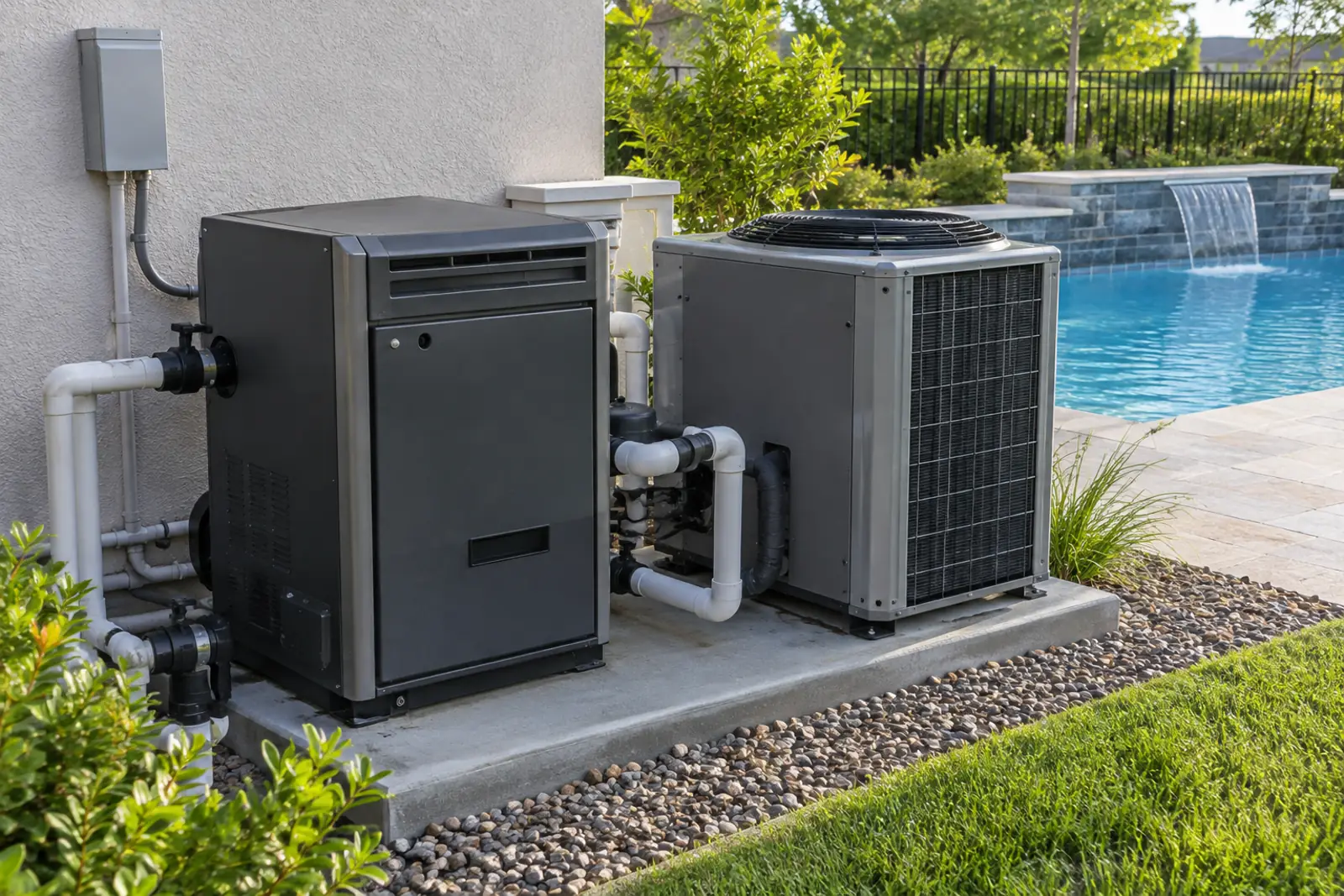
No US state has an outright gas pool heater ban as of October 18, 2026. Southern California's air district requires zero-NOx pool heaters for sales and installs from January 1, 2028 in new buildings and 2031 in existing ones. California's 2025 Energy Code requires heat pump or solar primary heat for new pools; federal standards tighten May 30, 2028.
Gas pool heater ban status in October 2026: 22 rules read on the primary text
No US state bans gas pool heaters outright as of October 18, 2026. The main binding limits sit in one federal efficiency standard, California’s building and appliance codes, and one air district rule that phases in zero-NOx pool heaters in 2028 and 2031. Six of the 22 entries are state laws that stop cities from restricting gas.
PC&S read each rule on the issuing body’s own text and coded whether it names pool or spa heaters. Of 22 registry entries, 12 are in force, 7 are adopted with a future date, 1 is proposed, 1 is suspended pending litigation and 1 was repealed (PC&S count, October 18, 2026). Nine entries name pool heaters directly, 4 have a scope clause that does not say, 1 reached them indirectly through a gas piping ban, 2 do not cover them and 6 are state preemption laws.
| Jurisdiction | Level | Rule | Covers gas pool heaters | What it requires | Status (Oct 18, 2026) | Effective or key date | Litigation | Evidence | Source |
|---|---|---|---|---|---|---|---|---|---|
| United States | Federal | 10 CFR 430.32(k)(1), DOE pool heater standard | Yes | Gas-fired pool heaters made April 16, 2013 to May 29, 2028 must reach at least 82% thermal efficiency | In force | 2013-04-16 | None found | Primary text (eCFR) | https://www.ecfr.gov/current/title-10/chapter-II/subchapter-D/part-430/subpart-C/section-430.32 |
| United States | Federal | 10 CFR 430.32(k)(2), DOE 2023 final rule (88 FR 34624) | Yes | Gas-fired and electric pool heaters made on or after May 30, 2028 must meet integrated thermal efficiency formulas; DOE says non-condensing gas heaters can comply; resistance heaters at DOE's 99% TEI fall short (PC&S calculation) | Adopted, future date | 2028-05-30 | None found | Primary text (eCFR, Federal Register) | https://www.govinfo.gov/content/pkg/FR-2023-05-30/html/2023-10849.htm |
| California | State (CEC) | Title 20, 20 CCR 1605.3(g)(1) and (g)(3) | Yes | Natural gas pool heaters may not have constant burning pilots; heat pump pool heaters made on or after March 1, 2003 need average COP of at least 3.5 | In force | 2003-03-01 | None found | Primary text (CCR via Cornell LII) | https://www.law.cornell.edu/regulations/california/20-CCR-1605.3 |
| California | State (CEC) | Title 24 Part 6, 2025 Energy Code, Sections 110.4(c) and 110.5 | Yes | New pool and spa heating must use a heat pump (gas allowed only as supplementary heat), solar of at least 60% of surface area, 60% renewable or recovered energy, or an approved equivalent; no continuously burning pilots; exception for alterations to pools with existing heating | In force | 2026-01-01 | None found | Primary text (CEC standards PDF) | https://www.energy.ca.gov/sites/default/files/2026-07/CEC-400-2025-010-F.pdf |
| South Coast AQMD | Air district | Rule 1146.2 Table 1 NOx limits | Yes | Gas pool heaters up to 400,000 Btu/h sold or installed must be certified to 55 ppmv (40 ng/J) NOx; larger units 20 ppmv | In force | 1998-01-09 | Rule upheld by Ninth Circuit, July 2, 2026 | Primary text (rule PDF) | https://www.aqmd.gov/docs/default-source/rule-book/reg-xi/rule-1146-2.pdf |
| South Coast AQMD | Air district | Rule 1146.2 zero-NOx limit, Phase II, new buildings | Yes | From January 1, 2028, gas pool heaters up to 2,000,000 Btu/h may not be sold or installed for new buildings unless they meet a 0 ppmv NOx limit (zero-emission units) | Adopted, future date | 2028-01-01 | Upheld, Rinnai v. SCAQMD (9th Cir. 2026); en banc rehearing sought | Primary text (rule PDF, opinion) | https://www.aqmd.gov/docs/default-source/rule-book/reg-xi/rule-1146-2.pdf |
| South Coast AQMD | Air district | Rule 1146.2 zero-NOx limit, Phase II, existing buildings | Yes | From January 1, 2031, the zero-NOx limit applies to sales and installations for existing buildings; homes (Residential Structures) are exempt from the age-based ban on operating older units | Adopted, future date | 2031-01-01 | Upheld, Rinnai v. SCAQMD (9th Cir. 2026); en banc rehearing sought | Primary text (rule PDF) | https://www.aqmd.gov/docs/default-source/rule-book/reg-xi/rule-1146-2.pdf |
| Bay Area AQMD | Air district | Rule 9-6-305 | Yes | Gas pool/spa heaters of 400,001 to 2,000,000 Btu/h made after January 1, 2013 limited to 20 ppm (14 ng/J) NOx; no zero-NOx date | In force | 2013-01-01 | None found | Primary text (rule PDF) | https://www.baaqmd.gov/~/media/dotgov/files/rules/reg-9-rule-6-nitrogen-oxides-emissions-from-natural-gasfired-water-heaters/2021-amendment/documents/20230315_rg0906-pdf.pdf |
| Bay Area AQMD | Air district | Rule 9-6 zero-NOx water heater limits (2023 amendments) | No | Zero-NOx for water heaters made after January 1, 2027 (up to 75,000 Btu/h) and 2031 (larger units); pool/spa heaters under 400,000 Btu/h exempt from 9-6-301 and 9-6-305 has no zero-NOx limit; amendments to delay to 2028 and 2033 go to hearing November 4, 2026; CARB says the Bay Area does not regulate pool heaters | Adopted, future date | 2027-01-01 | None found | Primary text (rule PDF, hearing notice) | https://www.baaqmd.gov/~/media/dotgov/files/rules/reg-9-rule-6-nitrogen-oxides-emissions-from-natural-gasfired-water-heaters/2021-amendment/documents/20230315_rg0906-pdf.pdf |
| Bay Area AQMD | Air district | Rule 9-4 furnaces (2023 amendments) | No | Zero-NOx for natural gas furnaces under 175,000 Btu/h made after January 1, 2029; space heating only | Adopted, future date | 2029-01-01 | None found | Primary text (rule PDF) | https://www.baaqmd.gov/~/media/dotgov/files/rules/reg-9-rule-4-nitrogen-oxides-from-fan-type-residential-central-furnaces/2021-amendments/documents/20230315_rg0904-pdf.pdf |
| California | State (CARB) | Clean Space and Water Heater Standards (proposal) | Yes | Proposed cap on the share of each manufacturer's California pool heater sales that may be GHG-emitting: 60% in 2030, 40% from 2031; credits allowed; not yet formally proposed to the Board | Proposed | 2030-01-01 | Not applicable | Agency workshop slides and FAQ | https://ww2.arb.ca.gov/sites/default/files/2025-12/December_2025_Workshop_Slides_ADA.pdf |
| New York State | State | All-Electric Buildings Act, Energy Law 11-104(6) to (8), buildings up to seven stories | Unclear | Code must bar fossil-fuel equipment and building systems in new buildings up to seven stories from December 31, 2025; pool heaters not named or exempted | Suspended pending litigation | 2025-12-31 | Upheld by Second Circuit June 30, 2026; en banc denied August 26, 2026; certiorari deadline November 24, 2026; effective date suspended by November 12, 2025 stipulation | Primary text (statute, opinion, stipulation) | https://www.nysenate.gov/legislation/laws/ENG/11-104 |
| New York State | State | All-Electric Buildings Act, all new buildings | Unclear | Same prohibition for all new buildings after December 31, 2028 | Adopted, future date | After December 31, 2028 | As R12 | Primary text (statute) | https://www.nysenate.gov/legislation/laws/ENG/11-104 |
| New York City | City | Local Law 154 of 2021, new buildings under seven stories | Unclear | No combustion of fuels emitting 25 kg or more CO2 per MMBtu within new buildings; scope phrase is 'within such building' | In force | 2024-01-01 | Upheld by Second Circuit June 30, 2026 | Primary text (court opinions quoting the law) | https://cdn.climatepolicyradar.org/navigator/USA/2023/association-of-contracting-plumbers-of-the-city-of-new-york-v-city-of-new-york_08618abc520e071472b6ca53bdd16703.pdf |
| New York City | City | Local Law 154 of 2021, new buildings of seven or more stories | Unclear | Same limit for taller new buildings from July 2, 2027 | Adopted, future date | 2027-07-02 | Upheld by Second Circuit June 30, 2026 | Primary text (court opinion) | https://cdn.climatepolicyradar.org/navigator/USA/2023/association-of-contracting-plumbers-of-the-city-of-new-york-v-city-of-new-york_08618abc520e071472b6ca53bdd16703.pdf |
| Berkeley, CA | City | Berkeley Municipal Code Chapter 12.80 (Ordinance 7,672-N.S.) | Indirect | Barred fuel gas piping in or in connection with new buildings or within the property lines; PC&S reads this as reaching gas piping to a pool heater | Repealed | 2020-01-01 | Held preempted by EPCA, Ninth Circuit (2023, amended 2024); repealed by Ordinance 7,907-N.S. (2024) | Primary text (opinion, repeal ordinance) | https://cdn.ca9.uscourts.gov/datastore/opinions/2024/01/02/21-16278.pdf |
| Florida | State preemption | Fla. Stat. 366.032 | Preempts local limits | Local governments may not restrict fuel sources supplied by gas utilities or LP gas dealers, or the use of appliances using them, except to enforce the state building or fire code | In force | July 1, 2021 (cutoff for void local measures) | None found | Primary text (statute) | http://www.leg.state.fl.us/statutes/index.cfm?App_mode=Display_Statute&URL=0300-0399/0366/Sections/0366.032.html |
| Arizona | State preemption | A.R.S. 9-810 and 11-867 (HB 2686) | Preempts local limits | Cities, towns and counties may not restrict use of a capable and authorized utility provider or deny building permits based on the utility provider | In force | Approved February 21, 2020 | None found | Primary text (session law) | https://www.azleg.gov/legtext/54leg/2R/laws/0003.pdf |
| Texas | State preemption | Utilities Code 181.903 (HB 17) | Preempts local limits | Political subdivisions may not ban or restrict utility connections or infrastructure based on the type or source of energy | In force | Passed May 4, 2021 | None found | Primary text (enrolled bill) | https://capitol.texas.gov/tlodocs/87R/billtext/html/HB00017F.htm |
| Louisiana | State preemption | La. R.S. 40:1730.21.1 (Acts 2020, No. 46) | Preempts local limits | Parishes and municipalities may not restrict use of a natural gas utility provider | In force | Acts 2020, No. 46 | None found | Primary text (statute) | https://www.legis.la.gov/legis/Law.aspx?d=1187451 |
| Georgia | State preemption | O.C.G.A. 46-1-6 | Preempts local limits | No governmental entity, state or local, may restrict gas or LP gas connections based on energy source or the appliance to be used | In force | Not stated in text read | None found | Statute text (FindLaw mirror) | https://codes.findlaw.com/ga/title-46-public-utilities-and-public-transportation/ga-code-sect-46-1-6/ |
| Tennessee | State preemption | Tenn. Code 7-51-2102 | Preempts local limits | Political subdivisions may not prohibit utility connections or the sale or installation of appliances for water heating or another end use based on energy source | In force | Not stated in text read | None found | Statute text (FindLaw mirror) | https://codes.findlaw.com/tn/title-7-consolidated-governments-and-local-governmental-functions-and-entities/tn-code-sect-7-51-2102/ |
Source: rule texts linked in each row, accessed October 18, 2026; PC&S coding of coverage and status. Download CSV
Timeline of gas pool heater rules and court rulings, 1998 to 2031
Most of the pool heater rules adopted since 2023 take effect between 2026 and 2031. The courts split in 2026: the Ninth Circuit upheld South Coast AQMD’s zero-NOx rule on July 2, 2026, while the Second Circuit upheld New York’s all-electric laws on June 30, 2026 and disagreed with the Ninth Circuit’s 2024 Berkeley ruling.
- Air districtScheduled: SCAQMD zero-NOx pool heaters, existing buildingsRule 1146.2 Phase II: sales and installations of pool heaters up to 2,000,000 Btu/h for existing buildings must be zero-NOx.
- CARB proposalProposed: CARB pool heater sales cap beginsCARB's December 2025 proposal would cap GHG-emitting pool heater sales at 60% of each manufacturer's California sales, then 40% from 2031.
- New YorkScheduled: NY all-electric rule reaches all new buildingsEnergy Law 11-104(6)(b) extends the fossil-fuel equipment ban to all new buildings after this date.
- FederalScheduled: DOE 2028 pool heater standardsGas-fired and electric pool heaters manufactured on or after this date must meet integrated thermal efficiency standards.
- Air districtScheduled: SCAQMD zero-NOx pool heaters, new buildingsRule 1146.2 Phase II starts for new buildings.
- New YorkScheduled: NYC Local Law 154 covers taller buildingsNew buildings of seven or more stories become subject to the 25 kg CO2 per MMBtu combustion limit.
- LitigationDeadline: certiorari petitions in the New York casesDeadline to ask the Supreme Court to review the Second Circuit decision, per the Sabin Center.
- Air districtHearing: Bay Area Rule 9-6 amendmentsThe Air District Board will consider exemptions and later zero-NOx dates for water heaters; pool/spa heater sections are unchanged in the proposal.
- CARB proposalCARB restates pool heater sales limitsCARB presentation lists pool heating limits of 60% (2030) and 40% (2035, 2040+) and says the Bay Area rules do not regulate pool heaters.
- LitigationSecond Circuit denies rehearing en bancPetitions for rehearing en banc of the New York decision were denied.
- LitigationAmicus brief supports rehearing in RinnaiA brief filed in No. 25-5129 supports rehearing en banc of the Ninth Circuit's Rule 1146.2 decision.
- LitigationNinth Circuit upholds SCAQMD Rule 1146.2EPCA does not preempt the zero-NOx rule that covers pool heaters (Rinnai America Corp. v. SCAQMD).
- LitigationSecond Circuit upholds New York all-electric lawsEPCA does not preempt NYC Local Law 154 or the state All-Electric Buildings Act; split with the Ninth Circuit.
- CaliforniaCalifornia 2025 Energy Code takes effectPermit applications from this date must meet Section 110.4(c): heat pump or solar primary heat for new pool and spa heating.
- New YorkNY all-electric date for low-rise buildings (suspended)Statutory start date for buildings up to seven stories; the implementing rules' effective date is suspended under the November 12, 2025 stipulation.
- CARB proposalCARB proposes emissive sales limitsWorkshop proposal replaces a 100% zero-emission concept with sales limits and credits starting in 2030, including a pool heating category.
- LitigationNew York suspends all-electric code dateStipulation filed in Mulhern Gas Co. v. Mosley suspends the effective date pending appeal and any certiorari petition.
- FederalDOE drops added pool heater reportingAfter a Congressional Review Act resolution, DOE removed integrated thermal efficiency reporting added in 2024; standards unchanged.
- LitigationDistrict court rules for New York StateJudgment for the Secretary of State in the challenge to the All-Electric Buildings Act (as recited in the stipulation).
- LitigationBerkeley case dismissedCalifornia Restaurant Association and Berkeley stipulate to dismissal after the city's repeal.
- Air districtSCAQMD amends Rule 1146.2Adds zero-NOx limits for pool heaters, larger water heaters and boilers; about 710,000 residential pool and spa heaters affected, per SCAQMD.
- CityBerkeley council passes repeal to printOrdinance 7,907-N.S. repealing Chapter 12.80 passed to print 8 to 0.
- LitigationNinth Circuit amends Berkeley opinionAmended opinion holds EPCA preempts Berkeley's ban on gas piping in new buildings; rehearing en banc denied.
- New YorkNYC Local Law 154 takes effectNew buildings under seven stories may not burn fuels emitting 25 kg or more CO2 per MMBtu.
- FederalDOE pool heater rule effectiveFinal rule effective; compliance with the new standards required from May 30, 2028.
- FederalDOE publishes pool heater final rule88 FR 34624 sets the first federal standards for electric pool heaters and new TEI standards for gas-fired models.
- Air districtBay Area amends Rules 9-4 and 9-6Zero-NOx dates for water heaters and furnaces; pool/spa heater sections unchanged.
- State preemptionFlorida preemption dateFlorida Statutes 366.032 voids local measures restricting fuel sources that existed on or before this date.
- State preemptionTexas HB 17 passes SenateAdds Utilities Code 181.903 barring local limits on utility service based on energy source.
- State preemptionArizona HB 2686 approvedAdds A.R.S. 9-810 and 11-867 preempting local limits on utility providers.
- CityBerkeley gas piping ban takes effectChapter 12.80 bars natural gas piping in newly constructed buildings.
- FederalDOE 82% thermal efficiency standardGas-fired pool heaters made from this date must reach 82% thermal efficiency.
- Air districtBay Area 20 ppm limit for large pool heatersRule 9-6-305 limit for pool/spa heaters of 400,001 to 2,000,000 Btu/h.
- CaliforniaCalifornia heat pump pool heater COP standardTitle 20 sets an average COP of at least 3.5 for heat pump pool heaters.
New York's second phase applies after December 31, 2028 and is shown in 2028.
Source: PC&S registry of federal, state, air district and city rule texts, accessed October 18, 2026. Download chart data (CSV)
The busiest year is 2028: DOE’s integrated thermal efficiency standard applies from May 30, 2028, South Coast AQMD’s zero-NOx requirement for new buildings from January 1, 2028, and New York’s all-electric requirement for all new buildings after December 31, 2028 (eCFR; SCAQMD Rule 1146.2; NY Energy Law 11-104).
The DOE pool heater rule for 2028: what gas and electric heaters must meet
The federal rule does not ban gas pool heaters. It sets a minimum integrated thermal efficiency (TEI) for gas-fired and electric pool heaters manufactured on or after May 30, 2028, which DOE expected about half of gas models to meet already and which electric resistance heaters cannot meet on DOE’s representative values.
- Gas-fired pool heaters made from April 16, 2013 until May 29, 2028 must reach at least 82% thermal efficiency (10 CFR 430.32(k)(1)).
- From May 30, 2028, gas-fired pool heaters must meet TEI = 84(Q IN + 491)/(Q IN + 2,536), and electric pool heaters TEI = 600(PE)/(PE + 1,619), with input capacity and active electrical power in Btu/h (DOE final rule, Table I.1).
- At 250,000 Btu/h of input, the 2028 gas floor works out to 83.32% TEI; at 400,000 Btu/h it is 83.57% (PC&S calculation from the DOE formula).
- DOE published the rule on May 30, 2023; it took effect July 31, 2023 (88 FR 34624; DOE).
- DOE estimated that 50% of gas-fired and 12% of electric consumer pool heaters already met the adopted levels, and that gas manufacturers would likely need to add a blower (Federal Register).
- DOE said the gas standard can be met by non-condensing heaters and did not adopt a condensing requirement (Federal Register).
- DOE set no standard for electric spa heaters or oil-fired pool heaters in this rule (Federal Register).
| Product class | Efficiency level | Design (DOE) | Representative TEI (%) | Projected 2028 share without new standards (%) | Meets 2028 standard |
|---|---|---|---|---|---|
| Gas-fired | EL 0 | Standing pilot, atmospheric | 61.1 | 4.1 | No |
| Gas-fired | EL 1 | Electronic ignition, atmospheric | 81.3 | 46.1 | No |
| Gas-fired | EL 2 | Electronic ignition, blower driven gas/air mix | 83.3 | 41.1 | Yes |
| Gas-fired | EL 3 | Condensing | 94.8 | 8.6 | Yes |
| Electric | EL 0 | Electric resistance | 99 | 8.8 | No |
| Electric | EL 1 | Heat pump | 387 | 10.4 | No |
| Electric | EL 2 | Heat pump, larger evaporator | 483 | 59.2 | No |
| Electric | EL 3 | Heat pump, larger evaporator | 534 | 9.4 | No |
| Electric | EL 4 | Heat pump, larger evaporator | 551 | 9.3 | Yes |
| Electric | EL 5 | Heat pump, larger condenser coil, off switch | 595 | 3.0 | Yes |
Source: DOE final rule, 88 FR 34624, Tables IV.6, IV.8, IV.14 and IV.15; PC&S coding of the adopted levels (TSL 5: EL 2 gas, EL 4 electric). Download CSV
On DOE’s projection, models below the adopted level made up 50.2% of the 2028 gas-fired market and 87.8% of the electric market without new standards (PC&S sum of DOE Tables IV.14 and IV.15). DOE’s representative TEI for electric resistance is 99%; the electric formula exceeds 99% at any active power above 319.9 Btu/h, so a resistance pool heater cannot comply (PC&S calculation).
Gas-fired models were about 72% of consumer pool heater units shipped each year, and about 92% of electric units were heat pumps, so heat pumps were about 25.8% of all units (DOE; PC&S calculation). DOE put the average life-cycle saving at $80 with a 2.3-year payback for gas-fired heaters and $1,130 with a 0.5-year payback for electric heaters, in 2021 dollars (DOE).
California Title 24: heat pump or solar primary heat for new pool heating since January 1, 2026
California does not prohibit gas pool heaters, but under its 2025 Energy Code a gas heater can serve a new pool or spa only as supplementary heat, according to the CEC. Replacing a heater on a pool that already has heating falls under an exception to the heat-source rule.
Buildings whose permit applications are filed on or after January 1, 2026 must meet the 2025 Energy Code (CEC). Section 110.4(c) requires pool and spa heating to use one of five paths: solar collectors covering at least 60% of the pool surface for single-family homes (65% for multifamily and nonresidential), a heat pump pool heater as the primary system with a supplementary heater of any energy source, at least 60% of annual heat from on-site renewable or recovered energy, solar plus a heat pump, or an approved equivalent (Title 24 Part 6, Section 110.4).
- Exception 2 to Section 110.4(c) covers alterations to existing pools and spas with existing heating systems or equipment (Section 110.4(c)).
- Spa-only heating is excepted in existing buildings with gas available, and where the roof lacks Solar Access Roof Area under 150.1(c)14 (Section 110.4(c)).
- With a heat pump and a supplementary heater, the supplementary heater may not run when the heat pump alone can meet the load (Section 110.4(d)).
- Outdoor pools and spas with gas or electric heating must have a cover (Section 110.4(b)3).
- Gas pool and spa heaters may not have a continuously burning pilot light (Section 110.5; Title 20 1605.3(g)(1)).
- Heat pump pool heaters made on or after March 1, 2003 must have an average COP of at least 3.5 (Title 20 1605.3(g)(3)).
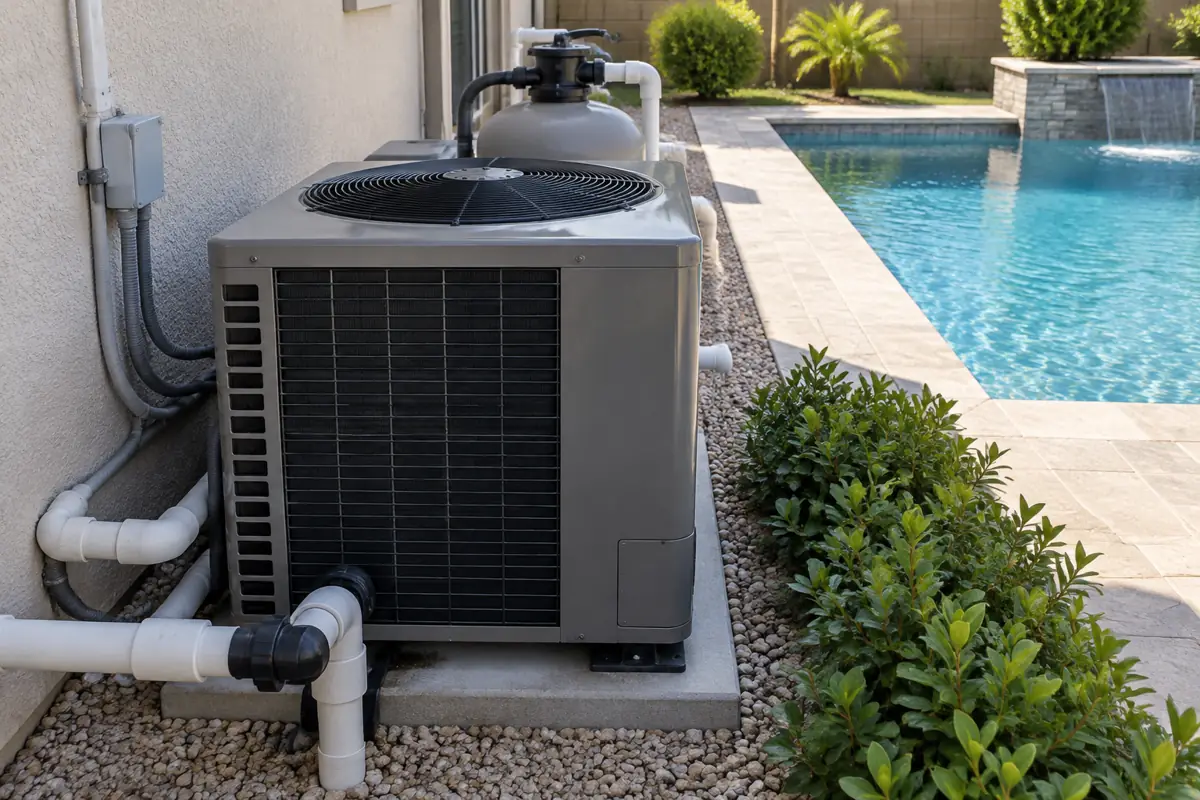
The 2022 code had no heating-source subsection; it instead barred electric resistance pool heating except for insulated package units and pools getting at least 60% of heat from site solar or recovered energy, and required 36 inches of pipe between filter and heater, now 18 inches (2022 Title 24 Part 6; 2025 Title 24 Part 6).
South Coast AQMD Rule 1146.2: zero-NOx pool heaters from 2028 and 2031
Rule 1146.2 is the only rule in this registry that phases out the sale and installation of gas pool heaters on a fixed date. It covers natural gas units up to 2,000,000 Btu/h in the South Coast AQMD, applies to new buildings from January 1, 2028 and existing buildings from January 1, 2031, and does not force homeowners to retire a working heater.
- Scope: natural gas units with rated heat input of 2,000,000 Btu/h or less; a pool heater is a water heater designed and used to heat a pool, hot tub or spa; pools and spas count as part of the building (Rule 1146.2 (b), (c)).
- Today: pool heaters up to 400,000 Btu/h must be certified to 55 ppmv (40 ng/J) NOx; larger units to 20 ppmv (14 ng/J) (Rule 1146.2 Table 1).
- From January 1, 2028 (new buildings) and January 1, 2031 (existing buildings), no person may manufacture, supply, sell, offer for sale or install a pool heater in the district unless it meets a 0 ppmv NOx and CO limit (Rule 1146.2 (d)(2), Tables 2 and 3).
- Homes are exempt from the rule’s ban on operating a unit past its Table 2 unit age (15 years for pool heaters up to 400,000 Btu/h, 25 years for larger units); that ban applies to other owners, with an exemption for registered small businesses (Rule 1146.2 (k)(4), (k)(5), Table 2).
- Units subject to Rule 1121 are exempt; Rule 1121 covers water heaters under 75,000 Btu/h, and SCAQMD says pool heaters rated 75,000 Btu/hr to 2 million Btu/hr fall under Rule 1146.2 (Rule 1121; SCAQMD).
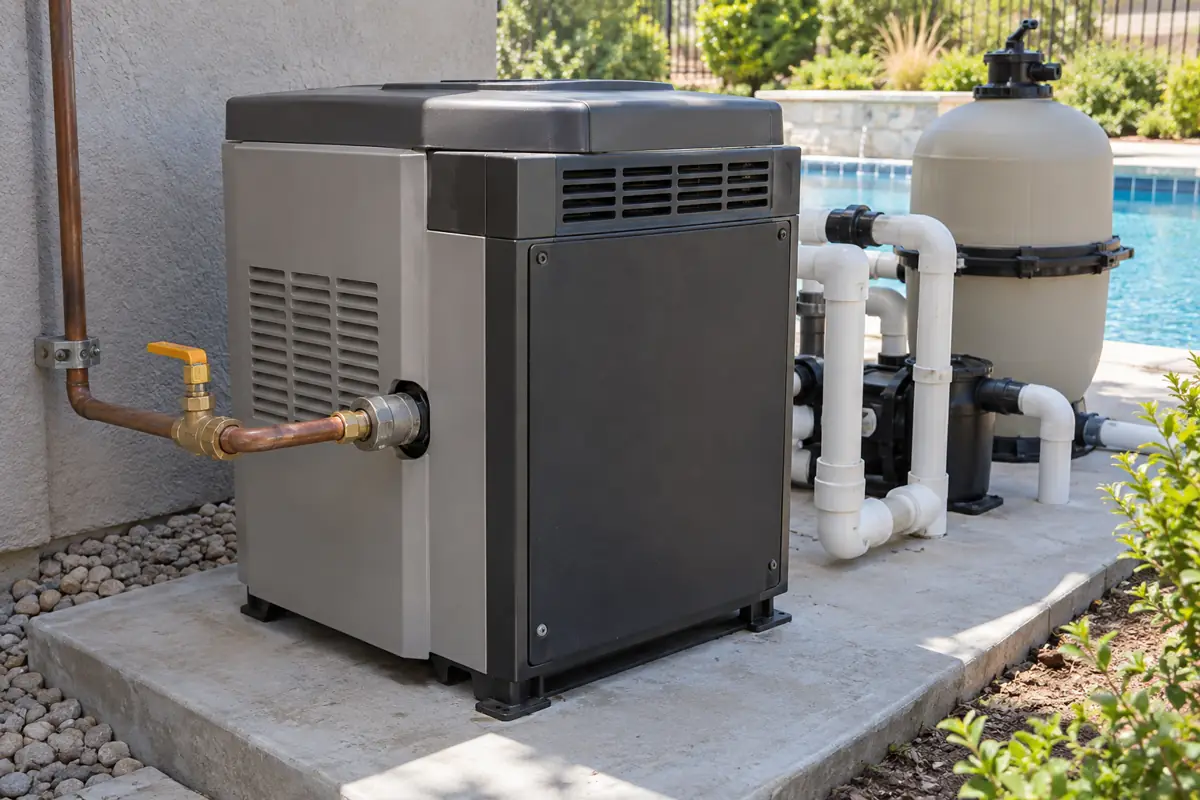
SCAQMD estimated the 2024 amendments affect about 1 million units, including approximately 710,000 natural gas-fired residential pool and spa heaters whose NOx limits had not changed since 1998, and expected a cut of about 5.6 tons per day of NOx (SCAQMD). The rule text addresses units fired with natural gas; propane-only units are not addressed (Rule 1146.2 (b)).
On July 2, 2026 the Ninth Circuit held that the federal Energy Policy and Conservation Act (EPCA) does not preempt amended Rule 1146.2, affirming summary judgment for the district over a dissent by Judge Lee (Rinnai America Corp. v. SCAQMD). An amicus brief supporting rehearing en banc was filed on August 24, 2026 (DktEntry 75.2); PC&S found no ruling on rehearing as of October 18, 2026.
Bay Area Rules 9-4 and 9-6: no zero-NOx date for gas pool heaters
The Bay Area’s 2023 zero-NOx rules name water heaters, boilers and furnaces, not pool heaters, and CARB reads them as not regulating pool heaters. Pool and spa heaters under 400,000 Btu/h are exempt from Section 9-6-301, and larger pool heaters face a 20 ppm NOx limit with no zero-NOx date.
- Rule 9-6-110.4 exempts natural gas pool/spa heaters under 400,000 Btu/h used only for pools, hot tubs or spas from Section 9-6-301 (Rule 9-6).
- Rule 9-6-305 limits pool/spa heaters of 400,001 to 2,000,000 Btu/h made after January 1, 2013 to 20 ppm (14 ng/J) NOx (Rule 9-6).
- Zero-NOx limits apply to storage water heaters up to 75,000 Btu/h made after January 1, 2027 and to boilers and water heaters of 75,001 to 2,000,000 Btu/h made after January 1, 2031; Section 9-6-305 for pool/spa heaters has no zero-NOx limit (Rule 9-6).
- Rule 9-4 covers natural gas furnaces under 175,000 Btu/h for space heating, zero-NOx from January 1, 2029 (Rule 9-4).
CARB said on September 16, 2026 that its proposed statewide rule covers pool heaters, an equipment type the Bay Area does not regulate (CARB). The Bay Area Air District Board will hold a hearing on November 4, 2026 on amendments that would add exemptions and move the water heater dates to 2028 and 2033; the pool/spa heater sections are unchanged in the proposed text (hearing notice; proposed strikethrough).
CARB's proposed statewide cap on gas pool heater sales from 2030
CARB’s clean space and water heater standard is a proposal, not a rule. The December 2025 version would cap the share of each manufacturer’s California pool heater sales that may emit greenhouse gases at 60% in 2030 and 40% from 2031, with tradable credits, and would not require anyone to replace a working heater.
Proposal only; CARB had not submitted a formal regulatory proposal to its Board as of the July 13, 2026 FAQ.
Source: California Air Resources Board, December 11, 2025 workshop slides 13 and 14; September 16, 2026 presentation. Download chart data (CSV)
CARB’s FAQ, last updated July 13, 2026, says the regulation has not been finalized and no formal regulatory proposal has gone to the Board (CARB FAQ). The December 11, 2025 proposal applies to equipment up to 2,000,000 Btu/h from January 1, 2030 and set separate limits for space heating, water heating and pool heating (CARB workshop slides). For comparison, the water heater limit would be 60% in 2030 and 50% from 2045, and the space heater limit 40% in 2030 and 25% from 2045 (CARB FAQ).
CARB’s baseline assumes pool heater emissive sales drop considerably in 2031 to match South Coast Rule 1146.2 (CARB). The concept has narrowed over time: the 2022 State SIP Strategy concept was 100% zero-GHG sales from 2030, and the May 2024 concept put pool heaters on a 2031 date (CARB May 2024 slides; CARB). DOE’s 2023 rule described the 2022 strategy as one that would effectively ban sales of new gas-fired pool heaters beginning in 2030 (DOE).
New York State and New York City all-electric laws: pool heaters are not named
New York’s state law and New York City’s Local Law 154 bar fossil fuel equipment in most new buildings, and both were upheld by the Second Circuit on June 30, 2026. Neither text names pool heaters, so whether an outdoor gas pool heater at a new home is covered is unclear on the texts read.
- State law: the code must prohibit fossil-fuel equipment and building systems in new buildings up to seven stories (except commercial or industrial buildings over 100,000 square feet) on or after December 31, 2025, and in all new buildings after December 31, 2028; existing buildings are excluded (Energy Law 11-104).
- Scope clause: “fossil-fuel equipment and building systems” means equipment that uses fossil fuel for combustion, or systems that supply or deliver fossil fuel for any purpose other than motor vehicles; equipment includes plumbing and heating equipment and “other mechanical additions or installations” (11-104(8); 11-102). The listed exemptions do not mention pool heaters.
- Status: under a stipulation filed November 12, 2025, the effective date of the implementing rules (19 NYCRR 1240.6 and Subpart 1229-2) is suspended until 120 days after the Second Circuit mandate, or longer if a certiorari petition is filed (N.D.N.Y. stipulation).
- New York City: Local Law 154 bars combustion of fuels emitting 25 kg or more of CO2 per million Btu “within such building” in new buildings under seven stories since January 1, 2024 and in taller buildings from July 2, 2027 (S.D.N.Y. opinion; Second Circuit).
The Second Circuit held on June 30, 2026 that EPCA does not preempt either law and acknowledged its split with the Ninth Circuit (Second Circuit opinion). Rehearing en banc was denied on August 26, 2026, and the certiorari deadline is November 24, 2026, according to the Sabin Center (Sabin Center).
Berkeley's gas piping ban and the EPCA preemption split
Berkeley’s 2019 ban on gas piping in new buildings, which reached piping within the property lines, was held preempted by EPCA in the Ninth Circuit and repealed in 2024. Pool heaters are EPCA covered products, so local rules that restrict them face the same preemption question.
Berkeley’s Chapter 12.80, effective January 1, 2020, barred “fuel gas piping … in or in connection with a building, structure or within the property lines of premises” in newly constructed buildings (Ninth Circuit, quoting the ordinance). The Ninth Circuit held in an opinion filed April 17, 2023 and amended January 2, 2024 that EPCA preempts building codes that ban natural gas piping within new buildings (89 F.4th 1094).
The Berkeley council passed Ordinance 7,907-N.S. repealing Chapter 12.80 to print on May 14, 2024 by 8 to 0 (City of Berkeley), and the parties stipulated to dismissal on August 12, 2024 (N.D. Cal. stipulation; Climate Case Chart). The Congressional Research Service reported in July 2026 that the Justice Department began litigation in January 2026 against state and local gas restrictions and that several California localities walked back gas infrastructure bans (CRS).
Which states preempt local gas bans: Florida, Arizona, Texas and three more
In Florida, Arizona, Texas, Louisiana, Georgia and Tennessee, state law stops cities and counties from restricting gas service. PC&S read six statutes; three (Florida, Georgia, Tennessee) also name appliances, which would include a pool heater, and Georgia’s law binds state agencies as well as local ones.
| State | Statute | Enacted or effective (as read) | Who it binds | Names appliances | What it bars |
|---|---|---|---|---|---|
| Florida | Fla. Stat. 366.032 | Voids local measures existing on or before July 1, 2021 | Local governments and districts | Yes | Restricting fuel sources from gas utilities or LP gas dealers, or the use of appliances using them |
| Arizona | A.R.S. 9-810, 11-867 | Approved February 21, 2020 | Cities, towns, counties | No | Restricting use of a capable and authorized utility provider; denying permits based on the provider |
| Texas | Utilities Code 181.903 | HB 17 passed May 4, 2021 | Regulatory and planning authorities, political subdivisions | No | Banning or limiting utility connections or infrastructure based on energy type or source |
| Louisiana | La. R.S. 40:1730.21.1 | Acts 2020, No. 46 | Parishes, municipalities | No | Restricting use of a natural gas utility provider |
| Georgia | O.C.G.A. 46-1-6 | Not stated in text read | State and local governmental entities | Yes | Restricting gas or LP gas connections based on energy source or the appliance to be used |
| Tennessee | Tenn. Code 7-51-2102 | Not stated in text read | Political subdivisions | Yes | Prohibiting utility connections or the sale or installation of appliances for water heating or another end use |
Source: Florida Statutes, Arizona Laws 2020 ch. 3, Texas HB 17, Louisiana R.S. 40:1730.21.1, O.C.G.A. 46-1-6, Tenn. Code 7-51-2102. Download CSV
Florida’s statute voids local measures that existed on or before July 1, 2021 and, in subsection 2, bars local restrictions on using an appliance that runs on gas or LP gas, except to enforce the Florida Building Code or Fire Prevention Code (Fla. Stat. 366.032). Arizona’s HB 2686 was approved February 21, 2020 (Arizona Legislature). Texas HB 17 passed the Senate on May 4, 2021 (Texas Legislature).
The National Propane Gas Association counts 27 states with such energy choice laws, representing 51% of propane gallons sold (NPGA). PC&S did not verify that count statute by statute. None of these laws changes the federal efficiency standards, which apply in every state.
How many heated pools use gas: 43.9% nationally, 56.5% in the Pacific division
Natural gas is the main heating fuel for 1.51 million of 3.44 million heated US pools in 2024. The share is highest in the West South Central and Pacific divisions and lowest in the South Atlantic, where electric heating dominates.
Divisions with withheld natural gas counts are not shown.
Source: EIA, 2024 RECS Tables HC2.1, HC2.7, HC2.8 (preliminary, March 2026); PC&S calculation. Download chart data (CSV)
| Region or division | Homes with a pool (million) | Heated pools (million) | Natural gas (million) | Electricity (million) | Propane (million) | Some other fuel (million) | Natural gas share of heated pools (%) |
|---|---|---|---|---|---|---|---|
| United States | 9.6 | 3.44 | 1.51 | 1.27 | 0.28 | 0.38 | 43.9 |
| Northeast | 1.64 | 0.52 | 0.22 | 0.14 | 0.13 | Q (withheld) | 42.3 |
| Midwest | 1.26 | 0.38 | 0.15 | 0.15 | Q (withheld) | Q (withheld) | 39.5 |
| South | 4.44 | 1.42 | 0.51 | 0.73 | Q (withheld) | Q (withheld) | 35.9 |
| South Atlantic | 2.63 | 0.92 | 0.19 | 0.61 | Q (withheld) | Q (withheld) | 20.7 |
| West South Central | 1.28 | 0.43 | 0.3 | Q (withheld) | Q (withheld) | Q (withheld) | 69.8 |
| West | 2.26 | 1.12 | 0.63 | 0.26 | Q (withheld) | 0.21 | 56.2 |
| Mountain South | 0.72 | 0.23 | 0.12 | Q (withheld) | Q (withheld) | 0.05 | 52.2 |
| Pacific | 1.49 | 0.85 | 0.48 | 0.21 | Q (withheld) | 0.16 | 56.5 |
Source: EIA RECS 2024 HC2.1, HC2.7, HC2.8 (preliminary, March 2026); PC&S share calculation. Download CSV
In 2024, 9.6 million US primary homes had a pool and 3.44 million heated it: 1.51 million mainly with natural gas, 1.27 million with electricity, 0.28 million with propane and 0.38 million with some other fuel (EIA RECS 2024). Counting propane, gas-fired heaters serve 52.0% of heated pools nationally and 67.3% in the Northeast (PC&S calculation). For the size of the installed base, see how many swimming pools there are in the US.
Gas heater vs heat pump running costs in the states with the strictest and loosest rules
In this eight-state comparison, the heat pump’s running-cost advantage is smallest where rules push hardest toward heat pumps. In PC&S’s season scenario at 2025 prices, the gas minus heat pump gap is $183 a season in California and $203 in New York, against an average of $466 in six states that preempt local gas limits.
Regional heat loads applied to state prices; heat pump at COP 5.0.
Source: PC&S Cost to Heat a Pool model (EIA RECS 2020 loads, EIA 2025 average prices). Download chart data (CSV)
| State | Rule context | Gas heater season cost ($, 2025 prices) | Heat pump season cost ($, 2025 prices) | Gas minus heat pump ($) | Heat pump cost as % of gas |
|---|---|---|---|---|---|
| California | Title 24 heat pump or solar rule; SCAQMD; proposed CARB cap | 695 | 512 | 183 | 73.7 |
| New York | All-electric law (suspended); NYC Local Law 154 | 804 | 601 | 203 | 74.8 |
| Florida | Preempts local limits | 1058 | 315 | 743 | 29.8 |
| Arizona | Preempts local limits | 587 | 241 | 346 | 41.1 |
| Texas | Preempts local limits | 806 | 320 | 486 | 39.7 |
| Louisiana | Preempts local limits | 722 | 260 | 462 | 36.0 |
| Georgia | Preempts local limits | 848 | 305 | 543 | 36.0 |
| Tennessee | Preempts local limits | 492 | 273 | 219 | 55.5 |
Source: PC&S Cost to Heat a Pool model (EIA RECS 2020 regional loads, EIA 2025 state prices), reused without change. Download CSV
The figures come from the PC&S cost to heat a pool model and are reused here unchanged. Across the US at 2025 prices that scenario puts a typical gas-heated pool at $582 a season with gas and $327 with a heat pump, and in July 2026 a heat pump delivered heat more cheaply in 44 of 44 jurisdictions with EIA gas prices (PC&S calculation). Solar is the other compliant primary source under Title 24; see solar pool heaters.
Import duties on gas heaters and heat pumps are tracked in pool equipment tariffs. Permit steps for a heater swap are covered in pool permits, and more reports are in the PC&S research library.
What the record shows
- Gas-fired pool heaters made from April 16, 2013 to May 29, 2028 must reach 82% thermal efficiency, United States (10 CFR 430.32(k)(1)).
- From May 30, 2028, the US gas-fired floor is TEI = 84(Q IN + 491)/(Q IN + 2,536), equal to 83.32% at 250,000 Btu/h input (DOE; PC&S calculation).
- DOE projected that 50.2% of 2028 US gas-fired shipments and 87.8% of electric shipments would sit below the adopted levels without the standard (DOE Tables IV.14, IV.15; PC&S sum).
- Heat pumps were about 25.8% of all US consumer pool heater units shipped, against about 72% gas-fired (DOE; PC&S calculation).
- South Coast AQMD pool heaters up to 400,000 Btu/h are limited today to 55 ppmv NOx, a limit SCAQMD says had not changed since 1998 (Rule 1146.2 Table 1; SCAQMD).
- SCAQMD estimated about 710,000 gas-fired residential pool and spa heaters in its district affected by the June 7, 2024 amendments (SCAQMD).
- The Ninth Circuit upheld Rule 1146.2 against an EPCA preemption challenge on July 2, 2026 (Rinnai v. SCAQMD).
- Bay Area pool and spa heaters under 400,000 Btu/h are exempt from Rule 9-6-301 and have no pool-specific NOx limit; larger ones face a 20 ppm limit since January 1, 2013 (BAAQMD Rule 9-6).
- California permit applications filed from January 1, 2026 must use a heat pump, solar covering at least 60% of a single-family pool’s surface, or 60% renewable or recovered energy as the primary pool heat source (Title 24 Section 110.4(c)).
- CARB’s December 11, 2025 proposal would cap GHG-emitting pool heater sales at 60% in 2030 and 40% from 2031 in California (CARB).
- New York State’s all-electric law covers new buildings up to seven stories from December 31, 2025 and all new buildings after December 31, 2028, but its effective date is suspended (Energy Law 11-104; stipulation).
- New York City’s Local Law 154 has applied to new buildings under seven stories since January 1, 2024 and reaches taller buildings July 2, 2027 (S.D.N.Y.).
- Berkeley’s 2020 gas piping ban was held preempted by the Ninth Circuit on January 2, 2024 (amended opinion) and repealed in 2024 (Ninth Circuit; City of Berkeley).
- In 2024, natural gas was the main fuel for 69.8% of heated pools in the West South Central division and 20.7% in the South Atlantic division (EIA RECS 2024; PC&S calculation).
- At 2025 prices, the season cost gap between a gas heater and a heat pump was $183 in California and $743 in Florida for a typical gas-heated pool (PC&S cost-to-heat-a-pool model).
Patterns across the registry
- No US state has an outright ban on gas pool heaters as of October 18, 2026; of 22 registry entries, 12 are in force, 7 adopted with a future date, 1 proposed, 1 suspended and 1 repealed (PC&S registry).
- Southern California: from January 1, 2028 (new buildings) and January 1, 2031 (existing buildings), gas pool heaters up to 2,000,000 Btu/h must be zero-NOx to be sold or installed (SCAQMD Rule 1146.2).
- California statewide: since January 1, 2026, new pool and spa heating must use a heat pump, solar or renewable energy as the primary source, with gas allowed as supplementary heat (Title 24 Section 110.4(c); CEC).
- United States: gas-fired and electric pool heaters made from May 30, 2028 must meet new integrated thermal efficiency floors; DOE expected 50% of gas models already to comply (DOE final rule).
- California proposal: CARB would cap GHG-emitting pool heater sales at 60% of each manufacturer’s California sales in 2030 and 40% from 2031; it was not before the Board as of July 13, 2026 (CARB).
- New York: the state all-electric law and NYC Local Law 154 were upheld June 30, 2026, but neither names pool heaters, and the state law’s effective date is suspended pending further appeal (Second Circuit; stipulation).
- Florida, Arizona, Texas, Louisiana, Georgia and Tennessee have statutes barring local restrictions on gas service; Florida, Georgia and Tennessee also name appliances (Fla. Stat. 366.032; O.C.G.A. 46-1-6; Tenn. Code 7-51-2102).
- In 2024, natural gas was the main fuel for 43.9% of 3.44 million heated US pools and 56.5% in the Pacific division (EIA RECS 2024; PC&S calculation).
Counts and rates we derived
Registry status count
How many US pool heater rules are in force, scheduled, proposed or gone?
count of registry entries by status as read on October 18, 2026Inputs: registry rows R01 to R22; derived D1, D2, D3
Limitations: A rule with two dates counts twice; coverage is coded from scope clauses, and 4 entries are coded unclear.
Gas share of heated pools by region
Where would gas pool heater rules reach the most homes?
natural gas heated pools / heated pools x 100, by region and divisionInputs: fact rows on RECS 2024 HC2.1, HC2.7, HC2.8; derived D4, D5
Limitations: Preliminary RECS 2024; several cells withheld; primary homes only; state-level data not published.
Running-cost gap in rule states
Do the states pushing heat pumps hardest also see the largest savings from them?
gas season cost minus heat pump season cost (reused PC&S model); mean across preemption states vs California and New YorkInputs: derived D10, D11, D13
Limitations: Scenario uses regional heat loads and average-revenue prices; heat pump COP 5.0.
Preemption map
Which states stop cities from banning gas pool heaters?
statutes read on primary or mirrored text; flag whether appliances are namedInputs: fact rows on FL, AZ, TX, LA, GA, TN statutes and NPGA count
Limitations: Only six statutes read; NPGA’s count not verified; Georgia and Tennessee text read on a commercial mirror.
2028 federal readiness
How much of the pool heater market already meets the May 30, 2028 standard?
sum of DOE projected 2028 shares at or above the adopted efficiency levelsInputs: derived D7, D8, D9
Limitations: DOE projection without new standards; representative TEI values per efficiency level.
Recent entries
- Bay Area Air District set a November 4, 2026 hearing on Rule 9-6 amendments; pool/spa heater sections are unchanged (notice).
- CARB restated its proposed pool heating sales limits and said Bay Area rules do not regulate pool heaters (CARB).
- Second Circuit denied rehearing en banc in the New York cases; certiorari deadline November 24, 2026 (Sabin Center).
- Ninth Circuit upheld South Coast AQMD Rule 1146.2, which phases in zero-NOx pool heaters (opinion).
- Second Circuit upheld New York State’s all-electric law and NYC Local Law 154 (opinion).
- California’s 2025 Energy Code took effect for new permit applications, with heat pump or solar primary pool heating (CEC).
Questions about the registry
When does the South Coast AQMD pool heater rule start?
Zero-NOx limits apply to sales and installation of pool heaters for new buildings from January 1, 2028 and existing buildings from January 1, 2031 (Rule 1146.2 Table 3).
Will I have to replace a working gas pool heater in Southern California?
Not at a home. Rule 1146.2 (k)(4) exempts Residential Structures from its ban on operating units past their unit age, which is 15 years for pool heaters up to 400,000 Btu/h (Rule 1146.2).
Does the Bay Area ban gas pool heaters?
No. Pool and spa heaters under 400,000 Btu/h are exempt from Rule 9-6 Section 9-6-301, and larger units face a 20 ppm NOx limit with no zero-NOx date (BAAQMD Rule 9-6).
Can a gas heater be the backup to a heat pump under Title 24?
Yes. Section 110.4(c) allows a heat pump as primary heater with a supplementary heater of any energy source, and 110.4(d) bars the backup from running when the heat pump can meet the load (2025 Title 24).
Are propane pool heaters covered by these rules?
It depends. SCAQMD Rule 1146.2 applies to units fired with natural gas, and CARB says it will evaluate whether to include propane (SCAQMD; CARB). Propane heated 0.28 million US pools in 2024 (EIA RECS 2024).
Does New York City's gas ban cover outdoor pool heaters?
Unclear. Local Law 154 bars combustion of fuels emitting 25 kg or more CO2 per MMBtu “within such building” in new buildings since January 1, 2024, and does not name pool heaters (S.D.N.Y. opinion).
Which states prohibit cities from banning gas?
What NOx limit applies to gas pool heaters in Southern California today?
Pool heaters up to 400,000 Btu/h must be certified to 55 ppmv (40 ng/J) NOx until the 2028 and 2031 zero-NOx dates (Rule 1146.2 Table 1).
How many US homes heat a pool with natural gas?
1.51 million primary homes in 2024, out of 3.44 million homes with a heated pool (EIA RECS 2024).
Do the 2028 federal standards require condensing gas pool heaters?
No. DOE said the adopted gas standard can be met by non-condensing heaters, though manufacturers would likely need to add a blower (DOE final rule).
Other questions
Are gas pool heaters being banned?
Not outright anywhere statewide as of October 18, 2026. The closest is South Coast AQMD Rule 1146.2, which bars sale and installation of gas pool heaters that emit NOx from January 1, 2028 for new buildings and January 1, 2031 for existing buildings in its district (SCAQMD).
Is California banning gas pool heaters?
Not statewide. Since January 1, 2026 the Energy Code requires heat pump, solar or renewable primary heat for new pool heating, with gas allowed as supplementary heat (Title 24). CARB’s proposed 60% then 40% sales cap is not adopted (CARB).
What is the DOE pool heater rule 2028?
Gas-fired and electric pool heaters made on or after May 30, 2028 must meet integrated thermal efficiency formulas; a 250,000 Btu/h gas heater needs 83.32% TEI (10 CFR 430.32(k)(2); PC&S calculation). DOE expected 50% of gas models already to comply (DOE).
Can I still install a gas pool heater?
In most of the US, yes, if it meets the 82% federal efficiency floor until May 29, 2028 (eCFR). In California a new pool needs heat pump or solar primary heat, and in the South Coast AQMD gas units must be zero-NOx from 2028 or 2031 (Title 24; SCAQMD).
Do heat pump pool heaters meet the new rules?
Heat pumps are the named primary option in California’s Title 24 and must reach a 3.5 average COP under Title 20 (Title 24; Title 20). For 2028, DOE projected 12% of electric pool heaters already at the adopted level, so many heat pump models must improve (DOE).
How the registry is compiled and checked
- Listed candidate rules from the brief and searched the Federal Register API, agency rule books and court dockets for 2025 and 2026 actions (raw/fr_search_*.json, raw/serper_*.json).
- Read each rule on its primary text: eCFR and Federal Register for DOE; CEC standards PDFs and Title 20 text; CARB FAQ and workshop slides; SCAQMD and Bay Area rule PDFs and hearing notices; New York statutes; Florida, Arizona, Texas and Louisiana statutes on legislature sites; Georgia and Tennessee on FindLaw.
- Read court opinions and filings: Ninth Circuit Berkeley (2024) and Rinnai (2026), Second Circuit New York (2026), S.D.N.Y. (2025), the N.D.N.Y. stipulation (2025) and the Berkeley dismissal (2024).
- Coded each entry for pool heater coverage (Yes, Unclear, Indirect, No, Preempts local limits) by quoting the scope clause, and for status as of October 18, 2026.
- Computed regional gas shares from EIA RECS 2024 tables HC2.1, HC2.7 and HC2.8 and DOE 2028 formula examples (scripts/build.py).
- Reused, without change, state season-cost scenarios from the PC&S cost-to-heat-a-pool model.
Included: Federal, state, air district and city rules that set efficiency, emission or fuel requirements for gas pool or spa heaters, or that ban gas equipment in new buildings, plus state laws that preempt local gas restrictions, with a primary text available on October 18, 2026.
Excluded: Rules whose primary text could not be opened (San Joaquin Valley Rule 4308; Montgomery County, Maryland, final enacted text), secondary summaries without a primary source, and product price claims.
Conflicting numbers: Where secondary pages or competitor articles described rules differently from the rule text (for example, describing Title 24 as banning gas heaters on replacement), the rule text and the agency FAQ were used, and remaining differences are flagged as unclear. SCAQMD’s 710,000 heater estimate and RECS’s 0.48 million Pacific gas-heated pools are reported separately as different measures.
Derived metrics: Status and coverage counts are tallies of the registry. Gas shares divide RECS natural gas counts by heated pools. TEI examples apply DOE’s formulas to illustrative inputs. Cost gaps subtract reused heat pump from gas season costs.
Caveats
- Coverage of pool heaters is unclear for New York State and New York City because neither text names them.
- RECS 2024 is preliminary and withholds several regional cells; RECS 2020 regional tables were not used because 2024 supersedes them for this characteristic.
- Only six state preemption statutes were read; the 27-state count is a trade association figure.
- Court status can change quickly; the New York certiorari deadline is November 24, 2026 and a rehearing request in Rinnai was pending.
Method last reviewed October 18, 2026.
Citing the registry
Figures from the registry
- As of October 18, 2026, no US state bans gas pool heaters outright; South Coast AQMD requires zero-NOx pool heaters for new buildings from January 1, 2028 and existing buildings from January 1, 2031. (South Coast Air Quality Management District)
- From May 30, 2028, a 250,000 Btu/h gas pool heater sold in the US must reach 83.32% integrated thermal efficiency. (U.S. Department of Energy, Federal Register)
- CARB’s December 2025 proposal would cap GHG-emitting pool heater sales at 60% of each manufacturer’s California sales in 2030 and 40% from 2031. (California Air Resources Board)
- In 2024, 1.51 million US homes heated a pool mainly with natural gas, 43.9% of 3.44 million heated pools. (U.S. Energy Information Administration)
- SCAQMD estimated about 710,000 gas-fired residential pool and spa heaters in its district are affected by its 2024 zero-NOx rule. (South Coast Air Quality Management District)
- Since January 1, 2026, new pool heating in California must use a heat pump, solar or renewable energy as the primary source. (California Energy Commission)
Records to cite directly
- Rule 1146.2, Emissions of Oxides of Nitrogen from Large Water Heaters and Small Boilers and Process Heaters (amended June 7, 2024), South Coast Air Quality Management District
- 10 CFR 430.32(k), Energy and water conservation standards: pool heaters (eCFR, current as of October 2026), U.S. Government Publishing Office / National Archives (eCFR)
- 2025 Building Energy Efficiency Standards, Title 24, Part 6 (CEC-400-2025-010-F), Sections 110.4 and 110.5, California Energy Commission
- Public Workshop slides, Zero-Emission Space and Water Heater Standards (December 11, 2025), California Air Resources Board
- Rinnai America Corp. v. South Coast AQMD, No. 25-5129 (9th Cir. July 2, 2026), opinion, U.S. Court of Appeals for the Ninth Circuit
- 2024 Residential Energy Consumption Survey, Table HC2.1 (preliminary, March 2026), U.S. Energy Information Administration
Registry summary
No US state bans gas pool heaters outright as of October 18, 2026, according to a Pool Construction & Service registry of 22 rules read on their primary texts. The firmest phase-out is in Southern California: South Coast AQMD Rule 1146.2 requires zero-NOx pool heaters for sales and installations from January 1, 2028 in new buildings and January 1, 2031 in existing buildings, and the Ninth Circuit upheld it on July 2, 2026. California’s 2025 Energy Code has required heat pump or solar primary heat for new pools since January 1, 2026. Federal pool heater efficiency standards tighten on May 30, 2028. CARB has proposed, but not adopted, a cap that would hold GHG-emitting pool heater sales to 60% in 2030 and 40% from 2031. New York’s all-electric laws do not name pool heaters. Six state laws reviewed bar local gas restrictions. Natural gas heats 43.9% of 3.44 million heated US pools (EIA, 2024).
Headlines the record supports
- No state bans gas pool heaters outright, but Southern California sets 2028 and 2031 zero-NOx dates
- Federal pool heater standard tightens May 30, 2028; DOE expected half of gas models already to comply
- California's 2025 Energy Code makes heat pumps or solar the primary heat for new pools
- CARB proposes capping gas pool heater sales at 40% of California sales from 2031
- Natural gas heats 43.9% of heated US pools, 56.5% in the Pacific division
Cite the registry
Pool Construction & Service. "Gas Pool Heater Ban Registry: US Federal, State, Air District and City Rules as of October 2026." PC&S Research Desk, October 18, 2026. https://poolconstructionandservice.com/research/gas-pool-heater-rules/
Reuse
The data tables and charts in this report are licensed under CC BY 4.0. Reuse them with this attribution: “Source: Pool Construction & Service (poolconstructionandservice.com), Gas Pool Heater Ban Registry: US Federal, State, Air District and City Rules as of October 2026.” Figures from third-party sources remain subject to their publishers’ terms.
Registry files
- Registry of US gas pool heater rules, status as of October 18, 2026 CSV
- Timeline of gas pool heater rules and court rulings, 1998 to 2031 CSV
- DOE projected 2028 pool heater market by efficiency level CSV
- State laws preempting local gas restrictions, six states CSV
- Heated pools by main fuel, US regions and divisions, 2024 CSV
- Gas heater vs heat pump season cost, eight states, 2025 prices CSV
- Full fact sheet with sources and limitations CSV
Source types
Tier 1: primary and government sources (42)
- U.S. Government Publishing Office / National Archives (eCFR): 10 CFR 430.32(k), Energy and water conservation standards: pool heaters (eCFR, current as of October 2026)
- U.S. Government Publishing Office / National Archives (eCFR): 10 CFR 430.2, Definitions: pool heater (eCFR, current as of October 2026)
- U.S. Department of Energy, Federal Register: Energy Conservation Standards for Consumer Pool Heaters, final rule, 88 FR 34624 (May 30, 2023)
- U.S. Department of Energy, Federal Register: Certification, Labeling and Enforcement: Congressional Review Act revocation, 90 FR 43371 (September 9, 2025)
- Office of the Federal Register: Federal Register API search: documents mentioning "pool heaters" published January 1, 2025 to October 18, 2026
- U.S. Department of Energy: Consumer Pool Heaters: standards and test procedures page
- California Energy Commission (text via Cornell LII): Cal. Code Regs. tit. 20, section 1605.3(g), State standards for pool heaters
- California Energy Commission: 2025 Building Energy Efficiency Standards, Title 24, Part 6 (CEC-400-2025-010-F), Sections 110.4 and 110.5
- California Energy Commission: 2022 Building Energy Efficiency Standards, Title 24, Part 6 (CEC-400-2022-010), Sections 110.4 and 110.5
- California Energy Commission: 2025 Building Energy Efficiency Standards program page
- California Energy Commission: 2025 Single-Family Pools and Spas FAQs
- South Coast Air Quality Management District: Rule 1146.2, Emissions of Oxides of Nitrogen from Large Water Heaters and Small Boilers and Process Heaters (amended June 7, 2024)
- South Coast Air Quality Management District: Rule 1121, Control of Nitrogen Oxides from Residential Type, Natural Gas-Fired Water Heaters (amended September 3, 2004)
- South Coast Air Quality Management District: South Coast AQMD Approves Rule to Accelerate the Transition to Zero-Emission for Water Heaters (Aug/Sep 2024 newsletter)
- U.S. Court of Appeals for the Ninth Circuit: Rinnai America Corp. v. South Coast AQMD, No. 25-5129 (9th Cir. July 2, 2026), opinion
- Pacific Legal Foundation and NFIB Small Business Legal Center (court filing): Amicus brief in support of plaintiffs-appellants and rehearing en banc, No. 25-5129, DktEntry 75.2 (August 24, 2026)
- Bay Area Air Quality Management District: Regulation 9, Rule 6: Nitrogen Oxides Emissions from Natural Gas-Fired Boilers and Water Heaters (amended March 15, 2023)
- Bay Area Air Quality Management District: Regulation 9, Rule 4: Nitrogen Oxides from Fan Type Residential Central Furnaces (amended March 15, 2023)
- Bay Area Air Quality Management District: Notice of Public Hearing for Proposed Amendments to Rule 9-6 (October 2, 2026)
- Bay Area Air Quality Management District: Proposed Rule 9-6 amendments, strikethrough text (October 2, 2026)
- California Air Resources Board: Clean Space and Water Heaters: Frequently Asked Questions (updated July 13, 2026)
- California Air Resources Board: Public Workshop slides, Zero-Emission Space and Water Heater Standards (December 11, 2025)
- California Air Resources Board: Public Workshop slides, Zero-Emission Space and Water Heater Standards (May 2024)
- California Air Resources Board (hosted by BayREN): Clean Space and Water Heater Standards, BayREN Regional Forum presentation (September 16, 2026)
- New York State Senate (Consolidated Laws): New York Energy Law section 11-104 (All-Electric Buildings Act provisions)
- New York State Senate (Consolidated Laws): New York Energy Law section 11-102, Definitions
- U.S. District Court, N.D.N.Y. (court filing): Mulhern Gas Co. v. Mosley, No. 1:23-cv-01267 (N.D.N.Y.), Stipulation and proposed order, Doc. 74 (filed November 12, 2025)
- U.S. Court of Appeals for the Second Circuit: Ass'n of Contracting Plumbers v. City of New York; Mulhern Gas Co. v. Mosley, Nos. 25-977, 25-2041 (2d Cir. June 30, 2026)
- U.S. District Court, S.D.N.Y.: Ass'n of Contracting Plumbers v. City of New York, No. 1:23-cv-11292 (S.D.N.Y.), opinion, Doc. 46 (filed February 21, 2025)
- U.S. Court of Appeals for the Ninth Circuit: California Restaurant Ass'n v. City of Berkeley, No. 21-16278, order and amended opinion (9th Cir. January 2, 2024)
- City of Berkeley: Ordinance No. 7,907-N.S., Repealing Berkeley Municipal Code Chapter 12.80 (council item, June 4, 2024)
- U.S. District Court, N.D. Cal. (court filing): California Restaurant Ass'n v. City of Berkeley, No. 4:19-cv-07668 (N.D. Cal.), stipulation of voluntary dismissal (August 12, 2024)
- Congressional Research Service: Natural Gas Appliances, Energy Policy, and Federalism: Who Is in Charge? (LSB11461, July 20, 2026)
- The Florida Legislature: Florida Statutes section 366.032, Preemption over utility service restrictions (2026)
- Arizona State Legislature: Laws 2020, Chapter 3 (HB 2686), adding A.R.S. 9-810 and 11-867
- Texas Legislature: HB 17, 87th Legislature (2021), enrolled: Utilities Code section 181.903
- Louisiana State Legislature: Louisiana R.S. 40:1730.21.1, State preemption of natural gas utility service
- Georgia Code via FindLaw: O.C.G.A. section 46-1-6 (text current as of March 28, 2024)
- Tennessee Code via FindLaw: Tenn. Code Ann. section 7-51-2102, Prohibited policies (text current as of January 2, 2024)
- U.S. Energy Information Administration: 2024 Residential Energy Consumption Survey, Table HC2.1 (preliminary, March 2026)
- U.S. Energy Information Administration: 2024 Residential Energy Consumption Survey, Table HC2.7, Northeast and Midwest (preliminary, March 2026)
- U.S. Energy Information Administration: 2024 Residential Energy Consumption Survey, Table HC2.8, South and West (preliminary, March 2026)
Tier 2: trade bodies, public companies, market research (2)
- Sabin Center for Climate Change Law, Columbia Law School: Climate Litigation Updates (October 9, 2026)
- Sabin Center for Climate Change Law, Climate Case Chart: California Restaurant Association v. City of Berkeley, case page
Tier 3: journalism and expert commentary (1)
Primary records
- U.S. Government Publishing Office / National Archives (eCFR). 10 CFR 430.32(k), Energy and water conservation standards: pool heaters (eCFR, current as of October 2026). Accessed 2026-10-18.
- U.S. Government Publishing Office / National Archives (eCFR). 10 CFR 430.2, Definitions: pool heater (eCFR, current as of October 2026). Accessed 2026-10-18.
- U.S. Department of Energy, Federal Register. Energy Conservation Standards for Consumer Pool Heaters, final rule, 88 FR 34624 (May 30, 2023). Accessed 2026-10-18.
- U.S. Department of Energy, Federal Register. Certification, Labeling and Enforcement: Congressional Review Act revocation, 90 FR 43371 (September 9, 2025). Accessed 2026-10-18.
- Office of the Federal Register. Federal Register API search: documents mentioning "pool heaters" published January 1, 2025 to October 18, 2026. Accessed 2026-10-18.
- U.S. Department of Energy. Consumer Pool Heaters: standards and test procedures page. Accessed 2026-10-18.
- California Energy Commission (text via Cornell LII). Cal. Code Regs. tit. 20, section 1605.3(g), State standards for pool heaters. Accessed 2026-10-18.
- California Energy Commission. 2025 Building Energy Efficiency Standards, Title 24, Part 6 (CEC-400-2025-010-F), Sections 110.4 and 110.5. Accessed 2026-10-18.
- California Energy Commission. 2022 Building Energy Efficiency Standards, Title 24, Part 6 (CEC-400-2022-010), Sections 110.4 and 110.5. Accessed 2026-10-18.
- California Energy Commission. 2025 Building Energy Efficiency Standards program page. Accessed 2026-10-18.
- California Energy Commission. 2025 Single-Family Pools and Spas FAQs. Accessed 2026-10-18.
- South Coast Air Quality Management District. Rule 1146.2, Emissions of Oxides of Nitrogen from Large Water Heaters and Small Boilers and Process Heaters (amended June 7, 2024). Accessed 2026-10-18.
- South Coast Air Quality Management District. Rule 1121, Control of Nitrogen Oxides from Residential Type, Natural Gas-Fired Water Heaters (amended September 3, 2004). Accessed 2026-10-18.
- South Coast Air Quality Management District. South Coast AQMD Approves Rule to Accelerate the Transition to Zero-Emission for Water Heaters (Aug/Sep 2024 newsletter). Accessed 2026-10-18.
- U.S. Court of Appeals for the Ninth Circuit. Rinnai America Corp. v. South Coast AQMD, No. 25-5129 (9th Cir. July 2, 2026), opinion. Accessed 2026-10-18.
- Pacific Legal Foundation and NFIB Small Business Legal Center (court filing). Amicus brief in support of plaintiffs-appellants and rehearing en banc, No. 25-5129, DktEntry 75.2 (August 24, 2026). Accessed 2026-10-18.
- Bay Area Air Quality Management District. Regulation 9, Rule 6: Nitrogen Oxides Emissions from Natural Gas-Fired Boilers and Water Heaters (amended March 15, 2023). Accessed 2026-10-18.
- Bay Area Air Quality Management District. Regulation 9, Rule 4: Nitrogen Oxides from Fan Type Residential Central Furnaces (amended March 15, 2023). Accessed 2026-10-18.
- Bay Area Air Quality Management District. Notice of Public Hearing for Proposed Amendments to Rule 9-6 (October 2, 2026). Accessed 2026-10-18.
- Bay Area Air Quality Management District. Proposed Rule 9-6 amendments, strikethrough text (October 2, 2026). Accessed 2026-10-18.
- California Air Resources Board. Clean Space and Water Heaters: Frequently Asked Questions (updated July 13, 2026). Accessed 2026-10-18.
- California Air Resources Board. Public Workshop slides, Zero-Emission Space and Water Heater Standards (December 11, 2025). Accessed 2026-10-18.
- California Air Resources Board. Public Workshop slides, Zero-Emission Space and Water Heater Standards (May 2024). Accessed 2026-10-18.
- California Air Resources Board (hosted by BayREN). Clean Space and Water Heater Standards, BayREN Regional Forum presentation (September 16, 2026). Accessed 2026-10-18.
- New York State Senate (Consolidated Laws). New York Energy Law section 11-104 (All-Electric Buildings Act provisions). Accessed 2026-10-18.
- New York State Senate (Consolidated Laws). New York Energy Law section 11-102, Definitions. Accessed 2026-10-18.
- U.S. District Court, N.D.N.Y. (court filing). Mulhern Gas Co. v. Mosley, No. 1:23-cv-01267 (N.D.N.Y.), Stipulation and proposed order, Doc. 74 (filed November 12, 2025). Accessed 2026-10-18.
- U.S. Court of Appeals for the Second Circuit. Ass'n of Contracting Plumbers v. City of New York; Mulhern Gas Co. v. Mosley, Nos. 25-977, 25-2041 (2d Cir. June 30, 2026). Accessed 2026-10-18.
- Sabin Center for Climate Change Law, Columbia Law School. Climate Litigation Updates (October 9, 2026). Accessed 2026-10-18.
- U.S. District Court, S.D.N.Y.. Ass'n of Contracting Plumbers v. City of New York, No. 1:23-cv-11292 (S.D.N.Y.), opinion, Doc. 46 (filed February 21, 2025). Accessed 2026-10-18.
- U.S. Court of Appeals for the Ninth Circuit. California Restaurant Ass'n v. City of Berkeley, No. 21-16278, order and amended opinion (9th Cir. January 2, 2024). Accessed 2026-10-18.
- City of Berkeley. Ordinance No. 7,907-N.S., Repealing Berkeley Municipal Code Chapter 12.80 (council item, June 4, 2024). Accessed 2026-10-18.
- U.S. District Court, N.D. Cal. (court filing). California Restaurant Ass'n v. City of Berkeley, No. 4:19-cv-07668 (N.D. Cal.), stipulation of voluntary dismissal (August 12, 2024). Accessed 2026-10-18.
- Sabin Center for Climate Change Law, Climate Case Chart. California Restaurant Association v. City of Berkeley, case page. Accessed 2026-10-18.
- Congressional Research Service. Natural Gas Appliances, Energy Policy, and Federalism: Who Is in Charge? (LSB11461, July 20, 2026). Accessed 2026-10-18.
- The Florida Legislature. Florida Statutes section 366.032, Preemption over utility service restrictions (2026). Accessed 2026-10-18.
- Arizona State Legislature. Laws 2020, Chapter 3 (HB 2686), adding A.R.S. 9-810 and 11-867. Accessed 2026-10-18.
- Texas Legislature. HB 17, 87th Legislature (2021), enrolled: Utilities Code section 181.903. Accessed 2026-10-18.
- Louisiana State Legislature. Louisiana R.S. 40:1730.21.1, State preemption of natural gas utility service. Accessed 2026-10-18.
- Georgia Code via FindLaw. O.C.G.A. section 46-1-6 (text current as of March 28, 2024). Accessed 2026-10-18.
- Tennessee Code via FindLaw. Tenn. Code Ann. section 7-51-2102, Prohibited policies (text current as of January 2, 2024). Accessed 2026-10-18.
- National Propane Gas Association. Energy Choice Laws. Accessed 2026-10-18.
- U.S. Energy Information Administration. 2024 Residential Energy Consumption Survey, Table HC2.1 (preliminary, March 2026). Accessed 2026-10-18.
- U.S. Energy Information Administration. 2024 Residential Energy Consumption Survey, Table HC2.7, Northeast and Midwest (preliminary, March 2026). Accessed 2026-10-18.
- U.S. Energy Information Administration. 2024 Residential Energy Consumption Survey, Table HC2.8, South and West (preliminary, March 2026). Accessed 2026-10-18.
Related pool research
Pool Contractor License Requirements by State, 2026: Exams, Experience, Bonds, Insurance and Licensee Counts

Pool Industry Acquisitions: A Registry of U.S. Deals From Primary Disclosures, 2015 to 2026
Pool Contractor Complaints: State Licensing Board Discipline Data, 2022 to 2026

Pool Equipment Tariffs: A Registry of U.S. Duties on Pumps, Filters, Heaters, Pools and Chemicals, 2018 to 2026
Pool Contractors Per Capita: A 2026 Metro Saturation Index

Pool Contractor Exam Pass Rate: Florida and California Results, and New Pool Licenses by Year, 2000 to 2026
All pool industry research (48 reports)