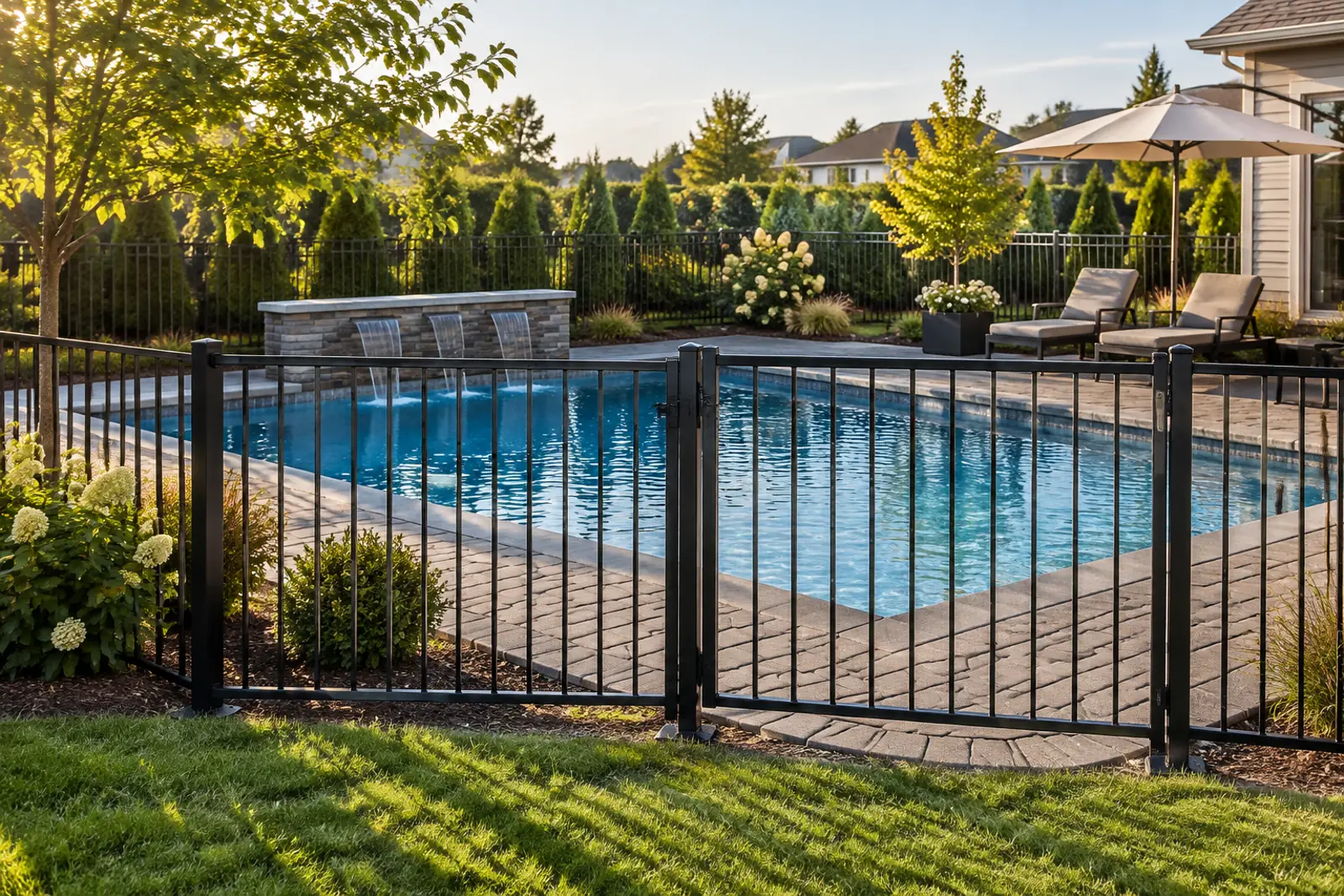
Pool Insurance: How Homeowners Policies Cover a Swimming Pool, and Where They Stop
Pool insurance is usually not a separate policy: a homeowners policy covers the pool as property and pays guest injuries under liability, $100,000 on a Citizens HO-3, against the $300,000 or $500,000 Triple-I suggests for pool owners.
- ✓Read from the policy formISO HO 00 03 and the Citizens HO-3 worksheet, clause by clause.
- ✓Filed rates, not guessesThe one filed liability charge we found, with its date.
- ✓Fence and diving board rulesUnderwriting rules from three insurer documents.
Key takeaways
- A standard ISO HO-3 homeowners form has no separate pool coverage: the pool is property under Coverage A, B or C, and guest injuries fall under Coverage E liability and Coverage F medical payments (ISO HO 00 03 05 11).
- Citizens Property Insurance, Florida’s state-backed insurer, fixes HO-3 liability at $100,000 and medical payments at $2,000, and does not cover diving boards, pool slides or empty pools (Citizens HO-3 worksheet, form 11/25).
- Triple-I suggests pool owners carry at least $300,000 or $500,000 of liability, and says most umbrella insurers want $300,000 of homeowners liability before selling a $1 million umbrella (Triple-I).
- We found no published national figure for how much a pool raises a premium; the one filed rate we found charged $80 a year to raise liability from $100,000 to $300,000 (American Platinum P&C Florida manual, approved 2011).
- Both filed underwriting guides we read treat an unfenced pool as ineligible, and The Hanover’s Maine guide also declines diving platforms more than 2 ft above the water and any pool slide (Hanover Maine guidelines, 2018).
- Attractive nuisance is a court doctrine, not an insurance rating: Ohio’s Supreme Court adopted Restatement (Second) of Torts s.339 in a 2001 case over an unused, partly unfenced pool (Bennett v. Stanley).
Does homeowners insurance cover a swimming pool?
Usually yes, inside limits. The ISO HO-3 form covers a pool as property and covers guest injuries under Coverage E and F. Citizens’ HO-3 puts a pool under Coverage A if it adjoins or abuts the house, Coverage B if clear space separates it, and Coverage C if it is above ground. Freeze damage and groundwater pressure on a pool are excluded.
| Number | Value | Source | Date |
|---|---|---|---|
| Citizens HO-3 personal liability (Coverage E) | $100,000; cannot be increased | Citizens Property Insurance HO-3 Coverage Worksheet | Form 11/25 |
| Citizens HO-3 medical payments to others (Coverage F) | $2,000 | Citizens HO-3 Coverage Worksheet | Form 11/25 |
| Citizens HO-3 Coverage B default | 2% of Coverage A; 5% to 60% available | Citizens HO-3 Coverage Worksheet | Form 11/25 |
| ISO HO 00 03 Coverage B limit | Up to 10% of Coverage A | ISO HO 00 03 05 11 | 2010 edition |
| Medical payments window in HO 00 03 | Expenses incurred within 3 years of the accident | ISO HO 00 03 05 11 | 2010 edition |
| Liability Triple-I suggests for pool owners | At least $300,000 or $500,000 | Insurance Information Institute | Accessed Oct 2026 |
| Homeowners liability most umbrella insurers want first | $300,000 (and $250,000 auto) | Insurance Information Institute | Accessed Oct 2026 |
| Filed charge to raise liability from $100,000 to $300,000 (one Florida insurer) | $80 a year | American Platinum P&C manual, FL OIR approved | Edition 06/11 |
Sources: Citizens HO-3 worksheet (11/25); ISO HO 00 03 05 11; Triple-I pool and umbrella pages; American Platinum P&C manual (2011). Download CSV
| Pool loss or claim | Part of the HO 00 03 form that answers it | What the form says | Citizens HO-3 (11/25) |
|---|---|---|---|
| A guest is hurt at the pool and sues | Section II, Coverage E Personal Liability | Pays damages an insured is legally liable for, up to the limit, and defends the suit; the duty to defend ends when the limit is paid out | $100,000 limit; cannot be increased |
| A guest's medical bills, regardless of fault | Section II, Coverage F Medical Payments to Others | Pays necessary medical expenses incurred within 3 years of the accident for people on the insured location with permission; not for you or household residents | $2,000 limit |
| Storm or fire damages an in-ground pool next to the house | Section I, Coverage A or B | Coverage B covers structures set apart from the dwelling by clear space | Coverage A if the pool adjoins or abuts the dwelling |
| The same damage to a pool across the yard | Section I, Coverage B Other Structures | Coverage B is capped at 10% of Coverage A | Coverage B if clear space separates it; default 2% of Coverage A |
| An above-ground pool is damaged | Section I, Coverage C Personal Property | Covered property, subject to Coverage C perils | Coverage C |
| Freeze or ice cracks the pool | Section I, A.2.c.(2) | Not insured: freezing, thawing, pressure or weight of water or ice to a fence, pavement, patio or swimming pool | Not stated on worksheet |
| Groundwater pushes the shell up or cracks it | Section I Exclusions, A.3.c | Excluded: water below the surface of the ground that exerts pressure on a swimming pool | Not stated on worksheet |
| The pool shell collapses | Section I, E.8 Collapse, item e | Loss to a swimming pool is not included unless it results from collapse of a building | Not stated on worksheet |
| Someone is hurt on a diving board or slide | No pool-specific exclusion in HO 00 03 | Insurers add exclusions or decline at underwriting | Diving boards, pool slides and empty pools not covered |
| You rent the pool to guests for money | Section II Exclusions, E.2 Business | Business activity is excluded; the definition exempts activities paying no insured more than $2,000 in the 12 months before the policy period | Homeshare hosting not covered |
| A screen pool cage is damaged | Section I, Coverage A or B | Covered unless the insurer excludes it | Screen pool cages not covered |
Sources: ISO HO 00 03 05 11 (2010 edition, copy filed with the Nevada Division of Insurance); Citizens HO-3 Coverage Worksheet (form 11/25). Accessed Oct 26, 2026. Download CSV
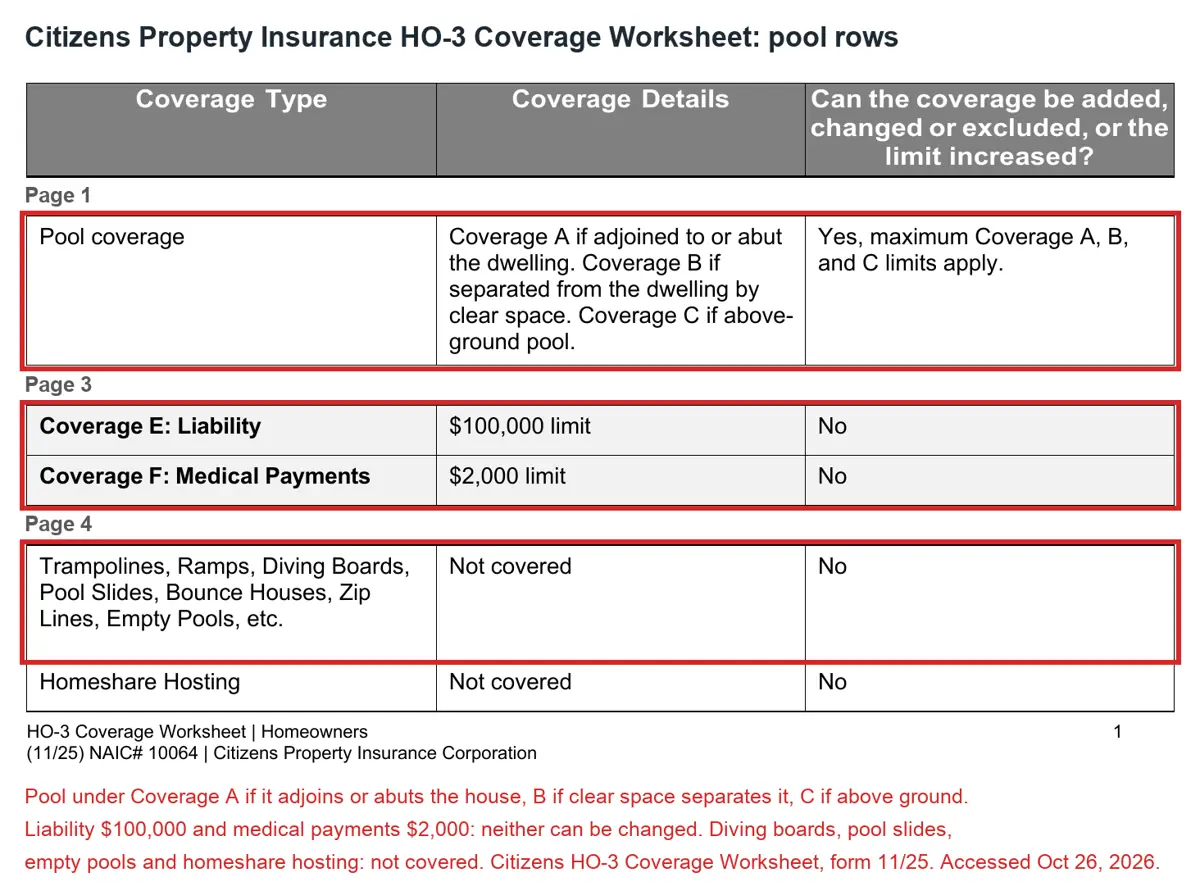
Placement decides the property limit. A pool across the yard falls under Coverage B, which the ISO form caps at 10% of the dwelling limit and Citizens sets at 2% by default, with 5% to 60% available (Citizens worksheet). On an illustrative $300,000 dwelling limit, that is $6,000 at 2% against $30,000 at 10%, before the cost of a pool shell is even counted.
Two exclusions in the HO 00 03 form land on pools: freezing, thawing, pressure or weight of water or ice to a swimming pool is not insured under Coverages A and B, and water below the ground that exerts pressure on a pool is excluded. Closing the pool correctly is the owner’s job; our pool winterizing guide lists the water levels and steps.
What insurance do you need for a pool?
Most pool owners need three things: property coverage that matches where the pool sits, liability of at least $300,000 or $500,000 as Triple-I suggests, and an umbrella if assets exceed that. Citizens HO-3 policyholders cannot raise liability above $100,000, so for them an umbrella is the only way to add liability.
Source: Citizens HO-3 Coverage Worksheet (11/25); American Platinum P&C Florida manual (approved 2011); Insurance Information Institute pool and umbrella pages (accessed Oct 2026). Download chart data (CSV)
| Insurer document | Coverage E (liability) | Coverage F (medical) | Extra yearly charge | Note |
|---|---|---|---|---|
| American Platinum P&C, Florida manual (approved 2011) | $100,000 | $1,000 | Included in base premium | Program minimum |
| American Platinum P&C, Florida manual (approved 2011) | $300,000 | $5,000 | $80 | Rule 601 |
| American Platinum P&C, Florida manual (approved 2011) | $500,000 | $10,000 | $120 | Above $300,000 needs company approval |
| Citizens Property Insurance HO-3 (form 11/25) | $100,000 | $2,000 | Not offered | Limits cannot be increased |
| Triple-I suggestion for pool owners | At least $300,000 or $500,000 | More if assets warrant it |
Sources: American Platinum P&C Florida manual, rule 601 (FL OIR approved 2011); Citizens HO-3 worksheet (11/25); Triple-I. Download CSV
Triple-I’s advice is that pool owners consider raising the liability portion of a homeowners policy to at least $300,000 or $500,000, more if their assets warrant it (Triple-I, pool safety and insurance). The South Carolina Department of Insurance repeats the same figures word for word in its consumer guide (SC DOI).
Liability limits apply per occurrence, and under HO 00 03 the insurer’s claim expenses, such as the cost of a suit it defends, are paid in addition to the limit. The defense stops when the limit is paid out, which is why the limit, not the premium, is the number to compare.
Does having a pool raise your homeowners insurance?
It can, but no primary source publishes a national figure, and quotes from blogs are not filed rates. The only filed number we found is liability-specific: a Florida insurer’s 2011 manual charged $80 a year to raise liability from $100,000 to $300,000 and $120 to reach $500,000. Your own insurer’s filed manual sets your price.
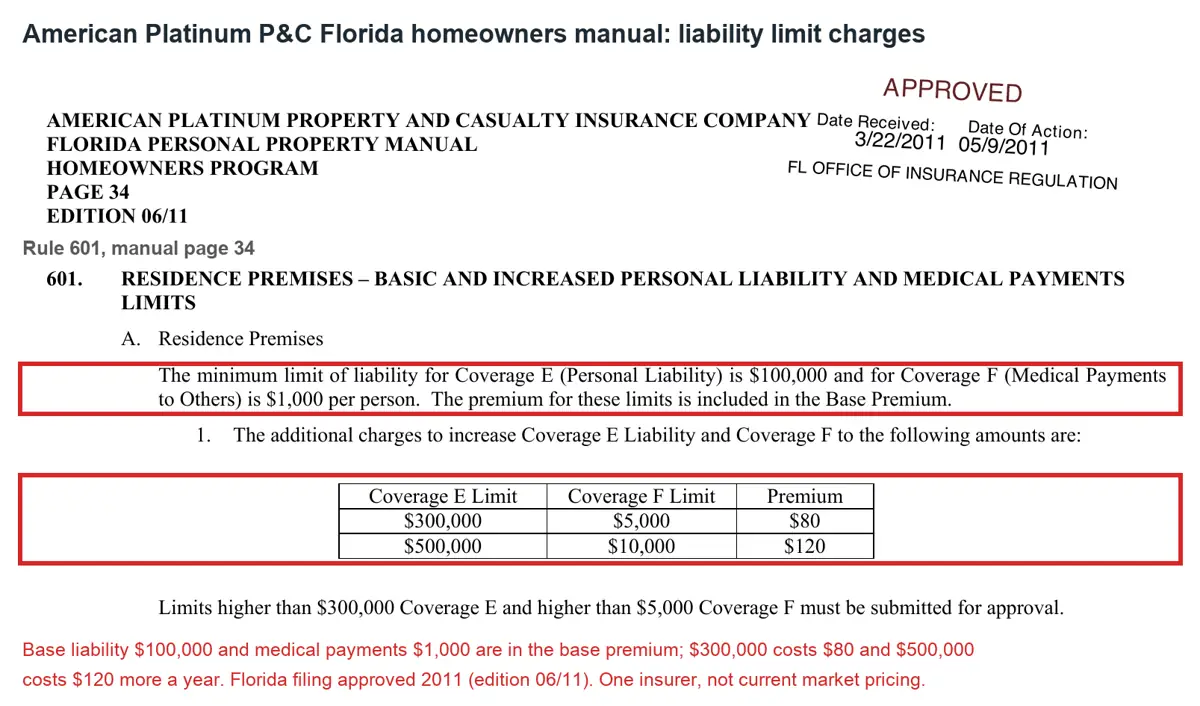
Treat the 2011 figures as an example of how a filing works, not as today’s price: they come from one Florida insurer’s approved manual and cover the liability step only, not any pool surcharge (American Platinum P&C manual). Rate manuals are filed with each state insurance department, so a current figure for your insurer exists in its filing, not in a cost guide.
- Which coverage part holds the pool? Ask whether it sits under Coverage A, B or C and what that limit is in dollars.
- What does a liability step cost? Ask the yearly charge to go from your Coverage E limit to $300,000 and $500,000.
- Is there a pool surcharge? Ask whether the pool itself changes the premium, and by how much, in writing.
- Which pool items are excluded? Diving boards, slides, empty pools, screen cages and pool rentals are the common ones.
- What barrier do you require? Ask for the fence height, gate and cover rules in your underwriting guide.
- Will an umbrella sit on top? Ask the underlying limit your umbrella insurer requires.
Which pool features can get a policy declined or excluded?
Fences, diving boards and slides decide most underwriting answers. The Hanover’s Maine guidelines decline unfenced in-ground pools, diving platforms more than 2 ft above the water and any pool with a slide; a filed Florida manual calls unfenced pools and pools with diving boards or slides ineligible; Citizens does not cover diving boards, slides or empty pools.
| Insurer document | Unfenced pool | Diving board or platform | Slide | Other pool items |
|---|---|---|---|---|
| Citizens Property Insurance, HO-3 worksheet (Florida, form 11/25) | Not addressed on worksheet | Not covered | Not covered | Empty pools and screen pool cages not covered |
| American Platinum P&C manual (Florida, approved 2011) | Ineligible: excessive or unusual liability | Ineligible | Ineligible | Company may still accept a risk on special review |
| The Hanover, Maine homeowners guidelines (effective Dec 3, 2018) | In-ground: ineligible; above-ground without fence or self-locking gate: ineligible | Ineligible if more than 2 ft above the water | Ineligible (any pool with a sliding board) | Trampolines ineligible |
Sources: Citizens HO-3 worksheet (11/25); American Platinum P&C manual (2011); The Hanover, Maine homeowners underwriting guidelines (effective Dec 3, 2018, posted by the Maine Bureau of Insurance). Download CSV
Each insurer writes its own list. The Maine Bureau of Insurance says insurers have their own underwriting guidelines that determine when they will or will not issue a policy, and posts sample forms from the 10 largest home insurance groups in the state by 2022 market share (Maine Bureau of Insurance). Ask for the rule in writing before you add a slide or board.
Screen enclosures are a separate Florida issue: Citizens excludes screen pool cages from Coverage A and B on its HO-3 worksheet (form 11/25), as our pool enclosure cost guide shows from the same worksheet. Hurricane deductibles and wind-only policies are covered in our pool hurricane rules research.
Is a swimming pool an attractive nuisance?
Sometimes, and a court decides it, not an insurer. Under Restatement (Second) of Torts s.339, a landowner can be liable to trespassing children for an artificial condition when five conditions are met, including that children are likely to trespass and the burden of removing the danger is slight. Ohio adopted that test in 2001 in a pool drowning case.
| Restatement (Second) of Torts s.339 element | What it says | What it can mean for a pool owner |
|---|---|---|
| (a) Place | The possessor knows or has reason to know children are likely to trespass | Neighbors' children, a gap in the fence or a path past the yard can make trespass foreseeable |
| (b) Condition | The possessor knows the condition involves an unreasonable risk of death or serious harm to children | Standing water in an unused pool was the condition in Bennett v. Stanley (2001) |
| (c) Youth | Children, because of their youth, do not realize the risk | The doctrine centers on young children; CPSC counts 291 pool or spa deaths a year under age 5 |
| (d) Burden | The utility of the condition and the burden of removing the danger are slight compared with the risk | A fence, self-latching gate or safety cover is the usual low-burden fix |
| (e) Care | The possessor fails to use reasonable care to remove the danger or protect children | Removing fencing and a tarp counted against the owners in Bennett |
Source: s.339 text as quoted and adopted in Bennett v. Stanley, 92 Ohio St.3d 35, 2001-Ohio-128 (Supreme Court of Ohio, June 13, 2001); CPSC count from the 2026 pool and spa submersion report. Download CSV
In Bennett v. Stanley, a five-year-old boy and his mother drowned in a neighbor’s pool that had gone unused for three years, held over six feet of rainwater, and had lost its tarp and the fencing on two sides. The Supreme Court of Ohio adopted s.339, reversed the judgment for the pool owners and sent the case back to the trial court (Supreme Court of Ohio).
The same opinion quotes Ohio’s 1986 Elliott decision, which refused to extend the doctrine to a residential pool owner where a 19-month-old visitor’s presence was not foreseeable. Foreseeability decided both cases, and element (e) asks whether the owner used reasonable care; a fence, a self-latching gate and a cover are the usual ways an owner shows that care.
Do you need an umbrella policy for a pool?
If a judgment could exceed your homeowners liability limit, yes. Triple-I says most insurers want $300,000 of homeowners liability and $250,000 of auto liability before they sell a $1 million umbrella. In the worked example, a $750,000 judgment leaves $650,000 unpaid on a $100,000 limit and nothing unpaid with a $300,000 limit plus a $1 million umbrella.
| Setup | Liability available | Illustrative $250,000 judgment: paid by policies | Left for the owner | Illustrative $750,000 judgment: paid by policies | Left for the owner |
|---|---|---|---|---|---|
| Coverage E $100,000 only | $100,000 | $100,000 | $150,000 | $100,000 | $650,000 |
| Coverage E $300,000 | $300,000 | $250,000 | $0 | $300,000 | $450,000 |
| Coverage E $500,000 | $500,000 | $250,000 | $0 | $500,000 | $250,000 |
| Coverage E $300,000 plus a $1,000,000 umbrella | $1,300,000 | $250,000 | $0 | $750,000 | $0 |
Sources: Triple-I umbrella guidance; HO 00 03 Coverage E. Judgment amounts are round illustrations, not claim data. PC&S calculation. Download CSV
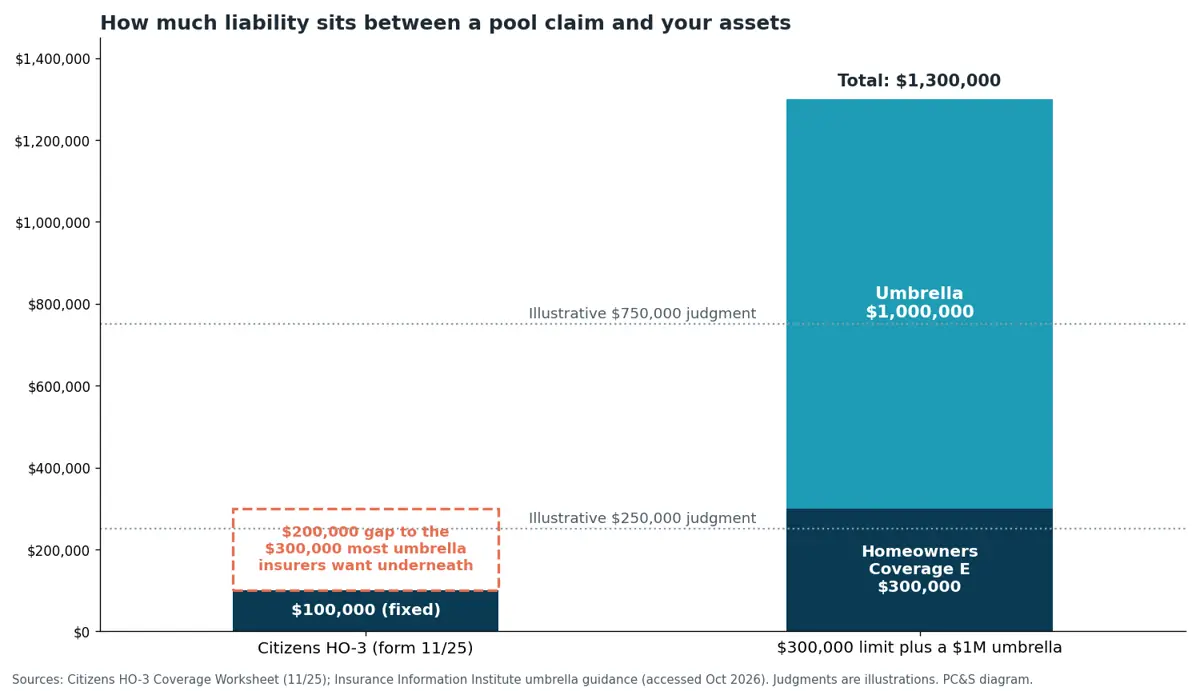
Citizens policyholders face a gap: their HO-3 liability is fixed at $100,000 (Citizens worksheet), while Triple-I says most umbrella insurers want $300,000 underneath (Triple-I). Ask an umbrella insurer whether it accepts a $100,000 underlying limit, and if so, whether you pay the first $200,000 of a loss yourself.
What barrier do insurers and codes expect around a pool?
A barrier at least 48 inches high with self-closing, self-latching gates that open outward is the model code rule (2024 ISPSC 305.2.1 and 305.3), and both filed underwriting guides we read treat an unfenced pool as ineligible. CPSC counts 291 pool or spa drowning deaths a year among children under 5 in 2021 to 2023, 60% at the child’s own home.
The 2024 ISPSC also sets the gate latch release at least 54 inches above the ground at residential pools when it can be reached from outside (2024 ISPSC 305.3.3). States adopt their own versions; our pool fence laws by state study maps the rule in all 50 states and DC and found 31 jurisdictions accept a safety cover in some form.
Price the barrier with the policy. Our pool fence cost guide lists installed prices per linear foot, the pool safety cover guide covers ASTM F1346 covers, and the automatic pool cover cost guide shows when a powered cover counts as the barrier. Drowning counts by state are in our pool drowning statistics report.
Which pool insurance steps fit your situation?
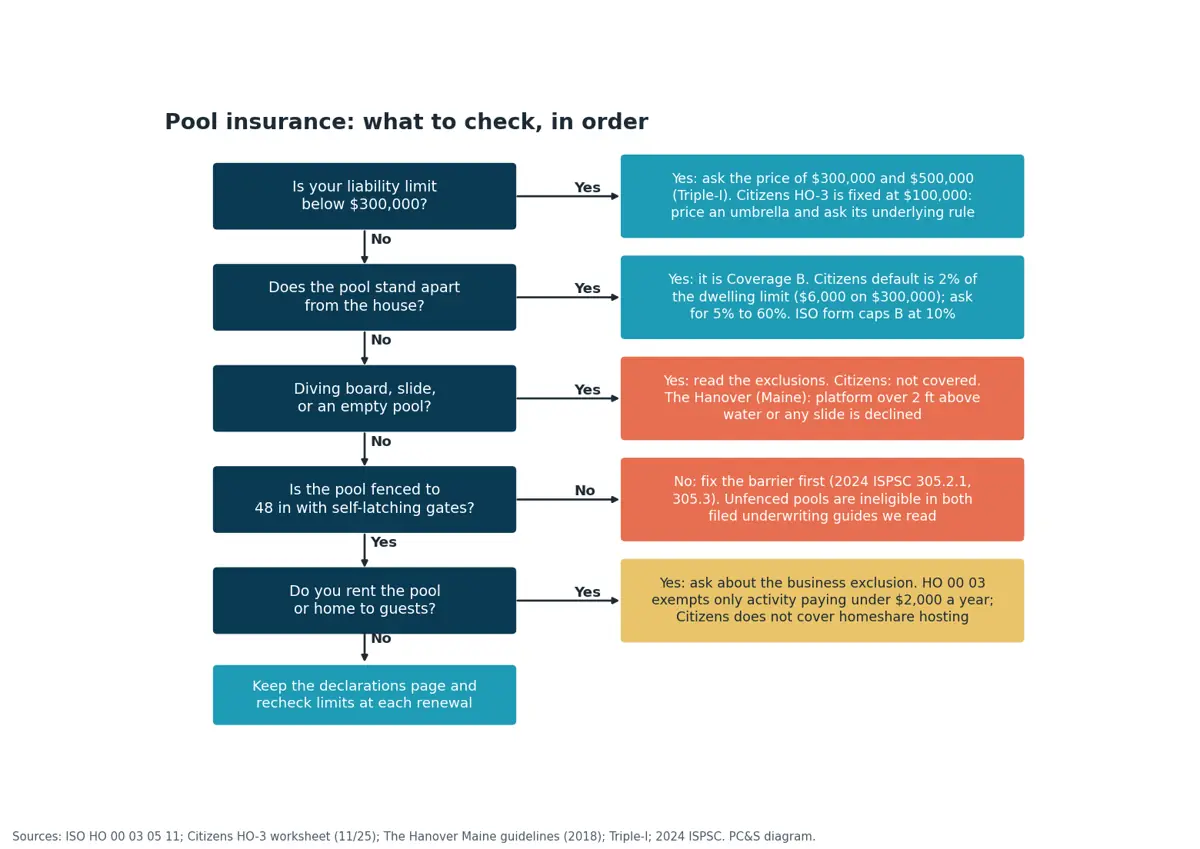
Start from the policy you have. If liability is $100,000, ask for $300,000 or $500,000; if you are with Citizens, price an umbrella; if the pool stands apart, check Coverage B in dollars; if there is a board, slide, rental or no fence, read the exclusions and underwriting rules before you buy. The table gives the rule behind each step.
| If your situation is | Do this |
|---|---|
| You are adding a pool | Tell the insurer before the build and ask in writing which coverage part (A, B or C) will cover it and at what limit |
| Your liability limit is $100,000 | Ask for $300,000 or $500,000 (Triple-I); one filed Florida manual charged $80 or $120 a year for those steps in 2011 |
| You are insured by Citizens in Florida | Coverage E is fixed at $100,000; ask an umbrella insurer whether it accepts that underlying limit, since Triple-I says most want $300,000 |
| The pool stands apart from the house | Check Coverage B: Citizens defaults to 2% of Coverage A ($6,000 on a $300,000 home) and sells 5% to 60% |
| You have or want a diving board or slide | Read the exclusions first: Citizens does not cover them, and The Hanover in Maine declines diving platforms more than 2 ft above the water and any slide |
| The pool is not fenced | Install a barrier at least 48 inches high with self-closing, self-latching gates (2024 ISPSC 305.2.1, 305.3); unfenced pools are ineligible in both filed underwriting guides we read |
| You rent the pool or home to guests | Ask whether the business exclusion applies; HO 00 03 exempts only activities paying under $2,000 a year, and Citizens does not cover homeshare hosting |
| The pool sits unused or empty | Keep it covered and fenced: Citizens does not cover empty pools, and an unused pool full of rainwater was the hazard in Bennett v. Stanley |
Sources: ISO HO 00 03 05 11; Citizens HO-3 worksheet; American Platinum P&C manual; The Hanover Maine guidelines; Triple-I; 2024 ISPSC; Bennett v. Stanley. Download CSV
| What several guides say | Who says it | What the primary document says |
|---|---|---|
| A pool is considered an attractive nuisance by the insurance industry | Triple-I; South Carolina Department of Insurance (same text) | Attractive nuisance is a tort rule courts apply case by case; Ohio adopted Restatement s.339 in Bennett v. Stanley (2001) and in 1986 declined it where a child's presence was not foreseeable |
| In-ground pools are often covered as other structures, typically around 10% of the dwelling limit | AAA (Apr 2026); Universal Property | Citizens puts a pool that adjoins or abuts the house under Coverage A, and its Coverage B default is 2%, not 10% |
| Raise liability to at least $300,000 or $500,000 | Triple-I; South Carolina DOI; Travelers | Citizens HO-3 liability is $100,000 and cannot be increased; Triple-I says most umbrella insurers want $300,000 of homeowners liability first |
| A homeowners policy typically provides $100,000 in base liability | Allstate | Matches Citizens HO-3 and the filed American Platinum minimum; check your declarations page |
Sources: Triple-I; SC DOI; AAA (Apr 20, 2026); Universal Property; Allstate; compared with Citizens, HO 00 03, Bennett v. Stanley. Download CSV
If you are still planning the pool, call the insurer before you sign: a diving board, a slide or a pool set apart from the house changes which coverage part applies, and at Citizens a detached pool starts at 2% of the dwelling limit. Our pool planning checklist and inground pool cost guide show where insurance falls in the budget.
How we compiled this
We read 1 standard policy form (ISO HO 00 03 05 11), 1 insurer coverage worksheet (Citizens HO-3, 11/25), 2 filed underwriting or rate documents (American Platinum P&C, Florida; The Hanover, Maine), 2 state insurance department pages, 2 Triple-I pages, 1 state supreme court opinion, the 2024 ISPSC and CPSC’s 2026 report, in October 2026. We left out forum posts and insurer blog premium estimates, and we did not obtain quotes or survey insurers.
Frequently Asked Questions
What insurance do you need for a pool?
A homeowners policy that covers the pool as property under Coverage A, B or C, plus liability of at least $300,000 or $500,000, which Triple-I suggests for pool owners. Add an umbrella if your assets exceed that; Triple-I says most umbrella insurers want $300,000 of homeowners liability underneath a $1 million umbrella.
Is pool insurance worth it?
There is rarely a separate pool policy to buy; the decision is how much liability to add. In one filed Florida manual, raising liability from $100,000 to $300,000 cost $80 a year in 2011 (American Platinum P&C). Ask your insurer for today’s figure in writing before you decide.
Does having a pool raise your homeowners insurance?
It can, but we found no published national figure, and the amount is set in each insurer’s filed rating manual. Ask for three numbers in writing: any pool surcharge, the cost of raising liability to $300,000 and $500,000, and the limit that applies to the pool itself under Coverage A, B or C.
Do insurance companies require a fence around a pool?
Many do. The Hanover’s Maine guidelines decline unfenced in-ground pools, and a filed Florida manual lists unfenced pools as ineligible (Hanover; American Platinum P&C). The model code barrier is at least 48 inches high with self-closing, self-latching gates (2024 ISPSC 305.2.1).
Does a diving board increase insurance?
Are above-ground pools covered by homeowners insurance?
Usually as personal property. Citizens’ HO-3 worksheet puts an above-ground pool under Coverage C, while in-ground pools fall under Coverage A or B depending on whether they touch the house (Citizens, form 11/25). The Hanover in Maine declines above-ground pools without a fence or self-locking gate.
Does homeowners insurance cover pool freeze damage?
Not under the standard ISO HO-3 form. HO 00 03 does not insure Coverage A or B loss caused by freezing, thawing, pressure or weight of water or ice to a swimming pool, and it excludes groundwater pressure on a pool (HO 00 03 05 11). Winterizing on time is the owner’s protection.
Sources
- Insurance Services Office. HO 00 03 05 11 Homeowners 3 Special Form (copy filed with the Nevada Division of Insurance, archived Jun 11, 2026). Accessed 2026-10-26.
- Citizens Property Insurance Corporation. HO-3 Coverage Worksheet, form 11/25. Accessed 2026-10-26.
- American Platinum Property and Casualty Insurance Company. Florida Personal Property Manual, Homeowners Program (editions 06/11 and 11/11, FL OIR approved). Accessed 2026-10-26.
- The Hanover (posted by Maine Bureau of Insurance). Maine Homeowners Underwriting Guidelines (effective Dec 3, 2018). Accessed 2026-10-26.
- Maine Bureau of Insurance. Homeowners Policy Comparison. Accessed 2026-10-26.
- South Carolina Department of Insurance. Pools and Insurance: What You Should Know. Accessed 2026-10-26.
- Insurance Information Institute. Pool safety and insurance. Accessed 2026-10-26.
- Insurance Information Institute. Should I purchase an umbrella liability policy?. Accessed 2026-10-26.
- Supreme Court of Ohio. Bennett v. Stanley, 92 Ohio St.3d 35, 2001-Ohio-128. Accessed 2026-10-26.
- International Code Council via UpCodes. 2024 International Swimming Pool and Spa Code, Chapter 3. Accessed 2026-10-26.
- U.S. Consumer Product Safety Commission. Pool or Spa Submersion: Estimated Nonfatal Drowning Injuries and Reported Drownings, 2026 Report. Accessed 2026-10-26.
- AAA. Guide to Swimming Pools and Homeowners Insurance (Apr 20, 2026). Accessed 2026-10-26.
- Universal Property. Can Swimming Pools Affect Your Home Insurance Policy?. Accessed 2026-10-26.
- Allstate. Swimming Pools and Homeowners Insurance. Accessed 2026-10-26.
- PC&S research. Pool fence laws by state. Accessed 2026-10-26.
- PC&S research. Pool drowning statistics by state. Accessed 2026-10-26.
Related pages
Get Quotes From Licensed Local Pool Pros
Tell us what you need and your ZIP code. We match you with pool companies that cover your area.