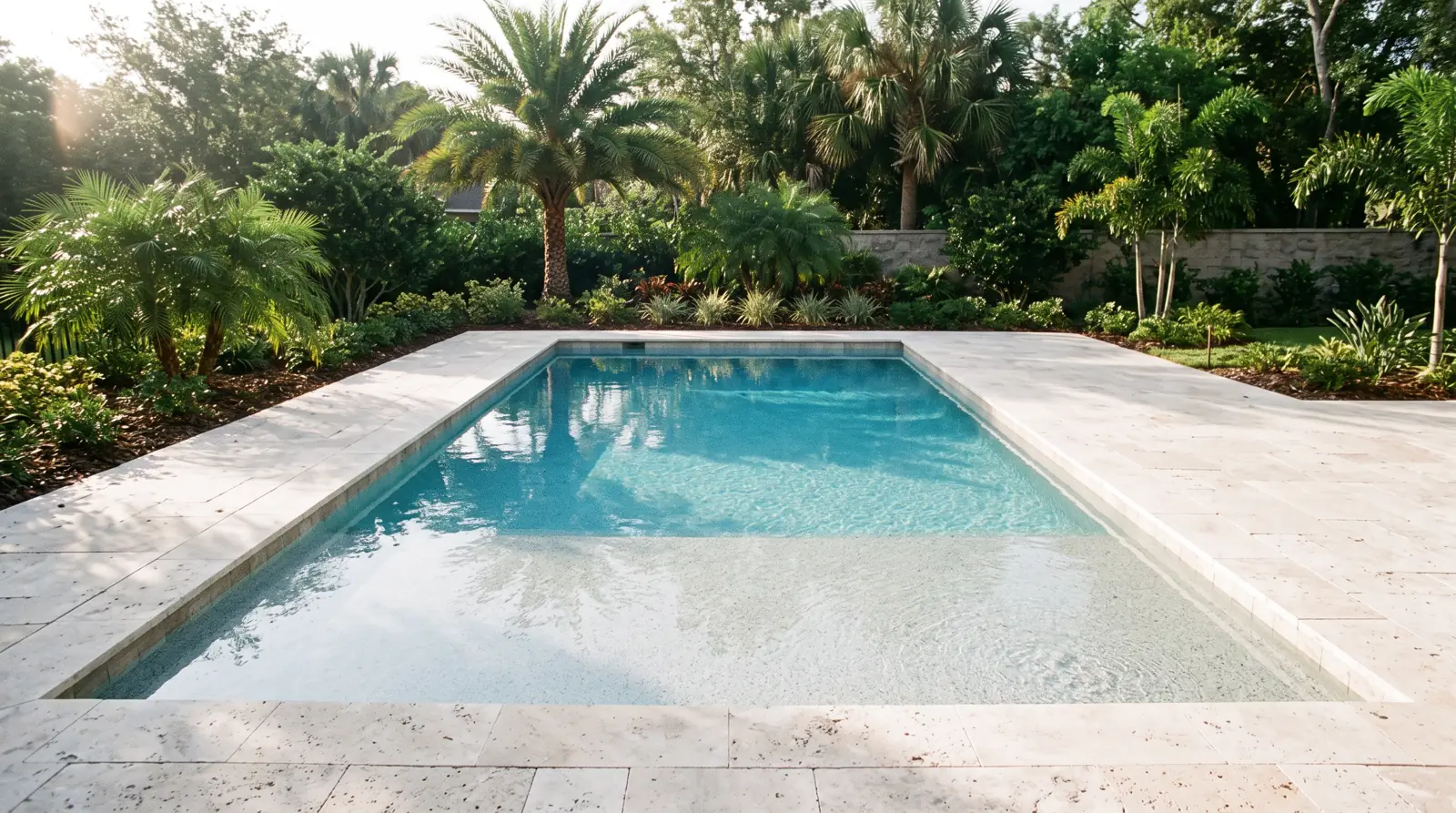
Beach Entry Pool Guide: Slope Rules, How Much Length It Takes, Costs and Fiberglass Models
A beach entry pool slopes from deck level into the water with no steps; the 2024 ISPSC caps that slope at 1 in 7, so reaching 24 in of water takes 14 ft of pool.
- ✓Every slope rule in one tableISPSC, MAHC, ADA and county rules with section numbers, for homes and public pools.
- ✓Length math you can checkRun length at 1:7 to 1:20 for 12 to 48 in of water, plus a worked corner beach.
- ✓Costs side by sideSix published figures with what each covers and its date, from $5,040 to $60,000.
Key takeaways
- The 2024 International Swimming Pool and Spa Code (ISPSC) defines a beach entry as a sloping entry that starts above the waterline at deck level and ends below it, says sand is not required, and caps the slope at 1 unit vertical in 7 horizontal, or 14% (ISPSC 202, ISPSC 809.6).
- Run length is depth times the slope ratio: at the 1 in 7 limit, 24 in of water takes 14 ft and 36 in takes 21 ft; at the 1:12 limit for public pools in the Model Aquatic Health Code, 30 in takes 30 ft.
- Published add-on costs run from $5,040 to $9,170 (Fixr, 2024) to $30,000 to $60,000 for a sloping entry in a remodel (Anthony & Sylvan, 2025); HomeGuide’s $50 to $125 per sq ft prices a 12 ft x 14 ft entry at $8,400 to $21,000.
- Beach entries are rare in public records: 9 of 91,881 residential pool permit records in our PC&S permit ledger name a beach, zero or walk-in entry, against 1,048 that name a tanning ledge, sun shelf or baja.
- San Juan sells beach versions of several fiberglass shells that run 2 ft 8 in to 5 ft 6 in longer than the standard model, and Thursday Pools holds US Patent 10,358,837 for a beach entry fiberglass design (Thursday Pools, 2019).
What is a beach entry pool?
A beach entry pool has a sloped floor that starts at deck level and runs down into the water, so people walk in instead of using steps or a ladder. The 2024 ISPSC calls it a beach entry or zero entry and says sand is not required. Public pool codes use zero depth entry for the same feature.
| Measure | Number | Source and date |
|---|---|---|
| Steepest beach entry slope, residential and public pools under the ISPSC | 1 in 7 (14%) | 2024 ISPSC Section 809.6 |
| Run needed to reach 24 in of water at 1 in 7 | 14 ft | PC&S arithmetic on ISPSC 809.6 |
| Steepest zero depth entry slope in public pools under the MAHC | 1:12 | MAHC 4.5.9.2 (2018 text, Pueblo County adoption 2022) |
| Depth where an ADA sloped entry must end | 24 to 30 in below the water | 2010 ADA Standards 1009.3.2 |
| Flatness tolerance across and down the slope | Plus or minus 1/2 in | 2024 ISPSC Section 809.6 |
| Published add-on cost range | $5,040 to $9,170 (Fixr, 2024) up to $30,000 to $60,000 (Anthony & Sylvan, 2025) | Fixr; Anthony & Sylvan Pools |
| Permit records naming a beach, zero or walk-in pool entry | 9 of 91,881 (1,048 name a ledge or baja) | PC&S permit ledger, 2004 to 2026 |
Sources: 2024 ISPSC Chapter 2, Chapter 3 and Chapter 8 (UpCodes); MAHC (Pueblo County adoption); 2010 ADA Standards; Fixr; Anthony & Sylvan; PC&S permit ledger. Download CSV
Three names, one geometry. The ISPSC definition reads ‘sloping entry starting above the waterline at deck level and ending below the waterline’, with zero entry as the alternate name (ISPSC 202). The Model Aquatic Health Code (MAHC), written for public pools, defines a zero depth entry as ‘a sloped entry into a pool from deck level into the interior of the pool as a means of access and egress’ (MAHC, 2018 text). Walk-in entry is a sales term; a 2026 Cape Coral permit uses it for a 16 ft x 28 ft pool.
A beach entry is not a tanning ledge. A ledge is a flat shelf holding a few inches of water at one depth, while a beach slopes continuously from zero to swimming depth. Latham notes that ledges ‘take up much less room than beach entries’ (Latham, 2021); our tanning ledge guide compares the two by size. The difference shows in permits: Los Angeles recorded only 4 pool permits naming a beach or beach entry between 2013 and 2020 (LADBS data).
What slope does the code allow for a beach entry?
For homes, the 2024 ISPSC allows a beach entry slope of up to 1 in 7 (14%), built flat to within 1/2 in and meeting the deck with no step. Public pools face tighter rules: the MAHC caps zero depth entries at 1:12, and an ADA sloped entry must run at 1:12 or flatter and end 24 to 30 in below the water, with two handrails.
| Rule | Requirement | Applies to | Section | Source |
|---|---|---|---|---|
| Definition | Sloping entry starting above the waterline at deck level and ending below it; sand not required; also called zero entry | All pools under the ISPSC | ISPSC 202 | 2024 ISPSC via UpCodes |
| Maximum slope | 1 unit vertical in 7 units horizontal (14%) | Beach and sloping entries used as a pool entrance | ISPSC 809.6 | 2024 ISPSC via UpCodes |
| Flatness and top of slope | Plus or minus 1/2 in across and down the slope; top of slope at one elevation and meeting the deck at the same or a lesser slope, with no step | Beach and sloping entries | ISPSC 809.6 | 2024 ISPSC via UpCodes |
| Steps or benches beside the slope | Top of step or bench no more than 12 in above the sloped floor; none along the top of the slope | Beach and sloping entries | ISPSC 809.7 | 2024 ISPSC via UpCodes |
| Shallow-end minimum depth | 33 in to 4 ft, except shallow areas designed under 809.6 to 809.8 | Residential inground pools | ISPSC 807.2 | 2024 ISPSC via UpCodes |
| Slip resistance when tested | Wet DCOF of 0.42 (ANSI A326) or P4 pendulum rating (SA AS4586) | Decks, ramps, coping and step surfaces | ISPSC 306.2 | 2024 ISPSC via UpCodes |
| Handrail height, where installed | 30 to 38 in above the ramp or step surface | Residential pools and spas | ISPSC 324.2.1 | 2024 ISPSC via UpCodes |
| Sand | Clean sand only over an impervious surface, kept from affecting circulation, safety and sanitation | Beach pools | ISPSC 307.2.1.1 | 2024 ISPSC via UpCodes |
| Zero depth entry, public pools | Maximum floor slope 1:12; slip-resistant; trench drains along the entry at the waterline | Public pools where the MAHC is adopted | MAHC 4.5.9 | MAHC 2018 text (Pueblo County 2022) |
| Sloped entry, ADA | Running slope no steeper than 1:12; rise per run 30 in maximum; ends 24 to 30 in below the water; two handrails 33 to 38 in apart | Public accommodations and government pools | ADA 405.2, 405.6, 1009.3.2, 1009.3.3 | 2010 ADA Standards (US Access Board) |
| County zero depth entry rule | Deck at the entry slopes toward the pool, no steeper than 1 ft in 12 ft; non-slip to 2 ft deep; trench drain full length; handrails at the ends; 1 hour turnover to 2 ft | Public and semipublic pools in Maricopa County, AZ | Ch. VI Sec. XIV | Maricopa County Environmental Health Code |
| Ramp threshold | A zero depth slope steeper than 1:20 is treated as a ramp | Recommendation | Recommendation 4.2 | US Access Board pool accessibility recommendations |
Sources: 2024 ISPSC Chapter 2, Chapter 3 and Chapter 8 (UpCodes), read Oct 8, 2026; MAHC 4.5.9, 2018 text adopted by Pueblo County; 2010 ADA Standards; Maricopa County Environmental Health Code (rev. Aug 19, 2026); US Access Board recommendations. Read Nov 2, 2026. Download CSV
Two ISPSC details shape the design more than the slope does. Section 807.2 normally requires the shallowest point of a pool to be 33 in to 4 ft deep, but shallow areas built under Sections 809.6 to 809.8 are exempt, which is what lets a beach start at zero (ISPSC 807.2). Section 809.7 bans steps and benches along the top of the slope and limits steps beside it to 12 in above the sloped floor.
Drainage at the top of the slope needs a plan. ISPSC 306.5.1 says decks slope away from the pool or toward deck drains (ISPSC 306.5.1), yet a beach entry meets the deck at the waterline. Public pool rules answer with drains: the MAHC requires trench drains along zero depth entries at the waterline, and Maricopa County requires a trench drain the full length of the entry (Maricopa County). Ask your builder where deck water goes at the top of the beach.
Accessibility is the other reason to go flatter than 1 in 7. Under the 2010 ADA Standards, a sloped entry follows ramp rules: no steeper than 1:12, no more than 30 in of rise per run, ending 24 to 30 in below the water, with two handrails 33 to 38 in apart (ADA 405.2, 405.6, 1009.3). The ADA Standards are written for public and commercial pools; for a home pool they are a reference for wheelchair users, not a requirement.
How much pool length does a beach entry take?
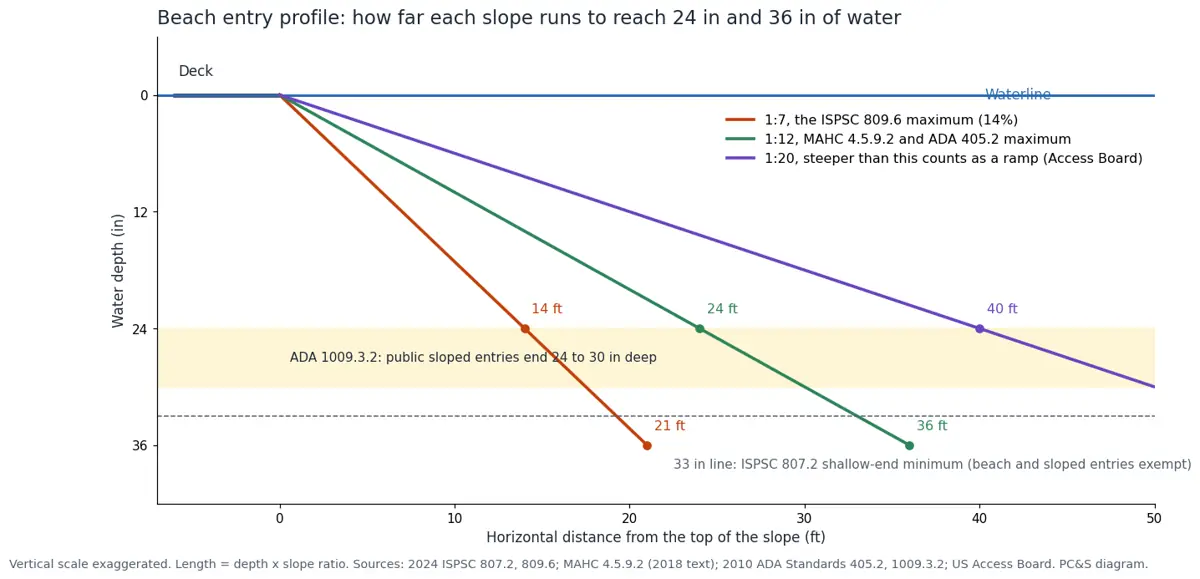
Multiply the water depth you want at the bottom of the slope by the slope ratio. At the ISPSC maximum of 1 in 7, a beach reaches 24 in of water in 14 ft and 36 in in 21 ft. At 1:12, the public pool limit, the same depths take 24 ft and 36 ft. Most fiberglass shells are no wider than 16 ft, so most beaches run along the length.
| Water depth at the toe (in) | Run at 1:7 (ft) | Run at 1:10 (ft) | Run at 1:12 (ft) | Run at 1:15 (ft) | Run at 1:20 (ft) |
|---|---|---|---|---|---|
| 12 | 7 | 10 | 12 | 15 | 20 |
| 18 | 10.5 | 15 | 18 | 22.5 | 30 |
| 24 | 14 | 20 | 24 | 30 | 40 |
| 30 | 17.5 | 25 | 30 | 37.5 | 50 |
| 36 | 21 | 30 | 36 | 45 | 60 |
| 42 | 24.5 | 35 | 42 | 52.5 | 70 |
| 48 | 28 | 40 | 48 | 60 | 80 |
Slope limits: ISPSC 809.6 (1:7), MAHC 4.5.9.2 and ADA 405.2 (1:12), Access Board (1:20). Lengths are PC&S arithmetic. Download CSV
Source: PC&S arithmetic on 2024 ISPSC 809.6, MAHC 4.5.9.2 and ADA 405.2 slope limits. Download chart data (CSV)
The worked example below takes a 12 ft wide corner beach to 24 in at 1 in 7. The sloped wedge holds 1,257 gallons where a flat shallow end at 3.5 ft would hold 4,398 in the same footprint, so a beach trades water you can stand in for a walk-in. If the beach lengthens the pool rather than eating its shallow end, it also adds 168 sq ft of surface that loses water and heat.
| Step | Input or formula | Result |
|---|---|---|
| 1. Slope | ISPSC 809.6 maximum, 1 in 7 | 1 ft down for every 7 ft across |
| 2. Depth at the toe | 24 in | 2 ft |
| 3. Run length | 2 ft x 7 | 14 ft |
| 4. Entry width | Corner beach | 12 ft |
| 5. Sloped floor area | 14 ft x 12 ft | 168 sq ft |
| 6. Water in the sloped wedge | 0.5 x 14 x 2 x 12 cu ft x 7.48 gal | 1,257 gal |
| 7. Same area as a flat 3.5 ft shallow end | 14 x 12 x 3.5 cu ft x 7.48 gal | 4,398 gal |
| 8. Evaporation if the beach adds this surface, Mesa AZ rate | 168 sq ft x 79 in a year / 12 x 7.48 | 8,273 gal a year |
| 9. Evaporation at the EPA range of 24 to 62 gal per sq ft a year | 168 x 24; 168 x 62 | 4,032 to 10,416 gal a year |
| 10. Build cost at HomeGuide's $50 to $125 per sq ft | 168 x $50; 168 x $125 | $8,400 to $21,000 |
Inputs: ISPSC 809.6; 7.48 gallons per cubic foot (USGS, as used in our pool volume calculator); City of Mesa (79 in a year) and EPA WaterSense (12,000 to 31,000 gal a year per 500 sq ft) via our pool evaporation study; HomeGuide ($50 to $125 per sq ft, 2025). PC&S arithmetic. Download CSV
Can a small yard fit a beach entry pool?
Only with a short toe depth or a long, narrow pool. At 1 in 7, a beach needs 14 ft of run to reach 24 in, so a 20 ft pool keeps 6 ft at standing depth. San Juan’s smallest beach versions are 7 ft 10 in x 20 ft and 8 ft 5 in x 23 ft; a 7 ft x 10 ft tanning ledge gives shallow water in far less length.
Beach entry pool designs fall into three layouts. A full-width beach spans one end; a corner or partial beach takes part of the end and leaves room for steps; a side beach runs along a long wall. The side layout rarely works on a fiberglass shell: River Pools puts the widest practical shell at about 16 ft, and at 1 in 7 a 16 ft run reaches only about 27 in. Our pool shapes guide covers which layouts suit each shape.
San Juan’s small beach shells show the trade-off in numbers. The Sedona Beach is 7 ft 10 in x 20 ft and 5 ft deep, 5 ft 6 in longer than the standard Sedona, and the Cyberlane Beach keeps the Cyberlane’s 8 ft 5 in x 23 ft footprint but holds 562 fewer gallons (San Juan Pools). Standard sizes for comparison are in our standard pool size guide.
Which fiberglass pools have a beach entry?
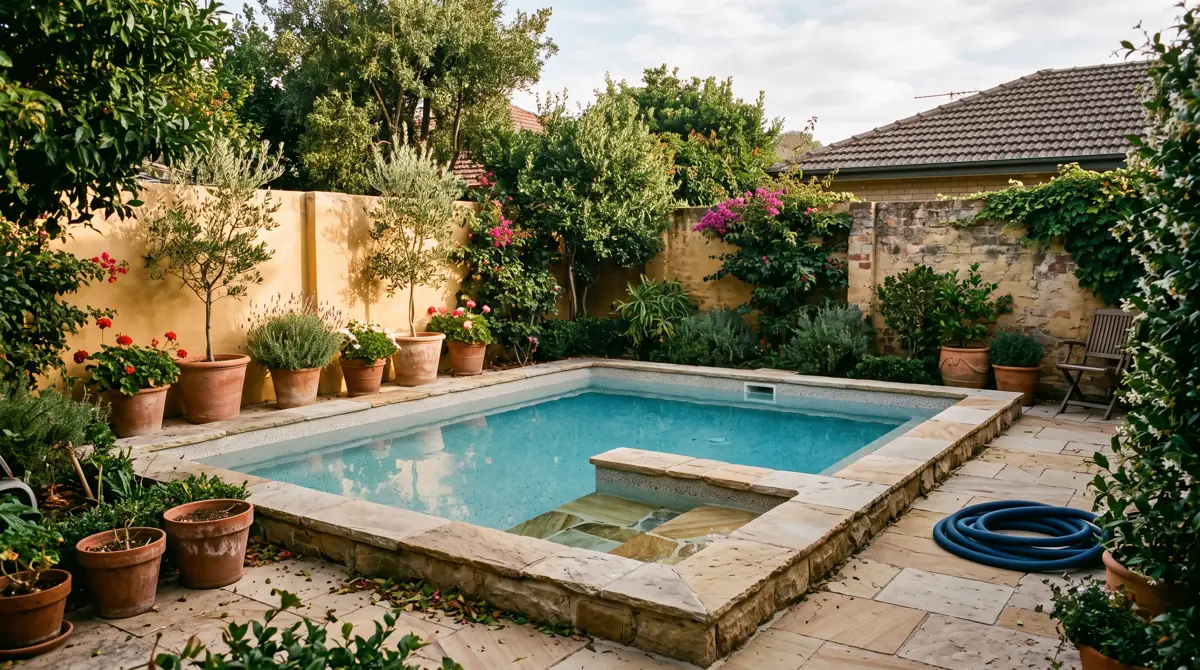
San Juan lists beach versions of at least seven of its shells next to the standard model, from the 7 ft 10 in x 20 ft Sedona Beach to the 16 ft x 45 ft 8 in Oceanside Beach. Thursday Pools patented a beach entry fiberglass design in 2019 and sells it as the Grace (three sizes) and the Sandal (two sizes). In fiberglass the slope comes molded into the shell.
| San Juan beach model | Width x length | Depth | Gallons | Standard model listed | Standard size | Standard gallons | Length added by the beach version |
|---|---|---|---|---|---|---|---|
| Oceanside Beach | 16 ft x 45 ft 8 in | 6 ft 2 in | 21,656 | Oceanside | 16 ft x 41 ft 2 in, 6 ft 5 in | 21,519 | 4 ft 6 in |
| Great Lakes Beach | 15 ft 11 in x 41 ft 3 in | 6 ft 4 in | 18,761 | Great Lakes | 15 ft 11 in x 36 ft 11 in, 6 ft 4 in | 18,653 | 4 ft 4 in |
| Caesar's Palace Beach | 15 ft 8 in x 36 ft | 5 ft 7 in | 12,057 | Caesar's Palace | 15 ft 8 in x 33 ft 4 in, 5 ft 7 in | 11,727 | 2 ft 8 in |
| Wylela Beach | 12 ft x 30 ft | 6 ft 1 in | 7,587 | Wylela | 12 ft x 25 ft, 6 ft 1 in | 7,201 | 5 ft |
| Sedona Beach (West Coast) | 7 ft 10 in x 20 ft | 5 ft | 2,612 | Sedona | 8 ft 4 in x 14 ft 6 in, 3 ft 5 in | 1,813 | 5 ft 6 in |
| Cyberlane Beach (East Coast only) | 8 ft 5 in x 23 ft | 4 ft 9 in | 3,788 | Cyberlane | 8 ft 5 in x 23 ft, 4 ft 9 in | 4,350 | None; 562 fewer gallons |
| Wylela Beach Ultra | 16 ft x 37 ft | 6 ft 1 in | 14,888 | Wylela Cove Ultra | 16 ft x 37 ft, 6 ft 1 in | 15,321 | None; 433 fewer gallons |
| Clearwater Beach | 15 ft 11 in x 36 ft 9 in | 6 ft 3 in | 13,387 | None listed |
Source: San Juan Pools model list, read Nov 2, 2026. Pairing by model name is PC&S work; San Juan’s list does not describe each beach model in words. Clearwater Beach description via a San Juan dealer page (Aquarec). Download CSV
The pairs make the geometry visible. The Great Lakes Beach is 4 ft 4 in longer than the Great Lakes and the Oceanside Beach 4 ft 6 in longer than the Oceanside, while gallons barely move: the wedge adds length but little water. A San Juan dealer page quoting the maker calls the Clearwater Beach the first of San Juan’s ‘huge beach entry models’, with an entry ‘wide enough for two’ (Aquarec). A 2026 Montgomery County, MD permit covers ‘installing San Juan Oceanside Beach fiberglass pool with concrete pool deck’ (PC&S permit ledger).
Thursday Pools received US Patent 10,358,837 for its beach entry fiberglass pool in August 2019 and offers the rectangular Grace in three sizes and the freeform Sandal in two (Thursday Pools). Builders quoted in Pool & Spa Marketing (Sept 2019) say a fiberglass beach adds no separate cost because the slope is pre-engineered in the shell, but the beach area must sit on crushed stone or flowable fill or it can feel hollow underfoot. Shell prices are compared in our fiberglass pool cost guide.
What does a beach entry pool cost?
Published figures for the beach itself run from $5,040 to $9,170 (Fixr, 2024) and $5,000 to $10,000 (Pool Research) up to $30,000 to $60,000 for a sloping entry added in a remodel (Anthony & Sylvan, 2025). HomeGuide’s rate of $50 to $125 per sq ft puts a 12 ft x 14 ft entry at $8,400 to $21,000. Angi averages a whole beach entry pool at $55,000.
| Publisher | What the figure covers | Figure | Date | Kind of source |
|---|---|---|---|---|
| Fixr | Adding the entry area, on top of the pool | $5,040 to $9,170 | Page modified Jan 25, 2024 | Cost guide |
| Pool Research | Adding a beach entry, average | $5,000 to $10,000 | Undated, read Nov 2, 2026 | Builder blog |
| Burton Pools & Spas, quoted by Pool & Spa Marketing | Beach entry added to a gunite pool | About $10,000 | Sept 23, 2019 | Trade press |
| HomeGuide | Beach or zero entry, per sq ft | $50 to $125 per sq ft | Modified July 16, 2025 | Cost guide |
| PC&S arithmetic on HomeGuide | A 12 ft x 14 ft entry (168 sq ft) | $8,400 to $21,000 | Nov 2026 | Worked example |
| Anthony & Sylvan Pools | Sloping beach entry as an accessibility feature, remodel guide | $30,000 to $60,000 | Modified Nov 21, 2025 | Builder guide |
| Angi | Average cost of a whole beach entry pool | $55,000 | Updated Aug 5, 2026 | Cost guide |
| Pool & Spa Marketing | Fiberglass beach entry model | No added cost; the slope is part of the shell | Sept 23, 2019 | Trade press |
Sources: Fixr; Pool Research; Pool & Spa Marketing; HomeGuide; Anthony & Sylvan; Angi. HomeGuide, Fixr and Angi read from saved copies in our build cost study (Oct 7, 2026); Anthony & Sylvan from our automatic cover package (Oct 26, 2026). Download CSV
Angi's $55,000 is for a whole beach entry pool, so it is left out of this chart.
Source: Fixr (2024), Pool Research (undated), Pool & Spa Marketing (2019), HomeGuide (2025, PC&S arithmetic for 168 sq ft), Anthony & Sylvan (2025). Download chart data (CSV)
The spread is mostly about what is being priced. Fixr and Pool Research quote the entry added to a new pool; Burton Pools & Spas told Pool & Spa Marketing that homeowners are ‘often shocked to learn the feature will add $10,000’ to a gunite pool, citing specialty products for the transition and slope code compliance. Anthony & Sylvan’s $30,000 to $60,000 sits in a remodel guide under accessibility features, where the old floor is broken out (Anthony & Sylvan). Remodel scope is covered in our pool remodeling guide.
Which finish works on a beach entry, and can you use sand?
Use a slip-resistant pool finish on the slope: pebble at $7 to $15 per sq ft, quartz plaster at $7 to $10 or slip-rated tile at $8 to $30 or more (HomeGuide, 2025). The ISPSC asks for a wet DCOF of 0.42 where a surface is tested. Real sand is allowed only over an impervious surface and must not interfere with circulation.
| Surface on the slope | Resurfacing cost per sq ft | Expected life | Rule or caution | Source |
|---|---|---|---|---|
| Plaster (marcite) | $6 to $8 | 7 to 12 years | Must pass the ISPSC 306.2 wet slip test where tested; MAHC 4.5.9.1 requires slip-resistant zero depth entries in public pools | HomeGuide 2025; ISPSC; MAHC |
| Quartz plaster | $7 to $10 | 10 to 15 years | Same slip rules as plaster | HomeGuide 2025 |
| Pebble aggregate | $7 to $15 | 15 to 20+ years | Textured surface; same slip rules | HomeGuide 2025 |
| Tile | $8 to $30+ | Not stated | Choose a tile rated to DCOF 0.42 wet (ANSI A326) for the slope | HomeGuide 2025; ISPSC 306.2 |
| Sand | Not priced | Not stated | Clean sand only over an impervious surface, controlled so circulation, safety and sanitation are not affected | ISPSC 307.2.1.1 |
Sources: HomeGuide resurfacing costs (modified Apr 25, 2025) as compiled in our pool finishes guide; ISPSC 306.2 and 307.2.1.1; MAHC 4.5.9.1. Download CSV
Sand is the most common misreading of the term. The ISPSC definition says ‘the presence of sand is not required’ (ISPSC 202), and where sand is used, Section 307.2.1.1 requires clean sand over an impervious surface, with the sand area designed and controlled so the circulation system, maintenance, safety and sanitation are not affected (ISPSC 307.2.1.1). In practice a sand-colored pebble or tile finish gives the look without loose sand reaching the filter.
Can you cover and heat a beach entry pool?
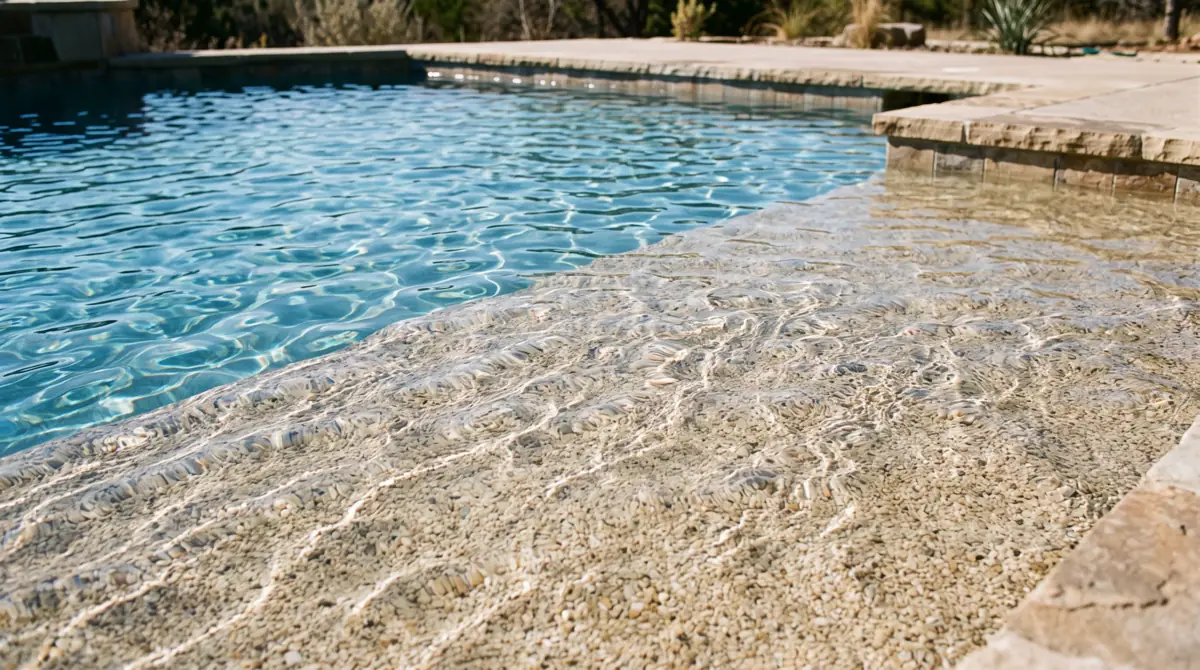
Covering is the harder part. Latham, which sells Coverstar automatic covers, says a beach entry can require added customization and cost. The ISPSC requires a vapor-retardant cover on heated outdoor pools unless more than 75% of the heat comes from a heat pump or on-site renewable source. The shallow slope also adds surface area, and each pound of 80 F water that evaporates removes 1,048 Btu (DOE).
Ask the cover maker for a written layout before you commit to a beach. Latham lists ‘jumping rocks, beach entry or an infinity edge’ among pool-surround features that ‘can require additional customization, which can increase the price’ (Latham, Sept 2026). If the beach cannot be covered, the ISPSC 305.1 exemption that lets a powered ASTM F1346 safety cover stand in for the barrier rules does not help you, and a fence is the plan. Prices are in our automatic pool cover cost guide.
Heat and water losses scale with surface area, not volume. A beach adds a lot of surface for little water: the 168 sq ft corner beach in the worked example holds 1,257 gallons. At the City of Mesa’s 79 in a year it would lose about 8,273 gallons, and EPA’s range of 12,000 to 31,000 gallons a year for an uncovered 500 sq ft pool works out to 24 to 62 gallons per sq ft (EPA WaterSense, 2022). The DOE calls evaporation the largest source of pool energy loss (DOE Energy Saver).
The shallow end also warms first. HomeGuide notes that beach entry pools ‘are warmer in the shallow end than traditional pools’ (HomeGuide, 2025), which suits toddlers and older swimmers but is also where algae gets a start. Public pool rules handle it with circulation: Maricopa County requires the area up to 2 ft deep to turn over at least once an hour, with at least two floor inlets no more than 15 ft apart and within 10 ft of the entry (Maricopa County).
How to build a beach entry pool, step by step
A beach entry is designed backward from the depth you want at the bottom of the slope. Pick that depth and a slope no steeper than 1 in 7, add the run to the pool length, then draw the slope lines, drainage and handrails before excavation. Fiberglass shells arrive with the slope molded in; concrete beaches are formed and shot on site.
- Set the toe depth and slopeChoose the water depth at the bottom, often 24 to 36 in, and a slope of 1 in 7 or flatter (ISPSC 809.6); 1:12 for public pools (MAHC 4.5.9.2).
- Add the run to the footprintRun = depth x ratio: 24 in at 1 in 7 is 14 ft. Check that the longer pool still meets your lot’s setbacks.
- Draw the slopeShow slope development lines perpendicular to the top of the slope, one elevation along the top and a flatness of plus or minus 1/2 in (ISPSC 809.6).
- Plan the deck edge and drainsThe top of the slope meets the deck with no step; put a deck or trench drain there, since ISPSC 306.5.1 wants deck water carried away from the pool.
- Prepare the baseFor fiberglass, set the beach area on crushed stone or flowable fill so it does not feel hollow (Pool & Spa Marketing, 2019); for concrete, form and shoot the slope with the shell.
- Place steps and railsSteps beside the slope sit no more than 12 in above it and never along its top (ISPSC 809.7); handrails, if installed, are 30 to 38 in high (ISPSC 324.2.1).
- Finish and inspectApply a slip-resistant finish (DCOF 0.42 where tested, ISPSC 306.2) and book the inspections listed on your permit before filling.
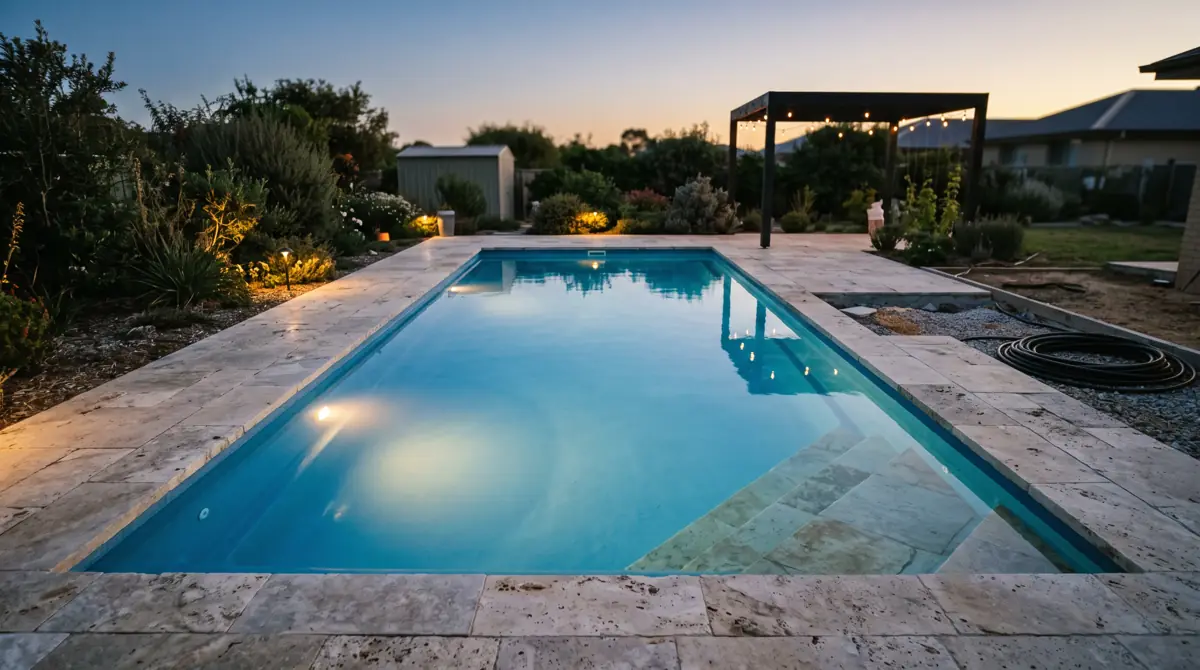
Is a beach entry pool right for your yard?
Choose a beach entry when step-free access matters more than swim length: for small children, older swimmers or a wheelchair user. Skip it when the yard limits pool length, when you need an automatic cover as your barrier, or when the budget cannot absorb $5,040 to $60,000 for the entry. The table pairs each situation with the rule that decides it.
| If your situation is | Do this | Rule or number behind it |
|---|---|---|
| The pool can be no longer than about 25 ft | Choose a tanning ledge or a corner bench, or accept a shallow toe of 12 to 18 in | At 1 in 7, 24 in of water takes 14 ft of run |
| A household member uses a wheelchair | Design to 1:12 with a landing 24 to 30 in deep and two handrails, or add a pool lift | ADA 405.2, 1009.3.2 and 1009.3.3 geometry; 24 to 30 ft of run |
| It is an HOA, rental or other public pool | Design to the MAHC or state code: 1:12 maximum and trench drains along the entry | MAHC 4.5.9; check your state's adopted code |
| You want an automatic safety cover as your barrier | Get the cover maker's written layout first; plan a fence if the beach cannot be covered | Latham: beach entries can need customization; ISPSC 305.1 exemption needs a powered ASTM F1346 cover |
| You want a fiberglass pool | Compare a maker's beach version with its standard twin | San Juan beach versions run up to 5 ft 6 in longer |
| Children or older adults will use the slope | Specify a slip-resistant finish and a handrail 30 to 38 in high | ISPSC 306.2 DCOF 0.42; ISPSC 324.2.1 |
| You live in a hot, dry climate | Budget the water the extra surface loses and keep a cover on when the pool is idle | EPA: 24 to 62 gal per sq ft a year uncovered |
| You want real sand | Only over an impervious base, with the sand kept out of the circulation system | ISPSC 307.2.1.1 |
| You are remodeling an existing pool | Price a sloped entry as a remodel line, not a new-build add-on | Anthony & Sylvan: $30,000 to $60,000 (2025) |
Sources: 2024 ISPSC; 2010 ADA Standards; MAHC; Latham; San Juan Pools; EPA WaterSense; Anthony & Sylvan. Download CSV
How we compiled this
We read the 26 sources listed below between Oct 3 and Nov 2, 2026: the 2024 ISPSC chapters 2, 3 and 8, the MAHC text adopted by Pueblo County, the 2010 ADA Standards, Maricopa County’s zero depth entry rule, the US Access Board’s pool recommendations, San Juan’s model list, Thursday Pools’ patent release, and five cost guides and builder pages. We searched 91,881 residential pool permit descriptions for beach, zero and walk-in entries. Run lengths, volumes and evaporation are our arithmetic; we did not build or measure any pool.
Frequently Asked Questions
What is a beach entry pool?
A pool whose floor slopes from deck level down into the water, so you walk in instead of using steps. The 2024 ISPSC calls it a beach entry or zero entry, defines it as starting above the waterline at deck level and ending below it, and says sand is not required. Public pool codes call it a zero depth entry.
How much does a beach entry add to a pool?
Published figures range from $5,040 to $9,170 (Fixr, 2024) and $5,000 to $10,000 (Pool Research) for a new pool, to $30,000 to $60,000 when added in a remodel (Anthony & Sylvan, 2025). HomeGuide prices beach entries at $50 to $125 per sq ft, or $8,400 to $21,000 for a 12 ft x 14 ft entry.
How steep can a beach entry be?
No steeper than 1 unit vertical in 7 horizontal, or 14%, under 2024 ISPSC Section 809.6, which also requires the slope to be flat within 1/2 in. Public pools under the MAHC are limited to 1:12, and ADA sloped entries must be 1:12 or flatter and end 24 to 30 in below the water.
Can you put a beach entry in a small pool?
Only with a shallow toe or a long pool. At the 1 in 7 limit, a beach needs 14 ft of run to reach 24 in of water, leaving little standing depth in a 20 ft pool. San Juan’s smallest beach shells are 7 ft 10 in x 20 ft and 8 ft 5 in x 23 ft; a 7 ft x 10 ft tanning ledge takes far less length.
Are there fiberglass pools with a beach entry?
Yes. San Juan lists beach versions of shells such as the Oceanside Beach (16 ft x 45 ft 8 in) and Great Lakes Beach (15 ft 11 in x 41 ft 3 in), each about 4 ft longer than the standard model. Thursday Pools patented its beach entry design in 2019 and sells the Grace in three sizes and the Sandal in two.
Can you put an automatic cover on a beach entry pool?
Sometimes, with customization. Latham, which sells Coverstar covers, says features such as a beach entry can require extra customization and raise the price. Get a written layout from the cover maker first; if the beach cannot be covered, the ISPSC 305.1 barrier exemption for a powered ASTM F1346 cover will not apply and you will need a fence.
Sources
- International Code Council. International Swimming Pool and Spa Code 2024, Chapter 2 Definitions (UpCodes). Accessed 2026-10-08.
- International Code Council. International Swimming Pool and Spa Code 2024, Chapter 3 General Compliance (UpCodes). Accessed 2026-10-08.
- International Code Council. International Swimming Pool and Spa Code 2024, Chapter 8 Residential Swimming Pools (UpCodes). Accessed 2026-10-08.
- Pueblo County Department of Public Health and Environment. 2022 Pueblo County Model Aquatic Health Code (2018 MAHC, 3rd edition text). Accessed 2026-11-02.
- US Access Board. 2010 ADA Standards for Accessible Design (Sections 242, 405, 1009). Accessed 2026-11-02.
- US Access Board. Swimming Pool Accessibility: Recommendations. Accessed 2026-11-02.
- Maricopa County Environmental Services. Environmental Health Code Chapter VI Section XIV, Zero Depth Entry Pools (rev. Aug 19, 2026). Accessed 2026-11-02.
- San Juan Pools. Fiberglass pool and spa model list. Accessed 2026-11-02.
- Aquarec. Clearwater Beach (dealer page quoting San Juan). Accessed 2026-11-02.
- Newswire / Thursday Pools. Thursday Pools Receives U.S. Utility Patent for World's First Beach Entry Fiberglass Pool Designs (Aug 26, 2019). Accessed 2026-11-02.
- Pool & Spa Marketing. The beach-entry phenomena: staying afloat with current trends in fibreglass pool design (Sept 23, 2019). Accessed 2026-11-02.
- Pool Research. Beach Entry Pools: Design Ideas, Inspiration and Considerations. Accessed 2026-11-02.
- Fixr. How Much Does It Cost to Build a Swimming Pool? (modified Jan 25, 2024). Accessed 2026-10-07.
- HomeGuide. How Much Does An Inground Pool Cost? (modified July 16, 2025). Accessed 2026-10-07.
- Angi. How Much Does an In-Ground Pool Cost? (updated Aug 5, 2026). Accessed 2026-10-07.
- Anthony & Sylvan Pools. Pool Remodel Cost (modified Nov 21, 2025). Accessed 2026-10-26.
- HomeGuide. How Much Does Pool Resurfacing Cost? (modified Apr 25, 2025). Accessed 2026-10-26.
- Latham Pool Products. Automatic Pool Covers: Price and Cost Factors. Accessed 2026-10-26.
- Latham Pool Products. Compare Tanning Ledge Options for Your Swimming Pool (June 3, 2021). Accessed 2026-11-02.
- US EPA WaterSense. Jump Into Pool Water Efficiency (2022). Accessed 2026-10-07.
- City of Mesa, Arizona. Is Your Pool Leaking? (evaporation chart). Accessed 2026-10-07.
- US Department of Energy. Energy Saver: Swimming Pool Covers (archived Jan 1, 2026). Accessed 2026-10-04.
- LA Department of Building and Safety. Building Permits Issued 2010 to 2019 and 2020 to Present. Accessed 2026-10-03.
- PC&S research. Average cost to build a pool: permit ledger (14 city and county open data sets). Accessed 2026-11-02.
- PC&S research. Pool evaporation rate by city. Accessed 2026-11-02.
- River Pools. What Are the Biggest and Smallest Sizes for Fiberglass Pools?. Accessed 2026-10-27.
Related pages
Get Quotes From Licensed Local Pool Pros
Tell us what you need and your ZIP code. We match you with pool companies that cover your area.