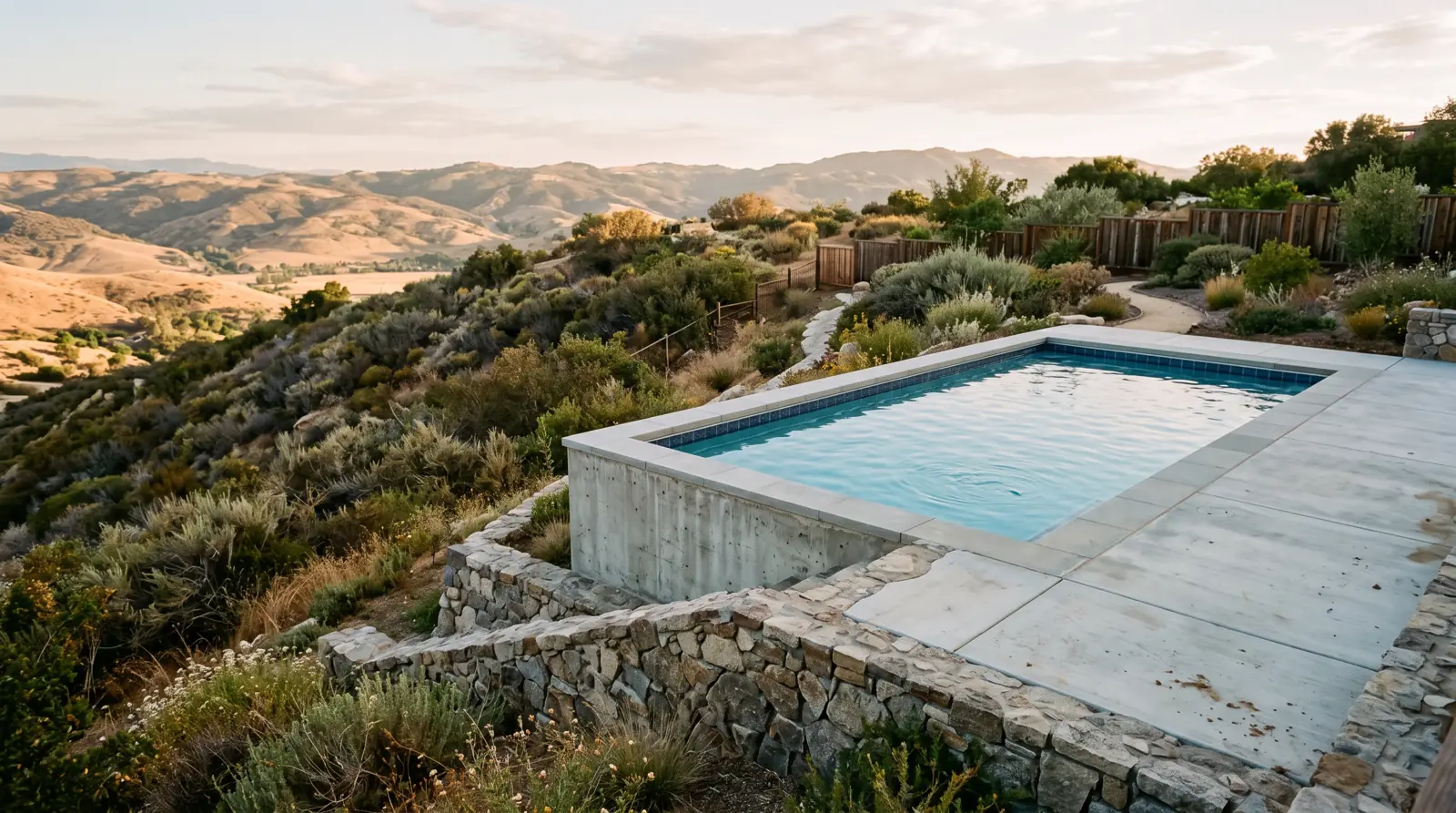
Pool on a Slope: Build Options, Retaining Wall Costs and the Code Setbacks That Apply
A pool on a slope is buildable with cut and fill, a retaining wall or a raised bond beam; IBC 1808.7.3 adds one hard rule: pool walls within 7 ft of a slope top must hold water without soil.
- ✓Three ways to level one pad268.8 vs 384 sq ft of wall for a 16 x 32 ft pool on a 10% grade.
- ✓Setbacks by slope heightH/6 up to 20 ft at the top, H/4 up to 7.5 ft at the toe, from the Los Angeles bulletin.
- ✓Permit and engineer triggersThe 4 ft, 48 in, 24 in and 3 ft lines from the IRC and Phoenix, in one table.
Key takeaways
- Slope rules start at 1 vertical in 3 horizontal (33.3%): IBC 1808.7 and IRC R403.1.7 set footing setbacks only on slopes steeper than that (IBC 2024 Chapter 18).
- IBC 1808.7.3 gives a pool half the building setback and says any pool wall within 7 ft of the slope top must hold its water without soil support; Los Angeles applies it as H/6, up to 20 ft (LADBS P/BC 2023-001).
- A retaining wall over 4 ft, or any wall supporting a surcharge (Phoenix names a pool within 3 ft uphill), loses the IRC R105.2 permit exemption, and IRC R404.4 requires an engineered wall over 48 in of unbalanced fill (IRC 2024 Chapter 4).
- Installed retaining walls run $20 to $53 per sq ft of face, $33 on average, as of October 2026 (LawnStarter); a 2026 Texas dealer survey puts the average extra-grading upcharge for a sloped yard at $2,000 (Thursday Pools).
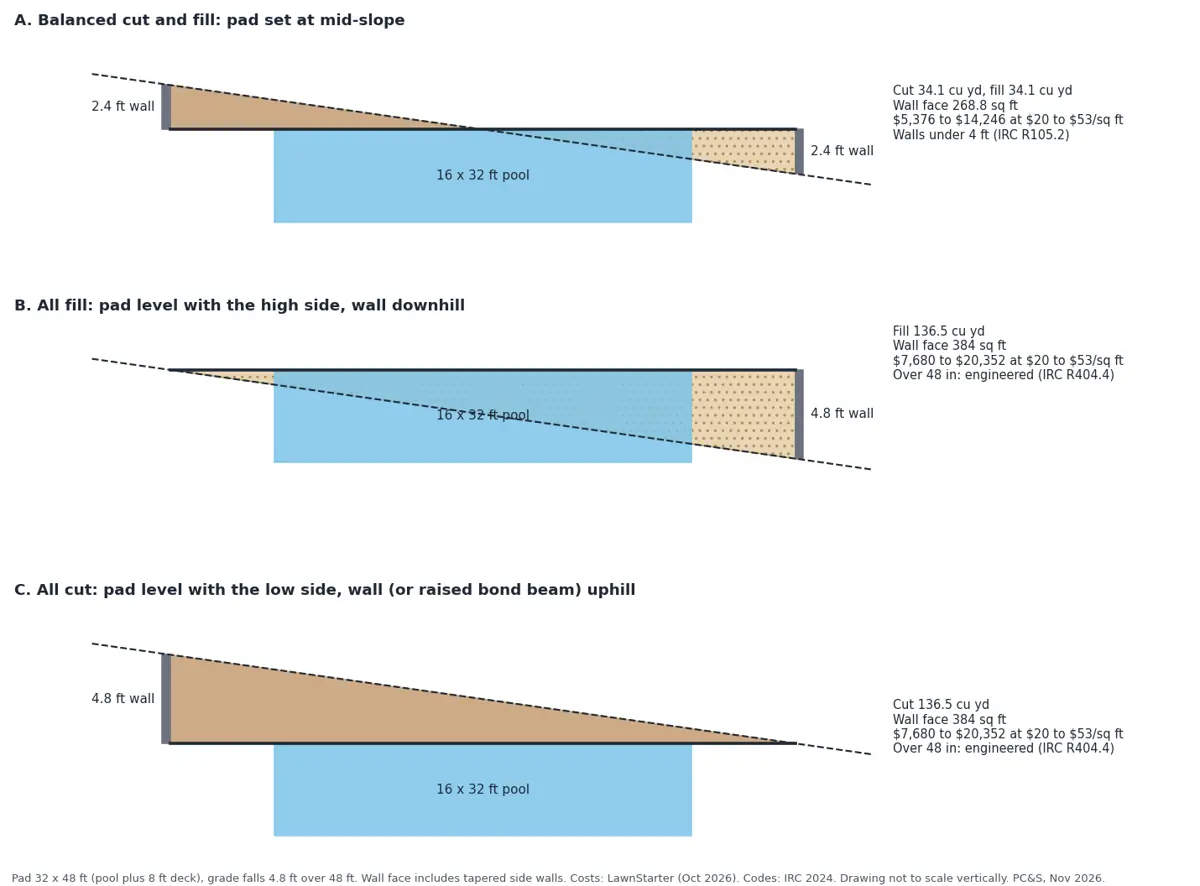
- On a 32 x 48 ft pad falling 4.8 ft, balancing cut and fill cuts wall face from 384 to 268.8 sq ft and keeps every wall at 2.4 ft, under the 4 ft permit line (PC&S arithmetic from LawnStarter rates).
Can you build a pool on a slope?
Yes. A pool on a slope is a site-work problem, not a pool-type problem: builders level a pad by cutting, filling, building a retaining wall or raising part of the pool wall. The code questions start when the slope is steeper than 1 vertical in 3 horizontal (33.3%), when a wall passes 4 ft, or when the pool sits within 7 ft of a slope top.
| Number | What it means | Source |
|---|---|---|
| 33.3% (1 vertical in 3 horizontal) | Slopes steeper than this trigger the slope setback rules | IBC 2024 Section 1808.7; IRC 2024 Section R403.1.7 |
| 7 ft | Any pool wall within 7 ft of the slope top must hold its water without soil support | IBC 2024 Section 1808.7.3 |
| H/6, max 20 ft | Los Angeles pool setback from a descending slope, measured from the pool spring line | LADBS P/BC 2023-001 (effective Jan 1, 2023) |
| 4 ft | Retaining wall height above which a permit is needed; any height if it supports a surcharge | IRC 2024 Section R105.2 |
| 48 in / 24 in | Unbalanced fill, or wall height with an added lateral load, that requires an engineered wall | IRC 2024 Section R404.4 |
| 3 ft | Phoenix permit line for walls; a pool within 3 ft uphill counts as a surcharge | Phoenix TRT/DOC/00181 (rev. July 22, 2013) |
| $20 to $53 per sq ft | Installed retaining wall cost per square foot of face; average $33 | LawnStarter, updated Oct 5, 2026 |
| $2,000 | Average Texas dealer upcharge for an above-average slope needing extra grading | Thursday Pools 2026 dealer survey |
Sources: IBC 2024 Chapter 18; IRC 2024 Chapter 4; IRC 2024 R105.2 (Austin adopted text); LADBS P/BC 2023-001; Phoenix TRT/DOC/00181; LawnStarter (Oct 5, 2026); Thursday Pools (2026 survey). Accessed 2026-11-01. Download CSV
The 2024 ISPSC treats a pool built into a hillside as an ordinary inground pool: Section 801.1 says permanent inground residential pools include pools that are partially or entirely above grade (ISPSC 2024 Chapter 8). Section 802.2 then sends the structural design to the International Residential Code, and Section 307.2.2 points to the IBC or IRC, so slope and wall rules come from those books.
Measure the slope before talking to builders. Divide the rise by the run across the pool and deck area: a 4.8 ft fall over 48 ft is a 10% grade, well under the 33.3% line where IBC 1808.7 setbacks begin. A bank that drops 10 ft over 20 ft is a 50% slope and brings the setback rules in (IBC 2024 Section 1808.7).
What are the options for a pool on a sloped yard?
Six layouts cover almost every sloped lot: cut and fill to a flat pad, a retaining wall uphill or downhill, a raised bond beam, a partly raised pool, a terraced deck, and an infinity edge facing downhill. Each has a different cost driver (cubic yards, square feet of wall face or extra shell) and a different code trigger to check before you sign.
| Option | How it works | What drives the cost | Code trigger to check |
|---|---|---|---|
| Cut and fill (grade it flat) | Soil from the high side fills the low side to make a level pad | Cubic yards moved: $8 to $25 per cu yd in dirt, $40 to $100 in rock (Angi, Mar 2025) | Compacted fill over 12 in under a foundation needs a geotechnical report (IBC 1803.5.8) |
| Retaining wall | A wall holds back the uphill cut or holds up the downhill fill | Square feet of wall face: $20 to $53 per sq ft (LawnStarter, Oct 2026) | Permit over 4 ft or with a surcharge (IRC R105.2); engineered over 48 in, or over 24 in with added load (IRC R404.4) |
| Raised bond beam | The uphill part of the pool wall rises above the deck to hold back soil or carry a water feature (Blue Haven) | Extra shell height, tile and coping; no published per-foot rate found | Shell design under the IRC or IBC (ISPSC 307.2.2, 802.2) |
| Partly raised pool | One end sits flush with grade, the other stands a foot or two out of the ground (Blue Haven) | Exposed wall finish, deck steps and a taller barrier on the low side | ISPSC 801.1 counts permanent pools partly above grade as inground pools |
| Terraced deck | Two or more shorter walls step the yard down in levels | More walls, each shorter; Blue Haven says shorter walls are often cheaper per wall | Each wall checked against the 4 ft and surcharge rules; guards where a level sits over 30 in above the next (IRC R321.1.1) |
| Infinity edge facing downhill | Water spills over the low wall into a catch basin and is pumped back (Fixr) | Catch basin, extra pump and engineering; Fixr lists $65,000 to $130,000 (Jan 2025) | A low wall within 7 ft of the slope top must stand without soil (IBC 1808.7.3) |
Sources: Angi pool excavation cost (updated Mar 14, 2025); LawnStarter (Oct 5, 2026); Blue Haven Pools, backyard conditions; Fixr infinity pool cost (Jan 31, 2025); IBC 2024; IRC 2024; ISPSC 2024. Download CSV
A raised bond beam turns the pool’s own uphill wall into the retaining wall: Blue Haven describes it as a section of pool wall that rises above the ground and can keep soil from the slope above out of the water (Blue Haven Pools). None of the 9 cost guide and builder pages we opened on November 1, 2026 publishes a per-foot price for it, so ask for it as its own line in the bid.
A partly raised pool leaves one end flush with grade and lets the other stand a foot or two out of the ground, the approach Blue Haven suggests for a moderate fall. The exposed side then counts toward the barrier only if it meets the 48 in rule in ISPSC Section 305, and a partly buried kit has its own limits, compared maker by maker in our semi inground pool guide.
An infinity edge uses the drop instead of fighting it: water spills over the low wall into a catch basin and is pumped back, and Fixr lists infinity pools at $65,000 to $130,000 as of January 2025 (Fixr). When that low wall sits within 7 ft of the slope top, IBC 1808.7.3 requires it to stand without soil, a point our infinity pool cost breakdown prices line by line.
How much does a pool on a slope cost?
The slope adds site work on top of the pool price. Retaining walls cost $20 to $53 per sq ft of face as of October 2026 (LawnStarter), ordinary digging $8 to $25 per cubic yard (Angi, 2025), and a 2026 Texas dealer survey averages $2,000 for extra grading. Builder estimates for the whole slope add-on run from $3,000 on a gentle grade to $120,000 or more on a hillside.
| Item | Published cost | Basis and date | Source |
|---|---|---|---|
| Retaining wall, installed | $20 to $53 per sq ft of face; average $33 | National, updated Oct 5, 2026 | LawnStarter |
| Retaining wall, installed | $15 to $45 per sq ft | National, updated Jan 31, 2025 | Fixr |
| Soldier pile (I-beam) wall for hillside pools and decks | $35 to $150 per sq ft | National, updated Jan 31, 2025 | Fixr |
| Rebar for walls over 4 ft | $1.50 to $2.50 per sq ft | National, Oct 2026 | LawnStarter |
| Wall waterproofing | $2 to $10 per sq ft | National, Oct 2026 | LawnStarter |
| French drain | $1,650 to $12,250 | National, Oct 2026 | LawnStarter |
| Retaining wall permit | $40 to $450 | National, Oct 2026 | LawnStarter |
| Excavation, ordinary dirt | $8 to $25 per cu yd | National, updated Mar 14, 2025 | Angi |
| Excavation, rocky soil | $40 to $100 per cu yd | National, updated Mar 14, 2025 | Angi |
| Above-average slope needing extra grading | $2,000 average upcharge | Texas dealer survey, 2026 | Thursday Pools |
| Rocky soil; limited yard access | $5,000; $3,500 average upcharge | Texas dealer survey, 2026 | Thursday Pools |
| Retaining wall for a pool | $7,000 to $20,000+ | Builder estimate, accessed Nov 2026 | River Pools |
| Fill dirt and patio changes on a slight slope | $1,000 to $4,000 | Builder estimate, accessed Nov 2026 | River Pools |
| Slope add-on: gentle; moderate; steep | $3,000 to $12,000; $12,000 to $50,000; $45,000 to $120,000+ | Builder working estimate, Oct 29, 2026 | Blue Haven Pools |
Sources: LawnStarter retaining wall cost (updated Oct 5, 2026); Fixr retaining wall cost (updated Jan 31, 2025); Angi pool excavation cost (updated Mar 14, 2025); Thursday Pools Texas survey (2026); River Pools; Blue Haven Pools (Oct 29, 2026). Download CSV
Per square foot of wall face (length x height). Soldier pile (I-beam) walls are the type Fixr names for pools and decks on hillsides.
Source: Fixr retaining wall cost guide (Jan 31, 2025); LawnStarter retaining wall cost guide (Oct 5, 2026). Download chart data (CSV)
Wall type moves the per-foot price more than anything else. Fixr prices gravity walls at $10 to $30 per sq ft and soldier pile (I-beam) walls, the type it names for pools and decks on hillsides, at $35 to $150 (Fixr, Jan 2025). LawnStarter adds $1.50 to $2.50 per sq ft of rebar for walls over 4 ft and $2 to $10 per sq ft of waterproofing.
Soil is the second driver. Angi prices digging at $8 to $25 per cubic yard in dirt and $40 to $100 in rock, and Thursday Pools’ 2026 Texas survey averages $5,000 extra for rocky soil and $3,500 for limited yard access (Thursday Pools). For the pool itself, use the ranges on our inground pool cost page.
How much wall does a 16 x 32 pool on a 10% slope need?
About 268.8 sq ft of wall face if you balance cut and fill, or 384 sq ft if you build everything up or dig everything down. On a 32 x 48 ft pad that falls 4.8 ft, that is $5,376 to $14,246 versus $7,680 to $20,352 at October 2026 wall prices, and only the balanced plan keeps every wall under 4 ft.
| Line | Balanced cut and fill | All fill (pad at the high grade) | All cut (pad at the low grade) | Basis |
|---|---|---|---|---|
| Pad: 16 x 32 ft pool plus 8 ft of deck on every side | 32 x 48 ft | 32 x 48 ft | 32 x 48 ft | PC&S assumption |
| Fall across the 48 ft length at a 10% grade | 4.8 ft | 4.8 ft | 4.8 ft | 48 x 0.10 |
| Tallest wall | 2.4 ft on each end | 4.8 ft downhill | 4.8 ft uphill | Half the fall vs the full fall |
| Soil cut | 34.1 cu yd | 0 | 136.5 cu yd | 0.5 x run x depth x 32 ft / 27 |
| Soil filled | 34.1 cu yd | 136.5 cu yd | 0 | Same wedge formula |
| Wall face (end walls plus tapered side walls) | 268.8 sq ft | 384 sq ft | 384 sq ft | Length x height; sides are triangles |
| Wall cost at $20 to $53 per sq ft | $5,376 to $14,246 | $7,680 to $20,352 | $7,680 to $20,352 | LawnStarter, Oct 2026 |
| Wall cost at the $33 average | $8,870 | $12,672 | $12,672 | LawnStarter, Oct 2026 |
| Digging the cut at $8 to $25 per cu yd | $273 to $853 | Fill priced separately | $1,092 to $3,413 | Angi, Mar 2025 |
| Code check | Under 4 ft: no permit unless the pool or deck surcharges the wall (IRC R105.2) | Over 48 in: engineered wall (IRC R404.4); fill over 12 in deep (IBC 1803.5.8) | Over 48 in: engineered wall (IRC R404.4) | IRC 2024; IBC 2024 |
Inputs: 16 x 32 ft pool, 8 ft deck on each side, 10% grade (PC&S assumptions). Rates: LawnStarter $20 to $53 and $33 per sq ft (Oct 5, 2026); Angi $8 to $25 per cu yd (Mar 14, 2025). Code: IRC R105.2, IRC R404.4, IBC 1803.5.8. Download CSV
Balancing saves about 30% of the wall face and 75% of the soil moved on each side, because each wall only holds half the fall. The catch is the surcharge: a 2.4 ft wall is 28.8 in tall, and IRC R404.4 requires an engineered design for walls over 24 in that resist lateral loads in addition to soil, a load a pool or deck close behind the wall can add (IRC 2024 R404.4).
The all-fill plan puts the downhill half of the pool on up to 4.8 ft of new fill. IBC 1803.5.8 requires a geotechnical investigation, with lift thickness and density tests, wherever shallow foundations bear on compacted fill more than 12 in deep (IBC 2024 Section 1803.5.8). Price the fill and compaction testing as separate lines; our worked table leaves them out.
When does a retaining wall near a pool need a permit and an engineer?
Under the 2024 IRC, a wall needs a permit once it is over 4 ft from the bottom of the footing, or at any height if it supports a surcharge, and it needs an engineered design over 48 in of unbalanced fill or over 24 in when it carries extra load. A pool uphill of a wall is a surcharge, and Phoenix spells that out at 3 ft.
| Rule | Trigger | What it requires | Source |
|---|---|---|---|
| IRC R105.2 (2024) | Wall over 4 ft from the bottom of the footing to the top, or any wall supporting a surcharge | Building permit | https://up.codes/viewer/austin/irc-2024/chapter/1/scope-and-administration |
| IRC R404.4 (2024) | Over 48 in of unbalanced fill without lateral support at the top, or over 24 in high and resisting lateral loads in addition to soil | Engineered design; safety factor of 1.5 against sliding and overturning | https://up.codes/viewer/austin/irc-2024/chapter/4/foundations |
| IBC 1807.2.3 (2024) | Every retaining wall under the IBC | Safety factor of 1.5 against sliding and overturning (1.1 with earthquake loads) | https://up.codes/viewer/austin/ibc-2024/chapter/18/soils-and-foundations |
| IRC R321.1.1 (2024) | Walking surface more than 30 in above the grade below within 36 in of the open side | Guard | https://up.codes/viewer/austin/irc-2024/chapter/3/building-planning |
| Phoenix TRT/DOC/00181 | Wall over 3 ft, or 3 ft or less with a house, road, swimming pool or fence within 3 ft uphill | Permit; walls over 3 ft need structural calculations | https://web-prod.phoenix.gov/content/dam/phoenix/pddsite/documents/trt/external/dsd_trt_pdf_00181.pdf |
| IBC 1803.5.8 (2024) | Shallow foundations on compacted fill more than 12 in deep | Geotechnical investigation with lift thickness and density tests | https://up.codes/viewer/austin/ibc-2024/chapter/18/soils-and-foundations |
| Orange County, CA pool packet | Pool less than 15 ft from the top or 8 ft from the toe of a slope steeper than 1:3 | Soils report; soils engineer memo before the steel inspection | https://ocds.ocpublicworks.com/sites/ocpwocds/files/2021-06/Swimming%20Pool%20and%20Spa%20Packet.pdf |
Sources: IRC 2024 Chapter 1; IRC 2024 Chapter 4; IRC 2024 Chapter 3; IBC 2024 Chapter 18; City of Phoenix TRT/DOC/00181 (rev. July 22, 2013); OC Public Works pool packet (rev. 01/2020). Accessed 2026-11-01. Download CSV
Phoenix states the surcharge rule plainly: a wall of 3 ft or less needs a permit when a house, building, road, swimming pool or fence sits within 3 ft measured from the uphill side, and walls over 3 ft need structural calculations (City of Phoenix TRT/DOC/00181). Phoenix’s minimum swimming pool permit fee is $234 under the schedule effective January 20, 2026, one of the fees compared in our pool permit cost research.
Guards follow height, not the permit. IRC R321.1.1 requires a guard on any walking surface more than 30 in above the grade below within 36 in of the open side (IRC 2024 R321.1.1), which catches the deck on top of a 4.8 ft downhill wall. Ask your builder who pulls the wall permit and whether it rides on the pool permit, as our pool permit guide explains.
How far must a pool be from the top or toe of a slope?
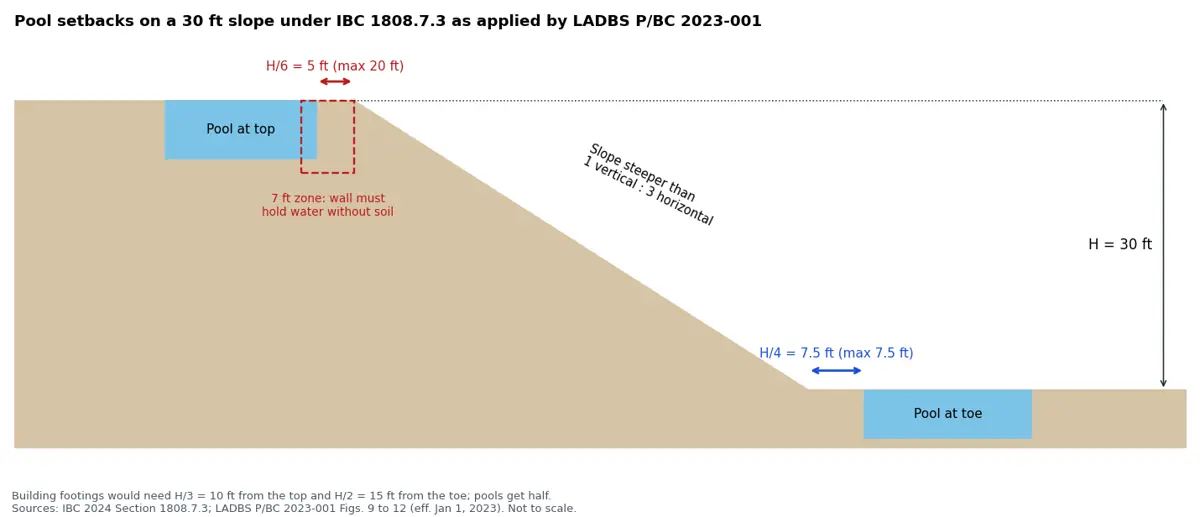
Under IBC 1808.7.3, half the distance a building footing needs. Footings sit H/3 (up to 40 ft) back from a descending slope and buildings H/2 (up to 15 ft) from an ascending one, so Los Angeles sets pools H/6 (up to 20 ft) from the top and H/4 (up to 7.5 ft) from the toe. Any pool wall within 7 ft of the top must stand without soil.
| Rule | Where it applies | Requirement | Source |
|---|---|---|---|
| IBC 1808.7 | Slopes steeper than 1 vertical in 3 horizontal (33.3%) | Setbacks and clearances in 1808.7.1 to 1808.7.5 apply | https://up.codes/viewer/austin/ibc-2024/chapter/18/soils-and-foundations |
| IBC 1808.7.2 and Figure 1808.7.1 | Footings near a descending slope | H/3, need not exceed 40 ft | https://ocds.ocpublicworks.com/sites/ocpwocds/files/2021-06/Swimming%20Pool%20and%20Spa%20Slope%20Setback.pdf |
| IBC 1808.7.1 and Figure 1808.7.1 | Buildings below an ascending slope | H/2, need not exceed 15 ft | https://ocds.ocpublicworks.com/sites/ocpwocds/files/2021-06/Swimming%20Pool%20and%20Spa%20Slope%20Setback.pdf |
| IBC 1808.7.3 | Pools | Half the building setback; wall within 7 ft of the top holds water without soil support | https://up.codes/viewer/austin/ibc-2024/chapter/18/soils-and-foundations |
| LADBS P/BC 2023-001 | City of Los Angeles, effective Jan 1, 2023 | H/6 up to 20 ft from the spring line at the top; H/4 up to 7.5 ft at the toe; 7 ft freestanding zone | https://web.archive.org/web/20251104093931/https://dbs.lacity.gov/sites/default/files/efs/forms/pc17/p-bc-2023-001-footing-building-setback-from-slopes.pdf |
| IBC 1808.7.5 and 1803.5.10 | Any site | Alternate setback allowed if a geotechnical investigation shows the intent is met | https://up.codes/viewer/austin/ibc-2024/chapter/18/soils-and-foundations |
| IRC R403.1.7 | One- and two-family dwellings | Same 1:3 slope trigger for footings; no pool clause | https://up.codes/viewer/austin/irc-2024/chapter/4/foundations |
| Orange County, CA pool packet (rev. 01/2020) | Unincorporated Orange County | No soils report if the top setback is H/3 (15 to 40 ft) with a deepened footing, or the toe setback is H/2 (max 8 ft) | https://ocds.ocpublicworks.com/sites/ocpwocds/files/2021-06/Swimming%20Pool%20and%20Spa%20Packet.pdf |
Sources: IBC 2024 Section 1808.7; OC Public Works slope setback handout (Figure 1808.7.1, rev. 1/2020); LADBS P/BC 2023-001 (effective Jan 1, 2023); IRC 2024 R403.1.7; OC Public Works pool packet. Download CSV
| Slope height H (ft) | Pool setback from top: H/6, max 20 ft | Pool clearance from toe: H/4, max 7.5 ft | Building footing setback: H/3, max 40 ft | Freestanding wall zone at the top |
|---|---|---|---|---|
| 6 | 1 | 1.5 | 2 | 7 ft |
| 12 | 2 | 3 | 4 | 7 ft |
| 18 | 3 | 4.5 | 6 | 7 ft |
| 30 | 5 | 7.5 | 10 | 7 ft |
| 42 | 7 | 7.5 | 14 | 7 ft |
| 60 | 10 | 7.5 | 20 | 7 ft |
| 120 | 20 | 7.5 | 40 | 7 ft |
| 150 | 20 | 7.5 | 40 | 7 ft |
PC&S arithmetic from LADBS P/BC 2023-001 Figures 9 to 12 and IBC 2024 Section 1808.7.3. Pool setback measured from the spring line, the point where the shell curves away from the slope. Download CSV
The 7 ft freestanding-wall zone at the top applies at every height, so it governs until H reaches 42 ft.
Source: LADBS P/BC 2023-001 Figures 9 to 12 (effective Jan 1, 2023); IBC 2024 Section 1808.7.3; PC&S arithmetic. Download chart data (CSV)
The 7 ft zone matters more than the setback on most backyard banks. H/6 only reaches 7 ft when the slope is 42 ft high, so on any shorter slope a pool set at the minimum setback still has part of its wall inside the zone and needs a shell designed to hold water alone. Water pushes about 312 psf at the floor of a 5 ft deep pool, using the USGS figure of 62.4 lb per cubic foot (USGS).
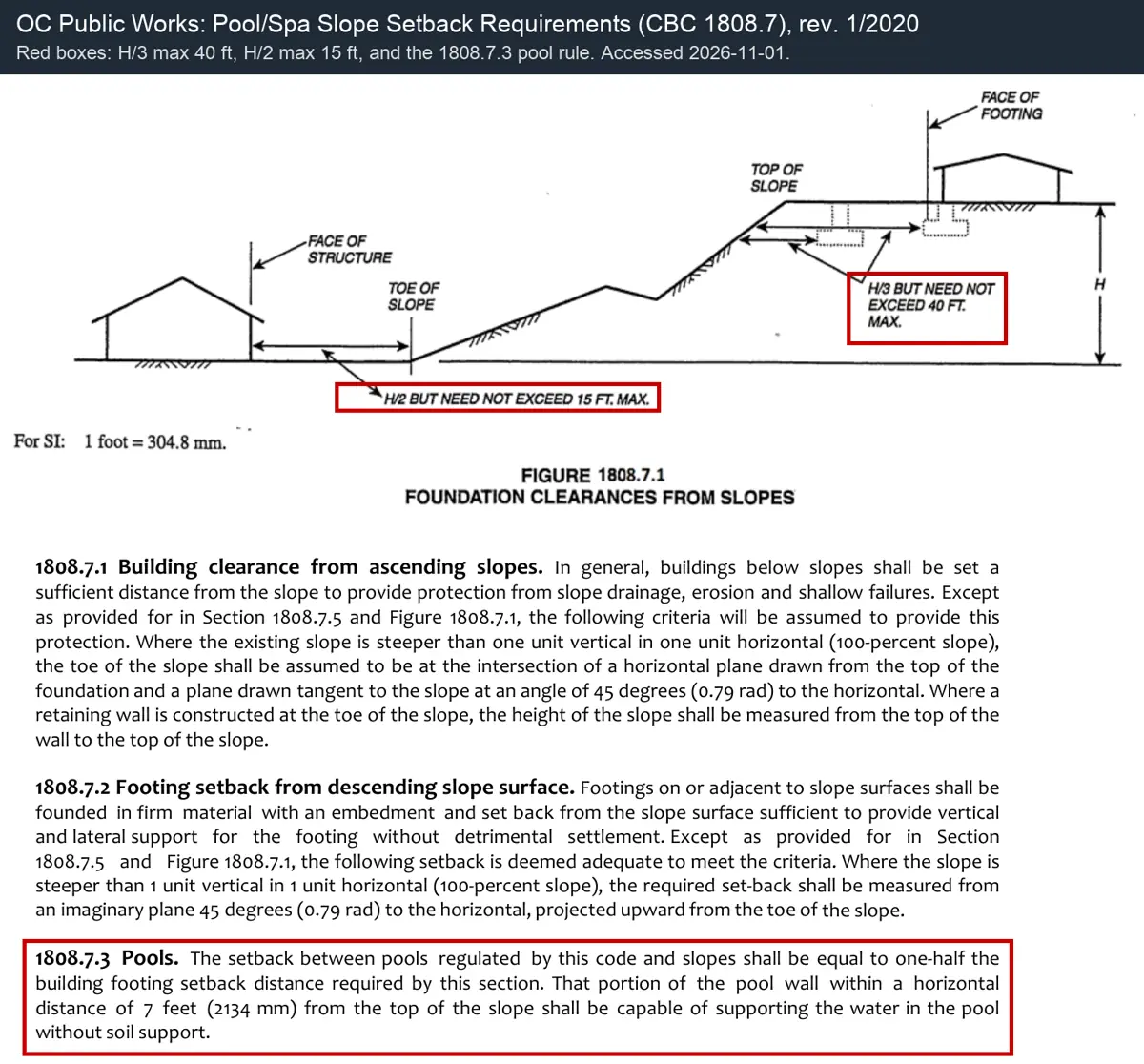
IRC R403.1.7 copies the footing rules for houses but has no pool clause (IRC 2024 R403.1.7), which is why California counties publish their own pool handouts. Where the yard cannot fit the setback, IBC 1808.7.5 lets the building official accept an alternate setback backed by a geotechnical investigation of slope height, gradient, load and erosion under Section 1803.5.10.
Do you need a soils report for a pool on a slope?
Often. Unincorporated Orange County, California requires a soils report when a pool is less than 15 ft from the top or 8 ft from the toe of a slope steeper than 1:3, and the IBC calls for a geotechnical investigation under foundations on more than 12 in of compacted fill and lets the official require one for alternate setbacks. Under IRC R401.4 the building official decides.
- Slope stability When Los Angeles requires a report, it accepts code setbacks only if the report shows a factor of safety of 1.5 static and 1.0 seismic (LADBS P/BC 2023-001).
- Fill specification Lift thickness, density test method and minimum in-place density for fill over 12 in (IBC 1803.5.8).
- Wall design pressure Orange County lets designers assume an equivalent fluid pressure of 100 pcf on a level lot and 125 pcf on a slope for expansive soil when no report exists.
- Excavation sign-off Orange County inspectors want a memo from the soils engineer that the pool excavation is suitable before the steel inspection.
- Drainage and erosion Surface water drainage, erosion potential and debris flow are three of the six items LADBS lists for a slope report.
Orange County waives the report when the plan already gives the slope room: a top-of-slope pool with a deepened footing and a daylight setback of H/3 (minimum 15 ft, maximum 40 ft), or a toe-of-slope pool set back H/2 (maximum 8 ft), with plumbing joints that can take soil movement (OC Public Works pool packet). Engineered plans also take longer there: about 15 working days for a first plan check against about 5 for county standard plans.
How do you handle drainage for a pool on a slope?
Send water around the pool, never toward it. IRC R401.3 wants grade to fall 6 in in the first 10 ft from a foundation, ISPSC 306.5 sets deck slopes of at least 1/8 in per foot for textured concrete and no more than 1/2 in, and ISPSC 306.5.2 says site and roof drainage must run away from the pool. Uphill runoff usually needs a swale or French drain, priced at $1,650 to $12,250 in 2026.
- Map the water firstMark where runoff enters from uphill and where it leaves; on a hillside the uphill side is the one that floods the deck.
- Intercept it uphillA swale or French drain above the pool area carries water past it; LawnStarter prices French drains at $1,650 to $12,250 (Oct 2026).
- Drain behind every wallGravel backfill and a perforated pipe behind each retaining wall; LawnStarter adds $2 to $10 per sq ft for wall waterproofing.
- Slope the deckAt least 1/8 in per foot for textured concrete and residential pavers, never more than 1/2 in per foot, away from the pool or to deck drains (ISPSC 306.5, 306.5.1).
- Grade away from the houseKeep 6 in of fall in the first 10 ft from the foundation, or a swale where the lot cannot fit it (IRC R401.3).
- Plan for groundwaterHillside seepage can lift an empty shell; a hydrostatic relief valve, usually under the main drain cover, must be opened when the pool is drained (TMI Aquatics).
Never empty a hillside pool without the builder’s sign-off; ISPSC 306.5.2 already requires site drainage to run away from the pool. TMI Aquatics notes that pools on naturally high groundwater see the most hydrostatic pressure and that relief valves sit under the pool main drain cover (TMI Aquatics). Our pool draining guide covers discharge rules, and deck surfaces with their slip and slope data are compared on our pool deck materials page.
Which slope option fits your yard?
Start with the fall across the pool and deck pad and the distance to any slope edge. Under about 2 ft, grade it flat; between 2 and 4 ft, balance cut and fill and watch for surcharge; over 4 ft, budget an engineered wall and a soils report. Within 7 ft of a slope top, the shell itself must be designed to stand without soil.
| If your situation is | Do this | Why |
|---|---|---|
| The pad falls 1 to 2 ft from end to end | Grade it flat: cut the high side and spread the soil | Blue Haven calls flattening the most cost-effective approach at a foot or two; dirt digging runs $8 to $25 per cu yd (Angi) |
| The pad falls 2 to 4 ft | Balance cut and fill so no wall passes 4 ft, then ask whether the pool or deck loads the wall | Balancing halves wall height; the R105.2 exemption ends at 4 ft or at any surcharge |
| The pad falls more than 4 ft, or the pool sits within 3 ft uphill of a wall | Budget an engineered, permitted wall and a soils report | IRC R404.4 (48 in); Phoenix TRT/DOC/00181; IBC 1803.5.8 for fill over 12 in |
| The pool edge is within 7 ft of the top of a slope steeper than 1:3 | Have the shell designed to hold its water without soil support | IBC 1808.7.3; LADBS Figure 10 |
| The pool is closer than H/6 (max 20 ft) to the top or H/4 (max 7.5 ft) to the toe | Move the pool, or ask for an alternate setback backed by a geotechnical investigation | IBC 1808.7.5 and 1803.5.10; LADBS P/BC 2023-001 |
| You want the downhill view | Price a vanishing edge with its catch basin as a separate line | Fixr lists infinity pools at $65,000 to $130,000 (Jan 2025) |
| You want a cheaper partly buried pool on a gentle slope | Compare semi-inground kits and their burial limits | Maker documents set burial depth; standard kits are not designed to be buried (Islamorada manual) |
Sources: Blue Haven Pools; Angi; IRC R105.2; IRC R404.4; Phoenix TRT/DOC/00181; IBC 2024 Chapter 18; LADBS P/BC 2023-001; Fixr; Islamorada pool manual. Download CSV
| What a ranking guide says | What the primary source says | Primary source |
|---|---|---|
| "Walls over about 4 feet usually need a structural engineer's stamp" (Blue Haven, Oct 29, 2026) | IRC R404.4 also requires engineering for walls over 24 in that resist loads in addition to soil, and R105.2 drops the 4 ft permit exemption for any surcharged wall; Phoenix exempts only walls of 3 ft or less with no pool within 3 ft uphill | IRC 2024 R404.4, R105.2; Phoenix TRT/DOC/00181 |
| "Many local codes limit how close you can build to the top or bottom of a slope" (Blue Haven) | IBC 1808.7.3 gives pools half the building setback; Los Angeles turns that into H/6 up to 20 ft at the top and H/4 up to 7.5 ft at the toe, plus a 7 ft freestanding zone | IBC 2024 1808.7.3; LADBS P/BC 2023-001 |
| "A retaining wall adds $7,000 to $20,000+" (River Pools) | The worked example needs 268.8 to 384 sq ft of wall face, or $5,376 to $20,352 at LawnStarter's Oct 2026 rates: in range, but driven by wall height | LawnStarter; PC&S arithmetic |
| "Drainage can eat 20 to 30 percent of the whole project" (a claim Blue Haven quotes from other articles) | No primary cost source found; LawnStarter prices a French drain at $1,650 to $12,250 and wall waterproofing at $2 to $10 per sq ft | LawnStarter, Oct 2026 |
Sources: Blue Haven Pools (Oct 29, 2026); River Pools; IRC 2024; Phoenix TRT/DOC/00181; LADBS P/BC 2023-001; LawnStarter. Download CSV
Time follows the paperwork. River Pools puts a standard install at about 4 to 6 weeks and a sloped project with a large wall at a few months (River Pools), and new residential pool permits in Los Angeles took a median 61 days from application to issue in 2025 (PC&S permit processing research). The build order is laid out on our pool construction process page.
How we compiled this
We read six chapters of the 2024 IBC, IRC and ISPSC covering slopes, retaining walls, fill and pool structure, and five local documents: the Los Angeles slope bulletin, two Orange County pool handouts, the Phoenix retaining wall guideline and the Phoenix fee schedule. Prices come from five dated cost guides and four pages from two pool builders, all opened on November 1, 2026. The worked example is our arithmetic with every input shown; we did not visit or measure any site.
Frequently Asked Questions
Can you put an inground pool on a steep slope?
Yes, with engineering. Once the slope is steeper than 1 vertical in 3 horizontal, IBC 1808.7.3 sets the pool back half the building setback, H/6 up to 20 ft in Los Angeles, and any pool wall within 7 ft of the top must hold its water without soil support (LADBS P/BC 2023-001). Expect a soils report and an engineered shell and wall.
Do I need a retaining wall for a pool on a slope?
Usually once the pad falls more than a foot or two. Blue Haven calls grading flat the cheapest fix for a foot or two of fall (Blue Haven). Beyond that a wall holds the cut or the fill; balancing both halves the wall height, and walls over 4 ft or carrying a pool need a permit under IRC R105.2.
Does a sloped yard make a pool cost more?
Yes, through site work. A 2026 Texas dealer survey averages $2,000 extra for above-average slopes needing grading (Thursday Pools), retaining walls cost $20 to $53 per sq ft of face (LawnStarter, Oct 2026), and Blue Haven estimates slope add-ons from $3,000 on gentle grades to $120,000 or more on steep hillsides.
How close can a pool be to a slope?
Half the building setback under IBC 1808.7.3. Los Angeles sets it at H/6, up to 20 ft, from the top of a descending slope, measured from the pool spring line, and H/4, up to 7.5 ft, from the toe of an ascending one (LADBS P/BC 2023-001). The rules apply to slopes steeper than 1:3, or 33.3%.
How long does it take to build a pool on a slope?
Longer than on flat ground. River Pools puts a standard install at about 4 to 6 weeks and a sloped job with a large retaining wall at a few months (River Pools). Engineered plans also slow plan check: Orange County, California quotes about 15 working days for a first review, against about 5 for its standard pool plans.
Can you put an above ground pool on a slope?
Only after leveling the pad. The Islamorada manual treats a slope of more than 2 in wall to wall as off level, says to dig high spots down rather than fill low spots, and states the pool is not designed to be buried (Islamorada manual). On a steeper yard, a retaining wall creates the flat pad.
Sources
- International Code Council via UpCodes. International Building Code 2024, Chapter 18 (Sections 1803.5.8, 1803.5.10, 1807.2, 1808.7). Accessed 2026-11-01.
- International Code Council via UpCodes. International Residential Code 2024, Chapter 4 (Sections R401.3, R401.4, R403.1.7, R404.4). Accessed 2026-11-01.
- International Code Council via UpCodes. International Residential Code 2024, Section R105.2 (Austin adopted text). Accessed 2026-11-01.
- International Code Council via UpCodes. International Residential Code 2024, Section R321.1.1. Accessed 2026-11-01.
- International Code Council via UpCodes. International Swimming Pool and Spa Code 2024, Chapter 3 (Sections 305, 306.5, 307.2.2). Accessed 2026-11-01.
- International Code Council via UpCodes. International Swimming Pool and Spa Code 2024, Chapter 8 (Sections 801.1, 802.2). Accessed 2026-11-01.
- Los Angeles Department of Building and Safety. Information Bulletin P/BC 2023-001, Footing/Building Setbacks from Slopes (effective Jan 1, 2023; Wayback capture Nov 4, 2025). Accessed 2026-11-01.
- OC Public Works. Pool/Spa Slope Setback Requirements per California Building Code (rev. 1/2020). Accessed 2026-11-01.
- OC Public Works. Swimming Pool and Spa Packet (rev. 01/2020). Accessed 2026-11-01.
- City of Phoenix Planning & Development. Required Permits for Fences and Retaining Walls, TRT/DOC/00181 (rev. July 22, 2013). Accessed 2026-11-01.
- City of Phoenix Planning & Development. PDD Fee Schedule, Ordinance G-7465 (effective Jan 20, 2026). Accessed 2026-11-01.
- LawnStarter. How Much Does a Retaining Wall Cost in 2026? (updated Oct 5, 2026). Accessed 2026-11-01.
- Fixr. How Much Does It Cost to Build a Retaining Wall? (updated Jan 31, 2025). Accessed 2026-11-01.
- Angi. Pool Excavation Cost (updated Mar 14, 2025; Wayback capture Apr 29, 2025). Accessed 2026-11-01.
- Thursday Pools. How Much Does a Fiberglass Pool Cost in Texas? (2026 dealer survey). Accessed 2026-11-01.
- River Pools. Pool retaining walls. Accessed 2026-11-01.
- River Pools. Can you build a fiberglass pool on a sloped or wooded lot?. Accessed 2026-11-01.
- Blue Haven Pools. Building an Inground Pool on a Slope or Hill: What It Really Takes (Oct 29, 2026). Accessed 2026-11-01.
- Blue Haven Pools. Swimming Pool Prices: Backyard Conditions That Impact Building Costs. Accessed 2026-11-01.
- Fixr. Infinity Pool Cost (updated Jan 31, 2025). Accessed 2026-11-01.
- U.S. Geological Survey. Water Density. Accessed 2026-11-01.
- Pro Pools (host). Islamorada round pool installation instructions. Accessed 2026-11-01.
- TMI Aquatics. The Importance of Hydrostatic Relief Valves (Wayback capture May 11, 2026). Accessed 2026-11-01.
- Los Angeles Department of Building and Safety. Building Permits Issued 2020 to Present (dataset pi9x-tg5x). Accessed 2026-11-01.
Related pages
Get Quotes From Licensed Local Pool Pros
Tell us what you need and your ZIP code. We match you with pool companies that cover your area.