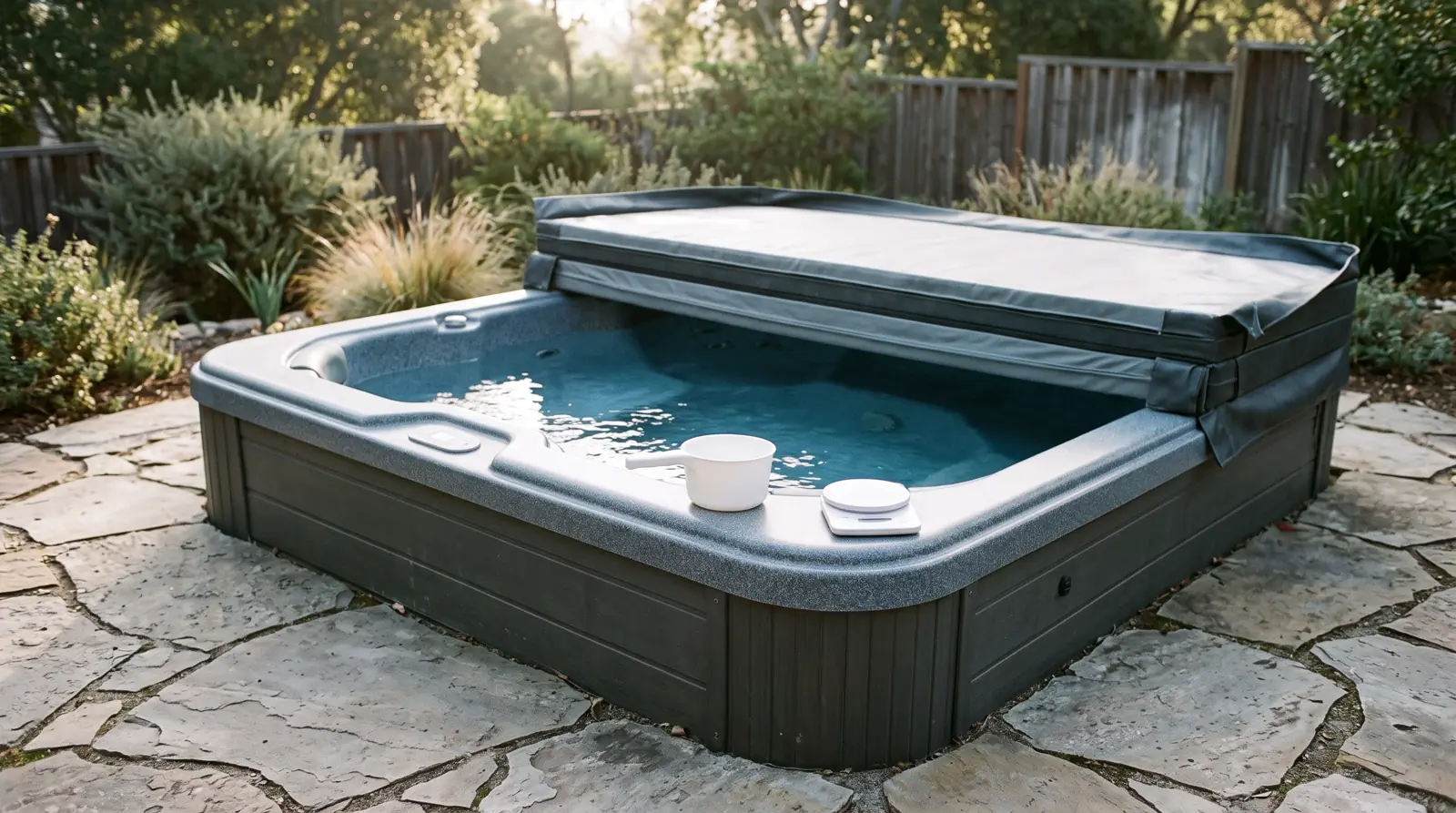
How to Raise pH in Hot Tub Water, Dosed for 200 to 600 Gallons
How to raise pH in hot tub water: get alkalinity to 80 to 120 ppm, then add soda ash, about 0.4 oz per 500 gallons at pH 7.0 to 7.2 (Virginia DOH), jets on, and retest after 30 minutes.
- ✓Alkalinity firstBaking soda: 1.12 oz per 500 gallons for each 10 ppm, the same chemistry as the 2024 MAHC Annex.
- ✓Doses disagree 8 foldPublished first doses for a 400 gallon tub near pH 7.0 run from 0.24 oz to 2 oz.
- ✓Tablets pull pH downA 1% bromine tablet solution has pH 4.8 and trichlor 2.8 to 3.5 (Florida DOH).
Key takeaways
- CDC sets hot tub pH at 7.0 to 7.8, and the 2024 Model Aquatic Health Code treats pH below 6.5 as an imminent health hazard that can close a public spa (6.6.3.1).
- Soda ash doses from the Virginia DOH chart, scaled to a 500 gallon tub, are 0.30 oz at pH 7.2 to 7.4, 0.40 oz at 7.0 to 7.2, 0.60 oz at 6.8 to 7.0 and 0.80 oz below 6.7; the SpaPure pH Up label says 1 oz at 6.8 to 7.1.
- Baking soda raises alkalinity 10 ppm at 0.22 oz per 100 gallons and 1.12 oz per 500 gallons, the 2024 MAHC Annex figure of 1.4 lb per 10,000 gallons scaled down, about 6.6 teaspoons at the Arm & Hammer label density.
- Sanitizer tablets drag pH down: a 1% solution of BCDMH bromine has pH 4.8 and trichlor 2.8 to 3.5, per the Florida DOH operators manual.
- Rain is a minor cause: an inch of acid rain at pH 4.2 (EPA) in an uncovered 7 x 7 ft tub carries about 0.3% of the acid buffer in 400 gallons at 80 ppm, though it dilutes alkalinity to about 74 ppm.
- Retest after about 30 minutes, the wait on the SpaPure, FreshWater and SpaGuard product pages; the Nordic Hot Tubs manual says wait at least 2 hours.
What pH should a hot tub be, and how low is too low?
Hold hot tub pH at 7.0 to 7.8, the CDC range and the 2024 Model Aquatic Health Code limit for public spas (5.7.3.4.1). Spa makers aim tighter: Coast, Nordic, Hot Spring and Caldera list 7.2 to 7.8, and Catalina 7.2 to 7.6. Below 7.0, CDC says pipes are more likely to corrode, and below 6.5 a public spa can be closed.
| Reading | What it means | Source |
|---|---|---|
| 7.2 to 7.8 | Maker target band (Catalina aims 7.2 to 7.6) | Coast 2026, Nordic, Hot Spring 2026 manuals; Catalina 2022 |
| 7.0 to 7.8 | Healthy range for home hot tubs and public spas | CDC (2025); 2024 MAHC 5.7.3.4.1 |
| Below 7.2 | Too acidic: sanitizer dissipates quickly, equipment corrodes | Nordic manual; Virginia DOH (pools) |
| Below 7.0 | Chlorine kills faster, but pipes are more likely to corrode or break down | CDC home water page |
| Below 6.5 | Imminent health hazard: public spa can be closed | 2024 MAHC 6.6.3.1 |
Sources: CDC hot tub guidance; CDC home water page; 2024 MAHC; Coast 2026 manual; Nordic manual; Hot Spring 2026 manual; Caldera 2025 manual; Catalina 2022 guide; Virginia DOH. Download CSV
Low pH is mostly an equipment and comfort problem. The CDC home water page says chlorine kills germs faster as pH drops below 7.0, but pool and hot tub pipes are more likely to corrode or break down, and the Nordic manual adds that sanitizers dissipate quickly below 7.2. If your reading runs the other way, our guide on how to lower pH in a hot tub doses pH decreaser by tub size.
Why does hot tub pH keep dropping?
Usually the sanitizer. Pennsylvania DOH says bromine, trichlor and dichlor reduce pH and alkalinity over time, and the Florida DOH manual lists a 1% bromine tablet solution at pH 4.8 and trichlor at 2.8 to 3.5. The 2024 MAHC Annex adds non-chlorine shock (potassium monopersulfate) to the net acidic list. Low alkalinity lets each dose swing pH further.
Florida lists dichlor's pH effect as neutral; Pennsylvania DOH and the 2024 MAHC Annex say it lowers pH over time.
Source: Florida Department of Health in Collier County, Swimming Pool Operators' Manual (2016 version), disinfectant characteristics chart. Download chart data (CSV)
| Cause | Why pH falls | Size of the effect | Source |
|---|---|---|---|
| Bromine tablets (BCDMH) | Acidic product; lowers pH and alkalinity over time | pH 4.8 in a 1% solution | Florida DOH; Pennsylvania DOH |
| Trichlor tablets | Strongly acidic stabilized chlorine | pH 2.8 to 3.5 in a 1% solution | Florida DOH; 2024 MAHC Annex |
| Dichlor granules | Net acidic over time per MAHC Annex and Pennsylvania DOH | pH 6.5 to 6.8 (Florida lists it as neutral) | Florida DOH; Pennsylvania DOH; MAHC Annex |
| Non-chlorine shock (potassium monopersulfate) | Net acidic oxidizer | Not quantified | 2024 MAHC Annex |
| Too much acid | Overshoot after lowering pH | Each pH Down dose | Pennsylvania DOH |
| Low total alkalinity | No buffer, so small inputs swing pH | Below 80 ppm | MAHC Annex; Nordic and Hydropool manuals |
| Rain in an uncovered tub | Dilutes alkalinity; adds little acid | About 0.3% of the buffer per inch (see rain table) | EPA; PC&S arithmetic |
Sources: Florida DOH; Pennsylvania DOH; 2024 MAHC Annex; Nordic manual; EPA; PC&S rain arithmetic below. Download CSV
Bromine tubs see this most. BCDMH tablets cannot be stabilized and lower pH steadily, which our chlorine vs bromine comparison prices against dichlor. Liquid chlorine works the other way: Pennsylvania DOH says sodium and calcium hypochlorite raise pH and alkalinity over time, which is why tubs on liquid chlorine more often need acid than soda ash.
Does rain lower hot tub pH?
Barely, and a covered tub gets none. EPA puts normal rain at pH 5.6 and acid rain at 4.2 to 4.4. An inch of acid rain on an uncovered 7 x 7 ft tub adds about 7.3 millimoles of acid, about 0.3% of the buffer in 400 gallons at 80 ppm alkalinity. The real effect is dilution: alkalinity falls to about 74 ppm.
| Step | Arithmetic | Result |
|---|---|---|
| 1. Rain on an uncovered 7 x 7 ft tub, 1 inch | 49 sq ft x 1/12 ft x 7.48 gal per cu ft (USGS) | 30.5 gal (116 L) |
| 2. Acid in normal rain, pH 5.6 (EPA) | 10^-5.6 mol/L x 116 L | 0.29 millimoles |
| 3. Acid in acid rain, pH 4.2 (EPA) | 10^-4.2 mol/L x 116 L | 7.3 millimoles |
| 4. Buffer in a 400 gal tub at 80 ppm alkalinity | 80 / 50.04 meq per L x 1,514 L | 2,421 millimoles |
| 5. Acid rain as a share of the buffer | 7.3 / 2,421 | 0.3% |
| 6. Dilution if the rain stays in the tub | 80 ppm x 400 / 431 gal | 74 ppm alkalinity |
Sources: EPA, What is Acid Rain? (normal rain about 5.6, acid rain 4.2 to 4.4); USGS (7.48 gallons per cubic foot); NIST SP 811 (3.785412 L per gallon); alkalinity as calcium carbonate, 50.04 mg per meq (PubChem molar mass 100.09). PC&S arithmetic; the 7 x 7 ft surface is an example. Download CSV
So the claim that rain makes hot tub water acidic is mostly a myth, at least for pH. Rain does thin out the buffer that holds pH steady, and Pennsylvania DOH puts rain near pH 5.75 because it carries dissolved carbon dioxide. After a storm in an uncovered tub, test alkalinity first and top it up with baking soda before chasing pH.
How much soda ash raises pH in a hot tub?
Start with the Virginia DOH chart scaled to your gallons: 0.40 oz of soda ash in a 500 gallon tub at pH 7.0 to 7.2, 0.60 oz at 6.8 to 7.0. Spa product labels run about twice that: SpaPure pH Up says 1 oz per 500 gallons at pH 6.8 to 7.1. Weigh the first dose if you can, since a teaspoon of soda ash is only about 4.7 g.
| Starting pH | 200 gal | 300 gal | 400 gal | 500 gal | 600 gal |
|---|---|---|---|---|---|
| 7.4 to 7.6 | none | none | none | none | none |
| 7.2 to 7.4 | 0.12 oz (0.7 tsp) | 0.18 oz (1.1 tsp) | 0.24 oz (1.4 tsp) | 0.30 oz (1.8 tsp) | 0.36 oz (2.2 tsp) |
| 7.0 to 7.2 | 0.16 oz (1.0 tsp) | 0.24 oz (1.4 tsp) | 0.32 oz (1.9 tsp) | 0.40 oz (2.4 tsp) | 0.48 oz (2.9 tsp) |
| 6.8 to 7.0 | 0.24 oz (1.4 tsp) | 0.36 oz (2.2 tsp) | 0.48 oz (2.9 tsp) | 0.60 oz (3.6 tsp) | 0.72 oz (4.3 tsp) |
| Below 6.7 | 0.32 oz (1.9 tsp) | 0.48 oz (2.9 tsp) | 0.64 oz (3.8 tsp) | 0.80 oz (4.8 tsp) | 0.96 oz (5.8 tsp) |
PC&S scaling of the Virginia DOH soda ash chart (6, 8, 12 and 16 oz per 10,000 gallons). Teaspoons use 6 tsp per oz from the SpaPure pH Up label (1 oz = 2 tbsp) and the FDA 3 tsp per tbsp. Tub sizes span the Coast Spas 232 to 527 gallon range. Download CSV
Know your gallons before you measure. The Coast Spas 2026 manual lists 232 gallons for its 3 to 4 seat 2Purfikt Traditional and 527 for the 7 to 8 seat Purfikt Infinity, Hot Spring gives 450 gallons for its Grandee, and the median certified inflatable spa holds 213 gallons (CEC listings).
An 8 fold spread for the same job; start at the health department dose and retest.
Source: Florida DOH operators manual; Virginia DOH Portsmouth guide (2018); SpaPure pH Up and FreshWater pH/Alkalinity Up retailer pages; Swim University; Aquatica; Poolonomics; Atlas Scientific. PC&S scaling to 400 gallons. Download chart data (CSV)
| Source | Published rate | 400 gallon tub | Teaspoons at label density |
|---|---|---|---|
| Florida DOH table, +0.2 pH | 6 oz per 10,000 gal | 0.24 oz | 1.4 |
| Virginia DOH, pH 7.0 to 7.2 | 8 oz per 10,000 gal | 0.32 oz | 1.9 |
| Virginia DOH, pH 6.8 to 7.0 | 12 oz per 10,000 gal | 0.48 oz | 2.9 |
| Florida DOH text, +0.3 pH | 1 lb per 10,000 gal | 0.64 oz | 3.8 |
| Aquatica, upper end | 1 tbsp per 300 to 400 gal | 0.50 oz | 3.0 |
| SpaPure pH Up label, pH 6.8 to 7.1 | 1 oz per 500 gal | 0.80 oz | 4.8 |
| FreshWater pH/Alk Up page | 1 oz per 500 gal | 0.80 oz | 4.8 |
| Swim University chart, pH 7.0 | 1 oz listed for 400 gal | 1.00 oz | 6.0 |
| Poolonomics and Atlas rule | 1 tbsp per 100 gal | 2.00 oz | 12.0 |
Sources: Florida DOH; Virginia DOH; Aquatica; SpaPure pH Up; FreshWater pH/Alkalinity Up; Swim University; Poolonomics; Atlas Scientific. PC&S scaling; teaspoons at 6 per oz. Download CSV
The spread is 8 fold, from 0.24 oz to 2 oz, and even one manual disagrees with itself: the Florida DOH manual says 1 lb per 10,000 gallons lifts pH 0.3 in its text, but its quick reference table says 6 oz lifts it 0.2 and 12 oz lifts it 0.8. Swim University lists 8 tsp beside 1 oz for 400 gallons at pH 7.0, while 8 tsp of soda ash weighs about 1.33 oz at label density. Start at the health department dose; a second small dose costs 30 minutes, an overshoot costs acid.
How much baking soda raises hot tub alkalinity?
About 0.22 oz per 100 gallons, or 1.12 oz per 500 gallons, for each 10 ppm. That is the 2024 MAHC Annex figure of 1.4 lb per 10,000 gallons scaled down, the same chemistry our pool alkalinity guide uses. At the Arm & Hammer label density of 4.8 g per teaspoon, 10 ppm in 500 gallons is about 6.6 teaspoons, a little over 2 tablespoons.
| Step | Arithmetic | Result |
|---|---|---|
| 1. Chemistry figure for 10,000 gal (2024 MAHC Annex; how-to-raise-alkalinity-in-pool) | 635.4 g sodium bicarbonate per 10 ppm | 1.40 lb |
| 2. Scale to 100 gal | 635.4 x 100 / 10,000 | 6.35 g = 0.22 oz |
| 3. Scale to 500 gal | 635.4 x 500 / 10,000 | 31.8 g = 1.12 oz |
| 4. Teaspoons (Arm & Hammer label: 1/8 tsp = 0.6 g, so 4.8 g per tsp) | 6.35 / 4.8 and 31.8 / 4.8 | 1.3 tsp per 100 gal; 6.6 tsp per 500 gal |
| 5. Soda ash for the same 10 ppm (2 equivalents per mole) | 400.8 g per 10,000 gal | 4.01 g (0.14 oz) per 100 gal; 20.0 g (0.71 oz) per 500 gal |
| 6. Soda ash teaspoons (SpaPure label: 1 oz = 2 tbsp, so 4.72 g per tsp) | 4.01 / 4.72 and 20.0 / 4.72 | 0.8 tsp per 100 gal; 4.2 tsp per 500 gal |
| 7. Check a label: SpaGuard, 1 tbsp per 100 gal raises about 25 ppm | 14.4 g / 6.35 g x 10 | 22.7 ppm by chemistry (label within about 10%) |
| 8. Check a label: FreshWater page, 1 tbsp soda ash per 100 gal raises about 10 ppm | 14.2 g / 4.01 g x 10 | 35.4 ppm by chemistry (page understates by 3.5 times) |
Sources: 2024 MAHC Annex 5.7.4.4.1 (635.0 g per 37,854.1 L); PubChem molar masses; Skinner and Hales (1995); Arm & Hammer label via Open Food Facts (1/8 tsp = 0.6 g); SpaPure; SpaGuard; FreshWater. PC&S arithmetic, November 2026. Download CSV
| Raise alkalinity by | 200 gal | 300 gal | 400 gal | 500 gal | 600 gal |
|---|---|---|---|---|---|
| 10 ppm | 12.7 g = 0.45 oz (2.6 tsp) | 19.1 g = 0.67 oz (4.0 tsp) | 25.4 g = 0.90 oz (5.3 tsp) | 31.8 g = 1.12 oz (6.6 tsp) | 38.1 g = 1.34 oz (7.9 tsp) |
| 20 ppm | 25.4 g = 0.90 oz (5.3 tsp) | 38.1 g = 1.34 oz (7.9 tsp) | 50.8 g = 1.79 oz (10.6 tsp) | 63.5 g = 2.24 oz (13.2 tsp) | 76.2 g = 2.69 oz (15.9 tsp) |
| 40 ppm | 50.8 g = 1.79 oz (10.6 tsp) | 76.2 g = 2.69 oz (15.9 tsp) | 101.7 g = 3.59 oz (21.2 tsp) | 127.1 g = 4.48 oz (26.5 tsp) | 152.5 g = 5.38 oz (31.8 tsp) |
PC&S scaling of 635.4 g per 10 ppm per 10,000 gallons (matches the MAHC Annex 635.0 g); teaspoons at 4.8 g from the Arm & Hammer label. Download CSV
Three sources land within about 10% of the chemistry; one chart doubles it.
Source: 2024 MAHC Annex 5.7.4.4.1; SpaGuard Total Alkalinity Increaser page with Arm & Hammer label density (4.8 g per tsp); Florida and Pennsylvania DOH manuals; Swim University. PC&S scaling to 500 gallons. Download chart data (CSV)
| Source | Published rate | Grams for +10 ppm in 500 gal | Share of chemistry figure |
|---|---|---|---|
| Chemistry: 2024 MAHC Annex and PC&S stoichiometry | 1.4 lb per 10,000 gal per 10 ppm | 31.8 g | 100% |
| SpaGuard label: 1 tbsp per 100 gal, about 25 ppm | 14.4 g per 25 ppm per 100 gal | 28.8 g | 91% |
| Florida and Pennsylvania DOH: 1.5 lb per 10 ppm | 1.5 lb per 10,000 gal | 34.0 g | 107% |
| Swim University chart: 71 g for 25 ppm in 200 gal | 71 g per 25 ppm per 200 gal | 71.0 g | 223% |
Sources: 2024 MAHC Annex; SpaGuard with Arm & Hammer label density; Florida DOH; Pennsylvania DOH; Swim University. PC&S scaling. Download CSV
Two spa labels check out differently. SpaGuard Total Alkalinity Increaser, 100% sodium bicarbonate, says 1 tablespoon per 100 gallons raises alkalinity about 25 ppm; the chemistry gives 22.7 ppm, close enough. The FreshWater pH/Alkalinity Up page says 1 tablespoon of soda ash per 100 gallons raises alkalinity about 10 ppm, but the chemistry gives about 35 ppm, so that rule would overshoot by 3.5 times. Full pool-size doses are in our guide on how to raise alkalinity in pool water.
Baking soda moves pH only a little: our pool alkalinity guide works out a rise of at most about 0.22 for a 40 ppm lift from 60 ppm. Swim University prints 71 g for a 25 ppm rise in 200 gallons, 2.2 times the 31.8 g the chemistry needs, and labels it 2 tablespoons, which weigh about 29 g.
Both chemicals are cheap per dose. At the September 2026 Leslie's prices in our pool equipment price research, $32.99 per 10 lb of soda ash and $29.99 per 10 lb of alkalinity increaser, a 0.40 oz soda ash dose costs about 8 cents and 1.12 oz of baking soda about 21 cents.
How to raise pH in hot tub water, step by step
Test pH and alkalinity, fix alkalinity under 80 ppm with baking soda, then add a measured dose of soda ash with the jets running, leave the cover open and retest after about 30 minutes. Repeat in small steps until pH reads 7.2 to 7.8. Add each chemical to the water separately, never mixed in a container.
- Test pH and total alkalinityStrips or a liquid kit; Catalina Spas says test at least twice a week. Note the gallons from your manual.
- Fix alkalinity under 80 ppm firstBaking soda at 1.12 oz per 500 gallons for each 10 ppm (0.90 oz in 400 gallons). Circulate and retest after 30 minutes.
- Weigh the soda ashUse the dose table: 0.40 oz per 500 gallons at pH 7.0 to 7.2 (about 2.4 tsp); 0.60 oz at 6.8 to 7.0.
- Jets on, cover openBroadcast it over the water with circulation running (SpaGuard); Catalina says run the pump at least 10 minutes and leave the cover partly open 20 minutes after adding chemicals.
- Add it to the water, never the reverseAdd chemicals to water, one product at a time, and never mix products (NPIC; EPA).
- Retest after 30 minutesSpaPure and FreshWater pages say about 30 minutes; the Nordic manual says at least 2 hours, so retest again later before a second dose.
- Repeat small, then check sanitizerStop at 7.2 to 7.8, then confirm at least 3 ppm chlorine or 4 to 8 ppm bromine (CDC). Hot tubs or spas were behind 176 of 560 treated water outbreaks reported to CDC from 2009 to 2023, per our pool and spa outbreak research.
| Source | Product or step | Wait before retesting |
|---|---|---|
| SpaPure pH Up (retailer page) | Soda ash pH increaser | About 30 minutes |
| FreshWater pH/Alkalinity Up (retailer page) | Soda ash, circulation running | At least 30 minutes |
| SpaGuard Total Alkalinity Increaser (retailer page) | Baking soda, circulation running | 30 minutes |
| Master Spas (maker guide) | Any pH adjustment, jets on | At least 30 minutes |
| Catalina Spas owner's guide | Any chemical | Run the pump 10 minutes; cover open 20 minutes |
| Nordic Hot Tubs owner's manual | pH up or pH down | At least 2 hours |
| Swim University | pH increaser or baking soda | 5 to 15 minutes (not used here) |
Sources: SpaPure pH Up; FreshWater; SpaGuard; Master Spas; Catalina; Nordic; Swim University. Download CSV
| Number | Value | Source |
|---|---|---|
| Target pH | 7.0 to 7.8 (makers: 7.2 to 7.6 or 7.8) | CDC; 2024 MAHC 5.7.3.4.1; maker manuals |
| Target total alkalinity | 80 to 120 ppm | Catalina; Nordic; FreshWater and SpaGuard pages |
| Soda ash, 500 gal, pH 7.0 to 7.2 | 0.40 oz (about 2.4 tsp) | Virginia DOH chart, PC&S scaling |
| Soda ash, 500 gal, pH 6.8 to 7.1 (label) | 1 oz (2 tbsp) | SpaPure pH Up |
| Baking soda per 10 ppm | 0.22 oz per 100 gal; 1.12 oz per 500 gal | MAHC Annex chemistry, PC&S scaling |
| Soda ash per 10 ppm alkalinity | 0.14 oz per 100 gal; 0.71 oz per 500 gal | Skinner and Hales; PubChem; PC&S |
| Baking soda density | 4.8 g per tsp | Arm & Hammer label (1/8 tsp = 0.6 g) |
| Soda ash density | 4.72 g per tsp | SpaPure label (1 oz = 2 tbsp) |
| Retest after a dose | 30 minutes (Nordic: 2 hours) | Retailer pages; Master Spas; Nordic |
| Public spa closure | pH below 6.5 | 2024 MAHC 6.6.3.1 |
Sources: CDC; 2024 MAHC; Virginia DOH; SpaPure; MAHC Annex; Skinner and Hales; Arm & Hammer label; Nordic; PC&S arithmetic. Download CSV
Can you raise hot tub pH without chemicals?
Yes, slowly, if alkalinity is already in range. Running the jets drives carbon dioxide out of the water: the 2024 MAHC Annex calls alkalinity a source of rising pH through carbon dioxide outgassing, and Master Spas says jet aeration pushes pH up over time. Open the air valves and leave the cover off while the jets run, then retest.
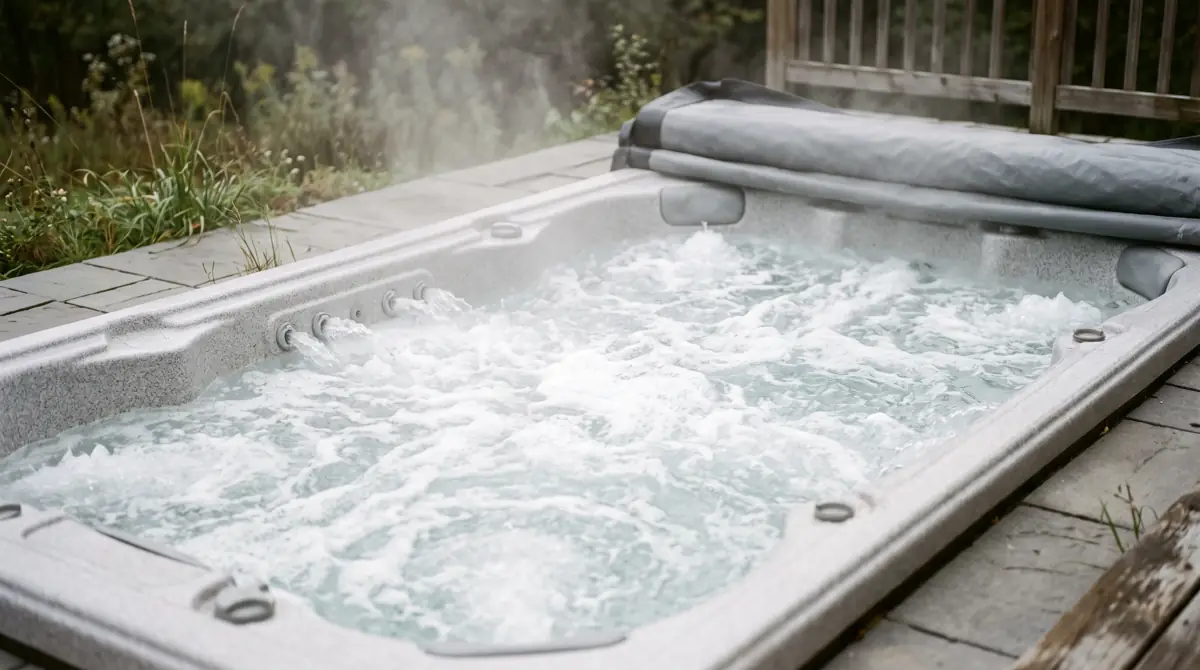
Aeration suits a tub whose pH reads 7.0 to 7.2 with alkalinity at 80 ppm or more, because it raises pH without adding alkalinity. It is the reverse of the advice Master Spas gives for lowering pH, where it says close the air valves and keep jet cycles short. Our hot tub maintenance schedule puts these checks on a weekly calendar.
Rather have a pro balance the spa water?
Hot tub chemistry drifts every week: Catalina says test at least twice a week, and bromine tablets keep pulling pH down between visits. A local spa service can test and dose on a schedule. Share your ZIP code and we will match you with licensed pool and spa service companies; the 2024 MAHC requires public spa staff to test pH before opening each day (5.7.5.1).
What should you do at your hot tub reading?
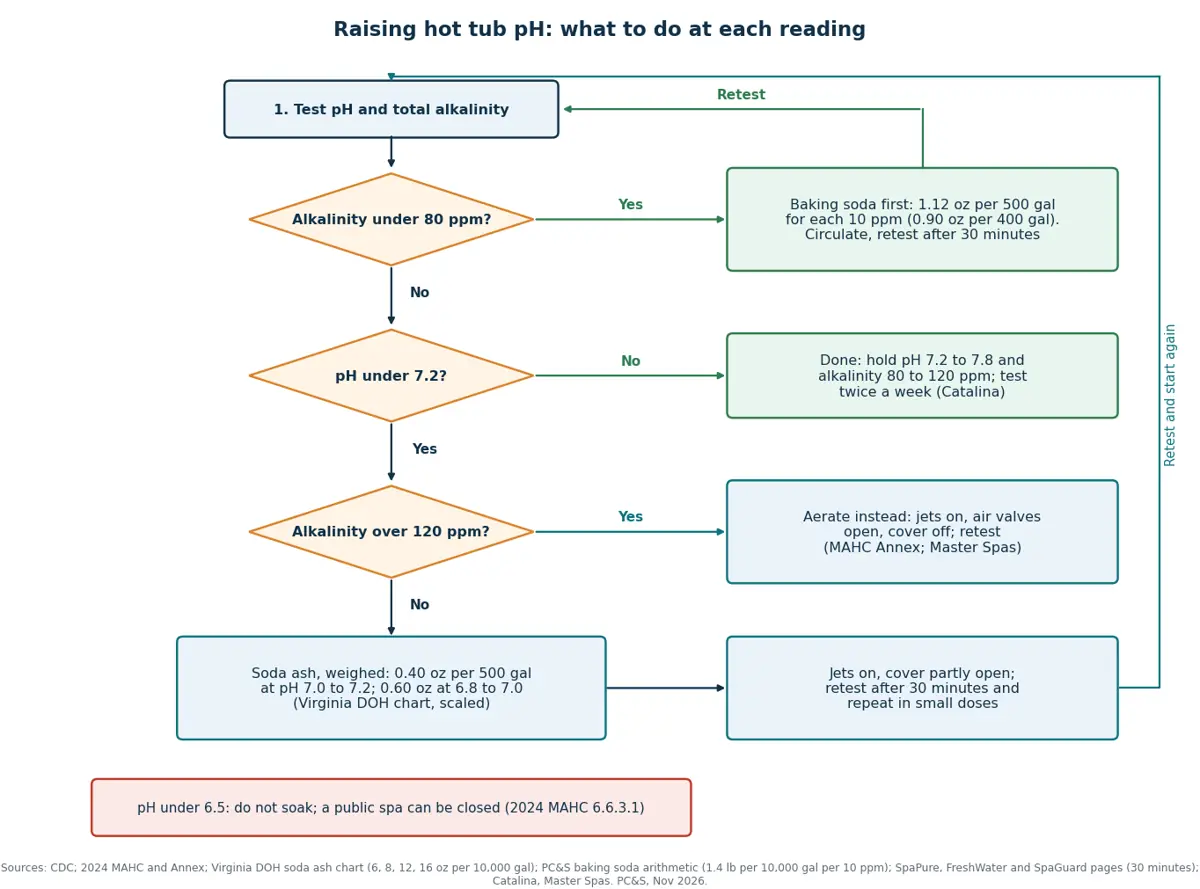
Read alkalinity first, then pH, then pick a row. Under 80 ppm alkalinity, baking soda comes first whatever the pH. With alkalinity in range, soda ash fixes pH under 7.2, and aeration handles a slightly low pH when alkalinity is high. The thresholds come from CDC, the 2024 MAHC, the Virginia DOH chart and spa maker manuals.
| If your situation is | Do this | Why (source) |
|---|---|---|
| pH 7.2 to 7.8, alkalinity 80 to 120 ppm | Nothing; retest at your next check | CDC; maker manuals |
| Alkalinity under 80 ppm (any pH) | Baking soda first: 1.12 oz per 500 gal per 10 ppm; retest after 30 minutes | MAHC Annex chemistry; SpaGuard; Nordic manual |
| Alkalinity in range, pH 7.0 to 7.2 | Soda ash 0.40 oz per 500 gal (Virginia DOH), jets on | Virginia DOH chart; SpaPure label for the upper end |
| Alkalinity in range, pH under 7.0 | Soda ash 0.60 oz per 500 gal, retest, then repeat once if needed | Virginia DOH chart |
| pH under 6.5 | Stop soaking; correct before use | 2024 MAHC 6.6.3.1 (public spas) |
| pH slightly low, alkalinity high (over 120 ppm) | Aerate: jets on, air valves open, cover off; no chemical | MAHC Annex (outgassing); Master Spas (jet air raises pH) |
| pH falls again within days on bromine tablets | Expect it: BCDMH is acidic; keep alkalinity at 80 to 120 ppm and test twice a week | Florida DOH; Pennsylvania DOH; Catalina |
| Water cloudy after soda ash | Let the filter run; use smaller doses next time | Skinner and Hales (1995): soda ash raises calcium carbonate cloud risk |
| Overshot above 7.8 | Lower it with pH decreaser in small doses | CDC range; how-to-lower-ph-in-hot-tub |
Sources: CDC; 2024 MAHC; MAHC Annex; Virginia DOH; SpaPure; SpaGuard; Nordic; Florida DOH; Pennsylvania DOH; Catalina; Master Spas; Skinner and Hales. Download CSV
Acidic water corrodes equipment, the heater included, per the Nordic manual, and heater trouble often shows up first as a temperature fault; our guide to hot tub temperature lists the set ranges and overheat cutoffs in 10 owner’s manuals. When pH will not hold after a few corrections, a drain and refill resets it; our guide on how to drain a hot tub covers the steps.
Is soda ash safe to handle in a hot tub?
Handled by the label, yes, but it is a strong base. The 2024 Model Aquatic Health Code lists soda ash and sodium bicarbonate as approved pH chemicals (5.7.3.4.2), and EPA warns that mixing pool and spa chemicals can release toxic gas. Wear gloves and goggles, add one product at a time to the water, and keep everyone out until it disperses.
Public spas must also use pH chemicals certified to NSF/ANSI 50 or 60 (MAHC 5.7.3.4.2.1), a useful mark to look for at home. Pool owners dealing with the same problem at 10,000 gallons or more can use our guide on how to raise pH in pool water, which works from the same Virginia DOH chart.
How we compiled this
We read 28 primary, maker and retailer documents in October and November 2026: four CDC sources including the 2024 Model Aquatic Health Code and its Annex, Florida, Virginia and Pennsylvania health department manuals, EPA’s acid rain page and chemical safety alert, NPIC, the 1995 Skinner and Hales dosage study, PubChem, NIST, USGS and FDA conversion data, five hot tub owner’s manuals, a Hot Spring capacity page, California Energy Commission spa listings, the Master Spas pH guide, four spa product pages and the Arm & Hammer label record. Doses and the rain figures are our arithmetic, shown above. We did not test products; competitor charts appear only for comparison, and forum posts were excluded.
Frequently Asked Questions
How do I raise the pH in my hot tub?
Test alkalinity first and bring it to 80 to 120 ppm with baking soda, 1.12 oz per 500 gallons per 10 ppm. Then add soda ash with the jets running: 0.40 oz per 500 gallons at pH 7.0 to 7.2 on the Virginia DOH chart. Retest after about 30 minutes and repeat in small doses.
Can I use baking soda to raise pH in my hot tub?
It raises alkalinity far more than pH. Baking soda adds 10 ppm of alkalinity per 1.12 oz in 500 gallons, but our pool alkalinity arithmetic puts the pH rise at no more than about 0.22 for a 40 ppm lift. Use it when alkalinity is under 80 ppm, and soda ash when only pH is low.
How much soda ash do I put in my hot tub?
Scale a chart to your gallons. The Virginia DOH chart gives 0.30 oz per 500 gallons at pH 7.2 to 7.4, 0.40 oz at 7.0 to 7.2 and 0.60 oz at 6.8 to 7.0. SpaPure pH Up’s label says 1 oz per 500 gallons at 6.8 to 7.1. Start low; a teaspoon is about 4.7 g.
Why is the pH in my hot tub so low?
Usually the sanitizer. Bromine tablets have a pH of 4.8 in a 1% solution and trichlor 2.8 to 3.5 (Florida DOH), and Pennsylvania DOH says bromine, trichlor and dichlor lower pH and alkalinity over time. Low alkalinity, under 80 ppm, lets each dose swing pH further. Rain matters far less than people think.
How long does it take to raise pH in a hot tub?
Plan on 30 minutes per dose. SpaPure, FreshWater and SpaGuard product pages all say to circulate and retest after about 30 minutes, and Catalina Spas says run the pump at least 10 minutes after adding chemicals. The Nordic Hot Tubs manual is stricter, at 2 hours before retesting.
What raises pH but not alkalinity in a hot tub?
Aeration. Running the jets with the air valves open drives out carbon dioxide, which the 2024 MAHC Annex says raises pH through outgassing, without adding alkalinity. Soda ash raises both: each 0.71 oz in 500 gallons adds about 10 ppm of alkalinity on top of the pH lift.
Can you use a hot tub if the pH is low?
A reading just under 7.0 is not an emergency, but fix it before soaking. CDC’s range is 7.0 to 7.8, below 7.0 pipes are more likely to corrode, and the 2024 Model Aquatic Health Code lets inspectors close a public spa below 6.5. Correct pH, then confirm sanitizer before anyone gets in.
Sources
- Centers for Disease Control and Prevention (CDC). What You Can Do to Stay Healthy in Hot Tubs (May 20, 2025). Accessed 2026-11-01.
- CDC. Home Pool and Hot Tub Water Treatment and Testing. Accessed 2026-10-19.
- CDC. 2024 Model Aquatic Health Code, 5th Edition, Code Language. Accessed 2026-11-01.
- CDC. 2024 Model Aquatic Health Code, 5th Edition, Annex. Accessed 2026-10-26.
- Virginia Department of Health. Pool Operation and Maintenance Guide (Portsmouth Health Department, 2018). Accessed 2026-11-01.
- Florida Department of Health in Collier County. Swimming Pool Operators' Manual, 2016 Version. Accessed 2026-11-01.
- Pennsylvania Department of Health. Public Swimming and Bathing Places: Operational Recommendations (2016). Accessed 2026-11-01.
- U.S. Environmental Protection Agency. What is Acid Rain?. Accessed 2026-11-01.
- U.S. Environmental Protection Agency. Chemical Safety Alert: Safe Storage and Handling of Swimming Pool Chemicals. Accessed 2026-11-01.
- National Pesticide Information Center. Pool and Spa Chemicals Fact Sheet. Accessed 2026-11-01.
- Kim Skinner and J. Que Hales (copy hosted by CPO Training). Dosages for Adjusting Alkalinity, JSPSI vol. 1 no. 1 (1995). Accessed 2026-11-01.
- National Library of Medicine, PubChem. Compound properties: sodium bicarbonate, sodium carbonate, calcium carbonate. Accessed 2026-10-27.
- National Institute of Standards and Technology. NIST Guide to the SI, Appendix B.8 (gallon, ounce). Accessed 2026-11-01.
- U.S. Geological Survey. Water Science Glossary (7.48 gallons per cubic foot). Accessed 2026-11-01.
- U.S. Food and Drug Administration (eCFR). 21 CFR 101.9(b)(5)(viii), household measures. Accessed 2026-10-19.
- Open Food Facts (label record). Arm & Hammer Pure Baking Soda, product 0033200011101 (serving 1/8 tsp, 0.6 g). Accessed 2026-11-01.
- Leisure Time Inc. (retailer product page). SpaPure pH Up (directions). Accessed 2026-11-01.
- Leisure Time Inc. (retailer product page). FreshWater pH/Alkalinity Up (directions). Accessed 2026-11-01.
- Leisure Time Inc. (retailer product page). SpaGuard Total Alkalinity Increaser (directions). Accessed 2026-11-01.
- Leisure Time Inc. (retailer product page). SpaGuard pH Increaser (directions). Accessed 2026-11-01.
- Catalina Spas. Owner's Guide (file dated 2022-12). Accessed 2026-11-01.
- Coast Spas. 2026 Owner's Manual, Purfikt Series. Accessed 2026-11-01.
- Nordic Hot Tubs. Owner's Manual (2023). Accessed 2026-11-01.
- Hot Spring Spas (Watkins Wellness). Highlife Collection 2026 Owner's Manual. Accessed 2026-11-01.
- Caldera Spas (Watkins Wellness). Paradise Series Owner's Manual, 2025. Accessed 2026-11-01.
- Hot Spring Spas. Hot Tub Facts and Stats (Grandee capacity). Accessed 2026-10-19.
- California Energy Commission via NW Regional Technical Forum. Portable electric spa listings (MAEDbS extract). Accessed 2026-10-27.
- Master Spas (maker guide). What to do when the pH in your hot tub is too high. Accessed 2026-11-01.
- Swim University. How to Raise pH in a Hot Tub (cited as a comparison). Accessed 2026-11-01.
- Aquatica. How to Increase pH in Hot Tub (cited as a comparison). Accessed 2026-11-01.
- Poolonomics. How To Raise pH In Your Hot Tub (cited as a comparison). Accessed 2026-11-01.
- Atlas Scientific. How To Raise pH In A Hot Tub (cited as a comparison). Accessed 2026-11-01.
Related pages
Get Quotes From Licensed Local Pool Pros
Tell us what you need and your ZIP code. We match you with pool companies that cover your area.