Free Chlorine vs Total Chlorine: What Each Reading Means and When to Act
Free chlorine vs total chlorine: free chlorine is the chlorine still able to disinfect, total chlorine adds the chloramines it has already formed, and total minus free is combined chlorine, which the 2024 MAHC acts on above 0.4 ppm.
- ✓Total = free + combinedCombined chlorine is total minus free (2024 MAHC glossary).
- ✓0.4 ppm action levelThe 2024 MAHC calls for action when combined chlorine passes 0.4 ppm.
- ✓10 times to break itBreakpoint takes about 10 times the combined chlorine (MAHC, CDC).
Key takeaways
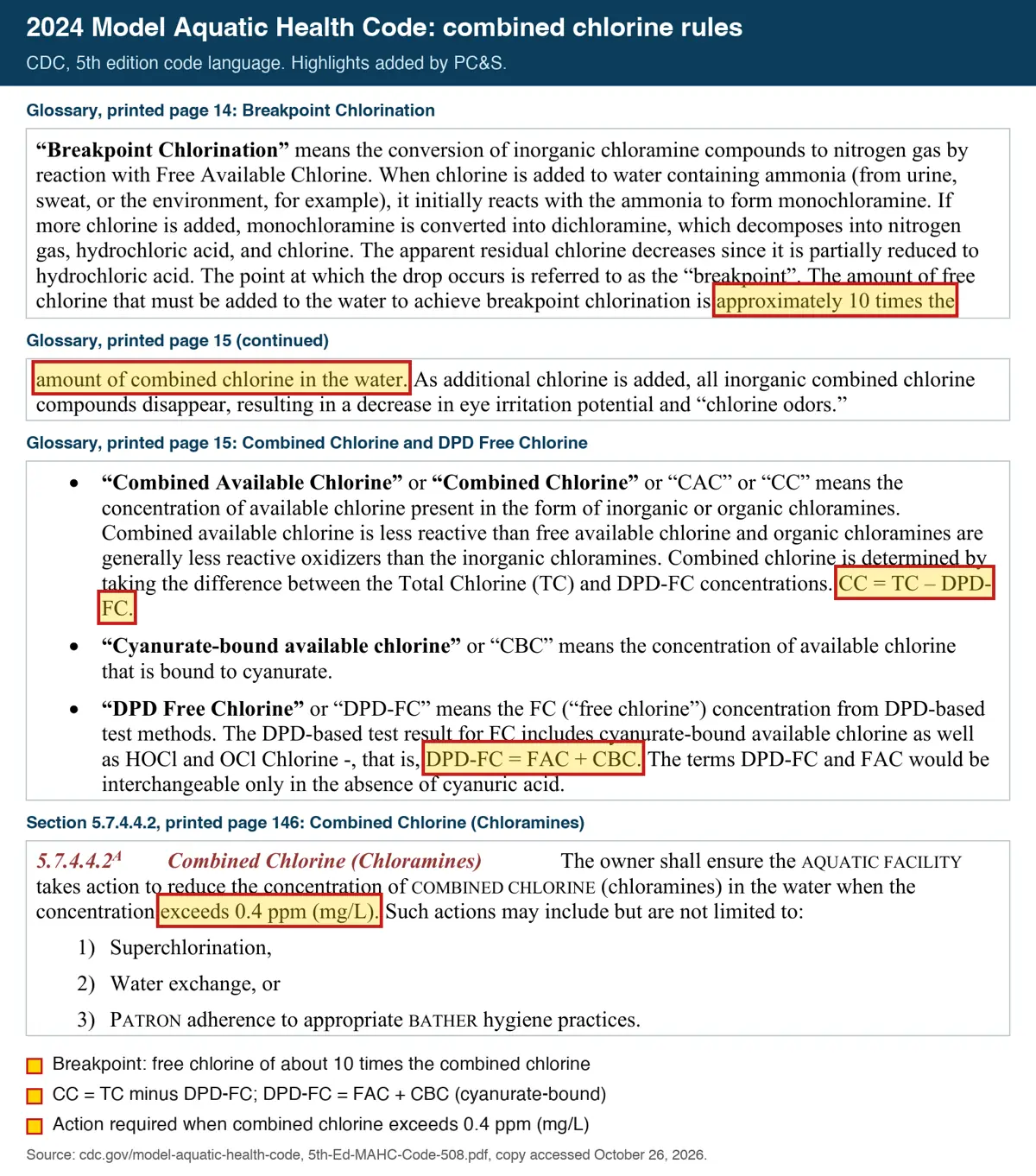
- Combined chlorine is total chlorine minus free chlorine: the 2024 Model Aquatic Health Code (MAHC) glossary defines it as CC = TC minus DPD-FC.
- The 2024 MAHC requires public pools to act when combined chlorine exceeds 0.4 ppm (section 5.7.4.4.2), while the PHTA guideline in the Taylor Technologies FAQ caps pools at 0.2 ppm.
- Breaking chloramines takes free chlorine of about 10 times the combined chlorine, a rule of thumb the MAHC glossary and the CDC chloramines toolkit both state.
- CDC sets free chlorine at 1 ppm or more, or 2 ppm with cyanuric acid, and warns that DPD tests above 10 ppm can bleach out and read falsely low.
- A chlorine smell is probably chloramines, not too much chlorine (CDC, May 2025), yet 77% of adults in the 2025 Healthy Pools survey blamed red eyes on too much chlorine.
What is the difference between free chlorine and total chlorine?
Free chlorine is the share still able to kill germs: hypochlorous acid (HOCl) and hypochlorite ion (OCl-). Total chlorine is free chlorine plus combined chlorine, the chloramines left after chlorine reacts with ammonia from sweat and urine. The 2024 MAHC defines combined chlorine as total minus free, so the two numbers match only when no chloramines are present.
| Reading | What it is | Chemical forms | How a DPD kit reads it | Target or limit | Source |
|---|---|---|---|---|---|
| Free chlorine (FC) | Chlorine still able to disinfect | Hypochlorous acid (HOCl) and hypochlorite ion (OCl-); with stabilizer, also chlorine bound to cyanuric acid | DPD #1 and #2: pink in proportion to free chlorine | 1 ppm or more; 2 ppm with stabilizer; 3 ppm in hot tubs | CDC home pool page (May 10, 2024); 2024 MAHC 5.7.3.1.1.2 |
| Combined chlorine (CC) | Chlorine already bound to nitrogen waste from sweat and urine | Monochloramine (NH2Cl), dichloramine (NHCl2), trichloramine (NCl3) and organic chloramines | Not read directly: total minus free | Action above 0.4 ppm (public pools) | 2024 MAHC 5.7.4.4.2 and glossary |
| Total chlorine (TC) | All available chlorine in the water | Free chlorine plus combined chlorine | DPD #3 (iodide) added to the free chlorine sample: the pink deepens | No separate limit; read it to get CC | 2024 MAHC glossary; Florida DOH Sarasota test kit guide |
Sources: CDC, 2024 MAHC code; CDC home pool page; Florida DOH Sarasota, How to Use Your Test Kit. Accessed October 26 and November 1, 2026. Download CSV
Every reading is in ppm “as Cl2”, so free and total can be subtracted directly. The MAHC glossary adds a twist for stabilized pools: a DPD free chlorine result equals free available chlorine plus chlorine bound to cyanuric acid (DPD-FC = FAC + CBC). At the MAHC’s 90 ppm cyanuric acid cap, the reading counts chlorine held in reserve, which is why our chlorine lock guide treats a normal reading with suspicion.
Combined chlorine is not useless, just slow. The MAHC Annex calls inorganic chloramines biocides that are less effective disinfectants than free chlorine, and the Florida Department of Health operators manual (2016) describes them as tied up with another substance, usually ammonia. Total chlorine alone therefore says little; the gap between the two numbers is the reading that matters.
Why does pH change how much free chlorine is working?
Because free chlorine splits between HOCl and OCl- by pH. The MAHC Annex puts the midpoint near pH 7.5, where each holds 50%, and says HOCl kills microorganisms about 100 times faster. With no stabilizer, 1 ppm of free chlorine gives 0.65 ppm HOCl at pH 7.2 but 0.32 ppm at pH 7.8, so the same test reading can carry half the killing power.
With 10 ppm or more cyanuric acid, the same pH rise cuts HOCl by only 24% to 26%.
Source: Source: CDC, 2024 Model Aquatic Health Code Annex, Table 5.7.3.4.2. Converted from ppm to ppb by PC&S.. Download chart data (CSV)
| pH | HOCl at 0 ppm CYA (ppm) | HOCl at 10 ppm CYA (ppm) | HOCl at 30 ppm CYA (ppm) | HOCl at 50 ppm CYA (ppm) |
|---|---|---|---|---|
| 7.2 | 0.6533 | 0.0480 | 0.0154 | 0.0091 |
| 7.4 | 0.5431 | 0.0424 | 0.0136 | 0.0081 |
| 7.6 | 0.4286 | 0.0384 | 0.0124 | 0.0074 |
| 7.8 | 0.3212 | 0.0353 | 0.0116 | 0.0069 |
Source: CDC, 2024 MAHC Annex, Table 5.7.3.4.2. Accessed October 26, 2026. Chart values converted from ppm to ppb by PC&S. Download CSV
Stabilizer flattens the curve. In the same Annex table, HOCl falls about 51% from pH 7.2 to 7.8 with no cyanuric acid but only 24% to 26% once 10 ppm or more is present, because most free chlorine is then held by the stabilizer. Neither the free nor the total chlorine test shows this split, so pH and cyanuric acid readings belong next to every chlorine reading. For the CYA side of that math, our cyanuric acid pool guide lists the MAHC limits.
What is combined chlorine, and why does it smell?
Combined chlorine is chlorine that has reacted with ammonia, urea and other nitrogen waste. CDC says a chlorine smell at a pool is probably chloramines, which can turn into gas and irritate eyes and lungs. The MAHC Annex names trichloramine as the worst for air quality, an irritant in water at just 0.02 ppm, while monochloramine is unlikely to smell below 5.0 ppm.
| Compound | Formula | Odor unlikely below (ppm) | What the 2024 MAHC says about it |
|---|---|---|---|
| Monochloramine | NH2Cl | 5.0 | Forms first when chlorine meets ammonia; can also arrive in fill water from utilities that use chloramination |
| Dichloramine | NHCl2 | 0.8 | Forms as more chlorine is added, then breaks down to nitrogen gas at breakpoint |
| Trichloramine | NCl3 | 0.02 | Greatest impact on air quality; irritant in water at 0.02 ppm |
Source: CDC, 2024 MAHC Annex, section 5.7.4.4.2. Accessed October 26, 2026. Download CSV
The smell points the wrong way for most swimmers. In the 2025 Healthy Pools survey of 2,000 U.S. adults, 77% said red, stinging eyes come from too much chlorine. Florida DOH says the opposite: swimmers who smell chlorine usually have too little free chlorine to remove the chloramines. Our pool hygiene statistics report tracks those survey results by year.
Indoors, the gas builds up. A 2008 NIOSH Health Hazard Evaluation of an Ohio indoor waterpark found some airborne trichloramine samples at levels reported to cause irritation, with lifeguards reporting more cough and eye irritation on busy days, even though the water chemistry met Ohio standards. CDC advises moving fresh air across the water surface toward exhaust vents.
How much combined chlorine is too much?
Published limits run from 0.2 to 0.5 ppm. The 2024 MAHC treats 0.4 ppm as an action level for public pools, CDC says most health departments use 0.4 ppm or less, and the PHTA pool guideline, Pennsylvania DOH and the World Health Organization point to 0.2 ppm. Two top-ranking guides use 0.5 ppm, the PHTA number for spas, not pools.
The MAHC 0.4 ppm figure is an action level that triggers a chloramine reduction plan, not a violation.
Source: Sources: WHO via 2024 MAHC Annex; PHTA via Taylor FAQ; Pennsylvania DOH 2016; 2024 MAHC 5.7.4.4.2; CDC chloramines toolkit (June 2025); Taylor Technologies (May 2025); Swim University; Sensorex.. Download chart data (CSV)
| Who sets it | Combined chlorine (ppm) | Type of number |
|---|---|---|
| World Health Organization (quoted in the 2024 MAHC Annex) | 0.2 | Ideal: as low as possible |
| PHTA guideline, pools (Taylor FAQ table) | 0.2 | Maximum |
| Pennsylvania DOH (2016 recommendations) | 0.2 | Maximum; tested twice daily |
| 2024 MAHC 5.7.4.4.2 | 0.4 | Action level, not a violation |
| CDC chloramines toolkit (June 2025) | 0.4 | Limit most health departments use |
| Taylor Technologies (May 2025) | 0.4 | Plan a shock when TC exceeds FC by more |
| PHTA guideline, spas (Taylor FAQ table) | 0.5 | Maximum |
| Swim University and Sensorex guides | 0.5 | Stay below |
Sources: MAHC Annex; Taylor FAQ, PHTA table; Pennsylvania DOH; 2024 MAHC; CDC chloramines toolkit; Taylor Technologies; Swim University; Sensorex. Accessed November 1, 2026. Download CSV
The MAHC explains why it chose an action level rather than a hard limit: a standard test kit measures organic and inorganic chloramines together, and only the inorganic ones, dichloramine and trichloramine, have well-documented health effects. The Annex adds that published data suggest combined chlorine is commonly above 0.2 ppm in swimming pools, so a 0.2 ppm target is strict but not unusual for well-run public pools.
| What guides say | Who says it | What the primary source says | Primary source |
|---|---|---|---|
| Combined chlorine should stay below 0.5 ppm | Swim University; Sensorex | Act above 0.4 ppm; the PHTA pool guideline maximum is 0.2 ppm | 2024 MAHC 5.7.4.4.2; Taylor FAQ (PHTA table) |
| At 2 ppm combined chlorine with free chlorine in range, use a non-chlorine shock | Swim University | Non-chlorine shock oxidizers might not reduce inorganic chloramines, and monopersulfate reads as false-high combined chlorine on a DPD test | 2024 MAHC Annex 4.7.3.5 and Table 4.7.3.5 |
| Red, stinging eyes come from too much chlorine | 77% of U.S. adults in the 2025 Healthy Pools survey | A chlorine smell is probably chloramines; Florida DOH says it usually means too little free chlorine | CDC eye irritation page (May 28, 2025); Florida DOH Collier manual (2016) |
| When free chlorine is lower than total, add more chlorine tablets, granules or shock | 1st Direct Pools | Breakpoint needs about 10 times the combined chlorine, and each 1 lb of trichlor in 10,000 gallons adds 7 ppm cyanuric acid | 2024 MAHC glossary; Taylor CYA article (February 26, 2025) |
Guides: Swim University; Sensorex; 1st Direct Pools; Healthy Pools 2025 release. Primary sources: MAHC Annex; 2024 MAHC; CDC; Florida DOH; Taylor CYA article; Taylor FAQ. Accessed November 1, 2026. Download CSV
How does a test kit tell free chlorine from total chlorine?
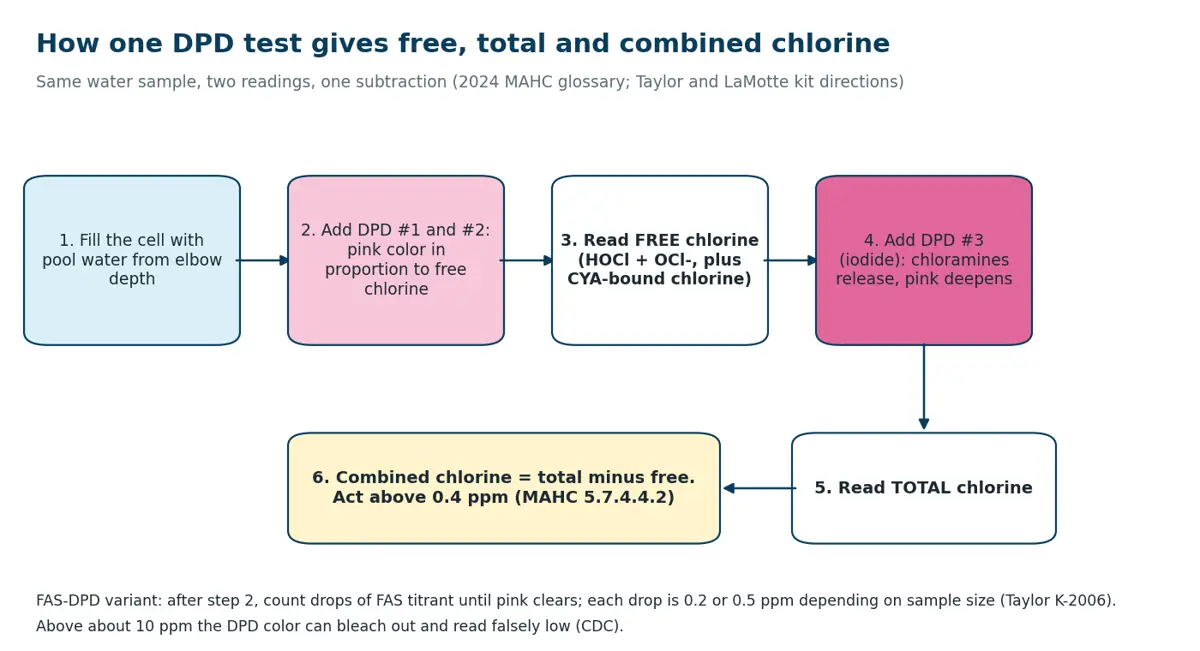
A DPD kit reads both from one sample. DPD reagents #1 and #2 turn the water pink in proportion to free chlorine; adding DPD #3, which carries iodide, pulls the chloramines into the reaction and deepens the pink to total chlorine. FAS-DPD kits count titrant drops instead of matching colors, at 0.2 or 0.5 ppm per drop on the Taylor K-2006.
- Fill the test cellRinse it in the pool, then fill from elbow depth to the line, 9 mL on the small Taylor tube in the Florida DOH Sarasota guide.
- Add DPD #1 and #25 drops each, cap and invert; read free chlorine in natural light against a light background.
- Add DPD #3 to the same sample5 drops; the deeper pink is total chlorine (MAHC: TC is measured with iodide reagent added).
- SubtractTotal minus free is combined chlorine; act above 0.4 ppm (MAHC 5.7.4.4.2).
- Rinse the cell wellLeftover DPD #3 makes the next free chlorine reading too high (Taylor FAQ).
Precision differs by method. The Taylor FAQ rates color matching at half the distance between two color standards and drop tests at plus or minus one drop. The MAHC Annex calls titration accurate to 0.2 mg/L and recommends it over color matching. The Taylor FAS-DPD article (May 8, 2025) adds that the pink-to-clear endpoint cannot bleach out, so it reads up to 20 ppm. Our guide on how to test pool water compares strips, kits and meters in full.
Can free chlorine be higher than total chlorine? Not chemically: total includes free, so a higher free reading is a test error. The usual causes, from Taylor and LaMotte instructions, are DPD #3 residue in the cell, monochloramine creeping into the free test, or two readings taken from different samples.
| What you see | Likely cause | Check | Source |
|---|---|---|---|
| Free chlorine 0 or very low right after a shock | Chlorine above 10 ppm bleaches the DPD color | Dilute 1:1 with tap water, retest, multiply by 2 | CDC home pool page; Taylor FAQ |
| Free chlorine higher than total | Leftover DPD #3 in the test cell from an earlier total test | Rinse the cell; run free and total on the same sample | Taylor FAQ |
| Free chlorine keeps climbing while you read it | Monochloramine breaking through into the free test | Read promptly; LaMotte sells Steadifac reagent for very high monochloramine | LaMotte ColorQ 2x user guide |
| High combined chlorine right after a non-chlorine shock | Monopersulfate reacts with DPD | Add a deox reagent such as Taylor R-0867 before the total test | 2024 MAHC Annex Table 4.7.3.5; Taylor K-2006 listing |
| Sample turns cloudy when DPD #1 goes in | Hardness above 500 ppm | Put DPD #1 and #2 in the cell first, then the sample | Taylor FAQ |
Sources: CDC; Taylor FAQ; LaMotte ColorQ 2x user guide; MAHC Annex Table 4.7.3.5; Taylor K-2006 listing (Sunplay). Accessed November 1, 2026. Download CSV
How do you calculate combined chlorine and the shock dose?
Subtract free chlorine from total chlorine, multiply the gap by 10, and add the difference between that target and your free chlorine. A pool at 2.0 ppm free and 2.6 ppm total has 0.6 ppm combined, a 6.0 ppm target and 4.0 ppm to add: about 80 fl oz of 12.5% liquid chlorine in 20,000 gallons on the Hasachlor label chart.
| Reading | Free chlorine (ppm) | Total chlorine (ppm) | Combined = total minus free (ppm) | Above 0.4 ppm? | Breakpoint target = 10 x combined (ppm) | Chlorine to add (ppm) | 12.5% liquid chlorine for 20,000 gal (fl oz) |
|---|---|---|---|---|---|---|---|
| A: clear, no smell | 3.0 | 3.2 | 0.2 | No | n/a | 0 | 0 |
| B: after a busy weekend | 2.0 | 2.6 | 0.6 | Yes | 6.0 | 4.0 | 80 |
| C: chlorine smell, red eyes | 1.0 | 2.5 | 1.5 | Yes | 15.0 | 14.0 | 280 |
| D: impossible pair | 3.5 | 3.0 | minus 0.5 | Test error | n/a | n/a | n/a |
PC&S arithmetic. Breakpoint rule: 2024 MAHC glossary. Dose: Hasachlor 12.5% label, EPA Reg. No. 10897-26 chart, 20 fl oz per 1 ppm in 20,000 gallons. Download CSV
Row C shows where the rule runs out of road. A 15 ppm target is above the 10 ppm level the MAHC lists as an imminent health hazard with swimmers present (section 6.6.3.1) and far above the 4 ppm re-entry limit on the Hasachlor label, so the pool closes until a test reads 4 ppm or less. At that strength a DPD comparator can bleach out, so read it with FAS-DPD or a 1:1 dilution.
Is 10 times combined chlorine exact? No. The MAHC glossary says approximately 10 times, and Virginia DOH frames superchlorination as raising free chlorine to 5 to 10 ppm. The Annex explains the limits: a kit’s combined chlorine includes organic chloramines that shocking removes poorly, and urea reacts with chlorine very slowly. Treat 10 times as the starting dose and retest.
Use unstabilized chlorine for the shock. Taylor puts the stabilizer cost at 7 ppm of cyanuric acid for each pound of trichlor in 10,000 gallons. Our guide on how to shock a pool gives label doses for each product, and how much chlorine to add to a pool converts any ppm target into ounces.
What should you do at your free and total chlorine readings?
Fix free chlorine first, then judge the gap. Below 1 ppm free (2 ppm with stabilizer), add chlorine. A gap of 0.2 ppm or less needs nothing. Above 0.4 ppm, shock to about 10 times the gap with unstabilized chlorine. Readings that do not add up, such as free above total, are test errors to rerun before you dose.
| If your situation is | Do this | Rule behind it |
|---|---|---|
| Free chlorine below 1 ppm (2 ppm with stabilizer) | Add chlorine to range before anyone swims | CDC home pool page; 2024 MAHC 5.7.3.1.1.2 |
| Total within 0.2 ppm of free, free chlorine in range | Change nothing; keep testing at least twice a day | CDC; PHTA pool maximum 0.2 ppm (Taylor FAQ) |
| Combined chlorine above 0.2 and up to 0.4 ppm | Retest the next day; cut bather waste with pre-swim showers | PHTA 0.2 ppm maximum; MAHC 5.7.4.4.2 item 3 (bather hygiene) |
| Combined chlorine above 0.4 ppm | Shock with unstabilized chlorine to about 10 times the combined chlorine; swim again at 4 ppm or less | 2024 MAHC 5.7.4.4.2 and glossary; Hasachlor label (4 ppm re-entry) |
| Breakpoint target above 10 ppm | Close the pool, read with FAS-DPD or a 1:1 dilution, ventilate an indoor pool | MAHC 6.6.3.1 item 3; CDC chloramines toolkit; Taylor FAQ |
| Combined chlorine back above 0.4 ppm within days of a shock | Replace part of the water and push bather hygiene | MAHC 5.7.4.4.2 items 2 and 3; MAHC Annex (organic chloramines accumulate) |
| Free chlorine reads higher than total | Rinse the cell and rerun both tests on one sample | Taylor FAQ |
| Free chlorine reads 0 right after a shock | Dilute 1:1, retest, multiply by 2 before adding anything | CDC home pool page; Taylor FAQ |
Sources: CDC; 2024 MAHC; MAHC Annex; Taylor FAQ; CDC chloramines toolkit; Hasachlor label. Accessed November 1, 2026. Download CSV
High free chlorine with a small gap is a different problem with the opposite fix; our guide on how to lower chlorine in a pool covers it. Public pools fail on the basics too: in Louisville, 14.5% of 1,748 routine inspection readings from October 2021 to April 2024 had free chlorine below 1.0 ppm, per our public pool inspection violations report.
How we compiled this
We compiled this page in October and November 2026 from 16 primary documents: the 2024 MAHC code and Annex, four CDC pages, the 2008 NIOSH waterpark evaluation, health department documents from Florida (two), Virginia and Pennsylvania, the Hasachlor EPA label, four Taylor Technologies pages and the LaMotte ColorQ 2x user guide. Five top-ranking guides were used only to compare their claims, and survey figures come from the Healthy Pools releases as reported in our research. We did not test water or products.
Frequently Asked Questions
Should free chlorine and total chlorine be the same?
Ideally they are close. When the two match, combined chlorine is zero. The PHTA pool guideline in the Taylor FAQ allows up to 0.2 ppm between them, and the 2024 MAHC requires public pools to act once the gap passes 0.4 ppm. A wider gap means chloramines are building up and the pool needs a breakpoint shock.
What does it mean when total chlorine is high but free chlorine is low?
Most of the chlorine is tied up as chloramines. Free 1.0 ppm with total 2.5 ppm means 1.5 ppm combined, far above the 0.4 ppm MAHC action level. Shock to about 10 times the combined chlorine, here 15 ppm, with unstabilized chlorine, keep swimmers out until free chlorine falls to 4 ppm or less, and retest both numbers.
Can free chlorine be higher than total chlorine?
No. Total chlorine includes free chlorine, so a higher free reading is a test error. Taylor Technologies says even a trace of DPD #3 left in the test cell raises the next free chlorine reading, and LaMotte warns that high monochloramine can break through into the free test. Rinse the cell and run both readings on one sample.
What is a good combined chlorine level?
0.2 ppm or less is good. That is the PHTA pool maximum and the Pennsylvania DOH limit, and the World Health Organization calls for as low as possible, ideally below 0.2 ppm. The 2024 MAHC sets 0.4 ppm as the point where public pools must act, and CDC says most health departments limit combined chlorine to 0.4 ppm or less.
Does shocking a pool lower total chlorine?
It lowers combined chlorine, and total follows once the extra free chlorine is used up. The MAHC glossary says the apparent residual drops at breakpoint as chlorine is reduced to hydrochloric acid, and Florida DOH says a sharp decrease in total chlorine usually follows. Right after a 10 ppm shock, total chlorine reads higher, not lower.
Which is more important, free chlorine or total chlorine?
Free chlorine, because it does the disinfecting: CDC sets the minimum at 1 ppm, or 2 ppm with stabilizer. Total chlorine matters only as the second number in the subtraction that reveals combined chlorine. A kit that reads total alone, such as an OTO kit, cannot tell you whether the chlorine present is working.
Sources
- CDC. 2024 Model Aquatic Health Code, 5th Edition, Code Language. Accessed 2026-10-26.
- CDC. 2024 Model Aquatic Health Code, 5th Edition, Annex. Accessed 2026-10-26.
- CDC. Home Pool and Hot Tub Water Treatment and Testing (May 10, 2024). Accessed 2026-10-26.
- CDC. Chloramines and Pool Operation (June 23, 2025). Accessed 2026-11-01.
- CDC. Preventing Eye Irritation from Pool Chemicals (May 28, 2025). Accessed 2026-11-01.
- NIOSH. Health Hazard Evaluation Report HETA 2007-0163-3062, Great Wolf Lodge, Mason, Ohio (June 2008). Accessed 2026-10-08.
- Florida Department of Health in Collier County. Swimming Pool Operators' Manual, 2016 Version. Accessed 2026-10-26.
- Florida Department of Health in Sarasota County. How to Use Your Test Kit. Accessed 2026-10-26.
- Virginia Department of Health. Pool Operation and Maintenance Guide (2018). Accessed 2026-10-26.
- Pennsylvania Department of Health. Public Swimming and Bathing Places: Operational Recommendations (November 1, 2016). Accessed 2026-10-26.
- U.S. EPA Pesticide Product and Label System. Hasachlor sodium hypochlorite 12.5%, EPA Reg. No. 10897-26 (April 24, 2026). Accessed 2026-10-19.
- Taylor Technologies. Water Testing Technical FAQs (incl. PHTA water quality table). Accessed 2026-11-01.
- Taylor Technologies. Difference Between Free, Combined and Total Chlorine in Pool Water (May 15, 2025). Accessed 2026-11-01.
- Taylor Technologies. How FAS-DPD Tests for Free and Combined Chlorine Values (May 8, 2025). Accessed 2026-10-26.
- Taylor Technologies. Why Monitoring Cyanuric Acid (CYA) in a Pool is Important (February 26, 2025). Accessed 2026-10-26.
- Taylor Technologies. Complete Test Kit (FAS-DPD), K-2006 product page. Accessed 2026-11-01.
- Sunplay. Taylor K-2006 listing. Accessed 2026-11-01.
- Taylor Technologies. 3-Way Test Kit (OTO), K-1000 product page. Accessed 2026-11-01.
- LaMotte. ColorQ 2x PRO 7 user guide (2086-UG). Accessed 2026-11-01.
- Pool & Hot Tub Alliance; American Chemistry Council. 2025 Healthy Pools survey press release. Accessed 2026-10-08.
- Louisville Metro Public Health and Wellness. Louisville Metro KY Pool Inspections (via PC&S public pool inspection violations report). Accessed 2026-10-06.
- Swim University. Free Chlorine vs. Total Chlorine (claims compared). Accessed 2026-11-01.
- Sensorex. Free Chlorine vs Total Chlorine (claims compared). Accessed 2026-11-01.
- 1st Direct Pools. What's the Difference Between Total Chlorine and Free Chlorine? (claims compared). Accessed 2026-11-01.
Related pages
Get Quotes From Licensed Local Pool Pros
Tell us what you need and your ZIP code. We match you with pool companies that cover your area.