Pool Salt Calculator: Pounds and Bags of Salt by PPM, Plus Dilution Math
This pool salt calculator multiplies the ppm you need by your gallons and 8.34, then divides by 1,000,000: taking 20,000 gallons from 0 to 3,200 ppm takes 534 lb, or 14 bags of 40 lb.
- ✓Checked against 5 makersPentair, AutoPilot, Hayward, Hot Spring and Arctic Spas charts land within 1.1% of the formula.
- ✓Bags for 10,000 to 40,000 gal40 lb bag counts at each maker's ideal, from 3,000 to 3,600 ppm.
- ✓Too much salt?Drain share = 1 minus target / current, with fill-water and rain cases worked out.
Pool salt calculator: enter gallons, current ppm and target ppm
Enter your pool’s gallons, the salt reading from a test strip, meter or chlorinator display, your chlorinator’s target ppm and your bag size. The calculator returns pounds of salt, whole bags rounded up and kilograms, using 8.34 lb per gallon of water. The default shows a 20,000 gallon pool filled fresh to Hayward’s 3,200 ppm.
Formula source: USGS Water Density table (62.4 lb per cubic foot) and USGS Water Science Glossary (7.48 gallons per cubic foot): 8.34 lb per gallon; formula checked against Pentair, AutoPilot, Hayward, Hot Spring and Arctic Spas salt charts. Estimates only.
Default result: 20,000 gallons from 0 to 3,200 ppm takes 534 lb of salt, which is 14 bags of 40 lb or 242 kg. At Leslie’s list price of $11.99 per 40 lb bag (June 2026 capture), that fill costs $167.86. If you do not know your gallons, run our pool volume calculator first. The full switch, from stabilizer and plaster waits to the chlorinator itself, is laid out in our guide on how to convert a pool to salt water.
The calculator stops at zero: a reading above the target returns 0 lb, and the dilution table in the overshoot section gives the share of water to drain instead. It assumes pure sodium chloride; the Pentair and Jandy manuals ask for at least 99.8% NaCl, so a 99% salt adds about 1% less than the number shown.
Key takeaways
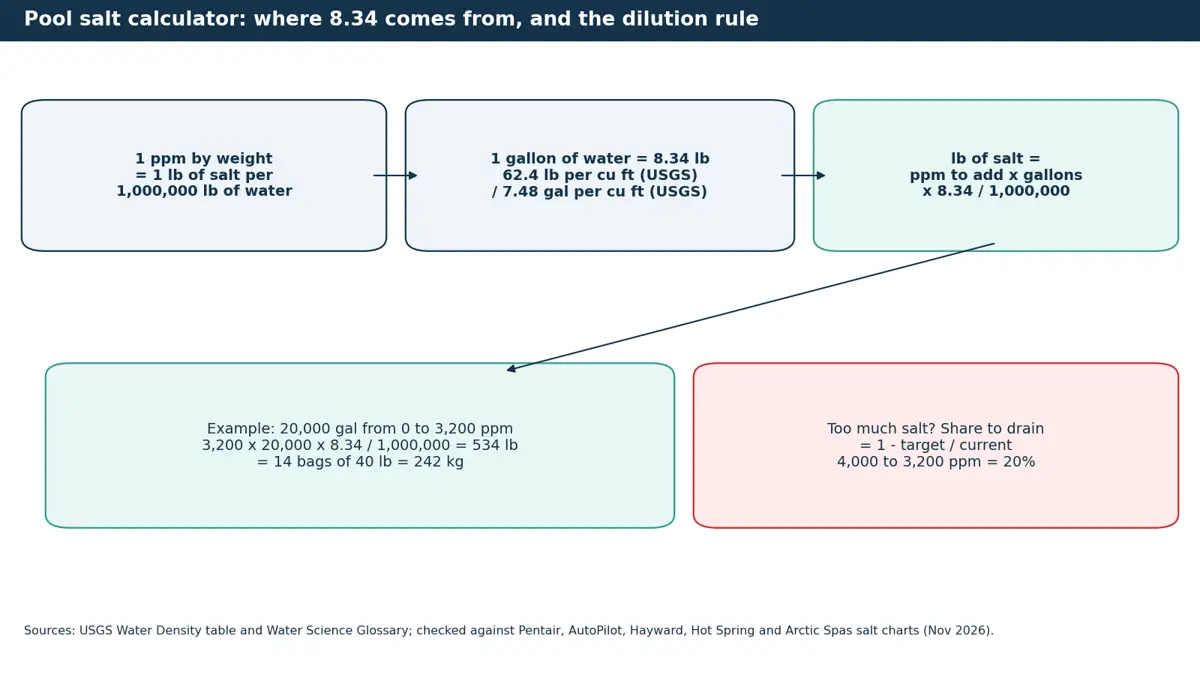
- Pounds of salt = ppm to add x gallons x 8.34 / 1,000,000, because a gallon of water weighs 8.34 lb (USGS: 62.4 lb per cubic foot divided by 7.48 gallons).
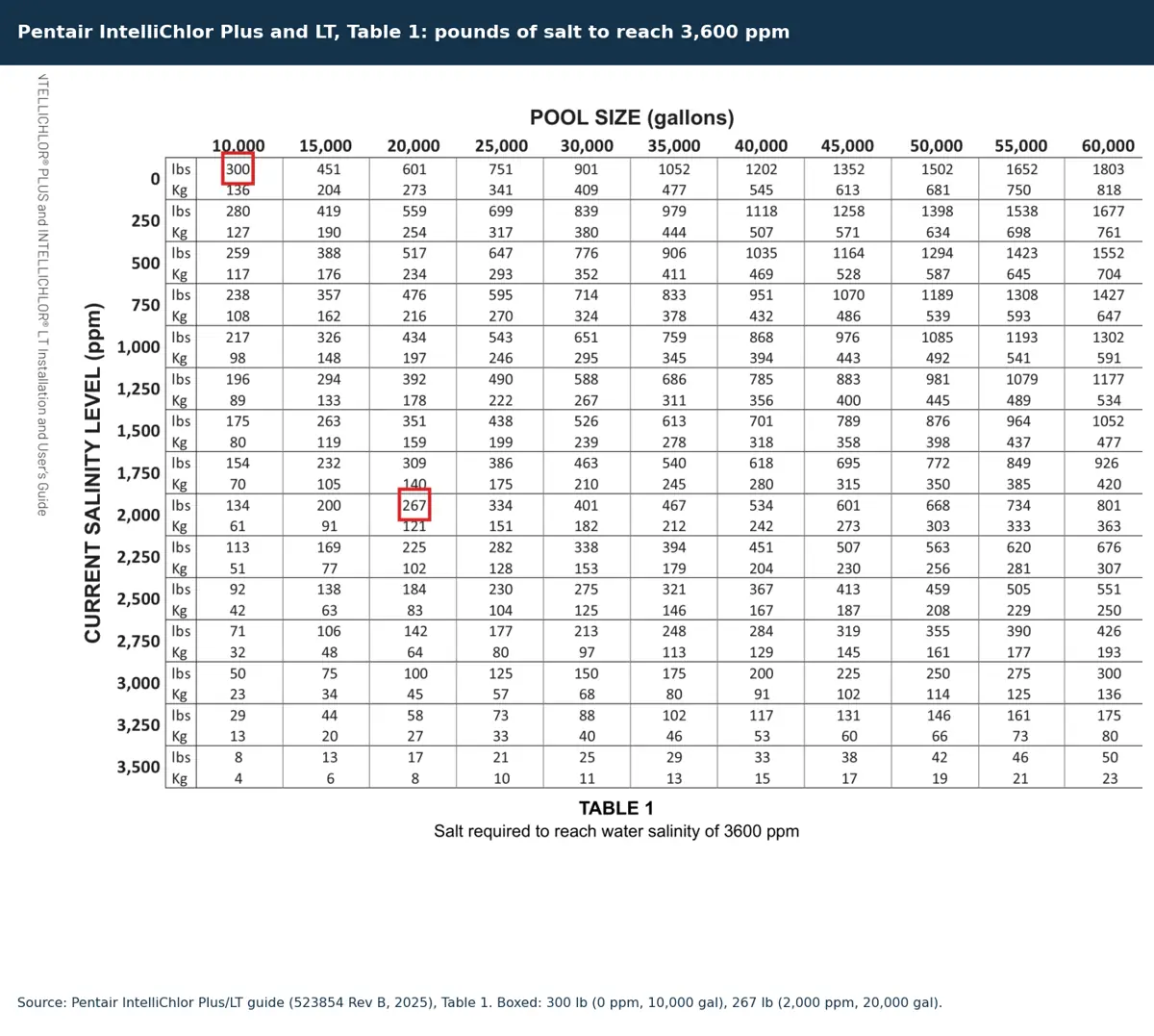
- The formula lands within 1.1% of 5 maker charts: Pentair IntelliChlor Plus/LT lists 300 lb for 10,000 gallons from 0 to 3,600 ppm (formula 300.2 lb) and AutoPilot 230 lb for 11,000 gallons from 500 to 3,000 ppm (229.3 lb).
- A new 10,000 to 40,000 gallon fill takes 7 to 27 bags of 40 lb salt at Hayward‘s 3,200 ppm and 8 to 31 bags at Pentair’s 3,600 ppm.
- Overshoot fix: drain 1 minus target/current of the water; 4,000 to 3,200 ppm is 20%, or 4,000 gallons of a 20,000 gallon pool, before Pentair‘s 4,500 ppm corrosion line for IntelliChlor IC cells.
- Five chlorinator makers rule out rock salt, and 21 CFR 172.490 allows up to 13 ppm yellow prussiate of soda in food salt, an anti-caking agent AutoPilot says can stain finishes yellow.
How many bags of salt does a pool need?
For a new fill, multiply your chlorinator’s target ppm by gallons and 8.34, divide by 1,000,000, then by your bag weight. At 3,200 ppm (Hayward) a 10,000 gallon pool needs 7 bags of 40 lb and a 40,000 gallon pool 27; at 3,600 ppm (Pentair) the same pools need 8 and 31. Top-ups are smaller: each 40 lb bag adds about 480 ppm to 10,000 gallons.
| Pool gallons | lb per 100 ppm | Intex or AutoPilot 3,000 ppm: lb (40 lb bags) | Hayward 3,200 ppm: lb (bags) | CircuPool 3,500 ppm: lb (bags) | Pentair 3,600 ppm: lb (bags) |
|---|---|---|---|---|---|
| 10,000 | 8.3 | 250 (7) | 267 (7) | 292 (8) | 300 (8) |
| 15,000 | 12.5 | 375 (10) | 400 (11) | 438 (11) | 450 (12) |
| 20,000 | 16.7 | 500 (13) | 534 (14) | 584 (15) | 600 (16) |
| 25,000 | 20.9 | 626 (16) | 667 (17) | 730 (19) | 751 (19) |
| 30,000 | 25.0 | 751 (19) | 801 (21) | 876 (22) | 901 (23) |
| 35,000 | 29.2 | 876 (22) | 934 (24) | 1,022 (26) | 1,051 (27) |
| 40,000 | 33.4 | 1,001 (26) | 1,068 (27) | 1,168 (30) | 1,201 (31) |
PC&S arithmetic: lb = ppm x gallons x 8.34 / 1,000,000; bags rounded up. Targets: Intex and AutoPilot 3,000 ppm; Hayward 3,200; CircuPool 3,500; Pentair 3,600. Download CSV
Test first: fill water and past liquid chlorine leave salt behind, so most pools need fewer bags.
Source: lb = ppm x gallons x 8.34 / 1,000,000, rounded up to whole 40 lb bags. Targets from Intex, AutoPilot, Hayward, CircuPool and Pentair manuals.. Download chart data (CSV)
Pick the target from your own manual: ideal salt runs from 3,000 ppm (Intex, AutoPilot) through 3,200 (Hayward) and 3,500 (CircuPool) to 3,600 (Pentair). Low-salt cutoffs, stabilizer targets and cell care for nine models are in our salt water pool maintenance guide. Bags come in several sizes: Hayward lists 40 to 80 lb bags and AutoPilot 25 to 60 lb (11 to 27 kg), which is why the calculator takes any bag weight.
Round up on paper, then add in stages. CircuPool says to add large amounts in portions and retest at each stage, and Hayward, Pentair and Jandy all allow 24 hours of circulation before the reading settles. A 15,000 gallon pool needs 400.3 lb for 3,200 ppm, which the table rounds to 11 bags; 10 bags give 3,197 ppm, close enough to stop and retest.
How is the pool salt formula derived, and does it match maker charts?
One ppm by weight is 1 lb of salt in 1,000,000 lb of water. A gallon of water weighs 8.34 lb (USGS: 62.4 lb per cubic foot divided by 7.48 gallons), so pounds of salt = ppm x gallons x 8.34 / 1,000,000. Charts from Pentair, AutoPilot, Hayward, Hot Spring and Arctic Spas land within 1.1% of it.
| Number | Value | Source |
|---|---|---|
| Weight of 1 gallon of water | 8.34 lb (62.4 lb per cu ft / 7.48 gal per cu ft) | USGS Water Density table; USGS glossary |
| Salt to raise 10,000 gal by 100 ppm | 8.34 lb | PC&S arithmetic |
| ppm added by 1 lb of salt in 10,000 gal | 12 ppm (11.99) | PC&S arithmetic |
| ppm added by one 40 lb bag in 10,000 gal | 480 ppm | PC&S arithmetic |
| Water that weighs 1,000,000 lb | 119,904 gal | PC&S arithmetic |
| Weight of 1 gallon at 80 F | 8.317 lb (62.217 lb per cu ft) | USGS Water Density table |
| Pounds to kilograms | x 0.4535924 (the widget rounds to 0.4536) | NIST SP 811 |
| Salt test interval at public pools with in-line generators | At least weekly | 2024 MAHC 5.7.5.11 |
Sources: USGS Water Density; USGS Water Science Glossary; NIST SP 811, Appendix B.8; 2024 MAHC. PC&S arithmetic. Download CSV
| Maker chart | Chart says | Formula: ppm x gallons x 8.34 / 1,000,000 | Difference |
|---|---|---|---|
| Pentair IntelliChlor Plus/LT, Table 1: 0 to 3,600 ppm, 10,000 gal | 300 lb | 300.2 lb | -0.1% |
| Pentair IntelliChlor Plus/LT, Table 1: 2,000 to 3,600 ppm, 20,000 gal | 267 lb | 266.9 lb | 0.0% |
| AutoPilot Digital Nano: 500 to 3,000 ppm, 11,000 gal | 230 lb | 229.3 lb | +0.3% |
| Hayward Aqua Rite chart: 0 to 3,200 ppm, 10,000 gal | 267 lb | 266.9 lb | 0.0% |
| Hot Spring FreshWater (spa): 2 1/3 cups (660 g) per 100 gal for 1,750 ppm | 1.455 lb per 100 gal | 1,745 ppm | -0.3% |
| Arctic Spas Spa Boy (spa): Cub, 275 gal, to 2,200 ppm | 5.1 lb | 5.05 lb | +1.1% |
Sources: Pentair IntelliChlor Plus/LT guide, Table 1 (2025); AutoPilot Digital Nano manual, Rev 5 (2020); Hayward Aqua Rite manual (2010); Hot Spring FreshWater Salt System manual (2018); Arctic Spas Spa Boy dose table (Wayback, Apr 2026). PC&S arithmetic. Download CSV
Water temperature barely moves the answer. The USGS density table lists 62.424 lb per cubic foot at 39.2 F and 62.217 lb at 80 F, which is 8.345 and 8.317 lb per gallon; at 80 F the 20,000 gallon default needs 532.3 lb instead of 533.8 lb, 0.3% less. Swim University‘s calculator uses 8.35, a 0.1% difference. Hot tubs use the same formula at 1,200 to 3,000 ppm, covered in our salt water hot tub guide.
Why does the salt reading drop after rain or a refill?
Salt leaves only with water. Rain that overflows the pool, backwashing, splash-out and partial drains take salt with them, while evaporation leaves it behind, according to the Hayward, AutoPilot and CircuPool manuals. Every 1,000 gallons that leave a pool at 3,200 ppm carry 26.7 lb of salt, so retest after refilling and dose only the difference.
| Event, 16 x 32 ft pool holding 18,191 gal at 3,200 ppm | Arithmetic | Salt reading after | Salt to put back |
|---|---|---|---|
| 2 inches of rain, overflow carries the same volume out | 512 sq ft x 2/12 ft x 7.48 = 638 gal = 3.5% of the water | About 3,088 ppm | 17 lb |
| 2 inches of evaporation, before topping off | Salt stays; water falls to 17,553 gal | About 3,316 ppm | None: top off, then retest |
| Drain 25% (4,548 gal) and refill with 0 ppm water | 3,200 x 0.75 | 2,400 ppm | 121 lb, or 4 bags |
| Drain 25% and refill with fill water that tests 200 ppm | 3,200 x 0.75 + 200 x 0.25 | 2,450 ppm | 114 lb, or 3 bags |
| Any 1,000 gal that leaves at 3,200 ppm | 1,000 x 3,200 x 8.34 / 1,000,000 | Depends on pool size | 26.7 lb |
PC&S arithmetic. Pool volume 18,191 gal from our pool volume calculator (USGS 7.48 gal per cu ft); salt loss rules from Hayward AquaRite S3, AutoPilot and CircuPool manuals. Download CSV
Test after topping off, not before. Two inches of evaporation from a 16 x 32 ft pool concentrates 3,200 ppm to about 3,316 ppm until the hose runs, and the reading returns to 3,200 once the water is back. Two inches of rain that overflows does the opposite: about 3,088 ppm, a 17 lb top-up. Evaporation rates by city are in our pool evaporation research.
Fill water is not always zero, and meters are not exact. The EPA secondary standard for chloride in drinking water is 250 mg/L, which equals 412 mg/L as sodium chloride, so test the hose water before a big refill. Pentair says its IntelliChlor salt sensor reads within plus or minus 500 ppm, and the Plus/LT guide asks owners to confirm with a separate reliable test before dosing. Test methods compared side by side are in our guide on how to test pool water.
What happens if you add too much salt, and how much water do you drain?
Salt does not evaporate or burn off, so the only fix is dilution: drain a share of the water equal to 1 minus target divided by current, then refill. From 4,000 ppm to 3,200 ppm that is 20%, or 4,000 gallons of a 20,000 gallon pool. Pentair warns IntelliChlor salt above 4,500 ppm may corrode equipment, and Hayward says most people taste salt at 3,500 to 4,000 ppm.
| Current reading, ppm | Share to drain (1 - 3,200 / current) | Gallons to drain, 20,000 gal pool | If fill water tests 200 ppm | If you drain and refill at the same time |
|---|---|---|---|---|
| 3,600 | 11.1% | 2,222 | 11.8% | 11.8% (2,356 gal) |
| 4,000 | 20.0% | 4,000 | 21.1% | 22.3% (4,463 gal) |
| 4,500 | 28.9% | 5,778 | 30.2% | 34.1% (6,819 gal) |
| 5,000 | 36.0% | 7,200 | 37.5% | 44.6% (8,926 gal) |
| 6,000 | 46.7% | 9,333 | 48.3% | 62.9% (12,572 gal) |
PC&S arithmetic. Corrosion and taste thresholds: Pentair IntelliChlor IC guide; Pentair Plus/LT guide; Jandy AquaPure; Hayward (2023). Download CSV
Fill water that already carries salt, or draining while the hose runs, both raise the share.
Source: Share = 1 - target / current, for one drain and refill with 0 ppm water.. Download chart data (CSV)
The rule is a mass balance. After draining a share d, the salt left is current x (1 minus d); setting that equal to the target gives d = 1 minus target / current, the same result PoolDial prints for 4,000 to 3,200 ppm. If the fill water carries F ppm, d = (current minus target) / (current minus F). Draining while the hose refills at the same time throws away some new water, so the share rises to the natural log of current / target: 22.3% instead of 20% from 4,000 ppm.
Corrosion limits set how urgent the drain is. Jandy says salt above 4,000 ppm may damage its AquaPure power center and above 6,000 ppm may corrode pool fixtures, and Pentair’s Plus/LT guide puts accelerated corrosion above 6,000 ppm. Before the pump goes on, check where the water may go; pump sizing and hose routes are in our guide on how to drain a pool.
What kind of salt should you use in a pool: evaporated, solar or mined?
Use sodium chloride that is at least 99% pure, and at least 99.8% if your chlorinator is a Pentair IntelliChlor Plus/LT or Jandy AquaPure. Evaporated and solar salt both qualify; mined rock salt does not, because five makers say its impurities shorten cell life or stain. Avoid salt with yellow prussiate of soda, iodine or calcium chloride.
| Salt type | What it is | US share of salt sold, 2025 (USGS) | Maker rules | Source |
|---|---|---|---|---|
| Evaporated (vacuum pan) salt | Brine boiled down in vacuum pans; granular, food grade | 9% | Jandy and Pentair ask for at least 99.8% NaCl, evaporated, granulated, non-iodized; CircuPool says evaporated, at least 99% | USGS MCS 2026; Jandy H0325600; Pentair 523854; CircuPool CORE |
| Solar salt | Seawater or brine dried by sun and wind | 9% | Hayward (2010) names Coarse Solar Salt; AutoPilot accepts solar salt flakes over 99% pure | USGS MCS 2026; Hayward Aqua Rite; AutoPilot Rev 5 |
| Rock salt (mined) | Mined underground; road-salt grade | 38% | Hayward, Jandy, Pentair, CircuPool and AutoPilot all say do not use it: insoluble impurities shorten cell life or stain | USGS MCS 2026; maker manuals |
| Water softener pellets | Compressed evaporated salt | Counted as evaporated | Allowed by Hayward, Jandy and CircuPool if at least 99% pure; slower to dissolve | Maker manuals |
| Salt with anti-caking agent (YPS) | Yellow prussiate of soda (sodium ferrocyanide), up to 13 ppm in food salt (21 CFR 172.490) | n/a | AutoPilot, CircuPool and Jandy warn of yellow staining or discoloration; Hayward S3 bars salt with more than 1% YPS | eCFR; AutoPilot; CircuPool; Jandy; Hayward S3 |
| Iodized table salt | Food salt with iodine added | n/a | Hayward and AutoPilot say do not use | Hayward manuals; AutoPilot |
| Calcium chloride, potassium chloride, sodium bromide | Not sodium chloride | n/a | Pentair, Jandy and CircuPool say do not use them as salt | Pentair 523854; Jandy; CircuPool |
| Pool grade salt for public pools | Certified to NSF/ANSI 50 or 60, or EPA FIFRA registered | n/a | Required at public venues under MAHC 5.7.3.1.5.1 | CDC, 2024 MAHC |
Sources: USGS Mineral Commodity Summaries 2026, Salt; 21 CFR 172.490; Jandy H0325600; Pentair 523854; CircuPool CORE; Hayward Aqua Rite; Hayward AquaRite S3; AutoPilot Rev 5; 2024 MAHC. Accessed Nov 1, 2026. Download CSV
Rock salt is tempting because it is cheap. The USGS put 2025 US salt sales at 44% salt in brine, 38% rock salt, 9% solar salt and 9% vacuum pan salt, with vacuum and open pan salt averaging $260 a metric ton at the plant against $54 for rock salt. Pool makers accept the higher-priced evaporated and solar grades and reject rock salt by name.
Yellow prussiate of soda is legal in food salt and still unwelcome in pools. 21 CFR 172.490 allows the anti-caking agent, sodium ferrocyanide, at up to 13 ppm; AutoPilot says it can tint water or stain finishes yellow, CircuPool and Jandy warn of discolored fittings, and Hayward’s AquaRite S3 manual bars salt with more than 1% of it. Public pools under the 2024 MAHC must use salt certified to NSF/ANSI 50 or 60 or registered under FIFRA (5.7.3.1.5.1).
What should you do at each salt reading?
Match the reading to the row: dose with the calculator when salt is low, top off and retest when water is missing, and drain a share when salt is above your maker’s limit. Each rule below cites the manual it comes from, so the table works for Hayward, Pentair, Jandy, CircuPool, AutoPilot and Intex owners, and for public pools under the 2024 MAHC.
| If your situation is | Do this | Why (source) |
|---|---|---|
| New fill or the reading is 0 | Enter 0 as current salt and your maker's ideal as target | Fill water starts near zero; AutoPilot and Hayward say test first anyway |
| Reading is below your maker's low cutoff | Add the calculated pounds, brush, run the pump 24 hours, retest | Hayward, Pentair and Jandy allow 24 hours to dissolve |
| The calculator says more than 4 bags | Add about two thirds, wait 24 hours, retest, then add the rest | CircuPool: add large amounts in portions and retest |
| Pool just lost water to rain overflow, backwash or a partial drain | Retest after refilling, then dose only the difference | Salt leaves only with water (AutoPilot, CircuPool) |
| Pool is low from evaporation | Top off first, then test | Evaporation leaves salt behind (Hayward S3), so a low pool reads high |
| Reading is above your maker's limit | Drain 1 - target / current of the water and refill | Pentair: above 4,500 ppm (IntelliChlor IC) may corrode equipment |
| You have only rock salt or iodized salt | Do not use it; buy 99% to 99.8% pure NaCl | Hayward, Pentair, Jandy, CircuPool, AutoPilot |
| Your pool is a public venue | Use NSF/ANSI 50 or 60 certified salt and test salt weekly | 2024 MAHC 5.7.3.1.5.1 and 5.7.5.11 |
Sources: AutoPilot; Hayward AquaRite S3; Pentair IntelliChlor IC; Pentair Plus/LT; Jandy; CircuPool; 2024 MAHC. Download CSV
How we compiled this
We checked the formula against salt charts in 5 maker documents (Pentair IntelliChlor Plus/LT, AutoPilot Digital Nano, Hayward Aqua Rite, Hot Spring FreshWater and Arctic Spas Spa Boy), read salt-type rules in 7 chlorinator manuals, and used USGS density, glossary and 2026 salt commodity data, 21 CFR 172.490, EPA’s secondary standards, the 2024 MAHC and a dated Leslie’s listing, in October and November 2026. All bag, rain and dilution figures are PC&S arithmetic shown in the tables. We did not test salt products.
Frequently Asked Questions
How many bags of salt for a 15,000 gallon pool?
About 10 bags of 40 lb for a new fill to 3,200 ppm: the formula gives 400.3 lb, and 10 bags reach 3,197 ppm. Pentair’s 3,600 ppm target takes 450 lb, so 12 bags rounded up. If the pool already reads 1,500 ppm, a 3,200 ppm target needs 213 lb, or 6 bags.
How much does 1 bag of salt raise ppm?
A 40 lb bag raises 10,000 gallons by about 480 ppm, 15,000 gallons by 320 ppm and 20,000 gallons by 240 ppm, because each pound adds 12 ppm per 10,000 gallons. Divide 4,796 by your gallons in thousands to get the rise for any pool, then confirm with a test after 24 hours of circulation.
Does rain lower my pool's salt level?
Only when water leaves. Rain that overflows the pool or that you pump back down carries salt out: 2 inches of overflow on a 16 x 32 ft pool drops 3,200 ppm to about 3,088 ppm. Evaporation does not remove salt, according to the Hayward, AutoPilot and CircuPool manuals, so top off before you test.
How do I lower the salt level in my pool?
Drain and refill. The share to drain is 1 minus target divided by current: from 4,000 to 3,200 ppm that is 20%, from 5,000 ppm 36%. If your fill water tests 200 ppm, use (current minus target) divided by (current minus 200), which raises 20% to 21.1%. Retest after 24 hours.
Can I use water softener salt in my pool?
Yes, if it is at least 99% pure sodium chloride. Hayward, Jandy and CircuPool accept water conditioning pellets, which are compressed evaporated salt, but say they dissolve more slowly than granular pool salt. AutoPilot rules out salt with rust preventatives; five makers rule out rock salt, and Pentair, Jandy and CircuPool rule out calcium chloride.
How much salt is 100 ppm?
8.34 lb per 10,000 gallons, because 100 ppm is 100 lb per 1,000,000 lb of water and 10,000 gallons weighs 83,400 lb. That is 16.7 lb for 20,000 gallons and 33.4 lb for 40,000 gallons, or just under one 40 lb bag per 100 ppm in a 40,000 gallon pool.
How long does pool salt take to dissolve?
About a day with the pump running. CircuPool says 24 to 48 hours in summer and longer in winter, and Hayward, Pentair and Jandy all allow 24 hours of circulation before the salt reading settles. Brush the floor so salt does not pile up, and leave the chlorinator output low until it dissolves.
Is 3,000 ppm salt enough?
For some models. 3,000 ppm is the ideal for Intex and AutoPilot and sits inside Hayward’s 2,700 to 3,400 ppm band, but Pentair’s IntelliChlor Plus and LT warn below 3,000 ppm and aim for 3,600. Check your manual’s ideal, then enter it as the target above.
Sources
- U.S. Geological Survey. Water Density. Accessed 2026-11-01.
- U.S. Geological Survey. Water Science Glossary. Accessed 2026-11-01.
- Pentair. IntelliChlor Plus and LT Installation and User's Guide (P/N 523854 Rev B, 2025). Accessed 2026-10-27.
- Pentair. IntelliChlor Installation and User's Guide, IC15 to IC60 (P/N 520589 Rev R, 2023). Accessed 2026-10-27.
- AutoPilot. Pool Pilot Digital Nano and Nano+ manual (LTP0086 Rev 5, 2020). Accessed 2026-10-27.
- Hayward. Aqua Rite Electronic Chlorine Generator manual (092009N Rev P, 2010). Accessed 2026-10-27.
- Hayward. AquaRite S3 Owner's Manual (092769 Rev D). Accessed 2026-10-27.
- Hayward. AquaRite 900 Series Owner's Manual (092623 Rev D). Accessed 2026-10-27.
- Hayward. How To Take Care of a Saltwater Pool (2023). Accessed 2026-10-27.
- Jandy (Zodiac Pool Systems). AquaPure and PureLink Installation and Operation Manual (H0325600 Rev F, 2021). Accessed 2026-10-27.
- CircuPool. CORE Series Salt Systems manual (R202411). Accessed 2026-10-27.
- Intex. Krystal Clear Saltwater System ECO5110/6110 manual (329PO R2, 2021). Accessed 2026-10-27.
- Watkins Wellness (Hot Spring). FreshWater Salt System Owner's Manual (2018). Accessed 2026-11-01.
- Arctic Spas. Spa Boy Salt Dose Guidance Table, Wayback capture Apr 11, 2026. Accessed 2026-11-01.
- U.S. Geological Survey. Mineral Commodity Summaries 2026: Salt. Accessed 2026-11-01.
- eCFR, U.S. Food and Drug Administration. 21 CFR 172.490, Yellow prussiate of soda. Accessed 2026-11-01.
- U.S. EPA. Secondary Drinking Water Standards: Guidance for Nuisance Chemicals. Accessed 2026-11-01.
- CDC. 2024 Model Aquatic Health Code, 5th Edition, Code Language. Accessed 2026-10-26.
- NIST. NIST Guide to the SI, Appendix B.8: Factors for Units Listed Alphabetically. Accessed 2026-11-01.
- Leslie's. Leslie's Pool Salt 40 lb listing, Wayback capture Jun 30, 2026. Accessed 2026-10-27.
- Swim University. Pool Salt Calculator. Accessed 2026-11-01.
- PoolDial. Free Salt Pool Calculator. Accessed 2026-11-01.
- PubChem, NIH. Sodium Chloride (CID 5234) and Chloride (CID 312) molecular weights. Accessed 2026-11-01.
Related pages
Get Quotes From Licensed Local Pool Pros
Tell us what you need and your ZIP code. We match you with pool companies that cover your area.