How Long After Shocking Pool Can You Swim? What 11 EPA Labels Say
How long after shocking pool can you swim? Until free chlorine tests 4 ppm or less, the limit on most EPA labels: often under 2 hours in sun without stabilizer, overnight or longer with it.
- ✓The rule is a reading8 of the 11 pool labels we read set 4 ppm; Scorch, Olympic trichlor and a lithium label set 3 ppm.
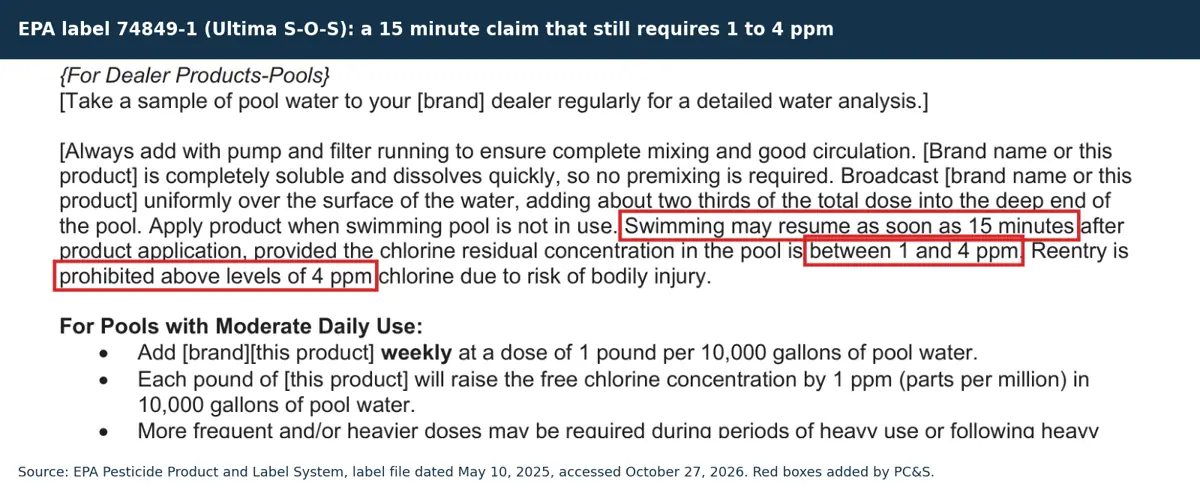
- ✓15 minutes is a dose claimLabels that print a 15 minute claim dose about 1 to 4 ppm and still require 1 to 4 ppm before anyone enters.
- ✓Hot tubs: 5 ppm chlorine, 8 ppm bromineSpa labels cap chlorine re-entry at 5 ppm, and the BCDMH label caps bromine at 8 ppm, the same 8.0 ppm the 2024 MAHC uses.
Key takeaways
- Pool shock labels set the swim rule as a chlorine reading, not a time: the Hasachlor label (10897-26) says re-entry into treated pools is prohibited above 4 ppm, and 8 of the 11 pool labels we read use that 4 ppm line.
- The strictest labels set 3 ppm: Scorch (3432-76) says do not enter until chlorine reads 1.0 to 3.0 ppm, and Olympic trichlor tablets (42177-18) prohibit re-entry above 3 ppm.
- The 2024 Model Aquatic Health Code leaves the maximum to the product label (section 5.7.3.1.1.5) and treats free chlorine above 10 ppm with bathers present as an imminent health hazard at public pools (MAHC 6.6.3.1).
- Sunlight sets the pace: 2 hours of direct sun can cut chlorine by up to 90% when cyanuric acid is low or absent, according to Greene County Public Health (Ohio, April 2024); stabilizer slows that loss to hours or days.
- Non-chlorine shock (potassium monopersulfate) is not a sanitizer, says the PHTA Recreational Water Quality Committee, and one maker lists swimming 15 minutes after a 1 lb per 10,000 gallon dose.
- Hot tubs follow spa labels: the Spa 56 label (7364-80) prohibits re-entry above 5 ppm chlorine, and the BioGuard Master BCDMH label (5185-420) above 8 ppm bromine.
How long after shocking a pool can you swim, according to the labels?
Until a test says the chlorine is down. We pulled 11 EPA-accepted pool labels from the EPA Pesticide Product and Label System: 8 prohibit re-entry above 4 ppm and 3 set 3 ppm. Clocks appear only as minimums, 15 minutes on two blended shocks and 12 hours on a 2009 lithium label, and each still requires a test.
| Product as registered (EPA Reg. No.) | Type and active ingredient | Exact re-entry wording on the label | Label file date | Label PDF |
|---|---|---|---|---|
| Hasachlor (10897-26) | Liquid; sodium hypochlorite 12.5% | Re-entry into treated pools is prohibited above levels of 4 ppm due to risk of bodily harm. | April 24, 2026 | https://www3.epa.gov/pesticides/chem_search/ppls/010897-00026-20260424.pdf |
| HTH Granular 73 (1258-1239) | Granular; calcium hypochlorite 73% | Re-entry into treated pools is prohibited above 4 ppm due to risk of bodily harm. | February 24, 2025 | https://www3.epa.gov/pesticides/chem_search/ppls/001258-01239-20250224.pdf |
| BioGuard Calcium Hypochlorite 73 (5185-515) | Granular; calcium hypochlorite 73% | Reentry into treated swimming pool is prohibited above levels of 4 ppm chlorine due to risk of bodily injury. | May 21, 2024 | https://www3.epa.gov/pesticides/chem_search/ppls/005185-00515-20240521.pdf |
| Zappit Shock Treatment and Super Chlorinator (748-237) | Granular; calcium hypochlorite 68% | Do not enter the pool until the free chlorine residual has dropped to 4.0 ppm or less as measured using a suitable test kit. | March 12, 2024 | https://www3.epa.gov/pesticides/chem_search/ppls/000748-00237-20240312.pdf |
| HTH Pool Shock (1258-1237) | Granular; calcium hypochlorite 47.6% | Re-entry into treated swimming pools is prohibited above levels of 4 ppm chlorine for risk of bodily injury. | April 12, 2018 | https://www3.epa.gov/pesticides/chem_search/ppls/001258-01237-20180412.pdf |
| Dichlor Chlorinating Granules (98507-2) | Granular; sodium dichlor, 62% available chlorine | Re-entry into treated pools is prohibited above levels of 4 ppm due to risk of bodily harm. | December 8, 2025 | https://www3.epa.gov/pesticides/chem_search/ppls/098507-00002-20251208.pdf |
| Swimming Pool Product Z, sold as Clorox Pool&Spa Shock Xtra Blue (67262-35) | Granular; sodium dichlor 63.05% plus copper 0.26% (39% available chlorine) | RE-ENTRY: Wait at least 15 minutes after product application before entering pool. Re-entry into treated swimming pools is prohibited above levels of 4 ppm chlorine due to risk of bodily injury. | April 12, 2024 | https://www3.epa.gov/pesticides/chem_search/ppls/067262-00035-20240412.pdf |
| Ultima S-O-S, distributed as Pace Shock Oxidizer (74849-1) | Granular blend; sodium dichlor 15% (9.53% available chlorine) | Swimming may resume as soon as 15 minutes after product application, provided the chlorine residual concentration in the pool is between 1 and 4 ppm. | May 10, 2025 | https://www3.epa.gov/pesticides/chem_search/ppls/074849-00001-20250510.pdf |
| Scorch (3432-76) | Granular; calcium hypochlorite 68% (65% available chlorine) | Pool should not be entered until chlorine residual reads 1.0-3.0 ppm. | September 22, 2025 | https://www3.epa.gov/pesticides/chem_search/ppls/003432-00076-20250922.pdf |
| Olympic Chlorinated Tablets 3 inch (42177-18) | Tablet; trichlor 99% | REENTRY: Reentry into treated pools is prohibited above 3 ppm chlorine due to risk of bodily injury. | November 1, 2012 | https://www3.epa.gov/pesticides/chem_search/ppls/042177-00018-20121101.pdf |
| Chloro-Pure Chlorine Sanitizer (3525-33) | Granular; lithium hypochlorite 29% | Shock in the evening when the pool will not be used for a minimum of 12 hours. Test the chlorine residual, and if above 3.0 ppm, do not allow swimming until the residual has decreased. (EPA's 2009 acceptance also required: Re-entry into treated pools is prohibited above levels of 4 ppm due to risk of bodily injury.) | August 18, 2009 | https://www3.epa.gov/pesticides/chem_search/ppls/003525-00033-20090818.pdf |
Sources: EPA-accepted labels on the EPA Pesticide Product and Label System, by EPA Reg. No.: 10897-26, 1258-1239, 5185-515, 748-237, 1258-1237, 98507-2, 67262-35, 74849-1, 3432-76, 42177-18, 3525-33. Product names as registered; distributor names from the PPLS product name search. Accessed October 27, 2026. Download CSV
For a home pool, the label on the product you used is the limit. Retest before swimming.
Source: EPA-accepted labels on the EPA Pesticide Product and Label System; CDC 2024 Model Aquatic Health Code 6.6.3.1. Accessed October 2026. Download chart data (CSV)
The label is the binding rule for a home pool. The Hasachlor label states that using the product in a manner inconsistent with its labeling violates federal law, and the 2024 MAHC gives public pools the same limit in section 5.7.3.1.1.5: maximum free chlorine shall not exceed the limit on the product label. The 10 ppm figure belongs to public pool enforcement, where section 6.6.3.1 lets an inspector close a pool above it.
| Key number | Value | Applies to | Source |
|---|---|---|---|
| Label re-entry limit (8 of 11 pool labels we read) | 4 ppm free chlorine | Pools treated with that product | EPA-accepted labels |
| Strictest label limit | 3 ppm (Scorch: 1.0 to 3.0 ppm) | Scorch, Olympic trichlor tablets, Chloro-Pure lithium | EPA-accepted labels |
| Minimum free chlorine to swim | 1 ppm; 2 ppm with cyanuric acid; 3 ppm in hot tubs | Home pools and hot tubs | CDC (May 2024) |
| Maximum free chlorine | The product label limit | Public pools | 2024 MAHC 5.7.3.1.1.5 |
| Imminent health hazard | Above 10 ppm with bathers present | Public pools | 2024 MAHC 6.6.3.1 |
| Spa label limits | 5 ppm chlorine; 8 ppm bromine | Spas and hot tubs | EPA labels 7364-80 and 5185-420 |
| Test bleach-out | Above 10 ppm a DPD test can read falsely low or 0 | Any DPD test kit | CDC (May 2024) |
| Sunlight loss without stabilizer | Up to 90% in 2 hours | Low or no cyanuric acid | Greene County Public Health (April 2024) |
| Swim after non-chlorine shock | 15 minutes | Potassium monopersulfate (MPS) shock | Doheny product listing |
Sources: EPA labels 10897-26, 1258-1239, 5185-515, 748-237, 1258-1237, 98507-2, 67262-35, 74849-1, 3432-76, 42177-18, 3525-33, 7364-80, 5185-420; CDC (May 2024); 2024 MAHC; Greene County Public Health (2024); Doheny. Accessed October 2026. Download CSV
Why do guides say to wait 8 to 24 hours?
Because a clock is easier to print than a test result. The pool company articles we read quote 12 hours, 8 to 12 hours or 8 to 24 hours, and none names the label behind the figure. The labels say the opposite: swim when the reading is in range, whether that takes 15 minutes or 2 days.
| What the guide says | Who says it | What the primary source says | Primary source |
|---|---|---|---|
| Wait 12 hours after shocking, regardless of pool size | Royal Pools and Spas (July 2024) | Swim at 4 ppm or less; none of the 11 pool labels we read sets 12 hours for a calcium hypochlorite shock | EPA labels 1258-1239, 5185-515, 748-237 |
| Wait 8 to 12 hours after cal-hypo or dichlor | Aqua Pools (Homer Glen, IL) | Same rule; the 98507-2 dichlor label adds: run the filter and pump at least 2 hours after adding | EPA label 98507-2 |
| Most owners wait 8 to 24 hours; cal-hypo needs 24 to 48 hours | Western Lehigh Services | Time to 4 ppm depends on sun and stabilizer: about 48 minutes to 1.8 days after a 10 ppm shock in our estimate table | Greene County Public Health; Lowry (Aqua Magazine) |
| Wait at least 8 hours and up to 24 hours | Swim University | Same as above: a reading, not a clock | EPA labels |
| Swim in as soon as 15 minutes | Marketing claim on the 67262-35 label (Clorox Pool&Spa Shock Xtra Blue) | The same label: wait at least 15 minutes and do not enter above 4 ppm; 1 lb per 12,000 gal adds about 3.9 ppm | EPA label 67262-35; PC&S arithmetic |
| Swimming is safe at chlorine up to the SLAM level for your CYA | Trouble Free Pool (January 2019) | Labels prohibit re-entry above 4 ppm (3 ppm on some); the MAHC lists more than 10 ppm with bathers present as a hazard | EPA labels; 2024 MAHC 6.6.3.1 |
| Non-chlorine shock: swim in 15 to 30 minutes | Western Lehigh Services; Aqua Pools | Doheny's MPS listing says 15 minutes; MPS is not a sanitizer, so free chlorine still has to be in range | Doheny listing; PHTA tech note (2019) |
Sources: Royal Pools and Spas; Aqua Pools; Western Lehigh Services; Swim University; Trouble Free Pool; Doheny; PHTA tech note; EPA labels 67262-35, 98507-2; 2024 MAHC. Accessed October 2026. Download CSV
None of these guides is wrong about a typical evening shock: a 10 ppm dose in a stabilized pool does take about 11 hours or more to fall to 4 ppm by our estimate. The clocks fail at the edges. A light liquid dose in noon sun can be back under 4 ppm in well under an hour, and the labels that print a 15 minute claim deliver only about 1 to 4 ppm per dose: the Ultima S-O-S label says each pound raises 10,000 gallons by 1 ppm.
How long does chlorine take to drop to 4 ppm after a shock?
Without stabilizer in direct sun, a 10 ppm shock reaches 4 ppm in about 48 to 79 minutes by our estimate; with cyanuric acid it takes about 11 hours to 2 days. These are estimates built from published loss rates, not measurements in your pool, and the MAHC Annex says chlorine decomposition rates are difficult to predict.
| Starting free chlorine (ppm) | No stabilizer, sun: 90% lost in 2 h (Greene County) | No stabilizer, sun: 75% lost in 2 h (Lowry) | With stabilizer: 8 times slower (Lowry) | With stabilizer: 1.5 ppm a day at 3 ppm (Lowry) |
|---|---|---|---|---|
| 5 | 12 min to 4 ppm; 27 min to 3 ppm | 19 min to 4 ppm; 44 min to 3 ppm | 2.6 h to 4 ppm; 5.9 h to 3 ppm | 10.7 h to 4 ppm; 24.5 h to 3 ppm |
| 7.5 | 33 min to 4 ppm; 48 min to 3 ppm | 54 min to 4 ppm; 79 min to 3 ppm | 7.3 h to 4 ppm; 10.6 h to 3 ppm | 30.2 h to 4 ppm; 44.0 h to 3 ppm |
| 10 | 48 min to 4 ppm; 63 min to 3 ppm | 79 min to 4 ppm; 104 min to 3 ppm | 10.6 h to 4 ppm; 13.9 h to 3 ppm | 44.0 h to 4 ppm; 2.4 days to 3 ppm |
| 16 | 72 min to 4 ppm; 87 min to 3 ppm | 2.0 h to 4 ppm; 2.4 h to 3 ppm | 16.0 h to 4 ppm; 19.3 h to 3 ppm | 2.8 days to 4 ppm; 3.3 days to 3 ppm |
| 20 | 84 min to 4 ppm; 99 min to 3 ppm | 2.3 h to 4 ppm; 2.7 h to 3 ppm | 18.6 h to 4 ppm; 21.9 h to 3 ppm | 3.2 days to 4 ppm; 3.8 days to 3 ppm |
Sources: Greene County Public Health, Chlorine Toxicity in Pools (rev. April 25, 2024); Robert Lowry in Aqua Magazine, October 2015 (reprinted by Horizon Commercial Pools). First-order decay arithmetic by PC&S; half-lives 36 minutes, 60 minutes, 8 hours and 33 hours. Download CSV
No published rate covers night, shade or a covered pool. Test before swimming.
Source: Greene County Public Health (Ohio), April 2024; Robert Lowry in Aqua Magazine, October 2015; first-order decay arithmetic by PC&S. Accessed October 2026. Download chart data (CSV)
| Step | Value | Basis |
|---|---|---|
| Loss rate, no stabilizer, direct sun | Up to 90% in 2 hours, so 10% remains | Greene County Public Health, April 2024 |
| Half-life | 2 h x ln 2 / ln 10 = 0.60 h, about 36 minutes | First-order decay arithmetic |
| Halvings from 10 to 4 ppm | log2(10 / 4) = 1.32 | Arithmetic |
| Time to 4 ppm | 1.32 x 36.1 min = 48 min | Arithmetic |
| Lowry, no stabilizer: 75% in 2 hours | Half-life 60 min; 1.32 x 60 = 79 min | Aqua Magazine, October 2015 |
| Lowry, stabilizer keeps chlorine 8 times longer | Half-life 8 h; 1.32 x 8 h = 10.6 h | Aqua Magazine, October 2015 |
| Lowry, 1.5 ppm a day lost at a 3 ppm maintenance level | Half-life 3 x ln 2 / 1.5 = 1.39 days (33.3 h); 1.32 x 33.3 h = 44 h, or 1.8 days | Aqua Magazine, October 2015; PC&S conversion |
Sources: Greene County Public Health (2024); Aqua Magazine (2015). Arithmetic by PC&S. Download CSV
Is it better to shock a pool at night or during the day? At night, if the goal is killing algae or chloramines: the HTH Granular 73 label says add it during evening hours, BioGuard 73 says preferably at night, and the 67262-39 label says use it at night to prevent sunlight degradation. If the goal is swimming soon, a daytime unstabilized dose falls fastest, under Greene County’s figure of up to 90% in 2 hours.
What happens if you swim in a pool that has been shocked?
A few ppm over the label limit mostly means irritation; high levels mean chlorine injury. Greene County Public Health lists burning eyes, nose and throat, nausea, rash, coughing and shortness of breath among chlorine poisoning symptoms, and says pools above 10 ppm should be cleared of all bathers. Pool chemicals were involved in an estimated 4,700 emergency room injuries in 2024.
Is it safe to swim 4 hours after shocking the pool? Only if a test reads 4 ppm or less at that point, or 3 ppm under the Scorch and Olympic labels. By our estimate, 4 hours is enough for an unstabilized 10 ppm dose in full sun and not enough for a stabilized one, which takes about 10.6 hours or more.
The injury estimate comes from CPSC’s NEISS emergency room sample, analysed in our pool injury statistics report: pool chemicals were involved in 4,700 of an estimated 90,300 nonfatal pool injuries treated in 2024. Testing habits are part of the problem: 23% of do-it-yourself pool owners in a 2020 industry survey tested chlorine and pH once every two weeks or less, as our pool hygiene statistics show.
How long after adding chlorine can you swim?
For a routine dose that keeps free chlorine at 4 ppm or less, as soon as it has mixed. Labels set no clock for maintenance doses: the HTH Granular 73 label allows 30 minutes for the product to disperse before testing, and the 98507-2 dichlor label says run the filter and pump at least 2 hours after any chlorine or pH adjustment.
| What you added | Label direction on timing | Swim when | Source |
|---|---|---|---|
| Liquid chlorine, routine dose (11 fl oz per 10,000 gal adds 0.6 to 1.0 ppm) | No wait printed; keep 1 to 4 ppm in stabilized pools | Mixed and 4 ppm or less | EPA label 10897-26 |
| Cal-hypo granules | Allow 30 minutes for the product to disperse, then test | Test reads 1 to 4 ppm | EPA label 1258-1239 |
| Dichlor granules | Run the filter and pump at least 2 hours after adding | 4 ppm or less | EPA label 98507-2 |
| Trichlor tablets in a feeder or floater | No wait printed | 3 ppm or less on the Olympic label | EPA label 42177-18 |
| Blended shock sold as swim in 15 minutes | Wait at least 15 minutes | 1 to 4 ppm | EPA labels 67262-35 and 74849-1 |
| Non-chlorine shock (MPS) | 15 minutes (maker listing) | Free chlorine still in your normal range | Doheny listing; PHTA tech note |
Sources: EPA labels 10897-26, 1258-1239, 98507-2, 42177-18, 67262-35, 74849-1; Doheny listing; PHTA tech note (2019). Accessed October 2026. Download CSV
A routine dose rarely pushes chlorine over the limit. By the Hasachlor label’s own chart, 10 fl oz of 12.5% liquid chlorine raises 10,000 gallons by 1 ppm, so lifting a pool from 2 to 3 ppm leaves it well under 4. Our chlorine dose table by pool size converts any target into ounces, and our comparison of liquid chlorine vs shock covers when each one fits.
How long after non-chlorine shock can you swim?
About 15 minutes by the maker directions we found, because potassium monopersulfate (MPS) adds no chlorine. Doheny lists ‘Start swimming in 15 minutes!’ for its 1 lb per 10,000 gallon dose. The catch: MPS is not a sanitizer, and it can make a DPD test read falsely high, so the reading you swim on may be wrong.
The PHTA Recreational Water Quality Committee tech note (Aqua Magazine, June 2019) says MPS is not a sanitizer or algaecide and must be used with an EPA-registered sanitizer, that most non-chlorine oxidizers contain 45% potassium monopersulfate, and that leftover MPS tests as combined chlorine on DPD kits. The 2024 MAHC Annex adds a false free chlorine reading once MPS passes about 25 ppm. The tech note’s fix: add MPS in the evening and test the next morning, or use a kit with an MPS neutralizing reagent.
Blended products blur the line. The Ultima S-O-S label (74849-1), distributed as Pace Shock Oxidizer, lists 15% sodium dichlor as its only registered active ingredient, delivers 1 ppm per pound per 10,000 gallons and allows swimming 15 minutes after application only if chlorine reads 1 to 4 ppm. If the active ingredient line lists a chlorine compound, the chlorine rule applies.
How long after shocking a hot tub can you get in?
When chlorine reads 5 ppm or less, or bromine 8 ppm or less, the re-entry limits on the six spa directions we read. That is higher than the pool limit because hot tubs need more sanitizer: CDC’s minimum is 3 ppm free chlorine in hot tubs against 1 ppm in pools, and CDC advises against cyanuric acid in hot tubs.
| Product (EPA Reg. No.) | Sanitizer | Exact spa re-entry wording | Label file date |
|---|---|---|---|
| Spa 56 Concentrated Chlorinating Granules, sold as HTH Spa Chlorinating Shock and Sanitizer (7364-80) | Dichlor dihydrate 99% | Re-entry into treated spas/hot tubs is prohibited above levels of 5 parts per million (ppm) free residual chlorine. | September 27, 2022 |
| HTH Granular 73, spa directions (1258-1239) | Calcium hypochlorite 73% | Re-entry into treated spas/hot tubs is prohibited above 5 ppm due to risk of bodily harm. | February 24, 2025 |
| HTH Pool Shock, spa directions (1258-1237) | Calcium hypochlorite 47.6% | Do not enter spa until the free available chlorine residual is 3-5 ppm. Re-entry Into treated spas is prohibited above levels of 5 ppm for risk of bodily injury. | April 12, 2018 |
| Hasachlor, spa directions (10897-26) | Sodium hypochlorite 12.5% | Re-entry into treated spas is prohibited above levels of 5 ppm due to risk of bodily harm. | April 24, 2026 |
| Ultima S-O-S, spa directions (74849-1) | Sodium dichlor 15% blend | Reentry is prohibited above levels of 5 ppm chlorine due to risk of bodily injury. | May 10, 2025 |
| BioGuard Master BCDMH (5185-420) | Bromine (BCDMH 96%) | Reentry into treated spas is prohibited above levels of 8 ppm bromine due to risk of body injury. | April 15, 2026 |
Sources: EPA labels 7364-80, 1258-1239, 1258-1237, 10897-26, 74849-1, 5185-420; CDC (May 2024). Accessed October 27, 2026. Download CSV
Public spas use the same numbers. The 2024 MAHC sets a spa minimum of 3.0 ppm free chlorine or 4.0 ppm bromine (sections 5.7.3.1.1.2.3 and 5.7.3.1.2.2) and a bromine maximum of 8.0 ppm. Under a closed cover there is no sunlight loss, so the sun-based estimates above do not apply; test with the cover off before soaking. Our hot tub maintenance guide covers routine dosing.
Want a pro to handle the shock and the testing?
Can you swim yet? Decision table
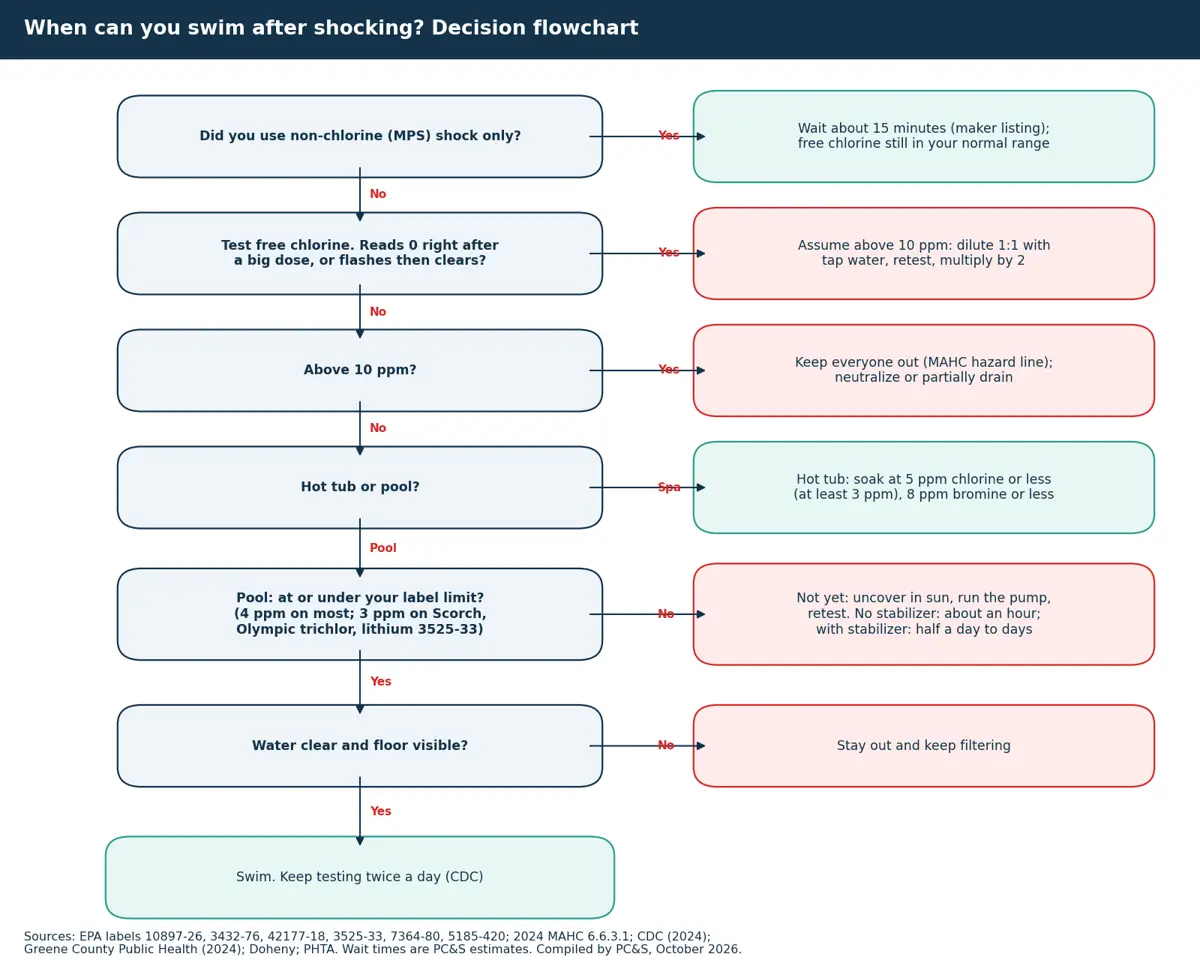
Find your situation and follow the row. The table turns the label re-entry limits, the 15 minute and 12 hour minimums, the MAHC 10 ppm hazard line, the DPD bleach-out warning and the spa limits into if-then steps, and the flowchart under it holds the same logic for quick use at the pool.
| If your situation is | Do this | Source |
|---|---|---|
| Free chlorine 1 to 4 ppm (2 to 4 ppm with stabilizer), pH 7.0 to 7.8, water clear | Swim | EPA labels; CDC (2024) |
| Your label says 3 ppm (Scorch, Olympic trichlor, Chloro-Pure lithium) | Wait for 3 ppm or less | EPA labels 3432-76, 42177-18, 3525-33 |
| Free chlorine above 4 ppm but 10 ppm or less | Stay out; uncover in sun, run the pump, retest every hour or two, or neutralize | EPA labels; Greene County Public Health |
| Free chlorine above 10 ppm | Keep everyone out; neutralize or partially drain | 2024 MAHC 6.6.3.1; Greene County Public Health |
| Test reads 0, or flashes pink then clears, right after a shock | Assume above 10 ppm; dilute 1:1 with tap water, retest, multiply by 2 | CDC (2024) |
| You used non-chlorine shock (MPS) only | Swim after about 15 minutes if free chlorine is in range; expect a falsely high combined chlorine reading | Doheny; PHTA tech note; 2024 MAHC Annex |
| Your shock label says wait at least 15 minutes | Wait 15 minutes, then confirm 1 to 4 ppm | EPA labels 67262-35 and 74849-1 |
| You shocked with lithium label 3525-33 | Keep the pool closed at least 12 hours, then test for 3.0 ppm or less | EPA label 3525-33 |
| Hot tub on chlorine | Soak at 5 ppm or less and at least 3 ppm | Spa labels; CDC (2024) |
| Hot tub on bromine | Soak at 8 ppm bromine or less | EPA label 5185-420; 2024 MAHC 5.7.3.1.2.3 |
| Green or cloudy water, floor not visible | Stay out whatever the chlorine reads | 2024 MAHC 6.6.3.1 item 14 |
Sources: EPA labels 10897-26, 1258-1239, 5185-515, 748-237, 1258-1237, 98507-2, 67262-35, 74849-1, 3432-76, 42177-18, 3525-33, 7364-80, 5185-420; 2024 MAHC; MAHC Annex; CDC (2024); Greene County Public Health; Doheny; PHTA. Accessed October 2026. Download CSV
If the pool was shocked because it turned green, the water also has to clear before anyone swims; our guide on how to clear a green pool covers the dose by pool size and why 1 to 7 days is a realistic range. For the shock itself, see how to shock a pool step by step.
What if the chlorine is still too high to swim?
Wait, uncover the pool in sun, or neutralize it. Greene County Public Health lists four fixes: stop dosing, use at least 2 hours of direct sunlight when cyanuric acid is low, partially drain and refill, or add a neutralizer such as sodium thiosulfate. Do not add acid to adjust pH until chlorine is back in range, the same guidance says.
Neutralizer doses, drain math and the safety data for sodium thiosulfate are in our guide on how to lower chlorine in a pool. High stabilizer is the usual reason chlorine lingers for days after a shock; our cyanuric acid guide shows the 90 ppm cap in the 2024 MAHC and how to dilute down to it.
How we compiled this
We read 14 EPA-accepted pool and spa labels from the EPA Pesticide Product and Label System, the 2024 Model Aquatic Health Code and its Annex, CDC’s home pool page, a 2024 Greene County Public Health guidance sheet, a 2019 PHTA tech note and a 2015 Aqua Magazine article, all accessed in October 2026, and quoted each label’s re-entry wording exactly. The wait-time table and chart are PC&S estimates from published loss rates, not measurements. We did not test water or products; four pool company articles, one publisher and one community site appear only in the guides versus labels comparison, and forum threads were excluded as a source of facts.
Frequently Asked Questions
Is it safe to swim 4 hours after shocking the pool?
Only if a test reads 4 ppm or less at that point, the re-entry limit on 8 of the 11 pool labels we read (3 ppm on Scorch, Olympic trichlor and one lithium label). By our estimate, an unstabilized 10 ppm shock in full sun gets there in about 48 to 79 minutes, while a stabilized pool takes about 10.6 hours or more.
What happens if you swim in a pool that has been shocked?
Near the label limit, expect red eyes and skin irritation; at high levels, chlorine injury. Greene County Public Health lists burning eyes, nose and throat, nausea, rash, coughing and shortness of breath as symptoms, and the 2024 MAHC treats more than 10 ppm with swimmers present as an imminent health hazard at public pools. Test first.
How long does it take for a shocked pool to clear?
Clear and safe are separate tests. The HTH Granular 73 label allows 30 minutes for the product to disperse before testing, while cloudy or green water needs the filter: the 1258-1250 label pairs a severe-bloom shock with flocculant and vacuuming to clear a green pool within 24 hours. Swim only when the water is clear and chlorine reads 4 ppm or less.
Is it better to shock a pool at night or day?
At night, for the treatment itself: the HTH Granular 73 label says add it during evening hours, BioGuard 73 says preferably at night, and the 67262-39 label says use it at night to prevent sunlight degradation. Daytime sun does lower chlorine faster, up to 90% in 2 hours without stabilizer per Greene County Public Health, but it also wastes the shock.
Can I swim 30 minutes after shocking the pool?
Only if chlorine already reads 4 ppm or less. After a 10 ppm shock that takes about 48 minutes even in full sun without stabilizer, by our estimate. Products labeled swim in 15 minutes dose 1 to 4 ppm, and non-chlorine shock adds no chlorine, so those are the cases where 30 minutes can work. The label limit, not the clock, decides.
How long after adding chlorine can you swim?
For a routine dose, once it has mixed and the reading is 4 ppm or less. The HTH Granular 73 label allows 30 minutes to disperse before testing, the 98507-2 dichlor label says run the pump at least 2 hours, and the Hasachlor chart shows 10 fl oz of 12.5% liquid raising 10,000 gallons by just 1 ppm.
How soon can you go in a hot tub after shocking?
When free chlorine reads 5 ppm or less, the limit on the Spa 56, HTH, Hasachlor and Ultima spa directions, or bromine 8 ppm or less on the BioGuard BCDMH label. Stay at or above CDC’s 3 ppm chlorine minimum for hot tubs, and test with the cover off. These limits hold whatever the clock says, because none of the spa directions we read sets a waiting time.
Sources
- Hasa label on file with U.S. EPA (Pesticide Product and Label System). Hasachlor, EPA Reg. No. 10897-26, label notification April 24, 2026. Accessed 2026-10-27.
- Innovative Water Care label on file with U.S. EPA. HTH Granular 73, EPA Reg. No. 1258-1239, label file dated February 24, 2025. Accessed 2026-10-27.
- Bio-Lab label on file with U.S. EPA. BioGuard Calcium Hypochlorite 73, EPA Reg. No. 5185-515, label dated May 21, 2024. Accessed 2026-10-27.
- Westlake label on file with U.S. EPA. Zappit Shock Treatment and Super Chlorinator, EPA Reg. No. 748-237, label file dated March 12, 2024. Accessed 2026-10-27.
- Innovative Water Care label on file with U.S. EPA. HTH Pool Shock, EPA Reg. No. 1258-1237, label file dated April 12, 2018. Accessed 2026-10-27.
- Swimables label on file with U.S. EPA. Dichlor Chlorinating Granules, EPA Reg. No. 98507-2, registration issued December 8, 2025. Accessed 2026-10-27.
- Recreational Water Products label on file with U.S. EPA. Swimming Pool Product Z, EPA Reg. No. 67262-35, label dated April 12, 2024. Accessed 2026-10-27.
- Innovative Water Care (Advantis) label on file with U.S. EPA. Ultima S-O-S, EPA Reg. No. 74849-1, label file dated May 10, 2025. Accessed 2026-10-27.
- N. Jonas & Co. label on file with U.S. EPA. Scorch, EPA Reg. No. 3432-76, label notification September 22, 2025. Accessed 2026-10-27.
- Alliance Trading label on file with U.S. EPA. Olympic Chlorinated Tablets 3 inch, EPA Reg. No. 42177-18, label dated November 1, 2012. Accessed 2026-10-27.
- Qualco label on file with U.S. EPA. Chloro-Pure Chlorine Sanitizer, EPA Reg. No. 3525-33, accepted August 18, 2009. Accessed 2026-10-27.
- Innovative Water Care (GLB) label on file with U.S. EPA. Spa 56 Concentrated Chlorinating Granules, EPA Reg. No. 7364-80, label dated September 27, 2022. Accessed 2026-10-27.
- Bio-Lab label on file with U.S. EPA. BioGuard Master BCDMH, EPA Reg. No. 5185-420, label dated April 15, 2026. Accessed 2026-10-27.
- Recreational Water Products label on file with U.S. EPA. Granular Trichlor 28, EPA Reg. No. 67262-39, label dated February 12, 2025. Accessed 2026-10-27.
- U.S. Environmental Protection Agency (EPA). Pesticide Product and Label System, product name search 'SHOCK' (October 27, 2026). Accessed 2026-10-27.
- Centers for Disease Control and Prevention (CDC). 2024 Model Aquatic Health Code, 5th Edition, Code Language. Accessed 2026-10-27.
- Centers for Disease Control and Prevention (CDC). 2024 Model Aquatic Health Code, 5th Edition, Annex. Accessed 2026-10-27.
- Centers for Disease Control and Prevention (CDC). Home Pool and Hot Tub Water Treatment and Testing (page dated May 10, 2024). Accessed 2026-10-27.
- Greene County Public Health (Ohio). Chlorine Toxicity in Pools: Guidance (rev. April 25, 2024). Accessed 2026-10-27.
- Horizon Commercial Pools reprint of Aqua Magazine. New Thinking: Chlorine/Cyanuric Acid in Balance (Aqua Magazine, October 2015, reprinted April 17, 2018). Accessed 2026-10-27.
- PHTA Recreational Water Quality Committee (PDF hosted by Hasa). Potassium Monopersulfate: Non-Chlorine Shock (Aqua Magazine Tech Notes, June 2019). Accessed 2026-10-27.
- Doheny's (retail listing). Doheny's Non-Chlorine Oxi-Shock, 12 lb. Accessed 2026-10-27.
- Royal Pools and Spas (guide claim only). How Long After Shocking a Pool Can You Swim? (July 22, 2024). Accessed 2026-10-27.
- Aqua Pools (guide claim only). How Long After You Shock a Pool Can You Swim Safely?. Accessed 2026-10-27.
- Western Lehigh Services (guide claim only). How Long After Shocking Pool Can You Swim Safely. Accessed 2026-10-27.
- Swim University (guide claim only). When is it Safe to Swim After Adding Pool Chemicals?. Accessed 2026-10-27.
- Trouble Free Pool (community site; guide claim only). The Free Chlorine and Cyanuric Acid Relationship (January 18, 2019). Accessed 2026-10-27.
- PC&S research. Pool Injury Statistics 2024 (CPSC NEISS microdata). Accessed 2026-10-27.
- PC&S research. Pool Hygiene Statistics (Water Quality & Health Council 2020 survey). Accessed 2026-10-27.
Related pages
Get Quotes From Licensed Local Pool Pros
Tell us what you need and your ZIP code. We match you with pool companies that cover your area.