Natural Swimming Pool Cost: What a Natural Pool Is, How It Works and What It Costs
Natural swimming pool cost runs $60,000 to $75,000 for a 16 x 32 ft biofilter pool (BioNova) and $75,000 to $150,000 for most planted swim ponds (Total Habitat, October 2026): plants and microbes replace chlorine.
- ✓Zone sizing worked outA 16 x 32 ft swim zone needs 861 to 1,707 sq ft of total water under the German FLL pond types (PC&S calculation).
- ✓Price history checkedOne builder’s entry tier rose from $60,000 to $70,000 in 2021 to $75,000 to $125,000 by July 2022 (Wayback captures).
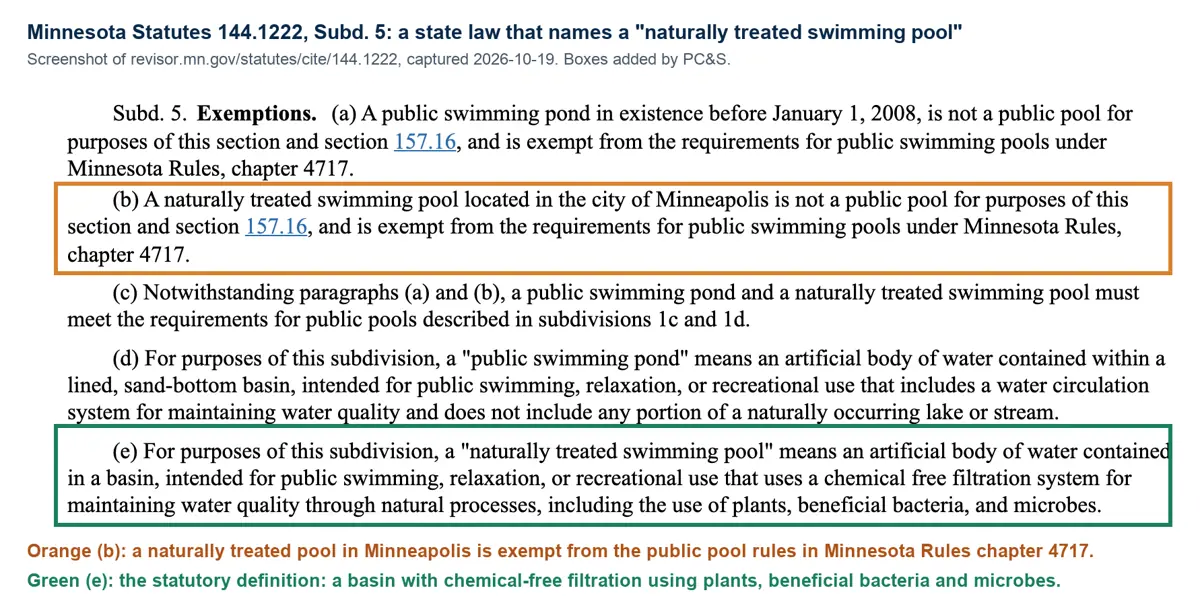
- ✓Rules namedMinnesota Statutes 144.1222 defines a naturally treated swimming pool; Florida counts any residential water over 24 in deep as a pool.
Key takeaways
- A 16 x 32 ft natural pool with a biofilm filter averages $60,000 to $75,000 per the BioNova FAQ, a figure unchanged on that page since at least March 2021.
- Total Habitat prices its entry planted pond at $75,000 to $125,000 turn-key; the same tier read $60,000 to $70,000 in a September 2021 capture.
- Under the German FLL pond types summarised by Walczak et al. (2023), the planted zone must be 70%, 50% or 40% of the water surface for types 1 to 3, so a 16 x 32 ft swim zone needs 861 to 1,707 sq ft of water.
- Minnesota Statutes 144.1222 defines a naturally treated swimming pool and exempts one in Minneapolis from the state public pool rules; the CDC Model Aquatic Health Code, a model that states may adopt, sets 1.0 ppm free chlorine for public pools.
- FLL guide values cap swim-water phosphorus at 0.01 to 0.03 mg/L (Lovibond), while EPA corrosion guidance targets 0.33 to 1.0 mg/L as P in treated tap water.
What is a natural pool?
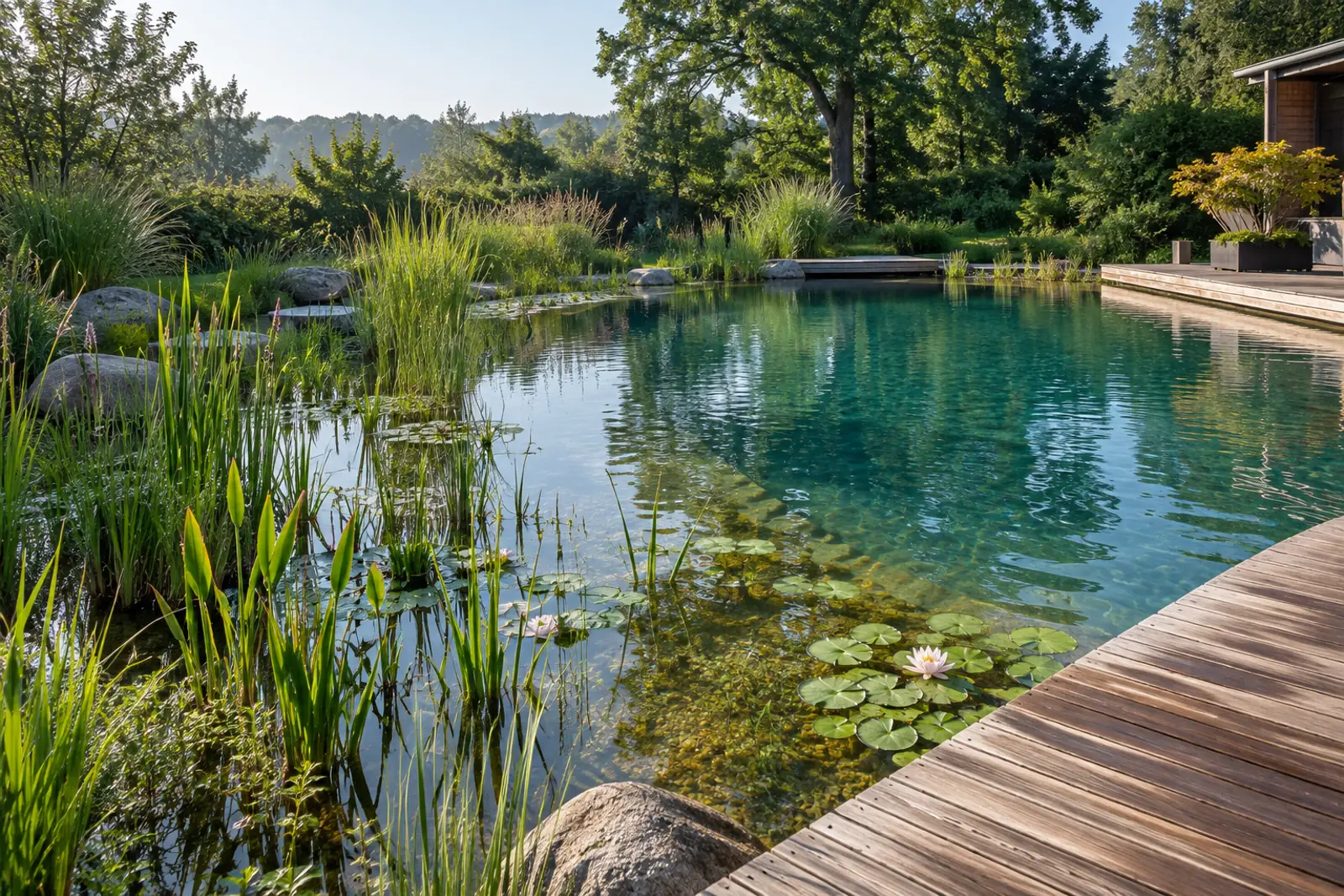
A natural pool is a swimming pool that keeps its water clean with plants, microbes and gravel or biofilm filters instead of chlorine or salt. Minnesota law defines a naturally treated swimming pool as an artificial basin that uses chemical-free filtration through plants, beneficial bacteria and microbes.
The terms vary: natural swimming pool, swim pond, eco pool and biopool all describe the same idea. What they share is a lined basin, often PVC or EPDM finished with 10 to 15 cm of gravel per Walczak et al. (2023), a skimmer and pump, and a biological filter: a planted regeneration zone or a biofilm filter vessel. BioNova, which designed the Webber pool in Minneapolis, does not allow fish in its pools because they add nutrients.
The best-documented US example is the Webber Natural Swimming Pool in Minneapolis: about 500,000 gallons, opened July 24, 2015, with a lower pool 6 ft 4 in deep. BioNova lists a 21,000 sq ft swim zone and a 16,000 sq ft regeneration zone, so 43% of the water surface is planted.
How does a natural swimming pool work?
A natural pool works by pumping water from a skimmer through a planted gravel bed or a biofilm filter, where bacteria break down organic matter and plants take up nitrogen and phosphorus, then returning it to the swim zone. With phosphorus held near 0.01 mg/L, algae have too little food to bloom.
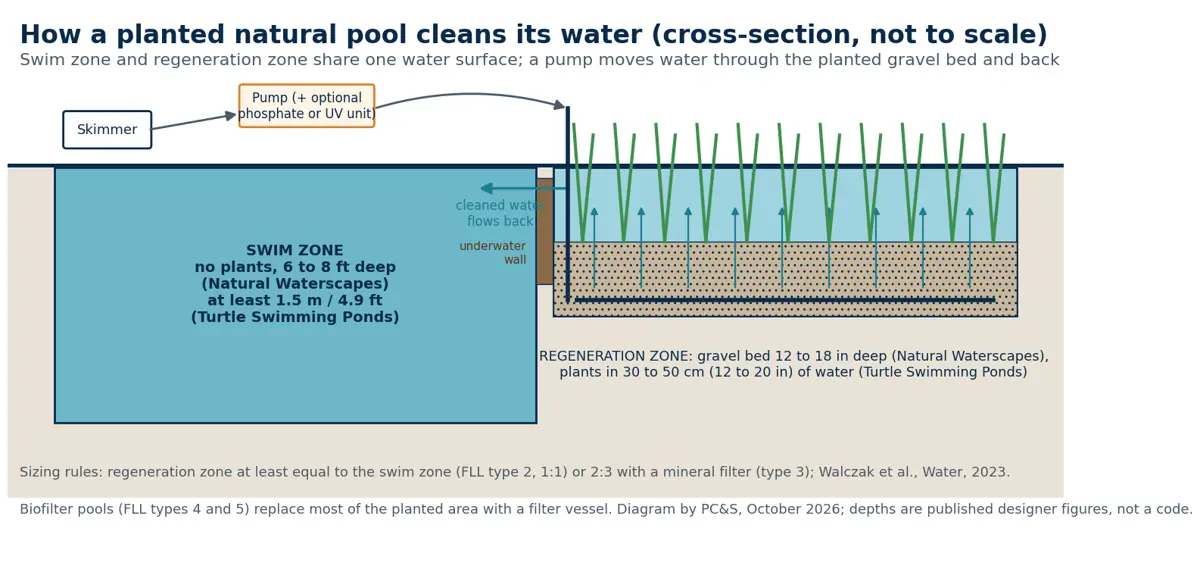
- SkimA surface skimmer with a sieve catches leaves and floating debris before the pump (Walczak et al. 2023).
- PumpA circulation pump moves water to the filter; FLL type 2 ponds use the pump alone, types 3 and 4 add a mineral filter.
- Filter through gravel or biofilmWater rises from a drain under the gravel bed; type 3 beds run slowly at 3 to 5 cubic meters per square meter per day.
- Strip nutrientsBacteria in the biofilm convert organic waste, and plants take up nitrogen and phosphorus that would otherwise feed algae.
- Return and testCleaned water flows back to the swim zone; operators test E. coli, enterococci and phosphorus against guide values.
| FLL type | Technology | Minimum pond size | Planted zone to swim zone |
|---|---|---|---|
| Type 1: technology-free | No pump or filter; wind and temperature move the water | At least 120 m2 (1,292 sq ft) | At least 7:3 (70% planted) |
| Type 2: hydro-botanical | Circulation pump and skimmer; no filter bed | At least 120 m2 (1,292 sq ft) | At least 1:1 (50% planted) |
| Type 3: hydro-botanical with mineral filter | Planted filter with slow flow of 3 to 5 m3 per m2 per day | At least 80 m2 (861 sq ft) | At least 2:3 (40% planted) |
| Type 4: rapid mineral filter | Separate filter with flow from 15 m3 per day; often automated | From 50 m2 (538 sq ft) | Not fixed; planted area optional |
| Type 5: advanced technology | Drum filters, modular filters, bioreactors | Not stated | Planted area 25% of pond or none |
Source: Walczak, Serafin and Siwiec, Treatment Wetlands in Natural Swimming Ponds (2023), adapted from the peer-reviewed paper in Water 15(10):1878; square feet by PC&S using the NIST factor. Download CSV
UV units and phosphate filters are where definitions split. Gün and Ak (2022) list UV filters as a form of mechanical filtration and report that the builders they interviewed in Turkey preferred phosphorus filters and UV to plant-only filtration for hygiene; Minnesota’s definition requires a chemical free filtration system. BioNova’s biofilm-filter pools, sold as BioPools, sit at the technical end, close to FLL types 4 and 5.
How big does the regeneration zone need to be?
The planted regeneration zone needs to be 70% of the water surface for an FLL type 1 pond, 50% for type 2 and 40% for type 3, with minimum pond sizes of 120 m2 (1,292 sq ft) and 80 m2 (861 sq ft). A 16 x 32 ft swim zone therefore needs 861 to 1,707 sq ft of total water.
| Swim zone | Swim zone (sq ft) | Type 1: planted / total water (sq ft) | Type 2: planted / total | Type 3: planted / total | Type 4 | Type 5: planted / total | BioNova planted pond, 1:1, 535 sq ft minimum |
|---|---|---|---|---|---|---|---|
| 12 x 24 ft | 288 | 1,004 / 1,292 | 1,004 / 1,292 | 573 / 861 | separate filter; pond 538 sq ft or more | 0 to 96 / 288 to 384 | 288 / 576 |
| 16 x 32 ft | 512 | 1,195 / 1,707 | 780 / 1,292 | 349 / 861 | separate filter; pond 538 sq ft or more | 0 to 171 / 512 to 683 | 512 / 1,024 |
| 20 x 40 ft | 800 | 1,867 / 2,667 | 800 / 1,600 | 533 / 1,333 | separate filter; pond 800 sq ft or more | 0 to 267 / 800 to 1,067 | 800 / 1,600 |
Source: PC&S calculation from FLL ratios and minimums in Walczak et al. (2023), the BioNova FAQ (1:1, 535 sq ft minimum) and NIST SP 811 (1 sq ft = 0.09290304 m2). Download CSV
Type 2 and type 3 totals are set by the FLL minimum pond sizes of 120 m2 and 80 m2, not by the ratio.
Source: PC&S calculation from FLL type ratios and minimum sizes in Walczak et al., Water 15(10) 1878, 2023; NIST area conversion. Download chart data (CSV)
Two numbers drive the land you need: the ratio and the minimum pond size. For small swim zones the minimum wins: a 12 x 24 ft swim zone under type 2 still needs a 1,292 sq ft pond because 120 m2 is the floor. A 20 x 40 ft swim zone clears the type 2 minimum on ratio alone, at 1,600 sq ft of water.
| Source | Planted share published | Date |
|---|---|---|
| Walczak et al., Water (2023), summarising the German FLL types | Planted zone 70% (type 1), 50% (type 2), 40% (type 3), 25% or none (type 5) | 2023 |
| BioNova FAQ | Planted zone about equal to the swim zone; a biofilm filter can be up to 90% smaller | Accessed October 2026 |
| Natural Waterscapes | At least 1:1; 1:2 (planted zone twice the swim zone) is better | Undated |
| BTL Liners | 50% planted; 60% to 70% for heavy use; as little as 20% if filters process 50% to 75% of the volume | Undated |
| Singular Green | One sixth to one half of the total surface | Updated September 26, 2024 |
| Pool Cost Estimator | 30% to 50% of the total water surface | June 2026 |
| Webber Natural Swimming Pool, Minneapolis (as built) | 16,000 sq ft planted zone to 21,000 sq ft swim zone: 43% planted | BioNova project page |
Sources: Walczak et al., BioNova, Natural Waterscapes, BTL Liners, Singular Green, Pool Cost Estimator, BioNova Webber project page. Download CSV
How deep are the swim zone and the plant zone?
Published designer figures put the swim zone at 1.5 m (4.9 ft) or deeper and the planted zone at roughly 30 to 50 cm (12 to 20 in) of water over a gravel bed, but no single public standard fixes these depths. The FLL guideline text itself is a paid document, so the table shows each source separately.
| Source | Swim zone depth | Planted zone depth | Date |
|---|---|---|---|
| Turtle Swimming Ponds (UK designer) | At least 1.5 m (4.9 ft) | 30 to 50 cm (12 to 20 in); margins up to 15 cm (6 in) | December 3, 2024 |
| Natural Waterscapes | 6 to 8 ft | 1 to 3 ft; gravel substrate 12 to 18 in | Undated |
| Mother Earth News (DIY article) | Not stated | Plants in 6 to 18 in of water | Updated July 31, 2024 |
| Aqua Exclusive | Not stated | Planted terraces 0.5 to 1.5 m (1.6 to 4.9 ft) | October 17, 2026 |
| Pool Cost Estimator | Not stated | 1 to 3 ft; gravel 4 to 12 in | June 2026 |
| Webber pool, Minneapolis (public) | Lower pool 6 ft 4 in; upper pool 3 ft 7 in | Not stated | North News, September 2, 2025 |
Sources: Turtle Swimming Ponds, Natural Waterscapes, Mother Earth News, Aqua Exclusive, Pool Cost Estimator, North News. Download CSV
Depth rules for residential pools still apply to the swim zone. A Florida swim pond with water over 24 in deep is a swimming pool under the Residential Swimming Pool Safety Act, which brings the barrier, cover or alarm rules that apply to any pool.
How much does a natural swimming pool cost?
A natural swimming pool costs about $60,000 to $75,000 for a 16 x 32 ft biofilter pool (BioNova) and $75,000 to $125,000 for an entry-level planted pond (Total Habitat), with larger ponds at $125,000 to $175,000 or more. Total Habitat puts most projects at $50 to $100 per square foot.
| Builder or source | Size or scope | Price | Date or age of figure |
|---|---|---|---|
| BioNova (biofilter pool, FAQ) | 16 x 32 ft pool | $60,000 to $75,000 | Same text on the page since at least March 2021 (Wayback) |
| BioNova (planted pond, FAQ) | Before biofilm filters | Started around $100,000 | Same capture history |
| Total Habitat (Essential NSP tier) | 28 to 50 ft across; 10,000 to 50,000 gallons | $75,000 to $125,000 turn-key | Live October 2026; unchanged since July 2022 (Wayback) |
| Total Habitat (larger or boulder-wall ponds) | Up to about 68,000 gallons in listed examples | $125,000 to $150,000 | Same |
| Total Habitat (large pools) | Often over 100,000 gallons | $175,000 or more | Same |
| Mid-South Ponds | 10 x 15 / 15 x 30 / 25 x 40 ft swim pond | $65,000 to $75,000 / $80,000 to $100,000 / $110,000 to $140,000 | August 25, 2022 |
| Pond Country (North Carolina) | 20 x 30 ft swimming pool, hybrid wall | From $150,000 | Page modified July 24, 2026 |
| The Natural Swimming Pond (Texas) | Smallest to largest swim ponds | $55,000 to $200,000 | Undated, accessed October 2026 |
| Pool Cost Estimator (aggregator, no sources) | Typical natural pool | $50,000 to $150,000 or more | June 2026 |
| Natural Waterscapes (guide) | Residential installation | $25,000 to $75,000 or more | Undated, accessed October 2026 |
Sources: BioNova FAQ (March 2021 capture), Total Habitat, Mid-South Ponds, Pond Country, The Natural Swimming Pond, Pool Cost Estimator, Natural Waterscapes; accessed 2026-10-19. Download CSV
Source: BioNova FAQ; Total Habitat; Mid-South Ponds (August 25, 2022); The Natural Swimming Pond (Texas); Pool Cost Estimator (June 2026). Download chart data (CSV)
Per square foot the spread is wide. Total Habitat says its projects ran $15 to $300 per square foot, most at $50 to $100, and that rock alone ranges from $35 to $750 or more per ton. BioNova’s 16 x 32 quote works out to $117 to $146 per square foot of swim zone; Mid-South’s 2022 prices work out to $178 to $222 for a 15 x 30 ft swim area.
| Design for a 16 x 32 ft swim zone | Total water surface (sq ft) | At Total Habitat typical $50 to $100 per sq ft |
|---|---|---|
| Type 1 planted pond | 1,707 | $85,350 to $170,700 |
| Type 2 planted pond | 1,292 | $64,600 to $129,200 |
| Type 3 with mineral filter | 861 | $43,050 to $86,100 |
| Biofilter pool (type 4 or 5) | 512 to 683 | BioNova quote: $60,000 to $75,000 |
Source: PC&S illustration. Total Habitat does not say whether its rate applies to the swim zone or the whole pond; we apply it to total water surface. Download CSV
Have natural pool prices gone up?
Yes, at least at one builder that publishes prices. Total Habitat’s entry Essential tier read $60,000 to $70,000 in September 2021, $75,000 to $95,000 in January 2022 and $75,000 to $125,000 from July 2022 onward. Its midpoint rose 54%, from $65,000 to $100,000.
| Capture date | Essential NSP tier | Middle tier | Top tier | Archived page |
|---|---|---|---|---|
| 2021-09-25 | $60,000 to $70,000 | $70,000 to $90,000 | $100,000 and up | https://web.archive.org/web/20210925134424/http://totalhabitat.com/nspcosts.html |
| 2022-01-23 | $75,000 to $95,000 | $100,000 to $150,000 | $150,000 and up | https://web.archive.org/web/20220123192939/https://www.totalhabitat.com/nspcosts.html |
| 2022-07-07 | $75,000 to $125,000 | $125,000 to $150,000 | $175,000 and up | https://web.archive.org/web/20220707144001/https://www.totalhabitat.com/nspcosts.html |
| 2026-09-23 | $75,000 to $125,000 | $125,000 to $150,000 | $175,000 and up | https://web.archive.org/web/20260923053931/http://totalhabitat.com/nspcosts.html |
| 2026-10-19 (live) | $75,000 to $125,000 | $125,000 to $150,000 | $175,000 and up | https://www.totalhabitat.com/nspcosts.html |
Sources: Total Habitat pricing page and Internet Archive captures (2021-09-25, 2022-01-23, 2022-07-07, 2026-09-23). Download CSV
One builder’s list, not a market index. Midpoint rose from $65,000 to $100,000 (54%).
Source: Total Habitat pricing page, live and Internet Archive Wayback Machine captures of September 25, 2021, January 23, 2022, July 7, 2022 and September 23, 2026. Download chart data (CSV)
Natural pool vs chlorinated pool: what changes in cost and rules?
A natural pool trades chlorine for land and nutrient control. A 16 x 32 ft planted design needs 861 to 1,707 sq ft of water instead of 512, and builder prices start near the $68,000 middle value of 2025 new-pool permits. It saves the $4,106 to $4,204 ten-year sanitizer bill of a 20,000-gallon chlorine or salt pool.
| Item | Natural pool | Chlorinated pool | Source |
|---|---|---|---|
| How the water is kept clean | Plants, biofilm and filtration; no chlorine or salt | Chlorine, from tablets, liquid or a salt cell | MN Stat. 144.1222 subd. 5(e); PC&S saltwater research |
| Public-pool disinfectant rule | Exempt only in Minneapolis under Minnesota law | CDC model code: at least 1.0 ppm free chlorine, 2.0 ppm with cyanuric acid | MN Stat. 144.1222; MAHC 2024 5.7.3.1.1.2 |
| Water area for a 16 x 32 ft swim zone | 861 to 1,707 sq ft planted (FLL types 1 to 3); 512 to 683 sq ft with technical filters | 512 sq ft | Walczak et al. 2023; PC&S calculation |
| Nutrient limit | Total phosphorus 0.01 to 0.03 mg/L in the swim water (FLL 2017) | No phosphorus limit in the CDC model code | Lovibond summary of FLL 2017; MAHC 2024 |
| Build cost, 16 x 32 ft class | $60,000 to $75,000 biofilter pool (BioNova); $75,000 to $125,000 planted pond tier (Total Habitat) | $68,000 middle of 10 city permit medians, 2025 | BioNova; Total Habitat; PC&S permit research |
| Sanitizer over 10 years, 20,000 gallons, year-round | $0 for chlorine | $4,106 (tablets) to $4,204 (salt) | PC&S saltwater vs chlorine research |
| Pump electricity | BioNova says energy use is lower; no published kWh found | $37 a month for a variable-speed pump at a 10-hour day | BioNova FAQ; PC&S pump cost research (EIA, DOE) |
| Fish | Not allowed in BioNova pools; a separate pond is the option | Not applicable | BioNova FAQ |
| Winterizing in cold climates | Blow out lines, drain equipment, cover the swim zone, net the planted zone | Blow out lines, drain equipment, cover the pool | BioNova FAQ |
Sources: Minn. Stat. 144.1222, MAHC 2024, Walczak et al., Lovibond (FLL 2017), BioNova, Total Habitat, PC&S permit research, PC&S saltwater vs chlorine research, PC&S pump cost research. Download CSV
On build cost alone, a natural pool sits at or above a conventional one. Our average cost to build a pool study found 2025 permit values for new inground pools centered on $68,000, from $47,418 in Mesa to $150,000 in Raleigh. Shell choice still matters for the swim zone, and our gunite vs fiberglass vs vinyl comparison covers that.
On running cost the natural pool avoids sanitizer: our saltwater vs chlorine study puts 10 years of tablets at $4,106 and salt at $4,204 for a 20,000-gallon pool. The pump still runs; a variable-speed pump costs about $37 a month at a 10-hour day per our pump cost study, and BioNova publishes no kWh figure for its systems.
Get quotes from pool builders
Are natural swimming pools legal and safe in the US?
Plan on the same local permits as any pool; Florida, for one, treats any residential structure for swimming with water over 24 inches as a swimming pool. Public use is harder: the CDC model code sets 1.0 ppm free chlorine, and Minnesota exempts only a naturally treated pool in Minneapolis.
| Parameter | Pool water guide value |
|---|---|
| Escherichia coli | 100 cfu per 100 mL |
| Enterococci | 50 cfu per 100 mL |
| Pseudomonas aeruginosa | 10 cfu per 100 mL |
| Legionella | Below detection in 100 mL |
| Total phosphorus | Under 0.01 mg/L |
| pH | 6.0 to 8.5 |
| Nitrate | 30 mg/L or less |
Source: Gün and Ak, Natural Swimming Pools: Design and Implementation Principles, IJIASR 6(4), 2022, Table 1. Download CSV
Bacteria closures happen. The Webber pool closed on July 29, 2025 for bacteria levels and reopened on August 4, with the lower pool back on August 1, according to North News. The Minneapolis park board told the paper it monitors the water in real time and closes the pool when bacteria exceed standards.
Fill water is the other risk. The FLL fill-water guide value for orthophosphate is 0.01 mg/L as P, but utilities that dose orthophosphate for lead control target 0.33 to 1.0 mg/L as P at the tap under EPA guidance, 33 to 100 times higher. BioNova says it tests a client’s water supply before the first fill for this reason. Filling 30,000 gallons costs $58.50 to $1,003.98 across 25 cities in our cost to fill a pool ledger. Chlorinated pools take in the same tap-water phosphate; our phosphates in pool guide lists utility readings and remover label doses.
Should you build a natural pool? Decision table
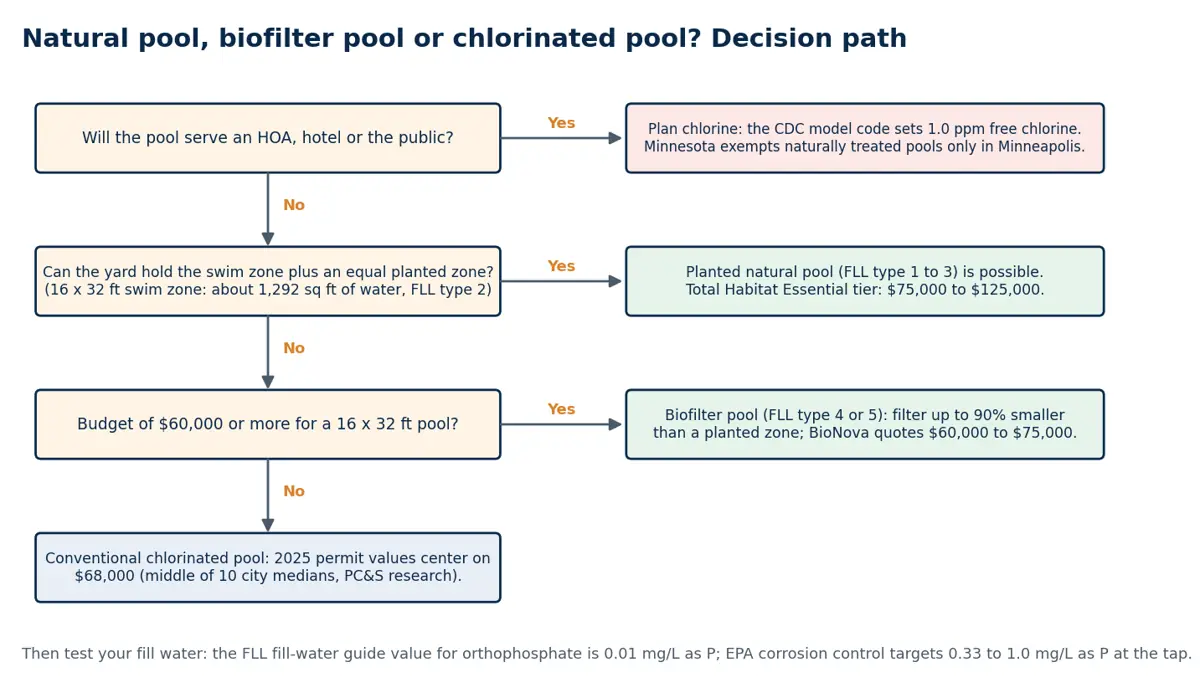
Build a planted natural pool if the yard holds the swim zone plus an equal planted zone and the budget starts at about $75,000. Choose a biofilter pool if space is tight, and a conventional pool if the budget is under $60,000 or the pool will serve the public outside Minneapolis.
| If your situation is | Do this | Rule source |
|---|---|---|
| The pool will serve an HOA, hotel, camp or the public | Plan for chlorine or ask the state health department about a variance before design | MAHC 2024 sets 1.0 ppm free chlorine; Minnesota exempts naturally treated pools only in Minneapolis |
| The yard can hold the swim zone plus an equal planted zone (about 1,292 sq ft of water for a 16 x 32) | A planted natural pool (FLL type 2) fits; budget from the $75,000 Total Habitat Essential tier | Walczak et al. 2023; Total Habitat |
| The yard fits little more than the swim zone | Choose a biofilter pool (FLL type 4 or 5) with a filter up to 90% smaller than a planted zone | BioNova FAQ; Walczak et al. 2023 |
| Budget is under $60,000 for a 16 x 32 ft pool | Price a conventional pool, or a smaller pond: published natural pool floors run from $25,000 (Natural Waterscapes) to $55,000 (a Texas builder) | BioNova ($60,000 for 16 x 32); Natural Waterscapes; The Natural Swimming Pond; PC&S permit research ($68,000 middle value) |
| Your utility doses orthophosphate for corrosion control | Test the fill water and plan phosphate removal or another water source | EPA targets 0.33 to 1.0 mg/L as P; FLL fill-water guide value 0.01 mg/L orthophosphate |
| You want koi or fish | Build a separate pond on its own loop | BioNova FAQ |
| Children under 6 at home in Florida | Fence it like any pool: water over 24 in makes it a swimming pool under state law | Fla. Stat. 515.25(11) |
Sources: MAHC 2024, Minn. Stat. 144.1222, Walczak et al., Total Habitat, BioNova, EPA, Lovibond (FLL 2017), Fla. Stat. 515.25, Natural Waterscapes, The Natural Swimming Pond. Download CSV
Converting an existing pool is another route. BioNova says conversion can be done on most existing swimming pools, and its FAQ describes winterizing a natural pool the same way as a chlorine pool. If you are weighing a conversion against a new vinyl liner at $3,000 to $7,500 (HomeGuide, 2025) or a replaster, our pool remodeling guide covers the contractors who quote that work.
What are the downsides of a natural pool?
The main downsides are space, nutrients and upkeep. Planted designs need 40% to 70% of the water surface for plants, fill water may carry 33 to 100 times the FLL phosphate guide value, bacteria can close the pool, fish are not allowed in BioNova pools, and the plants need seasonal cutting.
- Space: a 16 x 32 ft swim zone needs 861 to 1,707 sq ft of water as a planted pond (PC&S calculation from FLL types).
- Price: BioNova’s 16 x 32 quote starts at $60,000 and Total Habitat’s entry tier at $75,000; a DIY figure of $2,000 (Mother Earth News) is disputed by BioNova.
- Nutrients: phosphorus has to stay near 0.01 to 0.03 mg/L (FLL 2017), so lawn fertilizer runoff and orthophosphate-dosed tap water are problems.
- Closures: the Webber pool shut for 6 days in 2025 for bacteria (North News).
- Upkeep: plants need trimming and cutting back each season; BioPool biofilm filters need backwashing about twice a year (BioNova). For plants around a conventional pool, low-litter picks by climate and the setbacks behind them are in our pool landscaping ideas guide.
- Mosquitoes: BioNova says circulating water does not let them breed; a type 1 pond without a pump relies on wind and temperature to move water (Walczak et al. 2023).
How we compiled this
We pulled Google results for natural swimming pool cost and natural pool on October 19, 2026 and opened 12 builder, guide and reference pages they returned. We checked figures against 2 state statutes, the CDC Model Aquatic Health Code, an EPA guidance document, a peer-reviewed summary of the FLL pond types and a second journal paper, and dated builder prices with 6 Internet Archive captures. Zone sizes and per-square-foot figures are our arithmetic. Forum and social posts were used only to find questions, never as sources.
Frequently Asked Questions
How much does it cost to put in a natural swimming pool?
Published builder prices put a natural swimming pool at $60,000 to $75,000 for a 16 x 32 ft biofilter pool (BioNova) and $75,000 to $125,000 for an entry-level planted pond (Total Habitat). Larger ponds run $125,000 to $175,000 or more, and Pond Country starts its 20 x 30 ft swimming pool at $150,000.
Are natural swimming pools more expensive?
Usually, yes, to build. 2025 permit values for new inground pools centered on $68,000 across 10 cities in our permit study, while natural pool quotes start at $60,000 to $75,000 and planted ponds need 861 to 1,707 sq ft of water for a 16 x 32 ft swim zone. They skip a $4,106 to $4,204 ten-year sanitizer bill.
What are the downsides of a natural pool?
The main ones are space, nutrients and closures. Planted designs give 40% to 70% of the water surface to plants under the FLL types, phosphorus must stay near 0.01 to 0.03 mg/L, fish are not allowed in BioNova pools, and bacteria shut the public Webber pool in Minneapolis from July 29 to August 4, 2025.
Are natural swimming pools worth it?
Worth it comes down to land, budget and use, and each can be checked. If your yard fits about 1,292 sq ft of water for a 16 x 32 ft swim zone and you want no chlorine, a planted pond from about $75,000 fits. If space is tight, a $60,000 to $75,000 biofilter pool compares with the $68,000 middle value of 2025 new-pool permits.
Do natural pools attract mosquitoes?
BioNova says its pools do not breed mosquitoes because the water circulates continuously, and that stagnant spots such as plant saucers are the bigger risk. A FLL type 1 pond has no pump and moves water only by wind and temperature differences (Walczak et al., 2023), while pumped designs (types 2 to 5) keep the water moving.
Do you need a permit for a swim pond?
Expect the same permits and barrier rules as any pool. Florida’s Residential Swimming Pool Safety Act treats any residential structure for swimming with water over 24 inches deep as a swimming pool (Fla. Stat. 515.25), and 20 of 51 US jurisdictions require a barrier around new residential pools statewide, per our fence law study.
Are natural swimming pools safe?
They can be when tested. Guide values used in Europe set E. coli at 100 cfu and enterococci at 50 cfu per 100 mL (Gün and Ak, 2022). The public Webber pool closes when bacteria exceed its standards, as on July 29, 2025. For public pools the CDC model code, which states may adopt, sets 1.0 ppm free chlorine.
Sources
- BioNova Natural Pools. Frequently Asked Questions. Accessed 2026-10-19.
- Internet Archive. Frequently Asked Questions, Wayback capture of March 5, 2021. Accessed 2026-10-19.
- BioNova Natural Pools. Public NSPs (Webber Natural Swimming Pool). Accessed 2026-10-19.
- Total Habitat. Pricing: Natural Swimming Pools & Ponds. Accessed 2026-10-19.
- Total Habitat. Natural Swimming Pool/Ponds: Price Per Square Foot?. Accessed 2026-10-19.
- Internet Archive. Total Habitat pricing page, capture of September 25, 2021. Accessed 2026-10-19.
- Internet Archive. Total Habitat pricing page, capture of January 23, 2022. Accessed 2026-10-19.
- Internet Archive. Total Habitat pricing page, capture of July 7, 2022. Accessed 2026-10-19.
- Internet Archive. Total Habitat pricing page, capture of September 23, 2026. Accessed 2026-10-19.
- Internet Archive. Total Habitat price per square foot page, capture of December 9, 2021. Accessed 2026-10-19.
- Midsouth Ponds. How Much Does A Swimming Pond Cost Right Now? (August 25, 2022). Accessed 2026-10-19.
- Pond Country. Natural Swimming Ponds & Pools (modified July 24, 2026). Accessed 2026-10-19.
- The Natural Swimming Pond. Texas Natural Swim Pond Prices. Accessed 2026-10-19.
- Pool Cost Estimator. Natural Pool Cost Guide (June 2026). Accessed 2026-10-19.
- Natural Waterscapes. Natural Swimming Ponds: Design, Construction & Maintenance. Accessed 2026-10-19.
- Walczak, Serafin, Siwiec. Treatment Wetlands in Natural Swimming Ponds (Encyclopedia entry, May 25, 2023). Accessed 2026-10-19.
- MDPI. Natural Swimming Ponds as an Application of Treatment Wetlands, Water 15(10):1878 (DOI). Accessed 2026-10-19.
- Lovibond. Natural Swimming Ponds (FLL 2017 guide values). Accessed 2026-10-19.
- Gün and Ak. Natural Swimming Pools: Design and Implementation Principles, IJIASR 6(4), 2022. Accessed 2026-10-19.
- Minnesota Revisor of Statutes. Minnesota Statutes 144.1222, Public Pools; Hot Tubs. Accessed 2026-10-19.
- Florida Legislature. Florida Statutes 515.25, Definitions (Residential Swimming Pool Safety Act). Accessed 2026-10-19.
- Centers for Disease Control and Prevention. Model Aquatic Health Code, 5th edition (2024). Accessed 2026-10-19.
- U.S. Environmental Protection Agency. Optimal Corrosion Control Treatment Evaluation Technical Recommendations (EPA 816-B-16-003, March 2016). Accessed 2026-10-19.
- North News. Natural pool closes out 10th summer in North Minneapolis (September 2, 2025). Accessed 2026-10-19.
- Turtle Swimming Ponds. How to Design the Perfect Natural Swimming Pond (December 3, 2024). Accessed 2026-10-19.
- BTL Liners. The 50/50 Rules of Designing a Natural Swimming Pond. Accessed 2026-10-19.
- Mother Earth News. How to Build a Natural Swimming Pool (updated July 31, 2024). Accessed 2026-10-19.
- Aqua Exclusive. Natural Swimming Pools & Ponds: Types, Design, Water (October 17, 2026). Accessed 2026-10-19.
- Singular Green. How to make natural pools (updated September 26, 2024). Accessed 2026-10-19.
- National Institute of Standards and Technology. NIST Guide to the SI, Appendix B.8. Accessed 2026-10-19.
- BioNova Natural Pools. Conversions and Renovations. Accessed 2026-10-19.
- HomeGuide. How Much Does Pool Resurfacing Cost? (April 25, 2025). Accessed 2026-10-19.
- PC&S research. Average cost to build a pool: 2025 permit data. Accessed 2026-10-19.
- PC&S research. Saltwater Pool vs Chlorine: 10-Year Costs. Accessed 2026-10-19.
- PC&S research. Cost to run a pool pump (EIA and DOE data). Accessed 2026-10-19.
- PC&S research. Cost to Fill a Pool in 25 US Cities. Accessed 2026-10-19.
- PC&S research. Pool Fence Laws by State, 2026. Accessed 2026-10-19.
Related pages
Get Quotes From Licensed Local Pool Pros
Tell us what you need and your ZIP code. We match you with pool companies that cover your area.