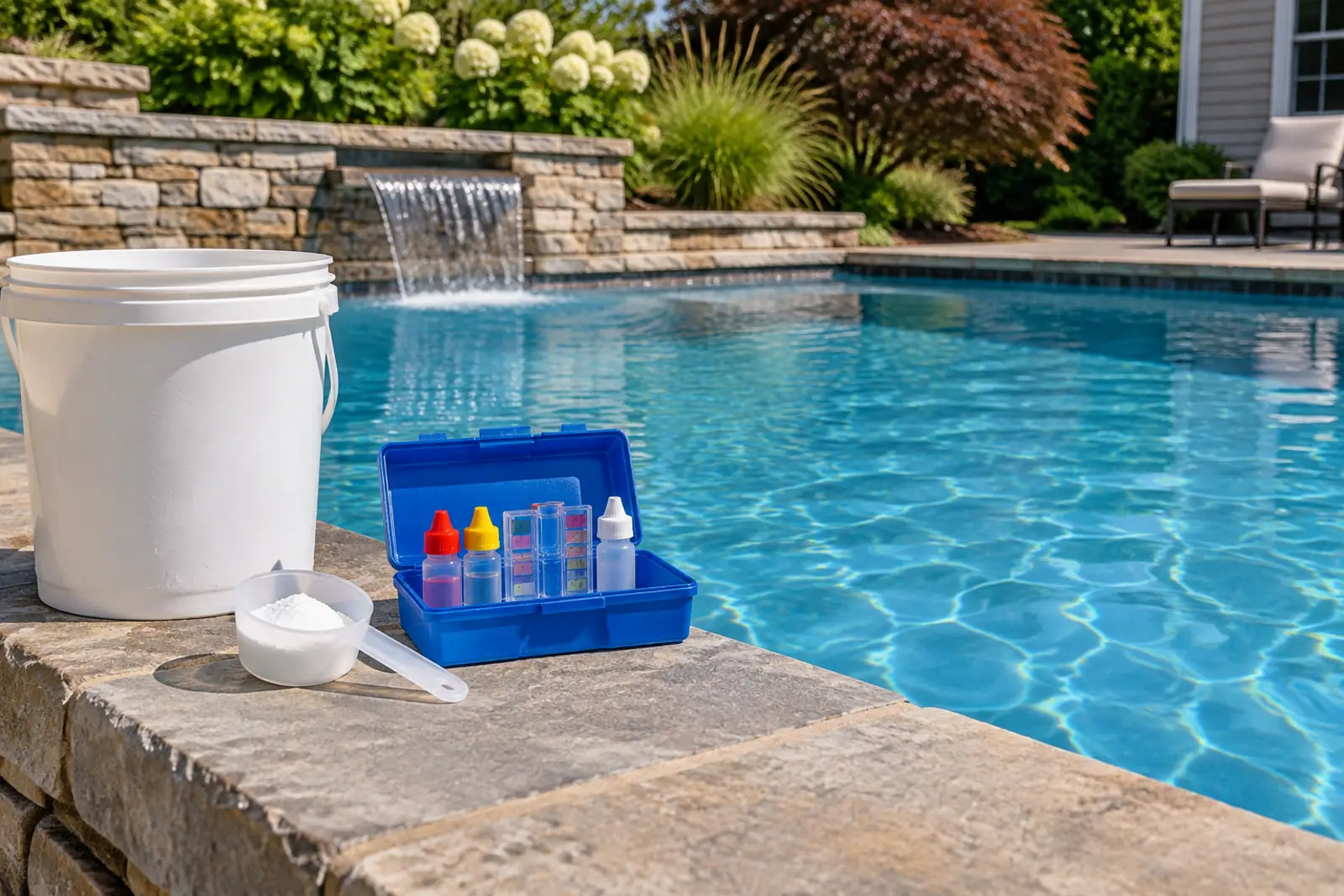
How to Raise pH in Pool Water Safely
Here is how to raise pH in pool water: test pH and alkalinity, bring alkalinity to 80 to 120 ppm, then add pre-dissolved soda ash, about 6 oz per 10,000 gallons for a 0.2 rise (Florida DOH). Retest after 6 hours.
- ✓Target pH 7.0 to 7.8CDC's range for home pools and hot tubs (page updated May 2024), the same range the 2024 Model Aquatic Health Code sets for public pools.
- ✓Soda ash moves pH, baking soda moves alkalinityFlorida DOH: 6 oz of soda ash lifts pH 0.2 in 10,000 gallons; 1.5 lb of baking soda lifts alkalinity 10 ppm.
- ✓Low pH is cited more than high pHSacramento County inspectors cited minimum pH 978 times and maximum pH 744 times at public pools, April 2023 to March 2026.
When pool pH is too low, and what low pH does
Raise pH when a reliable test reads below 7.2 for most home pools, and always before it reaches 7.0.
CDC recommends keeping home pool and hot tub water at pH 7.0 to 7.8, a range that balances germ killing, pipe life and swimmer comfort (CDC, page updated May 2024). Below 7.0, CDC says chlorine actually kills germs faster, but pool and hot tub pipes are more likely to corrode or break down. So low pH is mainly an equipment, surface and comfort problem rather than a disinfection failure.
Health department manuals list the damage in plain terms. The Virginia Department of Health guide for operators says low pH etches plaster, corrodes equipment, makes chlorine dissipate rapidly and irritates swimmers’ eyes. The Pennsylvania Department of Health adds excessive chlorine odor and skin irritation below pH 7.2, and recommends running public pools between 7.2 and 7.6.
| Source | Applies to | pH range | Note |
|---|---|---|---|
| CDC Healthy Swimming (2024) | Home pools and hot tubs | 7.0 to 7.8 | Free chlorine at least 1 ppm in pools, 3 ppm in hot tubs |
| Model Aquatic Health Code 2024 (CDC) | Public pools that adopt it | 7.0 to 7.8 | Below 6.5 or above 8.0 is an imminent health hazard |
| Florida Chapter 64E-9 (Florida DOH manual) | Florida public pools | 7.2 to 7.8 | Adjust total alkalinity first |
| Texas 25 TAC 265.193 | Texas public pools | 7.0 to 7.8 | Ideal 7.2 to 7.6 |
| Pennsylvania DOH recommendation (2016) | Pennsylvania aquatic facilities | 7.2 to 7.6 | Total alkalinity 80 to 120 ppm |
| Hayward Aqua Rite manual | Salt chlorine generator pools | 7.2 to 7.8 | Manufacturer guidance |
| Arm & Hammer | Home pools | 7.3 to 7.6 goal | Manufacturer guidance; alkalinity 110 to 150 ppm |
Sources: CDC; MAHC 2024; Florida DOH; Texas 25 TAC 265.193 via PC&S research; Pennsylvania DOH; Hayward and Arm & Hammer (manufacturer guidance). Download CSV
Low pH is not only a backyard problem. In Sacramento County, inspectors wrote 978 citations for minimum pH at public pools between April 2023 and March 2026, compared with 744 for maximum pH at public pools that get routine health inspections (PC&S analysis of county inspection data). The 2024 Model Aquatic Health Code treats pH below 6.5 as an imminent health hazard that can close a public pool.
Public pools only. Home pools are not inspected, so this shows how often trained operators still let pH drift.
Source: Source: Sacramento County Environmental Management Department inspection data, via PC&S research /research/public-pool-inspection-violations/.. Download chart data (CSV)
Why pool pH keeps dropping
Fixing the cause saves you from adding soda ash every week.
- Rain Rainwater has a pH of nearly 5.75, according to the Pennsylvania DOH, and the Virginia DOH lists rainfall among the things that pull pool pH down.
- Tablet and granular stabilized chlorine Trichlor and dichlor, along with bromine, tend to reduce both pH and alkalinity over time (Pennsylvania DOH). Cyanuric acid stabilizer is on Virginia’s list of pH-lowering substances too.
- Swimmers Urine and other bather waste push pH down (Virginia DOH).
- Gas chlorine and acid overdoses Gas chlorine lowers pH, and so does an over-generous dose of muriatic acid or dry acid used to fix high pH.
- Low total alkalinity When alkalinity is low, Virginia’s guide warns that pH can change dramatically and rapidly with small additions of chemicals or other agents.
Liquid chlorine (sodium hypochlorite) and calcium hypochlorite do the opposite: Pennsylvania’s guidance says they tend to raise pH and alkalinity over time. If your pool switched from tablets to liquid chlorine or a salt system, the pH problem may flip from low to high. Our guide on how to lower pH in pool water covers that side.
Raise alkalinity before you raise pH
Total alkalinity is the buffer that holds pH in place. Every state manual we read says to adjust it first.
Florida’s operators’ manual is direct: because total alkalinity stabilizes pH, “total alkalinity should always be adjusted first,” with 80 to 120 ppm as the most effective range. Virginia’s guide uses the same 80 to 120 ppm range and adds a useful twist: if your pH tends to fall, keep alkalinity in the upper part of the range, but not above 150 ppm.
The tool for alkalinity is sodium bicarbonate (baking soda). Florida and Pennsylvania both publish the same rule of thumb: 1.5 pounds per 10,000 gallons raises total alkalinity about 10 ppm. Knorr Systems, a commercial pool supplier, lists 1.4 pounds for the same change. Virginia’s table below scales it by pool size.
| Raise total alkalinity by (ppm) | 1,000 gal | 5,000 gal | 10,000 gal | 25,000 gal |
|---|---|---|---|---|
| 10 | 2.5 oz | 12 oz | 24 oz | 3.75 lb |
| 20 | 5 oz | 24 oz | 3 lb | 7.5 lb |
| 30 | 7.5 oz | 2.25 lb | 4.5 lb | 11.25 lb |
| 40 | 10 oz | 3 lb | 6 lb | 15 lb |
| 50 | 12 oz | 3.75 lb | 7.5 lb | 18.75 lb |
| 60 | 14.5 oz | 4.5 lb | 9 lb | 22.5 lb |
| 70 | 17 oz | 5.25 lb | 10.5 lb | 26.25 lb |
| 80 | 19 oz | 6 lb | 12 lb | 30 lb |
| 90 | 22 oz | 6.75 lb | 13.5 lb | 33.75 lb |
| 100 | 24 oz | 7.5 lb | 15 lb | 37.5 lb |
Source: Virginia Department of Health, Portsmouth Health Department, Pool Operation and Maintenance Guide (2018), page 33. Download CSV
Soda ash vs baking soda vs aeration: which raises pH best
There are three practical ways to push pool pH up, and they do different jobs. Soda ash (sodium carbonate) is the pH mover. It has a pH of about 11.6, roughly three units higher than baking soda’s 8.3 to 8.6, according to Orenda Technologies, a pool chemical maker. Florida DOH notes that baking soda raises alkalinity “without greatly affecting pH,” which is why a pool with low pH but normal alkalinity needs soda ash, not more baking soda.
| Method | Moves pH or alkalinity? | Product pH | Published dose per 10,000 gal | Best for | Watch out for | Source |
|---|---|---|---|---|---|---|
| Soda ash (sodium carbonate) | Mainly pH; alkalinity a little | About 11.6 | 6 oz for +0.2 pH (Florida DOH) | pH below 7.2 with alkalinity in range | Clouding if more than 1 lb per 10,000 gal at once | Florida DOH; Knorr Systems; Orenda |
| Baking soda (sodium bicarbonate) | Mainly alkalinity | 8.3 to 8.6 | 1.5 lb for +10 ppm alkalinity (Florida DOH, Pennsylvania DOH) | Low alkalinity with pH that keeps falling | Large amounts needed to move pH | Florida DOH; Pennsylvania DOH; Arm & Hammer |
| Aeration (fountains, jets, spillways) | pH only, no alkalinity added | No product | None published | Small pH lift when alkalinity is already high enough | Slow; keeps pushing pH up after you stop needing it | Orenda (manufacturer); Virginia DOH on carbon dioxide |
| Sodium hydroxide | pH | Not stated | Not published for homeowners | Commercial feed systems | Seldom used because it is dangerous to handle | Virginia DOH |
Sources: Florida DOH; Pennsylvania DOH; Virginia DOH; Knorr Systems and Orenda (manufacturer guidance). Download CSV
Aeration raises pH without adding any chemical. Dissolved carbon dioxide forms an acid in water (Virginia DOH), so driving carbon dioxide out with fountains, deck jets, spillways or returns aimed at the surface lets pH climb. Orenda goes further and argues most residential pools without acid feeders do not need soda ash at all because aeration and carbon dioxide loss raise pH on their own. FROG Products makes the same point from the other direction: splashing swimmers break up carbon dioxide and pH rises. Aeration is slow and hard to dose, so it suits a small correction when alkalinity is already in range.
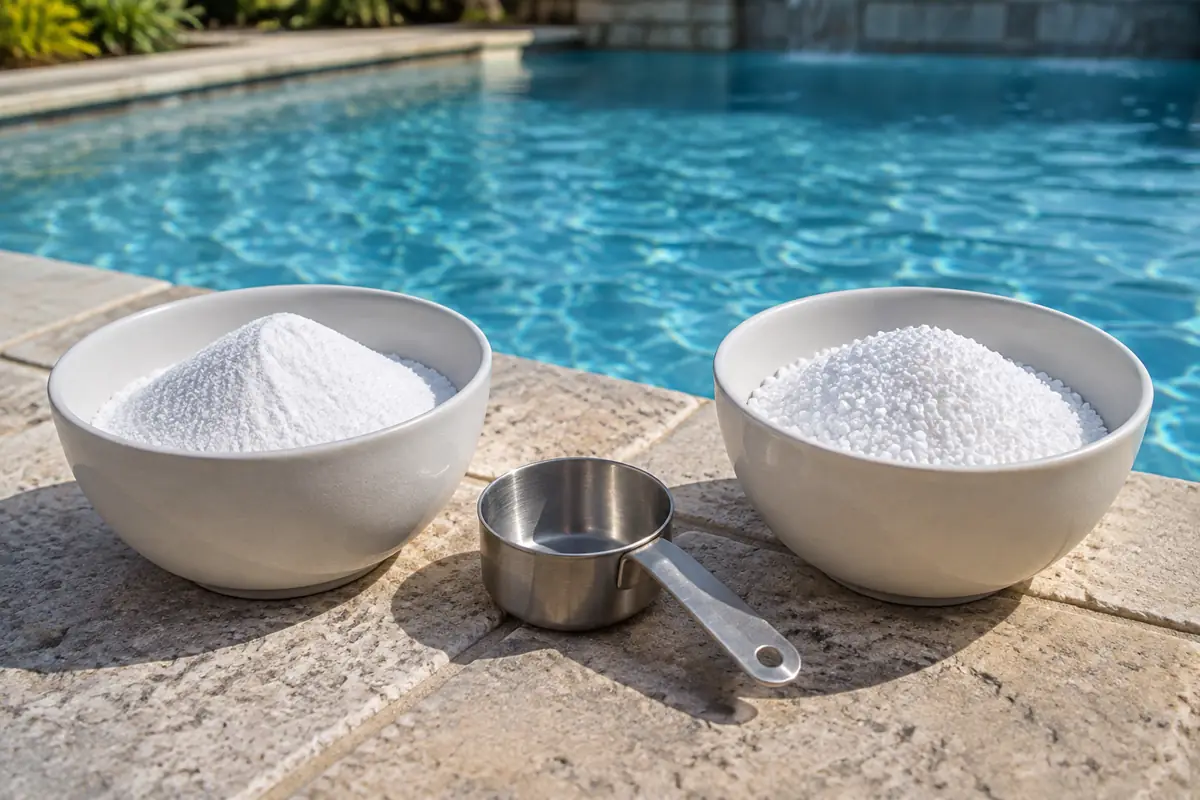
How much soda ash to raise pool pH: dose per 10,000 gallons
Use a health department chart, start with the low end, and retest before adding more.
The clearest public chart we found comes from the Virginia Department of Health’s Portsmouth Health Department guide. It sets the soda ash dose by starting pH and pool size. For a 10,000 gallon pool, a reading of 7.2 to 7.4 calls for 6 oz, 7.0 to 7.2 calls for 8 oz, 6.8 to 7.0 calls for 12 oz and anything below 6.7 calls for 16 oz. At 7.4 to 7.6 the chart says to add nothing.
| Starting pH | 5,000 gal (oz) | 10,000 gal (oz) | 15,000 gal (oz) | 20,000 gal (oz) | 25,000 gal (oz) | 30,000 gal (oz) |
|---|---|---|---|---|---|---|
| 7.4 to 7.6 | none | none | none | none | none | none |
| 7.2 to 7.4 | 3 | 6 | 9 | 12 | 15 | 18 |
| 7.0 to 7.2 | 4 | 8 | 12 | 16 | 20 | 24 |
| 6.8 to 7.0 | 6 | 12 | 18 | 24 | 30 | 36 |
| Below 6.7 | 8 | 16 | 24 | 32 | 40 | 48 |
Source: Virginia Department of Health, Portsmouth Health Department guide (2018), Annex 2.6. Values checked against the scanned page. Download CSV
Knorr Systems publishes a second chart that assumes total alkalinity of 60 to 120 ppm and a target of 7.4. Its doses run higher: 0.75 lb from pH 7.2 and 1.5 lb from pH 6.6 in 10,000 gallons. Knorr also warns not to add more than 1 pound per 10,000 gallons at a time, because larger doses can turn the water milky.
| Starting pH (target 7.4) | 10,000 gal | 25,000 gal | 50,000 gal |
|---|---|---|---|
| 6.6 | 1.5 lb | 3.75 lb | 7.5 lb |
| 6.8 | 1.25 lb | 3 lb | 6 lb |
| 7.0 | 1 lb | 2.25 lb | 4.75 lb |
| 7.2 | 0.75 lb | 2 lb | 3.25 lb |
Source: Knorr Systems, Chemical Dosing Charts (manufacturer guidance), accessed October 8, 2026. Download CSV
Florida DOH text rule (1 lb raises 0.3) and FROG rule (1 lb raises 0.1) were scaled to 0.2 by PC&S. Doses depend on total alkalinity, so start low and retest.
Source: Source: Florida DOH (Collier County) operators' manual 2016; Virginia DOH Portsmouth guide 2018; Knorr Systems dosing chart; FROG Products. Scaled values are PC&S arithmetic.. Download chart data (CSV)
To scale any chart, you need your pool’s real volume. Our pool volume calculator works out gallons from length, width and depth; Florida’s manual uses length x width x average depth x 7.5. As a worked example from the Virginia chart, a 20,000 gallon pool reading 7.1 needs 16 oz of soda ash.
How to raise pH in pool water, step by step
- Test pH, alkalinity and chlorineCDC recommends a DPD test kit and testing chlorine and pH at least twice per day. A reading under 7.2 is your cue to act.
- Confirm the gallonsMeasure the pool or use our volume calculator. A wrong volume is the fastest way to overshoot.
- Fix total alkalinity firstIf alkalinity is under 80 ppm, add baking soda using the table above, circulate, and retest pH before reaching for soda ash.
- Weigh the soda ashUse the Virginia chart for your starting pH and pool size. Keep each addition at or under 1 lb per 10,000 gallons (Knorr Systems).
- Pre-dissolve it in a bucket of waterFill a clean bucket with water first, then add the soda ash and stir until dissolved (Knorr Systems). Add chemicals to water, never water to chemicals (Oregon State University’s National Pesticide Information Center).
- Pour with the pump runningPour it slowly down the side of the pool, near a return if you can, so it disperses (Knorr Systems; FROG Products). Keep everyone out until it has dissolved and dispersed (Virginia DOH); Knorr closes pools for at least 15 minutes.
- Wait, then retestFROG Products says wait at least 6 hours before retesting; Arm & Hammer suggests 6 to 24 hours for baking soda. Repeat in small steps until pH reads 7.2 to 7.6.
- Write it downLog the reading, the product and the dose, as Virginia DOH asks public pool operators to do. After a few doses the log shows how far a given amount moves your own pool, which a generic chart cannot.
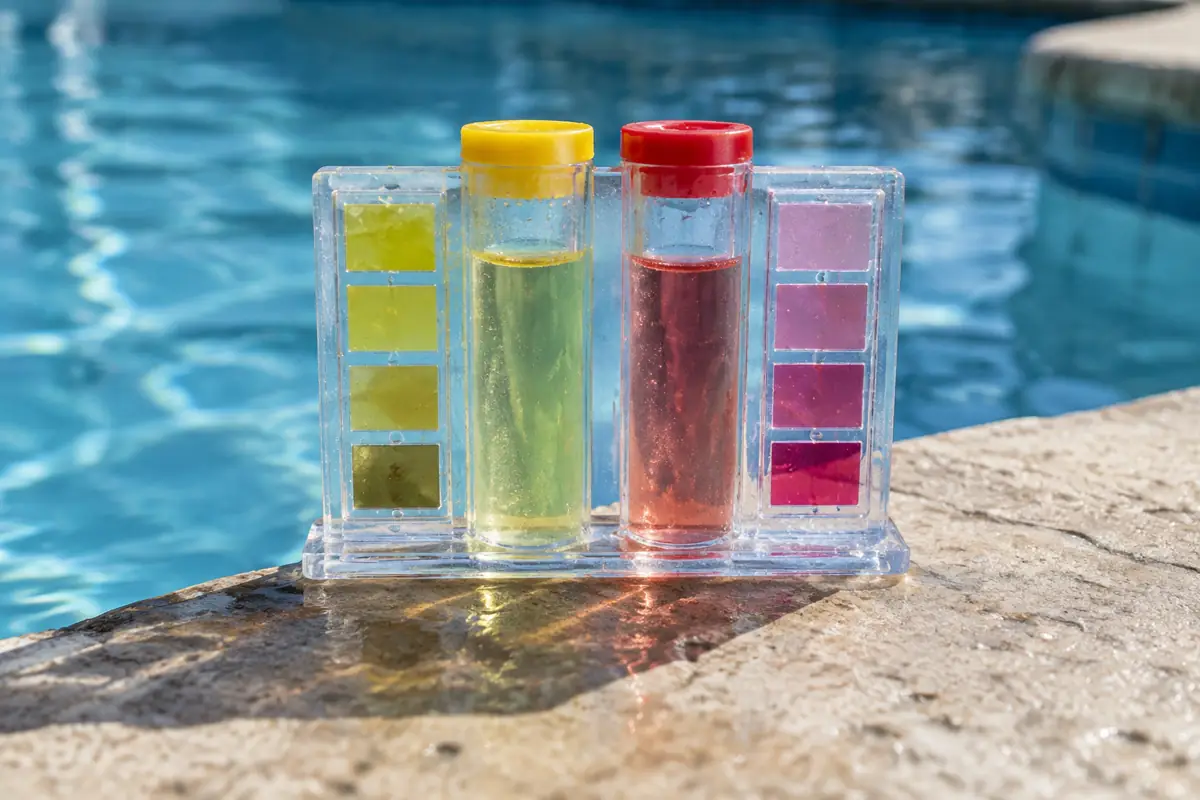
Rather have a pro balance the water?
Safety rules for soda ash, baking soda and other pool chemicals
Soda ash is strongly alkaline (pH about 11.6, per Orenda), and it goes into a chemical system that may also hold chlorine and acid. CDC’s storage advice applies at home: keep each chemical in its own labeled container, keep it dry, store it below 95 F and away from other chemicals. CDC estimates pool chemical injuries cause about 4,500 emergency department visits a year in the United States (PC&S research on pool injuries).
Public pools face an extra rule: the Model Aquatic Health Code requires pH chemicals to be certified to NSF/ANSI 50 or NSF/ANSI 60. Homeowners are not bound by it, but buying a product that carries one of those marks is an easy way to know what is in the bag.
Troubleshooting: pool pH will not stay up
| What you see | Likely cause | What to check or do | Source |
|---|---|---|---|
| pH falls again within a day or two | Total alkalinity too low to buffer pH | Test alkalinity; bring it to 80 to 120 ppm with baking soda before more soda ash | Virginia DOH; Florida DOH |
| Water turns milky right after adding soda ash | Too much soda ash at once, or alkalinity over 120 ppm | Let the filter run; next time pre-dissolve and stay at or under 1 lb per 10,000 gal per dose | Knorr Systems; Orenda |
| pH overshoots above 7.8 | Dose too large for your alkalinity | Lower it with a measured acid dose; see our lower pH guide | CDC; Virginia DOH |
| pH low after a storm | Rain is acidic (pH near 5.75) | Retest after heavy rain and correct in small steps | Pennsylvania DOH |
| pH keeps sliding with tablet chlorinator | Trichlor and dichlor lower pH and alkalinity | Check alkalinity weekly; consider the sanitizer choice with your pool pro | Pennsylvania DOH |
| Strong chlorine smell, stinging eyes | Low pH (below 7.2) or chloramines | Test pH and combined chlorine | Pennsylvania DOH; CDC |
| Etched plaster, corroded ladder or heater parts | Long periods of low pH or alkalinity | Fix chemistry, then have the surface or equipment inspected | Virginia DOH; Arm & Hammer |
Sources: Virginia DOH; Pennsylvania DOH; Florida DOH; CDC; Knorr Systems, Orenda and Arm & Hammer (manufacturer guidance). Download CSV
If soda ash clouds the water, Orenda explains why: the sudden local jump in pH and carbonate pulls calcium carbonate out of solution. It usually settles or redissolves as the filter runs. Our cloudy pool water guide walks through the other causes of haze.
When to stop adjusting and call a pool service
Testing is where most home pools fall down. In a 2020 Water Quality and Health Council survey, 23% of do-it-yourself pool owners said they test chlorine and pH no more often than once every two weeks (PC&S pool hygiene research). CDC’s advice is at least twice per day. If that gap is your gap, a weekly pool cleaning service that tests and doses on every visit is one way to close it. Our pool service cost guide shows what weekly plans charge, and our pool chemical price research tracks what the chemicals themselves cost producers.
Frequently Asked Questions
What is the fastest way to raise the pH of my pool?
Pre-dissolved soda ash (sodium carbonate) added with the pump running. Florida DOH lists 6 oz per 10,000 gallons for a 0.2 rise. Keep each dose at or under 1 lb per 10,000 gallons (Knorr Systems), then retest after at least 6 hours.
Will soda ash raise the pH in a pool?
Yes. Soda ash is the standard pH increaser and is on the Model Aquatic Health Code’s list of approved pH chemicals. It has a pH of about 11.6 (Orenda), so small amounts move pool pH quickly.
How much soda ash for a 10,000 gallon pool?
The Virginia DOH chart gives 6 oz at pH 7.2 to 7.4, 8 oz at 7.0 to 7.2, 12 oz at 6.8 to 7.0 and 16 oz below 6.7. Knorr Systems lists 0.75 to 1.5 lb to reach 7.4. Start low and retest.
Does baking soda raise pH or alkalinity more?
Alkalinity. Florida DOH says sodium bicarbonate raises total alkalinity without greatly affecting pH: 1.5 lb per 10,000 gallons adds about 10 ppm of alkalinity. Use it when alkalinity is under 80 ppm.
Do I adjust alkalinity or pH first in the pool?
Alkalinity first. Florida’s operators’ manual says total alkalinity “should always be adjusted first” because it stabilizes pH. Bring it to 80 to 120 ppm, retest pH, then add soda ash if pH is still low.
What happens if pH is too low in a pool?
Virginia DOH lists etched plaster, corroded equipment, rapid chlorine loss and irritated eyes. CDC adds that below pH 7.0 pipes are more likely to corrode. Public pools below 6.5 face closure under the 2024 Model Aquatic Health Code.
Is 7.2 pH too low for a pool?
No. 7.2 sits inside CDC’s 7.0 to 7.8 range and is the lower end of Florida’s 7.2 to 7.8 rule and Pennsylvania’s recommended 7.2 to 7.6. The Virginia chart calls for a small dose (6 oz per 10,000 gallons) only between 7.2 and 7.4.
Does shocking a pool increase pH?
It depends on the product. Pennsylvania DOH says calcium and sodium hypochlorite tend to raise pH over time, while dichlor and trichlor tend to lower it. Test pH again after shocking to see which way it moved.
How quickly does soda ash raise pH?
Test only after the water has fully circulated. Knorr Systems closes pools for at least 15 minutes after a dose, and FROG Products says wait at least 6 hours before retesting.
What happens if I put too much soda ash in my pool?
Two things: pH can overshoot above 7.8, and the water can turn milky as calcium carbonate drops out (Knorr Systems, Orenda). Let the filter run, then lower pH with a measured acid dose; see our lower pH guide.
Can you add soda ash and chlorine together?
No. Add each chemical separately to the pool water and never combine products in a bucket or feeder. NPIC says never mix products with acids or other pool chemicals, and the EPA warns mixing can release toxic gas.
How do I raise pH in a pool without chemicals?
Aerate. Fountains, deck jets and returns aimed at the surface drive out carbon dioxide, and pH rises; Orenda says this is enough for many home pools without acid feeders. It is slow, so test daily and stop once pH reaches 7.4 to 7.6.
Sources
- Centers for Disease Control and Prevention (CDC). Home Pool and Hot Tub Water Treatment and Testing (page updated May 10, 2024). Accessed 2026-10-08.
- Centers for Disease Control and Prevention (CDC). 2024 Model Aquatic Health Code, 5th Edition, Code Language (December 2024). Accessed 2026-10-08.
- Florida Department of Health in Collier County. Swimming Pool Operators' Manual, 2016 Version (Chapter 2, Maintaining Water Chemistry). Accessed 2026-10-08.
- Virginia Department of Health (Portsmouth Health Department). Pool Operation and Maintenance Guide (Portsmouth Health Department, compiled 2018). Accessed 2026-10-08.
- Pennsylvania Department of Health. Public Swimming and Bathing Places: Operational and Biological Contamination Protocol Recommendations (November 1, 2016). Accessed 2026-10-08.
- Knorr Systems (commercial pool equipment and chemical supplier; manufacturer guidance). Chemical Dosing Charts. Accessed 2026-10-08.
- Arm & Hammer (manufacturer guidance). How to Use Baking Soda for Pool Maintenance. Accessed 2026-10-08.
- Arm & Hammer (manufacturer guidance). How to Achieve a Balanced Pool Water pH. Accessed 2026-10-08.
- FROG Products (manufacturer guidance). How to Adjust Swimming Pool pH (Pool School). Accessed 2026-10-08.
- FROG Products (manufacturer guidance). How to Lower pH in a Swimming Pool: A Step-by-Step Guide. Accessed 2026-10-08.
- Orenda Technologies (manufacturer guidance). Why does Soda Ash cloud up pool water?. Accessed 2026-10-08.
- National Pesticide Information Center (Oregon State University, cooperative agreement with U.S. EPA). Pool and Spa Chemicals Fact Sheet. Accessed 2026-10-08.
- U.S. Environmental Protection Agency (EPA). Chemical Safety Alert: Safe Storage and Handling of Swimming Pool Chemicals (EPA 550-F-01-003, March 2001). Accessed 2026-10-08.
- Centers for Disease Control and Prevention (CDC). Pool Chemical Safety (page updated June 24, 2025). Accessed 2026-10-08.
- Hayward (manufacturer manual). Aqua Rite Electronic Chlorine Generator Manual (092009N RevP). Accessed 2026-10-08.
- Pool Construction & Service. Public Pool Inspection Violations (PC&S research). Accessed 2026-10-08.
- Pool Construction & Service. Pool Hygiene Statistics (PC&S research). Accessed 2026-10-08.
- Pool Construction & Service. Pool Injury Statistics (PC&S research). Accessed 2026-10-08.
Related pages
Get Quotes From Licensed Local Pool Pros
Tell us what you need and your ZIP code. We match you with pool companies that cover your area.