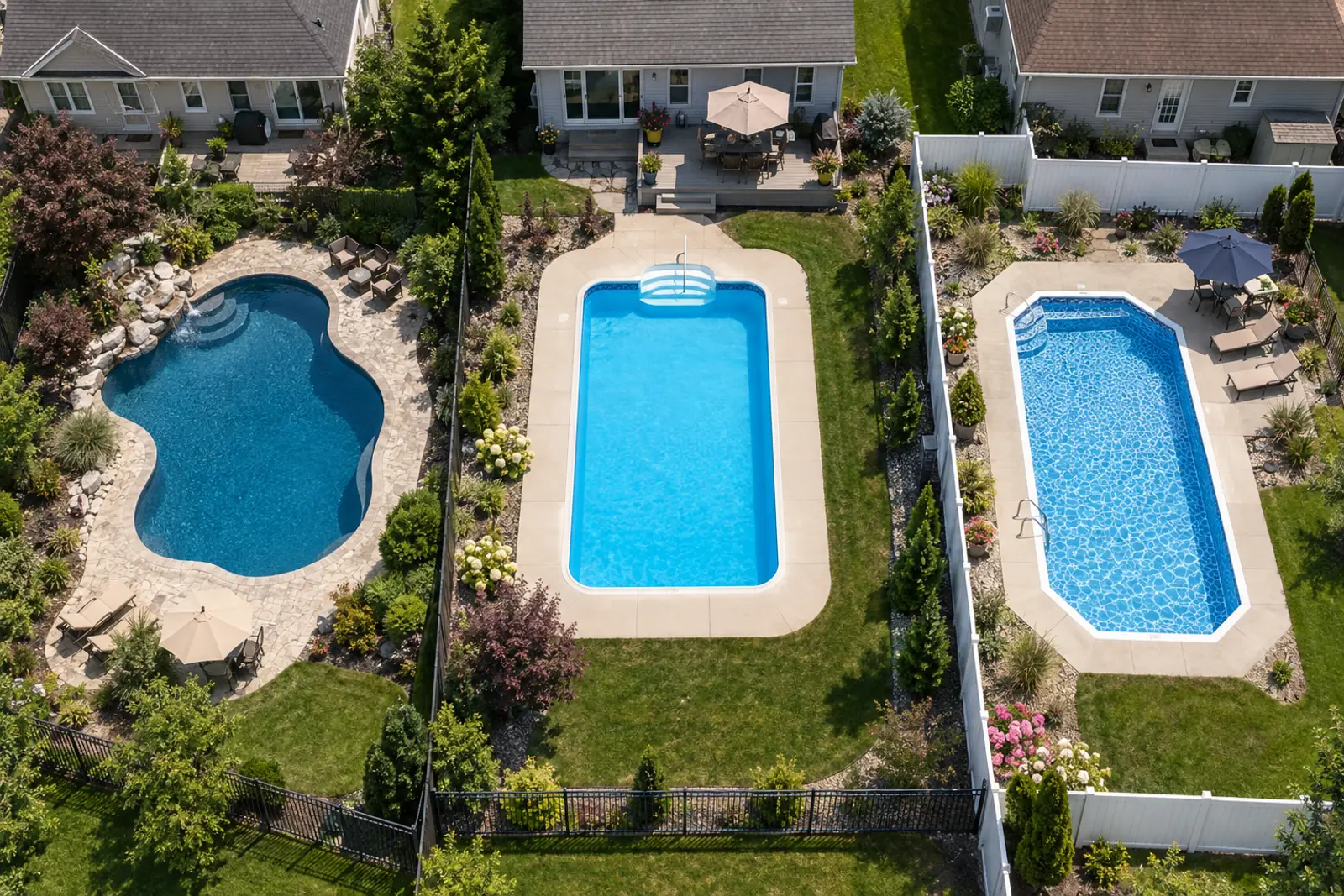
Gunite vs Fiberglass vs Vinyl Pool: Cost, Lifespan and Upkeep
Gunite vs fiberglass vs vinyl pool, in one line: concrete costs most and lasts longest, fiberglass has the lowest upkeep, and vinyl the lowest price (Angi; HomeGuide).
- ✓Gunite vs fiberglass vs vinyl pool pricesAngi's 2026 ranges: gunite $65,000 to $120,000, fiberglass $55,000 to $100,000, vinyl $40,000 to $75,000.
- ✓Public cost schedulesCalifornia's 2026 assessor schedule and Harris County, Texas appraisal data price the three types per square foot.
- ✓Sources that disagree, shownWhere guides and manufacturers give different lifespans, we list each one with its source.
Gunite vs fiberglass vs vinyl pool at a glance
Ten factors, three pool types, one table. Each cell names its source, because the sources do not always agree.
| Factor | Gunite (concrete) | Fiberglass | Vinyl liner |
|---|---|---|---|
| Installed cost, Angi 2026 | $65,000 to $120,000 | $55,000 to $100,000 | $40,000 to $75,000 |
| Installed cost, HomeGuide 2025 | $50,000 to $120,000 | $45,000 to $100,000 | $35,000 to $80,000 |
| Replacement cost per sq ft, California BOE 2026 | $94 to $173 | $70 to $94 | $45 to $70 |
| Appraisal base price per sq ft, Harris County 2026 | $40 | $34 | $27 (prefab vinyl), $19 (plastic liner) |
| Yearly maintenance, Angi 2026 | $2,700 to $4,000 | $500 to $1,500 | $1,100 to $1,700 |
| Typical build time | 6 to 8 weeks (HomeGuide) | As soon as 3 days after delivery (Latham, manufacturer claim) | 2 to 3 weeks (HomeGuide) |
| Surface renewal | Resurface every 10 to 15 years, $8,000 to $10,000 (HomeGuide) | Refinishing may be needed every 10 years (HomeGuide) | New liner every 6 to 12 years, $3,000 to $7,500 (HomeGuide) |
| Structure lifespan, HomeGuide | 50+ years | 25 to 30 years | 20+ years |
| Shape and size | Any shape and size (Fixr) | Limited sizes and depths; shells are trucked (Fixr) | Various forms and sizes (Fixr) |
| City inspections, St. Helena CA example | 4: pre-gunite, pre-deck, pre-plaster, final | 3: excavation, pre-deck, final | Not listed in the pamphlet |
Sources: Angi (2026), HomeGuide (2025), California BOE AH 531 (2026), Harris Central Appraisal District via PC&S property tax study, Fixr (2024), Latham, City of St. Helena Download CSV
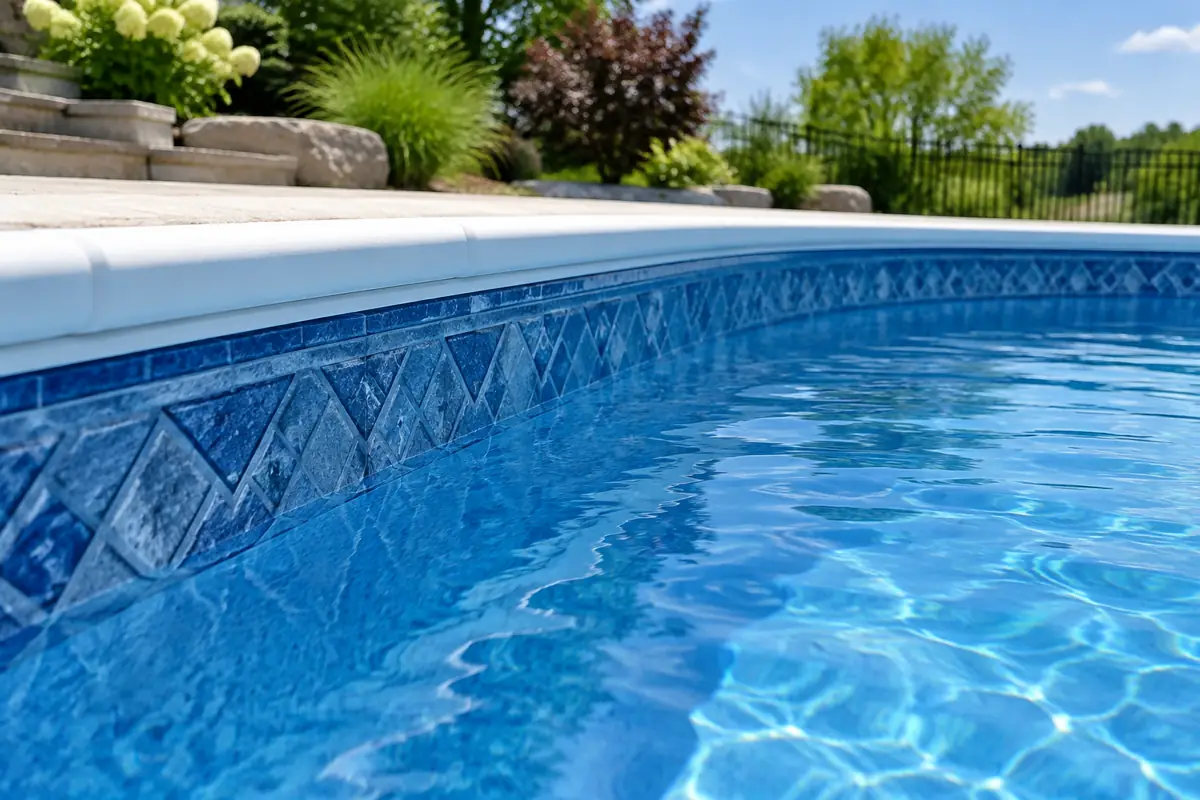
Gunite is sprayed concrete over tied steel reinforcement, finished with plaster; that is why inspectors check the steel before spraying and the shell before plastering (City of St. Helena). Fiberglass pools are shells pre-molded in a factory and trucked to the yard (Fixr). Vinyl liner pools hold the water in a fitted vinyl liner that is replaced as it wears (HomeGuide).
The short version: vinyl wins on entry price, fiberglass on upkeep and speed, and gunite on design freedom and structural life. The rest of this page shows how big each gap is, and where the evidence is thin. For full project pricing, including decking and running costs, see our inground pool cost guide.
Build cost: gunite vs fiberglass vs vinyl pool prices
Every source ranks the three types the same way at the top of the range. The bottoms overlap.
Pool shell and standard equipment; decking, fencing and extras are valued separately.
Source: California State Board of Equalization, Assessors' Handbook 531 (January 2026); PC&S calculation. Download chart data (CSV)
California’s State Board of Equalization publishes the replacement costs that county assessors use to value pools: concrete at $94 to $173 per square foot of pool surface in 2026, fiberglass at $70 to $94 and in-ground liner pools at $45 to $70 (BOE Assessors’ Handbook 531). Applied to a 15×30 pool of 450 square feet, that is $42,300 to $77,850 for concrete, $31,500 to $42,300 for fiberglass and $20,250 to $31,500 for vinyl (PC&S calculation). These figures cover the pool itself, not the whole backyard project.
Texas appraisers rank the types the same way. The Harris Central Appraisal District starts a gunite pool at $40 per square foot on its 2026 roll, fiberglass at $34, prefab vinyl at $27 and plastic liner at $19, before size and age adjustments (PC&S property tax study). That also means a gunite pool can add more to a property tax bill than a liner pool of the same size.
Consumer cost guides are wider and higher. Angi’s 2026 installed ranges are $65,000 to $120,000 for concrete, $55,000 to $100,000 for fiberglass and $40,000 to $75,000 for vinyl (Angi). HomeGuide’s table gives $35,000 to $80,000 for vinyl, although its text gives $25,000 to $65,000 for the same pool (HomeGuide). Fixr’s January 2024 ranges sit lower for all three types (Fixr).
Build time and inspections for each pool type
A factory shell skips the steps that make concrete slow: forming, spraying, curing and plastering on site.
HomeGuide puts a vinyl liner pool at 2 to 3 weeks and a concrete pool at 6 to 8 weeks of construction (HomeGuide). Latham, a manufacturer of fiberglass and vinyl pools, says a fiberglass pool can be ready as soon as three days after delivery (Latham); treat that as a best case for the shell set, not the whole project. Permit review comes first and varies more than construction: our permit processing time study found medians from 1 day to 70 days across 12 jurisdictions in 2025.
Inspections follow the build method. The City of St. Helena, California lists four inspections for a gunite pool (pre-gunite, pre-deck, pre-plaster and final) and three for a fiberglass pool (excavation, pre-deck and final) (City of St. Helena). The same city requires engineered plans stamped by a licensed engineer for structurally built pools, says some fabricated fiberglass and vinyl pools also need them, and requires fabricated pools to carry recognized listings.
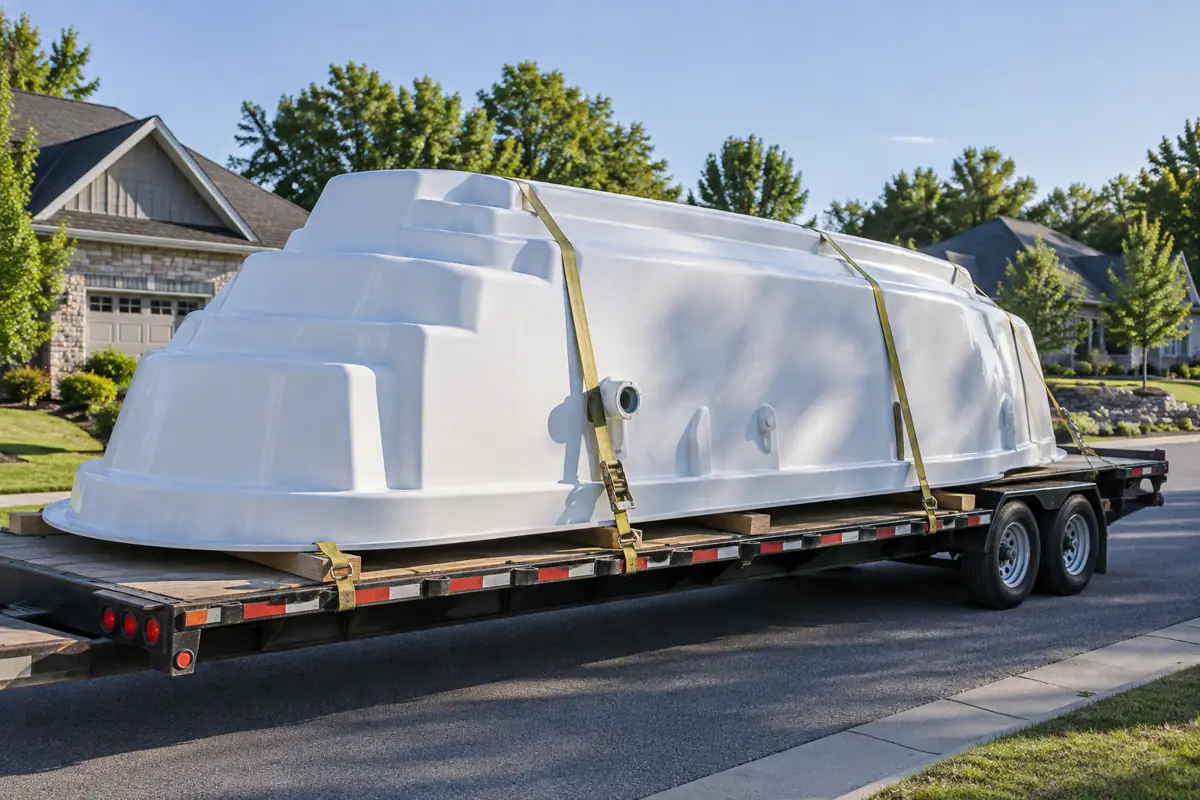
Shape is the trade-off. Fixr notes that fiberglass pools come in limited sizes and depths because they must be transported, while concrete can be formed to fit any shape and size (Fixr). If your lot is narrow, steep or hard to reach with a truck, raise access early; our pool construction process guide explains each phase.
Lifespan and resurfacing: what lasts longest
The structure of all three types can last decades. The surface you swim on is what wears out, and the sources disagree on how fast.
| Component | Stated interval | Source |
|---|---|---|
| Concrete plaster resurfacing | Every 10 to 15 years | HomeGuide (2025) |
| Concrete plaster resurfacing | Every 10 to 15 years | River Pools (fiberglass manufacturer) |
| Concrete plaster resurfacing | Approximately every 10 years | Latham (pool manufacturer) |
| Pool or spa plaster liner, multifamily | 8 years | Fannie Mae EUL table (2019) |
| Vinyl liner replacement | Every 6 to 12 years | HomeGuide (2025) |
| Vinyl liner replacement | 7 to 9 years | Fixr (2024) |
| Vinyl liner replacement | Every 5 to 9 years | River Pools (fiberglass manufacturer) |
| Vinyl liner replacement | On average every ten years | Latham (pool manufacturer) |
| Pool or spa plastic liner, multifamily | 8 years | HUD CNA e-Tool EUL table |
| Fiberglass refinishing | May be needed every 10 years | HomeGuide (2025) |
| Pool pumps and equipment, multifamily | 10 years | HUD CNA e-Tool EUL table |
| Pool deck, multifamily | 15 years | Fannie Mae EUL table (2019); HUD CNA e-Tool |
Sources: HomeGuide, Fixr, River Pools, Latham, Fannie Mae EUL table, HUD CNA e-Tool EUL table Download CSV
HomeGuide says concrete pools last 50 years or more but need resurfacing every 10 to 15 years at $8,000 to $10,000; fiberglass pools last 25 to 30 years and may need refinishing every 10 years; vinyl pools last 20+ years but need a new liner every 6 to 12 years at $3,000 to $7,500 (HomeGuide). Angi prices concrete resurfacing higher, at $10,000 to $20,000 (Angi).
Manufacturers frame the same facts in their own favor. River Pools, which makes fiberglass pools, puts liner life at 5 to 9 years; Latham, which makes vinyl and fiberglass pools, says about ten. Federal multifamily planning tables are the most neutral reference we found: Fannie Mae and HUD both assume 8 years for a pool plaster or plastic liner and 15 years for a pool deck, with HUD assuming 10 years for pumps and equipment (Fannie Mae; HUD). Those tables are written for apartment pools with heavy use, so a backyard pool may last longer.
Upkeep: which pool type needs the least maintenance
Fiberglass has the lowest published upkeep; concrete the highest.
Angi’s 2026 guide puts yearly maintenance at $500 to $1,500 for fiberglass, $1,100 to $1,700 for vinyl and $2,700 to $4,000 for concrete (Angi). HomeGuide gives the reasons: fiberglass is algae- and mineral-resistant, concrete is porous enough to need acid washing every 3 to 5 years at $300 to $1,000, and vinyl liners tear or scratch easily, which makes them a poor match for dogs (HomeGuide).
Some running costs do not depend on the shell at all. Pump electricity is $218 a year for a variable-speed pump against $705 for single-speed in the median state (PC&S pump study), and chemical prices, tracked in our pool chemical price index, stood at 124.1 in August 2026 against 100 in 2019. For weekly service pricing, see the pool service cost guide.
Twenty-year cost of gunite, fiberglass and vinyl pools
Upfront price ranks vinyl first. Over 20 years, the gap between vinyl and fiberglass nearly closes in a simple illustration.
Illustration, not a forecast. Fiberglass refinishing is excluded because no price is published.
Source: PC&S calculation from Angi (2026) and HomeGuide (2025). Download chart data (CSV)
| Pool type | Build, midpoint of Angi range $ | 20 years of upkeep, Angi midpoint $ | Surface renewals in 20 years, HomeGuide midpoint $ | Total, no inflation $ |
|---|---|---|---|---|
| Vinyl liner | 57,500 | 28,000 | 5,250 | 90,750 |
| Fiberglass | 77,500 | 20,000 | 0 | 97,500 |
| Gunite (concrete) | 92,500 | 67,000 | 9,000 | 168,500 |
PC&S calculation from Angi (2026) build and upkeep ranges and HomeGuide (2025) liner and resurfacing prices Download CSV
We took the midpoint of each Angi build range, added 20 years of Angi’s midpoint upkeep and one surface renewal at HomeGuide’s midpoint price: a new liner ($5,250) for vinyl and a resurfacing ($9,000) for concrete. The result is about $90,750 for vinyl, $97,500 for fiberglass and $168,500 for gunite, at 2025 to 2026 guide prices with no inflation (PC&S calculation).
What gets built in a big pool market
National guides suggest a three-way choice. Local records show one type can dominate.
Source: Harris Central Appraisal District, 2026 certified data; PC&S tabulation. Download chart data (CSV)
Of 121,971 residential pool lines on Harris County’s 2026 tax roll, 117,056, or 96.0%, are coded gunite; fiberglass accounts for 0.4% and vinyl and plastic liner pools together for 0.8% (Harris Central Appraisal District, PC&S tabulation in our property tax study). The roll covers pools of every age, so it reflects decades of local builder practice rather than this year’s sales.
If you want a type that is uncommon in your area, ask how many of that type each bidder has installed and who will service it later. Our guide to choosing a pool builder lists the license checks by state.
Which pool type fits your yard and budget
Use the evidence above to match the type to your priorities.
- Choose gunite if you want a custom shape, a deep end, an attached spa or a pool that matches local builder practice, and you can budget for resurfacing every 10 to 15 years (HomeGuide). A gunite spa built with the pool runs $14,512 to $26,927 in California’s 2026 schedule, against $11,460 to $19,290 for fiberglass (BOE).
- Choose fiberglass if low upkeep and a short build matter most and a standard shell size fits your yard and your access route. Budget for delivery and a crane.
- Choose vinyl if the lowest upfront price matters most and you accept a liner replacement every 6 to 12 years at $3,000 to $7,500 (HomeGuide). Keep pets and sharp toys in mind.
Frequently Asked Questions
Is a gunite pool better than vinyl?
It depends on the priority. Gunite lasts longer (50+ years for concrete against 20+ for vinyl, per HomeGuide) and allows any shape, but it costs more to build ($65,000 to $120,000 against $40,000 to $75,000, Angi 2026) and to maintain.
Which is better, a fiberglass or gunite pool?
Fiberglass has lower upkeep ($500 to $1,500 a year against $2,700 to $4,000, Angi 2026) and builds faster; gunite allows any shape and size and has the longer structural life (HomeGuide). Fiberglass sizes are limited by what can be trucked (Fixr).
How much does a 15×30 gunite pool cost?
At California’s 2026 assessor rates of $94 to $173 per square foot, a 15×30 concrete pool (450 square feet) works out to $42,300 to $77,850 for the pool itself (BOE; PC&S calculation). The BOE’s typical 440 square foot concrete pool is $49,781.60 to $70,862. Decking and extras are added on top.
How much does a 20×40 gunite pool cost?
At the same BOE rates, an 800 square foot concrete pool works out to $75,200 to $138,400 (PC&S calculation). Angi’s 2026 size table averages a 20×40 pool of any type at $70,000, and HomeGuide’s range is $64,000 to $200,000.
What type of pool lasts the longest?
Concrete. HomeGuide puts concrete at 50+ years, fiberglass at 25 to 30 years and vinyl at 20+ years (2025), although each needs surface work along the way.
What is the downside of a fiberglass pool?
Limited sizes and depths, because shells must be transported (Fixr), plus freight of $1,757 to $4,978 in California’s 2026 schedule (BOE). Fiberglass also costs more up front than vinyl: $55,000 to $100,000 against $40,000 to $75,000 (Angi 2026).
What happens to a fiberglass pool after 25 years?
HomeGuide says fiberglass pools last 25 to 30 years and may need refinishing every 10 years. River Pools, a fiberglass manufacturer, says a quality gelcoat can last decades. Expect to inspect the surface and equipment; HUD planning tables assume pumps and equipment last 10 years.
What are the downsides of vinyl liner pools?
Liner replacement every 6 to 12 years at $3,000 to $7,500 (HomeGuide), and liners that tear or scratch easily, which HomeGuide says makes them less pet-friendly. Fixr puts liner life at seven to nine years.
What is the average cost of a fiberglass pool compared to a vinyl pool?
Angi’s 2026 ranges are $55,000 to $100,000 for fiberglass and $40,000 to $75,000 for vinyl. California’s assessor schedule prices fiberglass at $70 to $94 per square foot against $45 to $70 for liner pools (BOE, 2026).
What type of inground pool is the most cost-effective?
Vinyl is cheapest to build. In our 20-year illustration using cost-guide midpoints, vinyl totals about $90,750 and fiberglass $97,500, close enough that upkeep habits and liner life decide it; gunite totals $168,500 (PC&S calculation from Angi and HomeGuide).
Which type of pool requires the least maintenance?
Fiberglass. Angi lists $500 to $1,500 a year in maintenance against $1,100 to $1,700 for vinyl and $2,700 to $4,000 for concrete (2026), and HomeGuide notes fiberglass resists algae and mineral buildup.
Sources
- Angi. How Much Does an In-Ground Pool Cost? [2026 Data]. Accessed 2026-10-08.
- HomeGuide. How Much Does An Inground Pool Cost?. Accessed 2026-10-08.
- Fixr. How Much Does It Cost to Build a Swimming Pool?. Accessed 2026-10-08.
- California State Board of Equalization. Assessors' Handbook Section 531, Residential Building Costs (January 2026). Accessed 2026-10-08.
- Harris Central Appraisal District. 2026 certified appraisal data (Real_building_land.zip). Accessed 2026-10-08.
- City of St. Helena, California. Swimming Pool Requirements pamphlet. Accessed 2026-10-08.
- Fannie Mae. Appendix F, Estimated Useful Life Tables (Form 4099.F). Accessed 2026-10-08.
- U.S. Department of Housing and Urban Development. CNA e-Tool Estimated Useful Life Table. Accessed 2026-10-08.
- Latham Pool Products. Fiberglass vs. Concrete vs. Vinyl Liner Pools. Accessed 2026-10-08.
- River Pools. Inground Swimming Pool Cost & Pricing Guide. Accessed 2026-10-08.
Related pages
Get Quotes From Licensed Local Pool Pros
Tell us what you need and your ZIP code. We match you with pool companies that cover your area.