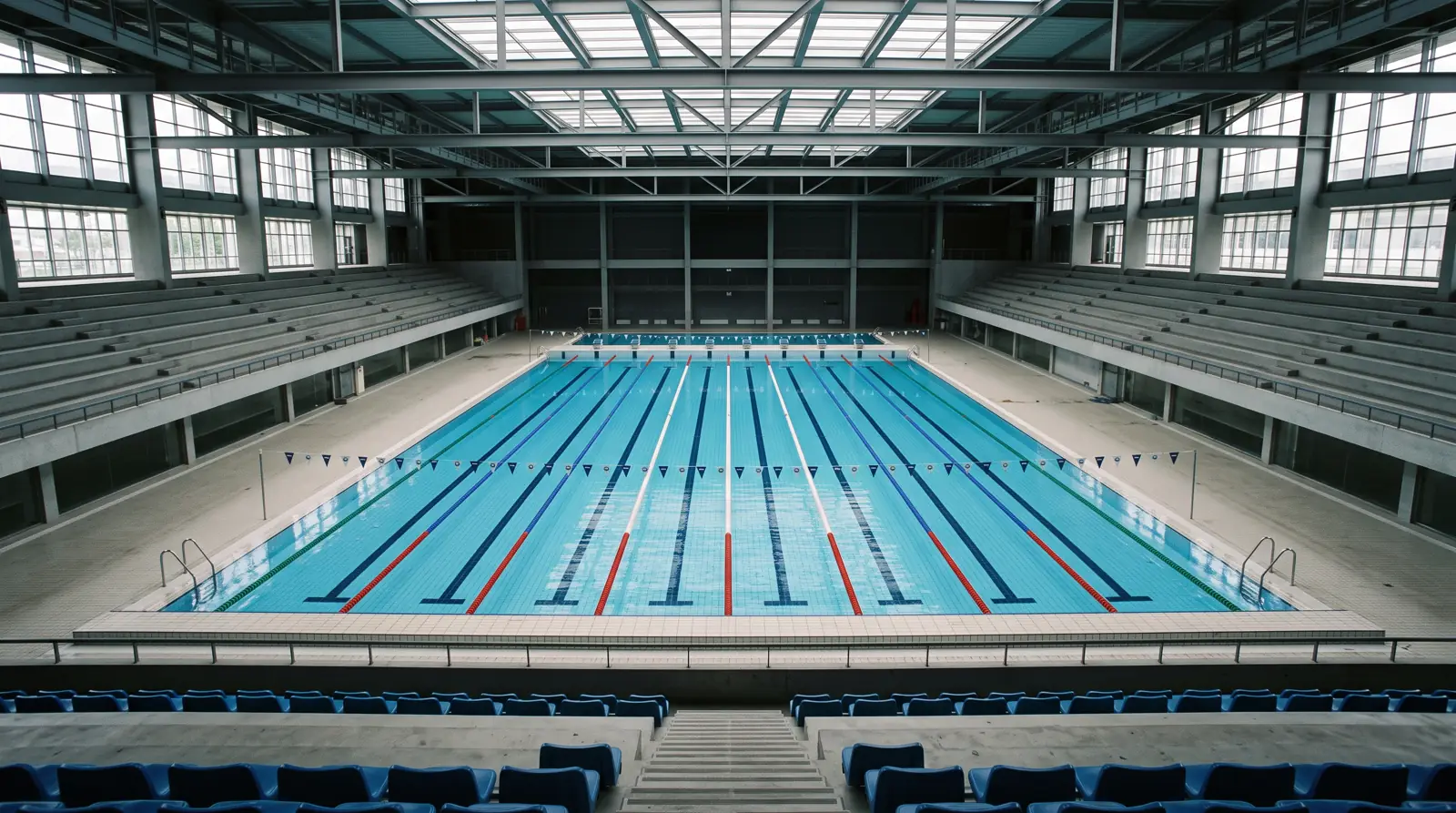
Olympic Pool Size: Dimensions, Depth and Gallons Under the 2026 Rules
Olympic pool size is 50 by 25 meters (164 by 82 feet) and at least 2.5 meters deep under World Aquatics' February 2026 rules: 3,125 cubic meters, or about 825,500 US gallons of water.
- ✓Rule text, not hearsayLength, width, depth, lanes and water temperature quoted article by article from the Competition Regulations in force from February 2026.
- ✓Gallons at every depthWorked volumes at 2.0, 2.15, 2.5 and 3.0 m in liters, US gallons, cubic meters and cubic feet.
- ✓Scaled to a backyardAbout 26 median backyard pools by surface and 48 pools of 16 x 32 ft by gallons.
Key takeaways
- An Olympic pool is 50.000 m (164.0 ft) long between touch panels and at least 25.000 m (82.0 ft) wide for a permanent pool, under articles 15.1.1.1 and 15.3.1 of the World Aquatics Competition Regulations in force from February 2026.
- The minimum depth at the Olympic Games and World Championships is 2.5 m (8.2 ft) under article 15.4.1; the old 2 m figure comes from FINA rule FR 2.2.4 in the 2021 to 2025 Facilities Rules.
- At 2.5 m an Olympic pool holds 3,125 cubic meters, 825,538 US gallons at NIST‘s 3.785412 liters per gallon; at the old 2.0 m minimum it held 660,430 gallons.
- One Olympic pool holds as much water as 47.7 backyard pools of 16 x 32 ft at a 4.5 ft average depth, which the City of Akron puts at 17,300 gallons each.
- A 5/8 inch garden hose at 12 to 15 gallons a minute (City of Highfill, AR) would need 38.2 to 47.8 days of nonstop running to fill an Olympic pool at 2.5 m.
What is the Olympic pool size in meters and feet?
An Olympic pool is 50 meters (164.0 ft) long between the touch panels, at least 25 meters (82.0 ft) wide and at least 2.5 meters (8.2 ft) deep. Those numbers come from articles 15.1, 15.3 and 15.4 of Part Two of the World Aquatics Competition Regulations, in force from February 2026. A temporary pool, like the ones built inside arenas, must be 26 meters wide.
| Measure | Value | Source (rule or dataset, date) |
|---|---|---|
| Olympic pool length | 50.000 m (164.0 ft) between touch panels | World Aquatics CR Part Two 15.1.1.1, Feb 2026 |
| Olympic pool width, permanent pool | 25.000 m (82.0 ft) minimum | World Aquatics CR Part Two 15.3.1, Feb 2026 |
| Olympic pool depth | 2.5 m (8.2 ft) minimum | World Aquatics CR Part Two 15.4.1, Feb 2026 |
| Water surface | 1,250 sq m (13,455 sq ft) | PC&S arithmetic, 50 x 25 m |
| Water volume at 2.5 m | 3,125 cubic m, about 825,500 US gallons | PC&S arithmetic, NIST liter per gallon factor |
| Water volume at 2.0 m (old minimum) | 2,500 cubic m, about 660,400 US gallons | PC&S arithmetic; FINA FR 2.2.4 (2021 to 2025) |
| Water temperature | 25.0 to 28.0 C (77.0 to 82.4 F) | World Aquatics CR Part Two 15.11.1, Feb 2026 |
| Light over the whole pool, Olympic Games | 1,500 lux minimum | World Aquatics CR Part Two 15.12.1, Feb 2026 |
Sources: World Aquatics Competition Regulations (Feb 2026); FINA FR 2.2.4; conversions with NIST SP 811; PC&S arithmetic. Download CSV
Olympic length is measured between the electronic touch panels, not the bare walls. Article 15.2.1.2 sets the wall to wall distance at 50.020 to 50.030 m when panels hang at both ends, and article 15.2.1.1 allows +0.010 m and -0.000 m on the swum distance, so a course 1 cm short fails. The length must hold from 0.3 m above to 0.8 m below the water surface, and a surveyor certifies it.
| Rule | Metres | Feet (1 ft = 0.3048 m) | Article | Source |
|---|---|---|---|---|
| Length between touch panels | 50.000 | 164.0 | Part Two 15.1.1.1 | World Aquatics CR, Feb 2026 |
| Wall to wall length with touch panels at both ends | 50.020 to 50.030 | 164.1 | Part Two 15.2.1.2 | World Aquatics CR, Feb 2026 |
| Length tolerance with touch panels | +0.010 / -0.000 | +0.03 / -0.00 | Part Two 15.2.1.1 | World Aquatics CR, Feb 2026 |
| Width, permanent pool (Olympics, Worlds) | 25.000 minimum | 82.0 | Part Two 15.3.1 | World Aquatics CR, Feb 2026 |
| Width, temporary pool (Olympics, Worlds) | 26.000 minimum | 85.3 | Part Two 15.3.1 | World Aquatics CR, Feb 2026 |
| Depth, Olympics and World Championships | 2.5 minimum | 8.2 | Part Two 15.4.1 | World Aquatics CR, Feb 2026 |
| Depth, World Swimming Championships (25m) | 2.0 minimum, 2.5 recommended | 6.6; 8.2 | Part Two 15.4.2 | World Aquatics CR, Feb 2026 |
| Depth, other events with starting blocks (1.0 to 6.0 m from wall) | 1.35 minimum | 4.4 | Part Two 15.4.3 | World Aquatics CR, Feb 2026 |
| Olympic lanes | 8 lanes of 2.5 plus a 2.5 gap each side | 8.2 each | Part Two 15.6.1 | World Aquatics CR, Feb 2026 |
| Water temperature | 25.0 to 28.0 C | 77.0 to 82.4 F | Part Two 15.11.1 | World Aquatics CR, Feb 2026 |
| Water inflow and outflow on competition days, 50 m pool | 220 to 250 cubic m per hour | n/a | Part Two 15.11.2.2.1 | World Aquatics CR, Feb 2026 |
| Light over the whole pool, Olympic Games | 1,500 lux minimum | n/a | Part Two 15.12.1 | World Aquatics CR, Feb 2026 |
| Depth, Olympics (superseded rule) | 2 minimum; 3 recommended for multi discipline | 6.6; 9.8 | FR 2.2.4 | FINA Facilities Rules 2021 to 2025 |
Sources: World Aquatics Competition Regulations, Part Two article 15 (Feb 2026); FINA Facilities Rules 2021 to 2025 (superseded row); feet at 0.3048 m per foot (NIST). Download CSV
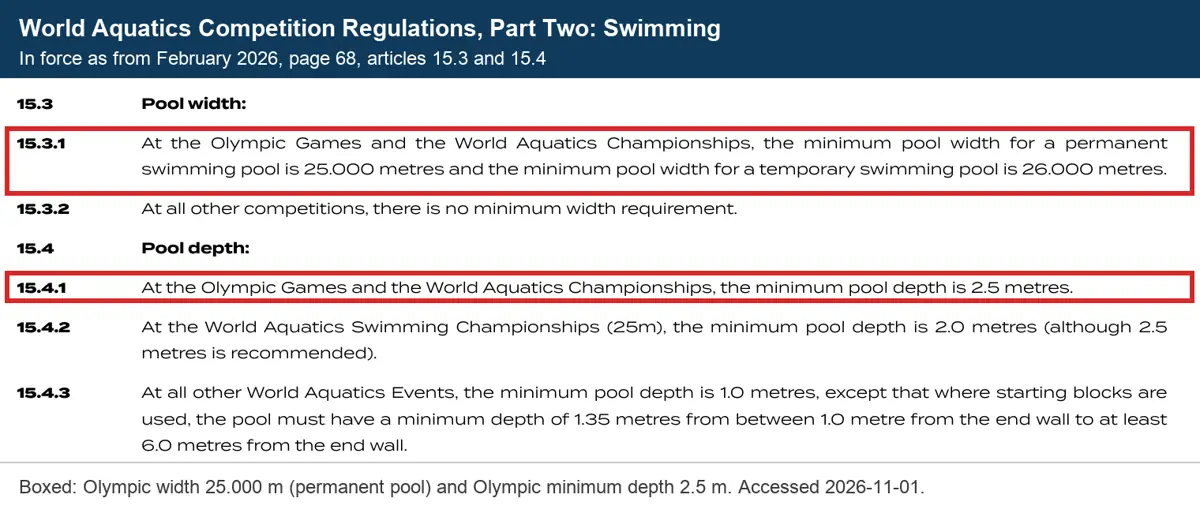
Width follows from the lanes. At the Olympic Games the pool must hold 8 lanes of 2.5 m with a 2.5 m gap outside lanes 1 and 8 (article 15.6.1), and World Championships pools carry 10 lanes (15.6.2). The water must sit between 25.0 and 28.0 C, or 77.0 to 82.4 F (15.11.1), under at least 1,500 lux of light across the whole pool (15.12.1).
| Event and pool | Lane layout (rule) | Arithmetic | Width |
|---|---|---|---|
| Olympic Games | 8 lanes of 2.5 m, 2.5 m gap outside lanes 1 and 8 (15.6.1) | 8 x 2.5 + 2 x 2.5 | 25.0 m |
| World Championships, permanent pool | 8 lanes of 2.5 m, 2 outer lanes of 2.4 m, 0.1 m gaps (15.6.2.1) | 8 x 2.5 + 2 x 2.4 + 2 x 0.1 | 25.0 m |
| World Championships, temporary pool | 10 lanes of 2.5 m, 0.5 m gaps (15.6.2.2) | 10 x 2.5 + 2 x 0.5 | 26.0 m |
Source: World Aquatics Competition Regulations, Part Two articles 15.6.1 and 15.6.2 (Feb 2026); arithmetic by PC&S. Download CSV
How many gallons are in an Olympic pool?
About 825,500 US gallons at the current 2.5 m minimum depth. 50 x 25 x 2.5 m is 3,125 cubic meters, or 3,125,000 liters, and NIST’s factor of 3.785412 liters per gallon turns that into 825,538 gallons. The 660,000 gallons most guides quote assumes the old 2.0 m minimum, and a 3.0 m deep pool holds about 990,600 gallons.
| Depth case | Depth (m) | Depth (ft) | Cubic metres (50 x 25 x depth) | Liters | US gallons (liters / 3.785412) | Cubic feet (cubic metres / 0.02831685) |
|---|---|---|---|---|---|---|
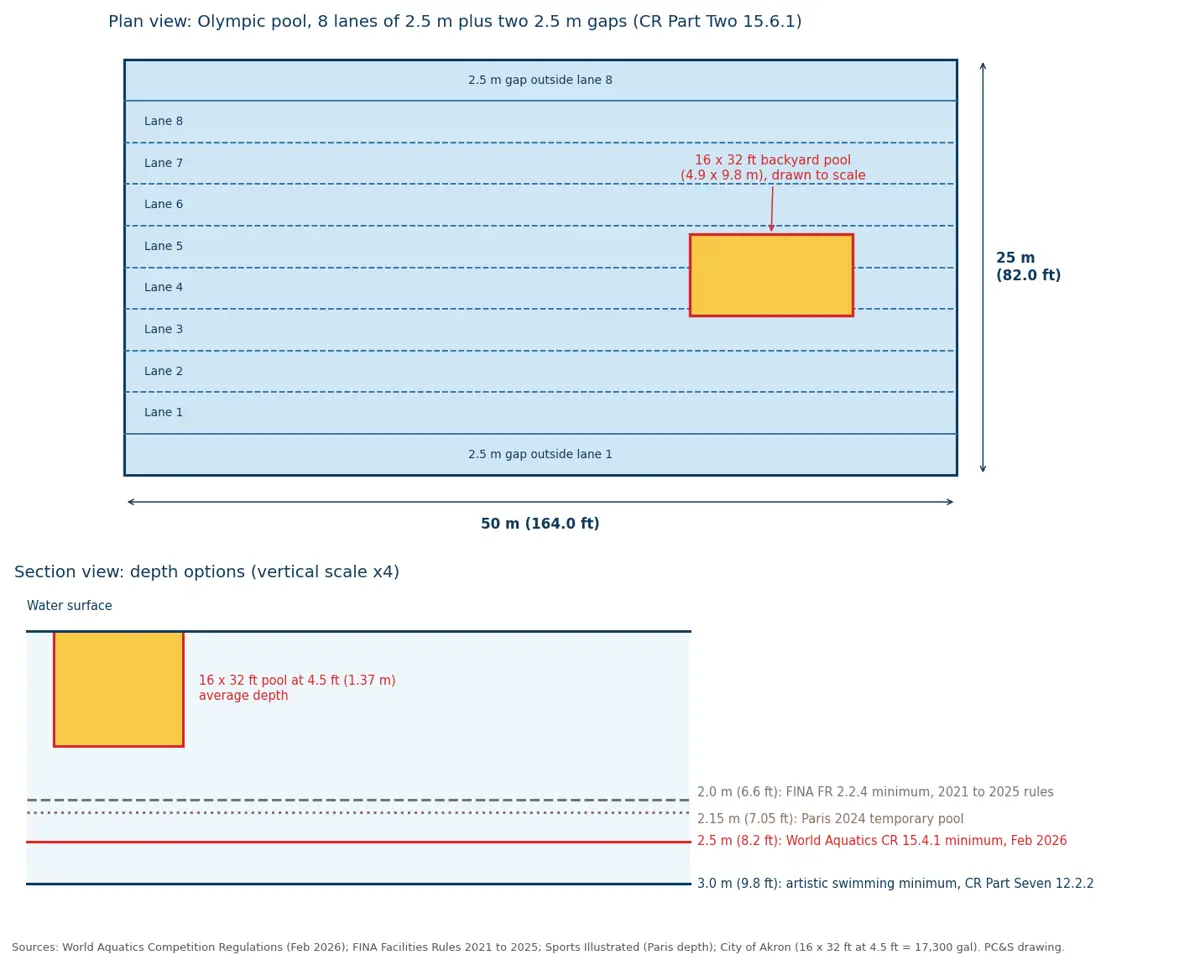
| FINA FR 2.2.4 minimum (2021 to 2025 rules) | 2.0 | 6.56 | 2,500 | 2,500,000 | 660,430 | 88,287 |
| Paris 2024 temporary pool, as built | 2.15 | 7.05 | 2,687.5 | 2,687,500 | 709,962 | 94,908 |
| World Aquatics CR 15.4.1 minimum (Feb 2026) | 2.5 | 8.20 | 3,125 | 3,125,000 | 825,538 | 110,358 |
| Artistic swimming minimum; FINA recommended | 3.0 | 9.84 | 3,750 | 3,750,000 | 990,645 | 132,430 |
Sources: dimensions from World Aquatics CR Feb 2026 and FINA FR 2.2.4; Paris depth from Sports Illustrated, July 30, 2024; conversion factors from NIST SP 811 Appendix B.9. PC&S arithmetic. Download CSV
The math has two steps. Multiply length by width by depth for cubic meters, then by 1,000 for liters. For US gallons divide the liters by 3.785412, and for cubic feet divide the cubic meters by 0.02831685; both factors are from NIST Special Publication 811. Working in feet lands within rounding: 110,358 cubic feet x 7.48 gallons per cubic foot, the USGS figure, is 825,480 gallons, 0.007% below the liter route.
A real venue holds a little more or less than the box. Gutters, a deeper diving well or a movable bulkhead change the count, so a specific pool’s volume comes from its plans. For a pool in your yard, measured in feet, our pool volume calculator runs the same math with the 7.48 factor.
How deep is an Olympic pool, and why do guides still say 2 meters?
At least 2.5 meters (8.2 ft). Article 15.4.1 of the World Aquatics Competition Regulations in force from February 2026 sets that minimum for the Olympic Games and World Championships. Many guides still print 2 meters because that was FINA rule FR 2.2.4 in the 2021 to 2025 Facilities Rules, which also recommended 3 meters for pools shared with artistic swimming.
| Claim | Where it appears (checked 2026-11-01) | What the current rule says |
|---|---|---|
| Minimum depth is 2 m (6 ft 7 in) | Wikipedia, Olympic-size swimming pool; ResortPass blog | 2.5 m minimum at the Olympics and World Championships (CR Part Two 15.4.1, Feb 2026); 2 m was FINA FR 2.2.4 in the 2021 to 2025 rules |
| An Olympic pool holds about 660,000 gallons | Wikipedia; SwimOutlet; ResortPass | True only at 2.0 m. At the 2.5 m minimum the water is 3,125 cubic m, about 825,500 US gallons |
| Olympic pools have 10 lanes | Several guides list 8 to 10 lanes | Olympics: 8 lanes of 2.5 m plus a 2.5 m gap each side (15.6.1). World Championships: 10 lanes (15.6.2) |
| 3 m is only a recommendation | Wikipedia (FINA wording) | 3.0 m is required for artistic swimming routines at the Olympics (CR Part Seven 12.2.2) |
Sources: guide pages read November 1, 2026; World Aquatics Competition Regulations (Feb 2026); FINA Facilities Rules 2021 to 2025. Download CSV
Paris 2024 shows why the number moved. The temporary pool at La Defense Arena was built 2.15 m deep, deeper than the 2 m minimum when the Paris plans were approved but short of the 2.5 m World Aquatics now sets, Sports Illustrated reported on July 30, 2024. The same report put the U.S. Olympic Trials pool in Indianapolis at about 2.8 m, and noted zero world records in the first 15 Paris events.
Depth is about waves. In Sports Illustrated’s account, a shallower pool sends more swimmer-made waves bouncing off the floor, and a deeper one keeps the water calmer, with 3 m called the ideal. At 2.5 m an Olympic pool holds 625 more cubic meters than at 2.0 m, about 165,100 extra gallons, which is the price of that calmer water.
| Discipline | Field or pool size | Minimum depth | Water temperature | Rule (World Aquatics CR, Feb 2026) |
|---|---|---|---|---|
| Swimming | 50 x 25 m | 2.5 m | 25.0 to 28.0 C | Part Two 15.1, 15.3.1, 15.4.1, 15.11.1 |
| Artistic swimming routines (Olympics, Worlds) | 30 x 20 m minimum | 3.0 m | 27 C or warmer | Part Seven 12.1.4, 12.2.2 |
| Water polo | Field of play 25 x 20 m | 2.00 m | 25.0 to 27.0 C | Part Six 20.2.2, 20.2.4, 20.2.5 |
| Diving (facilities built after 1 Jan 2025) | Per Appendix 1 and 2 tables | 5 m under boards if possible | 28 C or warmer | Part Four 15.1.2.1, 15.2.12.1 |
Source: World Aquatics Competition Regulations, Parts Two, Four, Six and Seven (Feb 2026). Download CSV
How big is an Olympic pool compared with a backyard pool?
One Olympic pool covers about 26 typical backyard pools and holds about 48 of them. Its 13,455 sq ft of water is 25.9 times the median 520 sq ft we measured across 24,562 backyard pools in 20 US metros, and its 825,538 gallons at 2.5 m equal 47.7 pools of 16 x 32 ft at a 4.5 ft average depth.
Backyard volume assumes Akron's 4.5 ft average depth for a 16 x 32 ft pool.
Source: World Aquatics CR Feb 2026; PC&S NAIP measurement (/standard-pool-size/); City of Akron; City of Las Vegas permits. PC&S arithmetic.. Download chart data (CSV)
| Comparison | Olympic pool | Backyard reference | Ratio | Source of the backyard figure |
|---|---|---|---|---|
| Water surface | 13,455 sq ft (1,250 sq m) | about 520 sq ft (median of 24,562 measured pools, 20 metros) | 25.9 | PC&S measurement of USDA NAIP imagery, 2022 to 2023 |
| Water surface | 13,455 sq ft | 512 sq ft (16 x 32 ft) | 26.3 | Arithmetic |
| Gallons at 2.0 m depth | 660,430 | 17,300 (16 x 32 ft at 4.5 ft average depth) | 38.2 | City of Akron gallons table |
| Gallons at 2.5 m depth | 825,538 | 17,300 (16 x 32 ft at 4.5 ft average depth) | 47.7 | City of Akron gallons table |
| Gallons at 3.0 m depth | 990,645 | 17,300 (16 x 32 ft at 4.5 ft average depth) | 57.3 | City of Akron gallons table |
| Gallons at 2.5 m depth | 825,538 | 10,300 (median 2025 Las Vegas permit volume) | 80.1 | City of Las Vegas permits, PC&S analysis |
Sources: World Aquatics CR Feb 2026; PC&S aerial measurement in our standard pool size study; City of Akron gallons table; 2025 Las Vegas permits via Average Cost to Build a Pool. Download CSV
The two backyard references bracket what Americans own. Our aerial measurement of 24,562 existing pools in 20 metros found a median of about 520 sq ft, close to a 16 x 32 ft pool, while the median new pool on 2025 Las Vegas permits held 10,300 gallons, so a 2.5 m Olympic pool equals 80 of those. Size bands, depths and gallons for home pools are in our standard pool size guide.
Depth drives the gap more than footprint does. A 16 x 32 ft pool covers 3.8% of an Olympic water surface but holds only 2.1% of its water, because Akron’s table assumes a 4.5 ft average depth while the Olympic floor sits at 8.2 ft or more across the full 50 m.
How long would it take to fill an Olympic pool with a garden hose?
About 38 to 48 days of nonstop running at the 2.5 m minimum depth. The City of Highfill, Arkansas puts a typical 5/8 inch garden hose at 12 to 15 gallons a minute, so 825,538 gallons takes 917 to 1,147 hours. The same hose fills a 16 x 32 ft backyard pool of 17,300 gallons in about 19 to 24 hours.
Real flow depends on water pressure, hose length and diameter.
Source: City of Highfill, AR (hose flow 12 to 15 gpm); World Aquatics CR Feb 2026; City of Akron. PC&S arithmetic.. Download chart data (CSV)
| Pool | US gallons | Hours at 15 gpm | Hours at 12 gpm | Days, nonstop (15 to 12 gpm) | Math |
|---|---|---|---|---|---|
| Olympic, 2.0 m deep | 660,430 | 733.8 | 917.3 | 30.6 to 38.2 | gallons / gpm / 60 / 24 |
| Olympic, 2.5 m deep | 825,538 | 917.3 | 1,146.6 | 38.2 to 47.8 | gallons / gpm / 60 / 24 |
| Olympic, 3.0 m deep | 990,645 | 1,100.7 | 1,375.9 | 45.9 to 57.3 | gallons / gpm / 60 / 24 |
| 16 x 32 ft backyard pool, 4.5 ft average | 17,300 | 19.2 | 24.0 | 0.8 to 1.0 | gallons / gpm / 60 / 24 |
Sources: hose flow from the City of Highfill, AR water audit; volumes from the table above and the City of Akron. PC&S arithmetic. Download CSV
Competition pools are not run off a hose. On competition and training days, article 15.11.2.2.1 requires 220 to 250 cubic meters of water an hour to flow in and out of a 50 m pool, which turns over all 3,125 cubic meters every 12.5 to 14.2 hours. One garden hose at 12 to 15 gpm moves 2.73 to 3.41 cubic meters an hour, and a hand-held hose with a spray nozzle runs 3 to 5 gpm (City of Thousand Oaks), which would stretch the fill to about 114.7 days.
Water bills for a backyard fill, city by city, with sewer credits and hydrant meter options, are priced in our cost to fill a pool study; in Phoenix, 10,000 gallons cost $90.31 in water and sewer charges at 2026 rates.
Is a 25-yard pool Olympic size? Short course pools explained
No. A 25-yard pool is 75 ft (22.86 m) long, less than half of the 164 ft Olympic course, and a 25 meter pool is 82 ft. Both are short course pools. The NCAA’s 2025-27 rules list 25 yards, 25 meters and 50 meters as standard lengths, and USA Swimming sanctions all three under article 103.3 of its 2026 rulebook.
| Course | Length | Lanes and width | Depth | Rule | Source |
|---|---|---|---|---|---|
| Long course meters (Olympic distance) | 50.00 m (164 ft 1/2 in) | Olympics: 25 m wide; USA Swimming: 8 or 10 lanes of 2.5 m at national championships | Olympics 2.5 m; USA Swimming national championships 2 m (6 ft 7 in) | CR 15.1, 15.4.1; USA Swimming 103.2.1, 103.3.1A | World Aquatics CR Feb 2026; USA Swimming 2026 Rulebook |
| Short course meters | 25.00 m (82 ft 1/4 in) | NCAA preferred: 8 lanes of 7 ft, 60 ft wide | World Swimming Champs (25m) 2.0 m; NCAA preferred 7 ft | CR 15.4.2; NCAA Rule 1-1-2 | World Aquatics CR Feb 2026; NCAA 2025-27 Rules |
| Short course yards | 25 yards (75 ft, 22.86 m) | NCAA preferred: 60 ft wide, 8 lanes of 7 ft; existing pools: 30 ft, 5 lanes of 6 ft | NCAA preferred 7 ft; at least 4 ft at the start end | NCAA Rule 1-1-2, 1-2-1 | NCAA 2025-27 Rules |
| Any sanctioned USA Swimming meet | 50 m, 25 m or 25 yd; minus 0.000 m tolerance | Local minimum lane 7 ft (2.13 m) | Racing starts need 4 ft (1.22 m) from 3 ft 3.5 in to 16 ft 5 in out | USA Swimming 103.2.3, 103.3.2B | USA Swimming 2026 Rulebook |
Sources: World Aquatics CR (Feb 2026); NCAA Swimming and Diving Rules 2025-26 and 2026-27, Rule 1 (updated Oct. 1, 2026); USA Swimming 2026 Rules and Regulations, Article 103. Download CSV
Short course rules are looser on depth. The NCAA prefers 7 ft (2.13 m) of water in pools with plans dated after September 1, 1996, requires only 4 ft (1.22 m) at the starting end, and accepts existing 25 yard pools 30 ft wide with five 6 ft lanes. USA Swimming asks for 2 meters (6 ft 7 in) throughout the course at its national championships and international meets and allows racing starts in 4 ft of water measured 3 ft 3.5 in to 16 ft 5 in from the wall (articles 103.2.1 and 103.2.3).
Lap counts change with the course. The 1,500 m freestyle in the World Aquatics program is 30 lengths of a 50 m pool, and a statute mile of 1,609.344 m (NIST) is 32.19 lengths. College swimmers race the 1,650 yard freestyle in the NCAA program, which is 66 lengths of a 25 yard pool. A 25 meter pool runs 7.02 ft (2.14 m) longer than a 25 yard pool, so times from the two courses are not interchangeable.
What size are public pools in the US?
Public pool counts do not record length. Trust for Public Land counted 1,354 public pools in 99 of the 100 largest US cities for its 2026 City Park Facts, counting any indoor or outdoor pool at least 4 ft deep. In NRPA’s 2026 review, 25% of park and recreation agencies ran an indoor competitive pool of 25 yards or 25 meters or larger.
Neither dataset splits out 50 m pools, so check a pool’s course before you train for a long course meet. Access varies about 30-fold between large cities, from Cleveland’s 10.73 public pools per 100,000 residents to Madison’s 0.35, and the city tables are in our public pools by city study. New York City Parks, for one, lists “Olympic and intermediate pools” among its free outdoor pools.
Which pool size do you need?
Match the pool to the course you race or the space you have. An Olympic course is 50 m; the NCAA also races 25 yards and 25 meters; and a backyard lap pool needs one 2.5 m (8.2 ft) lane rather than a 25 m wide basin. The table gives the rule or number behind each choice, from volume math to start-end depth.
| If your situation is | Do this | Rule or number behind it |
|---|---|---|
| You need the volume of an Olympic pool for a calculation | Use 3,125 cubic m (about 825,500 gal) unless you know the pool is 2.0 m deep | CR 15.4.1 sets 2.5 m; 50 x 25 x 2.5 = 3,125 cubic m |
| A local pool advertises Olympic size | Ask for the course length (50 m or 25 yd), lane count and depth at the start end | Only a 50 m course is Olympic length; NCAA and USA Swimming also sanction 25 yd and 25 m |
| You train for college or high school meets | A 25 yard (75 ft) pool is the course you race in | NCAA Rule 1-2-3 lists 25 yards, 25 meters or 50 meters as standard lengths |
| You want a backyard lap pool | Plan one 2.5 m (8.2 ft) lane and 40 to 75 ft of length, not an Olympic footprint | A 16 x 32 ft pool is under 4% of an Olympic water surface |
| You are scoping a public or school competition pool | Fix the course (25 yd, 25 m or 50 m), lane count and start-end depth before design | NCAA prefers 7 ft depth; USA Swimming racing starts need 4 ft |
Sources: World Aquatics CR (Feb 2026); NCAA Rule 1; USA Swimming Article 103; PC&S arithmetic. Download CSV
For a home pool, competition length is rarely the goal. Angi describes the typical residential lap pool as 8 by 40 ft and 4 ft deep, and lengths and recorded permit prices are in our lap pool cost guide. A school, club or city pool built to NCAA or USA Swimming rules is a different contract, covered in our commercial pool construction guide.
How we compiled this
On November 1, 2026 we read the World Aquatics Competition Regulations in force from February 2026 (Parts Two, Four, Six and Seven), FINA’s 2021 to 2025 Facilities Rules, the NCAA’s 2025-27 swimming rules and USA Swimming’s 2026 rulebook, and quoted each rule by article. Volumes and fill times are our arithmetic with NIST and USGS factors; backyard figures come from our aerial measurement, City of Akron and Las Vegas permit data, with hose flow from two city water pages: 12 primary documents and datasets in all.
Frequently Asked Questions
How many gallons is an Olympic-sized pool?
About 825,500 US gallons at the 2.5 m minimum depth that World Aquatics sets in article 15.4.1 of its February 2026 rules: 50 x 25 x 2.5 m is 3,125 cubic meters, or 825,538 gallons at 3.785412 liters per gallon. The widely quoted 660,000 gallons assumes the old 2.0 m minimum, and a 3.0 m deep pool holds about 990,600 gallons.
How deep is an Olympic pool in feet?
At least 8.2 ft (2.5 m) at the Olympic Games and World Championships, under article 15.4.1 of the World Aquatics Competition Regulations in force from February 2026. Artistic swimming routines need 3.0 m (9.8 ft). The 2.0 m (6.6 ft) minimum in FINA’s 2021 to 2025 rules no longer applies, though the Paris 2024 pool was built to it at 2.15 m.
How long is an Olympic pool in feet?
164 ft 1/2 in, which is 50.00 m, as USA Swimming states in article 103.3.1 of its 2026 rulebook. The width is at least 25 m, or 82.0 ft, for a permanent Olympic pool. With touch panels at both ends, World Aquatics sets the wall to wall distance at 50.020 to 50.030 m so the swum distance is never short.
How many laps in an Olympic pool is a mile?
A statute mile of 1,609.344 m (NIST) is 32.19 lengths of a 50 m Olympic pool, or about 16 round trips. The 1,500 m freestyle, a World Aquatics event, is exactly 30 lengths. In a 25 yard pool the college distance event is the 1,650 yard freestyle, which is 66 lengths.
Why are Olympic pools so deep?
To calm the water. Sports Illustrated reported on July 30, 2024 that a shallower pool sends more swimmer-made waves bouncing off the floor, with 3 m called the ideal. World Aquatics now requires 2.5 m for Olympic swimming (article 15.4.1) and 3.0 m for artistic swimming routines (Part Seven 12.2.2); the Paris 2024 pool was 2.15 m deep.
How long does it take to fill an Olympic pool?
With one 5/8 inch garden hose at 12 to 15 gallons a minute, the flow the City of Highfill, Arkansas gives, about 38 to 48 days nonstop for 825,538 gallons at 2.5 m depth. Competition pools circulate 220 to 250 cubic meters an hour on meet days (World Aquatics article 15.11.2.2.1), 65 to 92 times the flow of one hose.
Is an Olympic pool 25 or 50 meters?
50 meters. Olympic swimming is long course, and World Aquatics article 15.1.1.1 requires 50.000 m between the touch panels. A 25 meter pool is short course, used for the separate World Aquatics Swimming Championships (25m), where article 15.4.2 sets a 2.0 m minimum depth. A 25 yard pool, 75 ft long, is the third standard course in NCAA and USA Swimming rules.
Sources
- World Aquatics. Competition Regulations, in force as from February 2026 (Part Two article 15; Parts Four, Six, Seven). Accessed 2026-11-01.
- FINA (now World Aquatics). Facilities Rules 2021 to 2025, valid as of August 5, 2021 (FR 2.1, FR 2.2). Accessed 2026-10-08.
- NCAA. Men's and Women's Swimming and Diving Rules 2025-26 and 2026-27, Rule 1 (updated Oct. 1, 2026). Accessed 2026-11-01.
- USA Swimming. 2026 Rules and Regulations, Article 103 Facilities Standards. Accessed 2026-11-01.
- National Institute of Standards and Technology. NIST Guide to the SI, Appendix B.9 conversion factors. Accessed 2026-11-01.
- National Institute of Standards and Technology. Revised Unit Conversion Factors (foot = 0.3048 m). Accessed 2026-10-08.
- U.S. Geological Survey. Water Science Glossary (1 cfs = 7.48 gallons per second). Accessed 2026-11-01.
- City of Akron, Ohio. How to calculate the gallons in a swimming pool. Accessed 2026-10-04.
- City of Highfill, Arkansas. Do-It-Yourself Residential Customer Water Audit. Accessed 2026-10-04.
- City of Thousand Oaks. Water Use. Accessed 2026-10-04.
- Sports Illustrated. Are the Paris Olympics Suffering From a Slow Pool? (July 30, 2024). Accessed 2026-11-01.
- Trust for Public Land. City Park Facts 2026, Amenities and Facilities data tables. Accessed 2026-10-05.
- National Recreation and Park Association. 2026 NRPA Agency Performance Review. Accessed 2026-10-05.
- City of Las Vegas. Building Permits open data (pool volume field), 2025. Accessed 2026-10-03.
Related pages
Get Quotes From Licensed Local Pool Pros
Tell us what you need and your ZIP code. We match you with pool companies that cover your area.