Pool Bonding: The NEC 680.26 Equipotential Bonding Checklist
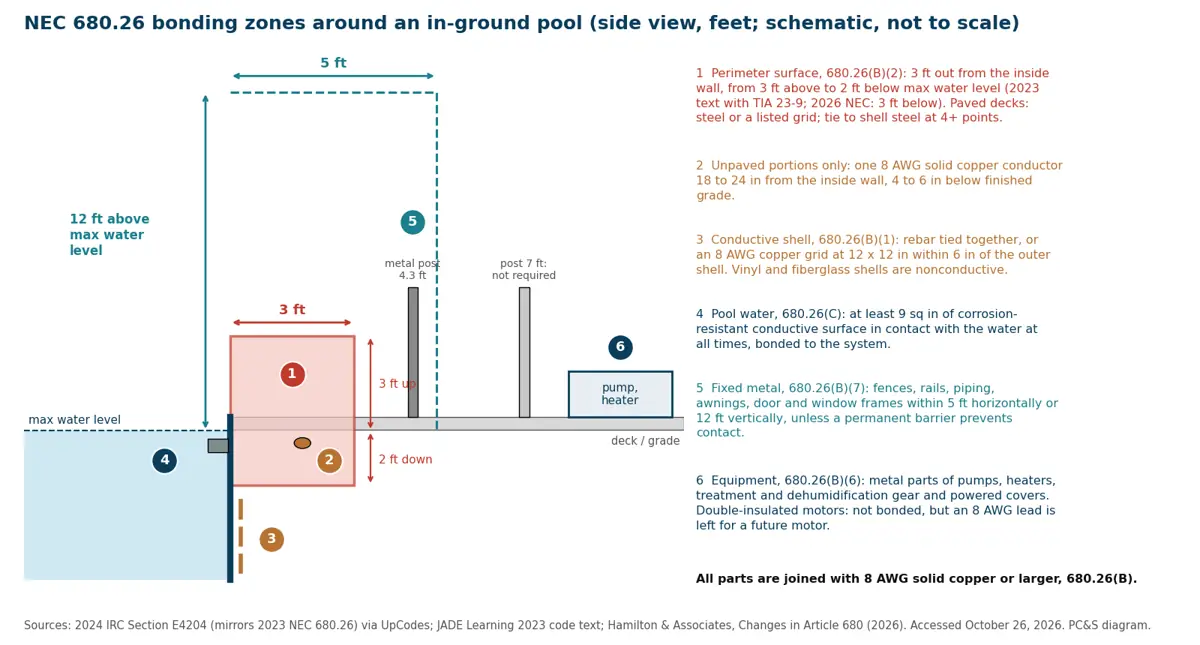
Pool bonding is the NEC 680.26 equipotential bonding of a pool: the shell steel, the deck 3 ft out, metal within 5 ft, pumps and the water are joined with 8 AWG solid copper.
- ✓Section by section12 checklist rows with 2023 NEC section numbers, methods and exceptions.
- ✓Edition awareWhat changed in 2017, 2020, 2023 (TIA 23-9) and 2026, and which states enforce which edition.
- ✓Inspection readyPre-gunite, pre-deck and final checks from a city checklist, plus common violations.
Key takeaways
- NEC 680.26 joins the shell steel, the deck within 3 ft, metal within 5 ft, pumps and the water itself with 8 AWG solid copper or larger (2024 IRC E4204, mirroring 2023 NEC 680.26).
- The pool water needs a bond of at least 9 sq in of conductive surface in contact with the water at all times, a rule in force since the 2008 and 2014 editions (JADE Learning, 680.26(C)).
- Under the 2023 NEC with TIA 23-9, the bonded perimeter runs 3 ft out and from 3 ft above to 2 ft below maximum water level; the 2026 NEC makes it 3 ft below (Hamilton & Associates, 2026).
- A single 8 AWG copper ring 18 to 24 in out and 4 to 6 in deep now serves unpaved ground only; paved decks need embedded steel or a listed grid (2024 IRC E4204.2).
- As of October 2026, 18 states enforce the 2023 NEC, 17 the 2020 edition and 6 the 2026 edition, so the rule your inspector reads depends on the state (NFPA, via our electrocution research).
- CPSC knows of 33 electrocution deaths in US pools and spas from 2002 to 2018 (CPSC).
What is pool bonding, and how is it different from grounding?
Pool bonding is equipotential bonding under NEC 680.26: every conductive part a swimmer can touch, plus the water, is joined with 8 AWG solid copper so no voltage difference builds between them. Grounding is a separate job that connects equipment to earth and clears faults. The 8 AWG bonding conductor need not run back to the panel.
| Rule | Number | NEC section (2023) | Source |
|---|---|---|---|
| Minimum bonding conductor | 8 AWG solid copper (2026 NEC adds 40% copper-clad steel) | 680.26(B) | 2024 IRC E4204.2; JADE Learning |
| Perimeter surface reach | 3 ft horizontally from the inside pool wall | 680.26(B)(2) | 2024 IRC E4204.2 |
| Perimeter surface height band | 3 ft above to 2 ft below max water level (2023 with TIA 23-9); 3 ft below in 2026 | 680.26(B)(2) | JADE Learning; Hamilton & Associates |
| Tie points, conductive shell | 4 or more, uniformly spaced | 680.26(B)(2) | 2024 IRC E4204.2 |
| Unpaved single conductor | 18 to 24 in from inside wall, 4 to 6 in below finished grade | 680.26(B)(2)(b) | 2024 IRC E4204.2 |
| Copper grid in or under shell | 12 x 12 in, 4 in tolerance, within 6 in of outer shell | 680.26(B)(1)(b) | 2024 IRC E4204.2 |
| Fixed metal reach | 5 ft horizontally, 12 ft vertically above max water level | 680.26(B)(7) | 2024 IRC E4204.2 |
| Pool water bond | 9 sq in (5,800 sq mm) of conductive surface | 680.26(C) | 2024 IRC E4204.3 |
| Wall that limits the perimeter | Permanent wall or building 5 ft tall or more | 680.26(B)(2) | 2024 IRC E4204.2 |
| Small metal parts exempt | 4 in or less in any dimension and 1 in or less into the structure | 680.26(B)(5) | 2024 IRC E4204.2 |
Sources: 2024 IRC Section E4204 via UpCodes; JADE Learning 680.26(B)(2); JADE Learning 680.26(B); Hamilton & Associates. Download CSV
Section 680.26(A) states the purpose: reduce voltage gradients in the pool area. L. Keith Lofland, writing in EC&M (July 6, 2021), calls 680.26 one of the most misread sections of the code, and splits the job in two: the conductive pool shell (belly steel) and the perimeter surface (deck steel), each with its own rules.
NFPA offers free online access to the full NEC text through its NFPA 70 page after registration. For one- and two-family homes, many cities enforce the same rules through the International Residential Code, where Section E4204 reproduces 680.26 with section references in brackets. The spa and hot tub rules in Part IV of Article 680, from the GFCI to the 5 ft disconnect, are summarized in our hot tub wiring guide.
Does my pool need to be bonded?
Yes, if it is a permanently installed pool, spa or hot tub, with or without electrical equipment, per the 2023 NEC and 2024 IRC E4204.1. Vinyl and fiberglass shells skip shell bonding but still need the deck, metal parts, equipment and water bonded. Listed self-contained spas with a rim at least 28 in above surfaces within 30 in are exempt from perimeter bonding, among other conditions.
Storable pools are the gray zone. The 2026 NEC adds that a storable pool assembled on site against a permanent deck that encloses part of its perimeter must meet 680.26, according to the Hamilton & Associates handout presented at The Pool & Spa Show 2026; a kiddie pool on a patio is not covered.
Older pools are not forced to upgrade. The same handout notes that the NEC does not require older pools to be brought to current standards routinely, but since the 2020 edition a reconstructed conductive shell must meet current bonding rules, and a replaced pump motor needs GFCI protection under 680.21(D). A replaster or rebuild is the moment to fix bonding.
What must be bonded under NEC 680.26? A checklist by component
NEC 680.26 lists seven groups of bonded parts plus the pool water: the conductive shell, perimeter surfaces, other metallic components, underwater lighting, metal fittings, electrical equipment and fixed metal parts within 5 ft horizontally or 12 ft vertically. The checklist below gives each component its method, size, 2023 section number and exceptions.
| Component | What gets bonded | Method and size | NEC 2023 section | Exceptions |
|---|---|---|---|---|
| Conductive pool shell | Cast-in-place, sprayed concrete and plastered block shells | Rebar tied with steel tie wire; if rebar is encapsulated, an 8 AWG bare solid copper grid at 12 x 12 in within 6 in of the outer shell | 680.26(B)(1)(a), (b) | Vinyl liners and fiberglass shells are nonconductive |
| Perimeter surface, paved | Concrete, pavers and other paving within 3 ft of the inside wall | Unencapsulated rebar or welded wire embedded in the paving; if not possible, a listed copper grid or welded wire directly under it, 6 in or less below finished grade | 680.26(B)(2)(a) | Pool side only behind a permanent wall or building 5 ft or taller |
| Perimeter surface, unpaved | Soil, gravel or lawn within 3 ft | At least one 8 AWG bare solid copper conductor, 18 to 24 in from the inside wall, 4 to 6 in below finished grade | 680.26(B)(2)(b) | None stated |
| Nonconductive perimeter | Raised decks on nonconducting supports | No bonding required | 680.26(B)(2)(c) | Applies only when separated from earth or electrically separated |
| Interconnection | All bonded perimeter sections | Listed splicing devices or exothermic welding; 8 AWG solid copper may encircle the pool | 680.26(B)(2)(d) | None stated |
| Tie to the shell | Perimeter bonding to shell steel or grid | 4 or more uniformly spaced points (conductive shells); to the 8 AWG conductor (nonconductive shells) | 680.26(B)(2) | None stated |
| Metallic components | Other reinforcing metal of the structure | Bonded to the system | 680.26(B)(3) | Rebar encapsulated in a nonconductive compound |
| Underwater lighting | Metal forming shells and no-niche mounting brackets | Bonded to the system | 680.26(B)(4) | Listed low-voltage systems with nonmetallic forming shells |
| Metal fittings | Ladders, rails, drains and fittings attached to the pool | Bonded to the system | 680.26(B)(5) | Parts 4 in or less that enter the structure 1 in or less; small cover anchors |
| Electrical equipment | Pump motors, heaters, treatment and dehumidification gear, powered covers | Metal parts bonded | 680.26(B)(6) | Double-insulated motors (leave an 8 AWG lead); heaters over 50 A bond only marked parts |
| Fixed metal parts | Fences, piping, awnings, door and window frames, metal raceways | Bonded if within 5 ft horizontally or 12 ft vertically | 680.26(B)(7) | Behind a permanent barrier that prevents contact |
| Pool water | The water itself | 9 sq in or more of corrosion-resistant conductive surface in contact at all times | 680.26(C) | Not needed if a bonded part already touches the water |
Sources: 2024 IRC Section E4204 (mirrors 2023 NEC 680.26); JADE Learning 2023 code language; JADE Learning 680.26(C). Download CSV
Two exceptions trip up bids. A double-insulated pump motor is not bonded, but 680.26(B)(6)(a) still requires an 8 AWG solid copper lead left near the motor for a future replacement. Pool water heaters rated over 50 A bond only the parts the maker designates, under 680.26(B)(6)(b). Our pool pump replacement cost guide covers the GFCI rule that applies when the motor is swapped.
How far does pool bonding extend around the deck?
The bonded perimeter surface extends 3 ft horizontally from the inside wall of the pool. Under the 2023 NEC with TIA 23-9 it covers surfaces from 3 ft above to 2 ft below maximum water level; the 2026 NEC makes it 3 ft above and below. Paved decks need embedded steel or a listed grid; unpaved ground may use one 8 AWG ring.
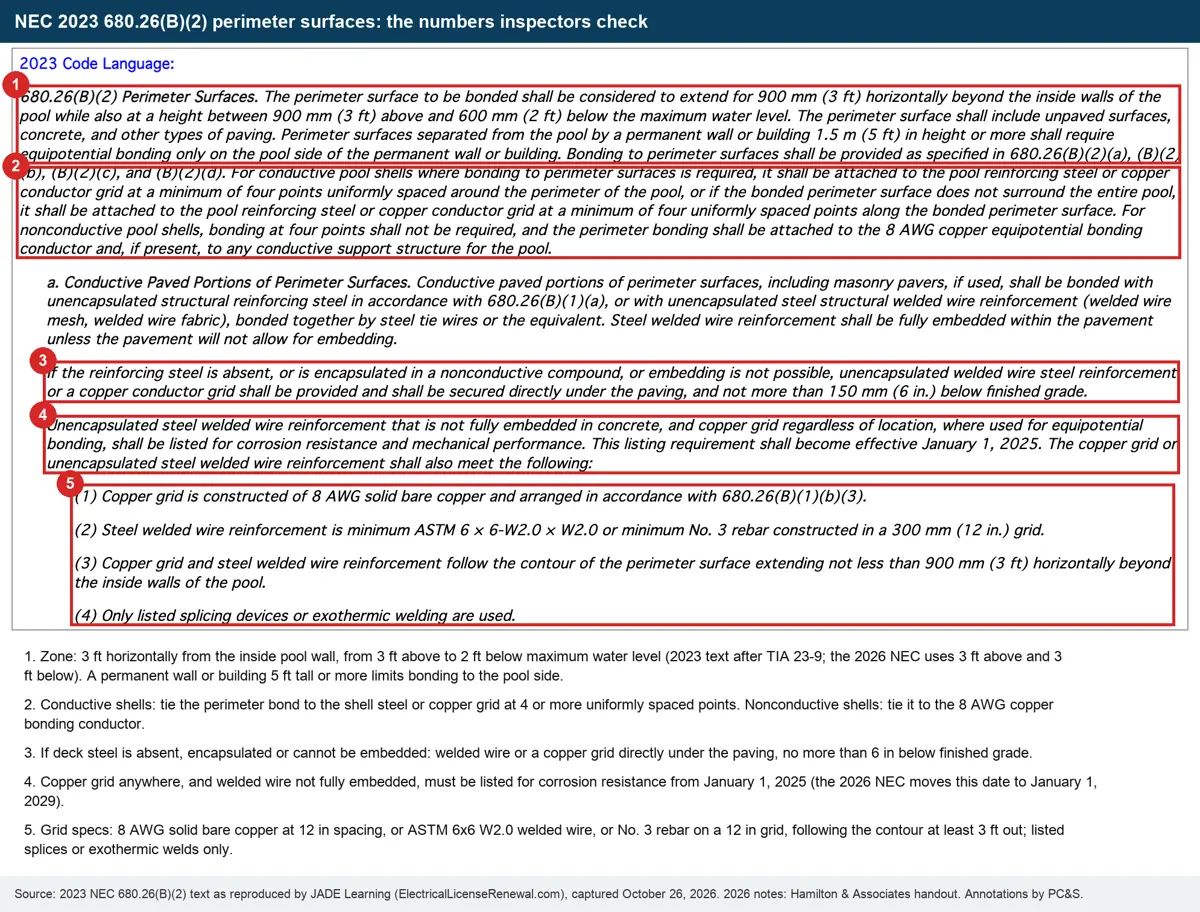
How deep does pool bonding need to be? For unpaved ground, the single 8 AWG conductor sits 4 to 6 in below finished grade and 18 to 24 in from the inside wall. Under paving with no usable steel, the grid or welded wire goes directly under the paving, no more than 6 in below finished grade (2023 NEC 680.26(B)(2)).
Copper grids, and welded wire not fully embedded in concrete, had to be listed for corrosion resistance from January 1, 2025 under the 2023 text; the 2026 NEC moves that date to January 1, 2029. The Hamilton handout also warns that some states do not recognize TIAs, and there the older 2020 language, with the copper ring allowed for everything, still governs.
| What a guide says | Who says it | What the code text says | Code source |
|---|---|---|---|
| Bonding a pool involves running a thick copper wire around the perimeter | Pool Pros (Wisconsin) blog | Under the 2023 text with TIA 23-9 and the 2026 NEC, a single 8 AWG conductor serves unpaved portions only; paved decks need embedded steel or a listed grid | 680.26(B)(2)(a), (b) |
| Install the bonding ring 6 to 8 inches below final grade | Village of Olmsted Falls, Ohio handout (undated) | 4 to 6 inches below finished grade (subgrade in editions before 2023) | 680.26(B)(2)(b) |
| Perimeter bonding attaches at a minimum of 4 points around the pool | InterNACHI article | The 4-point rule applies to conductive shells; nonconductive shells tie the perimeter to the 8 AWG bonding conductor | 680.26(B)(2) |
| Bonding makes a low-impedance path to trip the overcurrent device | InterNACHI article | Equipotential bonding reduces voltage gradients, and its 8 AWG conductor need not run to a panelboard, service or electrode | 680.26(A), (B) |
| Products meet NEC 2014 Article 680.26 | Harger line card | Four later editions (2017, 2020, 2023, 2026) changed 680.26; check which edition your city enforces | NFPA enforcement map |
| Section 680.26(8) requires bonding of metal within 5 ft and 12 ft | City of Murrieta DS-141 (May 2024) | The fixed-metal rule sits in 680.26(B)(7) | 680.26(B)(7) |
Sources: Pool Pros WI; Village of Olmsted Falls; InterNACHI; Harger; City of Murrieta DS-141; code text from 2024 IRC E4204 and JADE Learning. Download CSV
What changed in NEC 680.26 in the 2017, 2020, 2023 and 2026 editions?
Four editions since 2014 changed pool bonding. 2017 defined the perimeter as an area 3 ft out including unpaved ground; 2020 pulled reconstructed shells under current rules; 2023 with TIA 23-9 capped the height band and required grids under paved decks; 2026 widened the band to 3 ft below and allowed 40% copper-clad steel.
| NEC edition | What changed for pool bonding | Section | Source |
|---|---|---|---|
| 2008 | Bond to pool water introduced; conductive vs nonconductive shells clarified; perimeter grid vs single conductor ring | 680.26(B), (C) | Hamilton & Associates; JADE Learning |
| 2011 | Water bond set at 9 sq in minimum; perimeter bonding limited to the pool side of a permanent wall or building 5 ft or taller | 680.26(B)(2), (C) | JADE Learning; Hamilton & Associates |
| 2014 | Water bond must be corrosion resistant, in contact at all times, and not dislodged in normal use | 680.26(C) | JADE Learning |
| 2017 | Perimeter surface defined as an area 3 ft out, including unpaved surfaces; bonding terminals listed for direct burial | 680.26(B)(2); 680.7 | Hamilton & Associates |
| 2020 | Reconstructed conductive shells must meet current bonding rules; small pool cover anchors exempted; GFCI on replaced pump motors | 680.26(B)(1), (B)(5); 680.21(D) | Hamilton & Associates |
| 2023 with TIA 23-9 (effective April 10, 2023) | Bond pools with or without equipment; perimeter limited to 3 ft above and 2 ft below max water level; paved surfaces need steel or a grid; listed grids from January 1, 2025 | 680.26(B)(2) | Hamilton & Associates; JADE Learning |
| 2026 | Band becomes 3 ft above and 3 ft below; 40% copper-clad steel allowed; grid listing date moves to January 1, 2029; storable pools abutting a permanent deck must comply | 680.26(B), (B)(2) | Hamilton & Associates; JADE Learning |
Sources: Hamilton & Associates, Changes in Article 680 (Pool & Spa Show 2026); JADE Learning 680.26(C); JADE Learning 680.26(B); JADE Learning 680.26(B)(2). Download CSV
The 2026 states are Colorado, Maine, Massachusetts, Minnesota, North Dakota and Wyoming.
Source: Source: NFPA NEC enforcement maps (accessed October 7, 2026), via PC&S research /research/pool-electrocution-statistics/. Some states list separate commercial and residential editions; the listed edition is shown.. Download chart data (CSV)
The edition matters more than the newest code book. As of October 2026, 3 states still list the 2008 NEC and 3 leave adoption to cities, per the NFPA enforcement maps summarized in our pool electrocution statistics report. A Phoenix-area builder and a Denver builder can therefore face different perimeter rules for the same deck.
How is pool bonding inspected?
Bonding is inspected before it is buried. The City of Murrieta, California requires four pool inspections: pre-gunite, pre-deck, pre-plaster and final, and its May 2024 handout lists the bonded parts it checks. Steel and grid bonds must pass before concrete or pavers cover them; the water bond and equipment bonds are checked at final.
- Pre-gunite: shell steelRebar tied together, or a 12 x 12 in 8 AWG copper grid within 6 in of the shell; bonded to the common grid (Murrieta DS-141; 680.26(B)(1)).
- Pre-deck: perimeterDeck steel, welded wire or listed grid 3 ft out, tied to the shell at 4 or more points; unpaved ring 18 to 24 in out and 4 to 6 in deep (680.26(B)(2)).
- ConnectionsListed clamps or exothermic welds; terminals marked for direct burial (DB) under 680.7; no sheet metal screws on bonding conductors (InterNACHI).
- Fittings and fixed metalLadders, rails, light niches, fences and frames within 5 ft or 12 ft bonded (680.26(B)(4), (B)(5), (B)(7)).
- Final: equipment and waterPump, heater and treatment equipment bonded; 9 sq in water bond present; GFCI on pump and underwater light circuits (680.26(B)(6), (C); 680.21 and 680.23).
Lofland’s list of common Article 680 violations in EC&M starts with the bonding grid, which he says installers and inspectors alike misread, treating belly steel and deck steel as one component and mixing up bonding with grounding. The same list flags the missing 8 AWG lead at double-insulated pump motors.
The stakes are legal as well as physical. The Hamilton handout recounts a 2013 Houston hotel pool electrocution in which 2 electricians were charged with criminally negligent homicide; investigators found no GFCI on the pool light, improper bonding and no permit. Our pool permit guide shows a typical city inspection sequence, and the pool construction process shows where each inspection falls in the build. The GFCI, 18 in lens depth and 4 ft junction box rules for the light itself are set out in our pool lighting guide.
What happens if a pool is not bonded?
Without bonding, a fault can put the water, ladder and deck at different voltages, and current flows through a swimmer who touches two of them. CPSC knows of 33 electrocution deaths in US pools and spas from 2002 to 2018 and lists tingling, muscle cramps or being unable to move as warning signs. A missing bond can also fail inspection or a home sale.
33 deaths and 33 injuries across 47 incidents.
Source: Source: U.S. Consumer Product Safety Commission, Don't Swim with Shocks (CPSRMS data, 2002 to 2018), via PC&S research /research/pool-electrocution-statistics/.. Download chart data (CSV)
Injury data show the scale beyond deaths. A 2019 study in Pediatric Emergency Care found 566 emergency-department cases of pool electrical injury in NEISS from 1991 to 2013; 91.8% were treated and released, 48.4% were children, and outlets or receptacles were involved in 39.8%. That last figure points at GFCI and receptacle rules, which work alongside bonding rather than replacing it.
If swimmers report tingling, CPSC says to get out of the water without touching a metal ladder, turn off all power and only then help others. A licensed electrician can test the bonding system before the pool reopens. Our pool electrocution statistics report has the full death and injury records.
How much does pool bonding cost?
No national survey prices pool bonding alone. Materials are modest: a 112 ft 8 AWG copper ring for a 16 x 32 ft pool costs about $106 in wire, and a copper grid for a paved deck about $1,390 in two 100 ft rolls at October 2026 retail prices. River Pools puts a full electrical package with bonding at $3,500 to $4,500 in Virginia, Maryland and DC.
| Item (16 x 32 ft pool) | Quantity | Unit price (USD, Oct 2026) | Materials cost (USD) | Arithmetic |
|---|---|---|---|---|
| Unpaved ring: 8 AWG bare solid copper at 24 in out | 112 ft | 473.99 per 500 ft roll | 106.17 (1 roll: 473.99) | 2 x (20 + 36) = 112 ft; 112 x 473.99 / 500 |
| Paved deck: CMI EB3100 copper grid, 3 ft x 100 ft | 108 ft centerline | 695 per 100 ft roll | 1,390 (2 rolls) | 2 x (19 + 35) = 108 ft; 108 / 100 rounds up to 2 rolls |
| Full electrical package incl. bonding, pump, light, timer, GFCI receptacle | 1 job | Contractor estimate | 3,500 to 4,500 | River Pools, Virginia, Maryland and DC (updated July 2020) |
Prices: EZ Pool & Spa Supply (CMI EB3100 grid; 8 AWG bare copper, 500 ft), October 26, 2026; River Pools (updated July 20, 2020). Lengths: PC&S arithmetic from 680.26(B)(2) distances. Download CSV
The deck method sets the materials line: a paved deck costs about 13 times the copper of a lawn edge in this example ($1,390 vs $106). Builders who own pool service routes can price retrofit work around replasters, when 2020 and later codes already require shell bonding. See how to start a pool service business for the license split between cleaning and repair, and for pool pros for how PC&S checks licenses before introductions.
| If your situation is | Do this | Code basis |
|---|---|---|
| New gunite or shotcrete pool | Tie the shell rebar and pass the steel and bonding inspection before concrete covers it | 680.26(B)(1)(a) |
| Vinyl liner or fiberglass pool | Skip shell bonding but still bond the deck, metal parts, equipment and water; tie the deck to the 8 AWG conductor | 680.26(B)(1), (B)(2), (C) |
| Poured concrete deck within 3 ft | Bond the deck steel or welded wire and tie it to the shell at 4 or more points; schedule the pre-deck inspection | 680.26(B)(2)(a) |
| Pavers on sand or a deck with no steel | Use a listed copper grid or welded wire directly under the paving, 6 in or less below finished grade | 680.26(B)(2)(a) |
| Lawn or gravel within 3 ft | One 8 AWG bare solid copper conductor 18 to 24 in out, 4 to 6 in below finished grade | 680.26(B)(2)(b) |
| Replacing a pump motor | Reconnect the motor bond to the system and add GFCI protection; a double-insulated motor keeps an 8 AWG lead nearby | 680.26(B)(6); 680.21(D) |
| Replastering or rebuilding a concrete shell | Under the 2020 NEC and later, a reconstructed shell must meet current shell bonding rules | 680.26(B)(1) |
| Older pool, no work planned | The NEC does not force a routine upgrade, but tingling in the water means power off and a licensed electrician | Hamilton & Associates; CPSC |
| Your state enforces the 2026 NEC (6 states as of October 2026) | Use the 3 ft above and 3 ft below band; 40% copper-clad steel is allowed | 680.26(B), (B)(2) (2026) |
Sources: 2024 IRC E4204 (2023 NEC 680.26); Hamilton & Associates; CPSC; NFPA enforcement maps. Download CSV
How we compiled this
We read the 2023 NEC 680.26 text as reproduced by JADE Learning and the 2021 and 2024 IRC Section E4204 on UpCodes, the Hamilton & Associates Article 680 changes handout (2026), handouts from Murrieta, California and Olmsted Falls, Ohio, InterNACHI and EC&M articles, CPSC and a PubMed-indexed study, on October 26, 2026. NEC edition counts reuse our October 7, 2026 NFPA review. We did not inspect any pool and excluded forum posts.
Frequently Asked Questions
What is pool bonding?
Pool bonding is the equipotential bonding NEC 680.26 requires: the shell steel, the deck within 3 ft, metal within 5 ft, pumps and heaters and the water itself are joined with 8 AWG solid copper so they sit at the same voltage (2024 IRC E4204). It reduces voltage gradients that could push current through a swimmer.
How much does pool bonding cost?
No national survey prices it alone. For a 16 x 32 ft pool, an 8 AWG ring for unpaved ground needs about 112 ft of copper, about $106 at October 2026 retail, while a paved-deck copper grid takes two $695 rolls. River Pools quotes $3,500 to $4,500 for a full electrical package with bonding in Virginia, Maryland and DC (River Pools).
Does my pool need to be bonded?
Yes for any permanently installed pool, spa or hot tub, with or without electrical equipment, under the 2023 NEC. Vinyl and fiberglass pools still bond the deck, metal parts, equipment and water. Older pools are not forced to upgrade, but since the 2020 NEC a reconstructed concrete shell must meet current bonding rules.
What happens if a pool is not bonded?
A fault can leave the water, ladder and deck at different voltages, and current can flow through a swimmer touching two of them. CPSC knows of 33 pool and spa electrocution deaths from 2002 to 2018 (CPSC). An unbonded pool also fails the steel, deck or final inspection and can surface in a home sale.
How deep does pool bonding need to be?
For unpaved ground, the single 8 AWG copper conductor goes 4 to 6 in below finished grade and 18 to 24 in from the inside pool wall, under 680.26(B)(2)(b). Under paving without usable steel, a listed grid or welded wire sits directly under the paving, no more than 6 in below finished grade.
Do above-ground pools need bonding?
Storable pools that are taken down for storage fall outside 680.26, which covers permanently installed pools (IRC E4204.1), but the 2026 NEC adds that a storable pool built against a permanent deck that encloses part of its perimeter must meet the bonding rules, per the Hamilton & Associates 2026 handout. Permanently installed above-ground pools are bonded like any permanent pool. Ask your inspector which category applies.
Sources
- International Code Council via UpCodes. Section E4204 Equipotential Bonding (2024 IRC, mirrors 2023 NEC 680.26). Accessed 2026-10-26.
- International Code Council via UpCodes. E4204.2 Bonded Parts (2021 IRC, mirrors 2020 NEC 680.26). Accessed 2026-10-26.
- JADE Learning (ElectricalLicenseRenewal.com). 680.26(B)(2) Perimeter Surfaces (2023 code language). Accessed 2026-10-26.
- JADE Learning (ElectricalLicenseRenewal.com). 680.26(B) Equipotential Bonding (2023 and 2026 code language). Accessed 2026-10-26.
- JADE Learning (ElectricalLicenseRenewal.com). 680.26(C) Pool Water (2011 and 2014 code language). Accessed 2026-10-26.
- Hamilton & Associates. Changes in Article 680: 2020, 2023 and 2026 National Electrical Code (Pool & Spa Show 2026 handout). Accessed 2026-10-26.
- NFPA. NFPA 70, National Electrical Code (free access). Accessed 2026-10-26.
- NFPA. NEC enforcement maps, via PC&S research. Accessed 2026-10-07.
- U.S. Consumer Product Safety Commission. Don't Swim with Shocks: Electrical Safety In and Around Pools, Spas and Hot Tubs. Accessed 2026-10-26.
- Tashiro J, Burnweit CA (PubMed). Swimming Pool Electrical Injuries: Steps Toward Prevention (Pediatr Emerg Care 2019). Accessed 2026-10-26.
- City of Murrieta Building and Safety. DS-141 Swimming Pool Inspections & Equipotential Bonding (May 2024). Accessed 2026-10-26.
- Village of Olmsted Falls Building Department. Pool Bonding Requirements. Accessed 2026-10-26.
- InterNACHI. Inspecting Grounding and Bonding at Residential Swimming Pools (Wayback copy, 2026). Accessed 2026-10-26.
- EC&M (L. Keith Lofland). Common Code Violations with Swimming Pools and Similar Installations (July 6, 2021). Accessed 2026-10-26.
- Pool Pros (Wisconsin). Pool Bonding 101. Accessed 2026-10-26.
- Harger. Pool Grounding & Bonding line card. Accessed 2026-10-26.
- River Pools. Swimming Pool Wiring: How Much Does Electrical Hook-up Cost? (updated July 20, 2020). Accessed 2026-10-26.
- EZ Pool & Spa Supply. CMI EB3100 copper equipotential bonding grid and 8 AWG bare copper listings. Accessed 2026-10-26.
- PC&S Research. Pool Electrocution Statistics. Accessed 2026-10-26.