Pool Finishes Compared: Plaster, Quartz, Pebble, Glass Bead and Tile
Pool finishes are the cement, stone, glass or tile layer that lines a concrete pool: plaster lasts about 7 to 12 years, quartz 10 to 15 and pebble 15 to 20 or more, per HomeGuide.
- ✓Maker warranties read line by lineSGM, Pebble Technology International and NPT terms compared: term, registration, exclusions and who pays labor.
- ✓Lifespan claims checkedSGM gives white plaster 7 to 10 years on one page and 5 to 10 on another; Fannie Mae plans on 8.
- ✓Start-up rules side by sideNPC, SGM and Pebble Tec disagree on salt timing: 28 days or 30 days after plastering.
Key takeaways
- HomeGuide prices standard plaster at $6 to $8 per square foot, quartz at $7 to $10, pebble at $7 to $15 and tile at $8 to $30 or more (April 2025); its Pebble Tec page puts that brand at $10 to $20.
- Lifespan claims disagree even inside one maker: SGM gives white plaster 7 to 10 years on its plaster page and 5 to 10 years on its comparison page, while Fannie Mae plans on 8 years for a pool plaster liner.
- SGM extends its 1-year warranty to 10 years residential for Diamond Brite and River Rok, pro-rated and for materials only, and voids it without monthly computerized water tests (SGM warranty terms).
- Pebble Technology International covers material defects for at least 5 years and requires its Authorized Installer to cover workmanship for at least 5 years; neither transfers to a new owner (PTI warranties).
- The National Plasterers Council start-up procedure (REV 03-2021) says a new finish is most prone to staining and scaling in its first 28 days: no chlorine for 48 hours, no salt for 30 days, then keep the saturation index at 0.0 to +0.3.
- SGM excludes freeze-thaw cracking, delamination and debonding from its warranty, including damage after draining a pool for winter (SGM FAQ).
What are the main types of pool finishes?
Concrete pools take five families of finish: white plaster, quartz, pebble (exposed aggregate), glass bead and tile, plus polished marble and paint at the edges of the market. The National Plasterers Council describes the cement finishes as white cement with white sands or other aggregates such as colored quartz, pebble or glass bead, mixed with water, additives and pigments.
| Finish | What it is made of | Feel | Price per sq ft (HomeGuide 2025) | Lifespan (HomeGuide 2025) | Example product lines | Source |
|---|---|---|---|---|---|---|
| White plaster (marcite) | White cement and crushed marble | Smoothest cement finish | $6 to $8 | 7 to 12 years | SGM Pool Brite; NPT PlasterScapes | HomeGuide; SGM; NPC |
| Quartz | Cement with natural or colored quartz aggregate | Smooth | $7 to $10 | 10 to 15 years | SGM Diamond Brite; NPT QuartzScapes; PTI PebbleQuartz | HomeGuide; SGM; NPT; PTI |
| Pebble (exposed aggregate) | Natural pebbles in cement, surface washed to expose the stone | Textured | $7 to $15 (Pebble Tec: $10 to $20) | 15 to 20+ years | PTI PebbleTec, PebbleSheen, PebbleFina; SGM River Rok; NPT StoneScapes | HomeGuide; SGM; PTI; NPT |
| Glass bead | Glass beads in white cement and pigment, or glass blended with stone | Smooth to lightly textured | Priced within aggregate: $6 to $15 | 15 years or more (aggregate) | NPT JewelScapes; PTI PebbleBrilliance | HomeGuide; NPT; PTI |
| Polished marble | Marble aggregate polished smooth; NPT adds glass and polishes with diamond abrasives | Very smooth | Not listed by HomeGuide | SGM: 15 to 20 years (Durazzo) | SGM Durazzo; NPT PolishedScapes | SGM; NPT |
| Tile | Ceramic, porcelain or glass tile set over the shell | Smooth with grout joints | $8 to $30+ | No year figure published | Many tile makers | HomeGuide |
| Paint | Epoxy or rubberized latex coating | Smooth | $1 to $2 | 5 to 7 years | n/a | HomeGuide |
Sources: HomeGuide (April 2025), HomeGuide Pebble Tec (March 2025), SGM, NPT, Pebble Technology International, NPC Technical Bulletin 3; accessed 2026-10-26. Download CSV
White plaster, also called marcite, is white cement mixed with crushed marble, which SGM, a Florida finish maker selling pool finishes since 1978, sells as Pool Brite (SGM). The National Plasterers Council (NPC), the trade group for pool plasterers, calls it a relatively soft finish that is more exposed to water chemistry than newer products (NPC). Its weak point is calcium hydroxide, which makes up 24 to 27% of fully hydrated white cement and is the first compound aggressive water dissolves (NPC Technical Bulletin 3).
Quartz and pebble finishes put a harder aggregate at the surface where it takes the wear. SGM says its Diamond Brite quartz finish is technically an exposed aggregate rather than a plaster, and the NPC describes pebble surfaces as the most durable surface available because river pebbles are chemically inert (NPC). Glass bead finishes swap stone for glass: NPT JewelScapes is 100% glass beads in white cement and pigment (NPT).
| Number | What it is | Source and date |
|---|---|---|
| $6 to $8 per sq ft | Standard white plaster resurfacing price | HomeGuide, April 2025 |
| $10 to $20 per sq ft | Pebble Tec price per square foot | HomeGuide Pebble Tec page, March 2025 |
| 8 years | Pool or spa plaster liner life in a lender planning table | Fannie Mae Form 4099.F Appendix F |
| 10 years | SGM extended residential warranty for Diamond Brite and River Rok (pro-rated, materials only) | SGM warranty terms, page modified June 2025 |
| 5 years | Minimum PTI material warranty and minimum installer workmanship warranty on PebbleTec finishes | PTI warranty page, modified January 2025 |
| 28 days | Window in which a new finish is most prone to staining, scaling and discoloration | NPC start-up procedure, REV 03-2021 |
| 0.0 to +0.3 | Saturation index (LSI) the NPC recommends for ongoing care | NPC start-up procedure, REV 03-2021 |
Sources: HomeGuide, HomeGuide Pebble Tec, Fannie Mae, SGM, PTI, NPC; accessed 2026-10-26. Download CSV
Quartz pool finish: what is it and how long does it last?
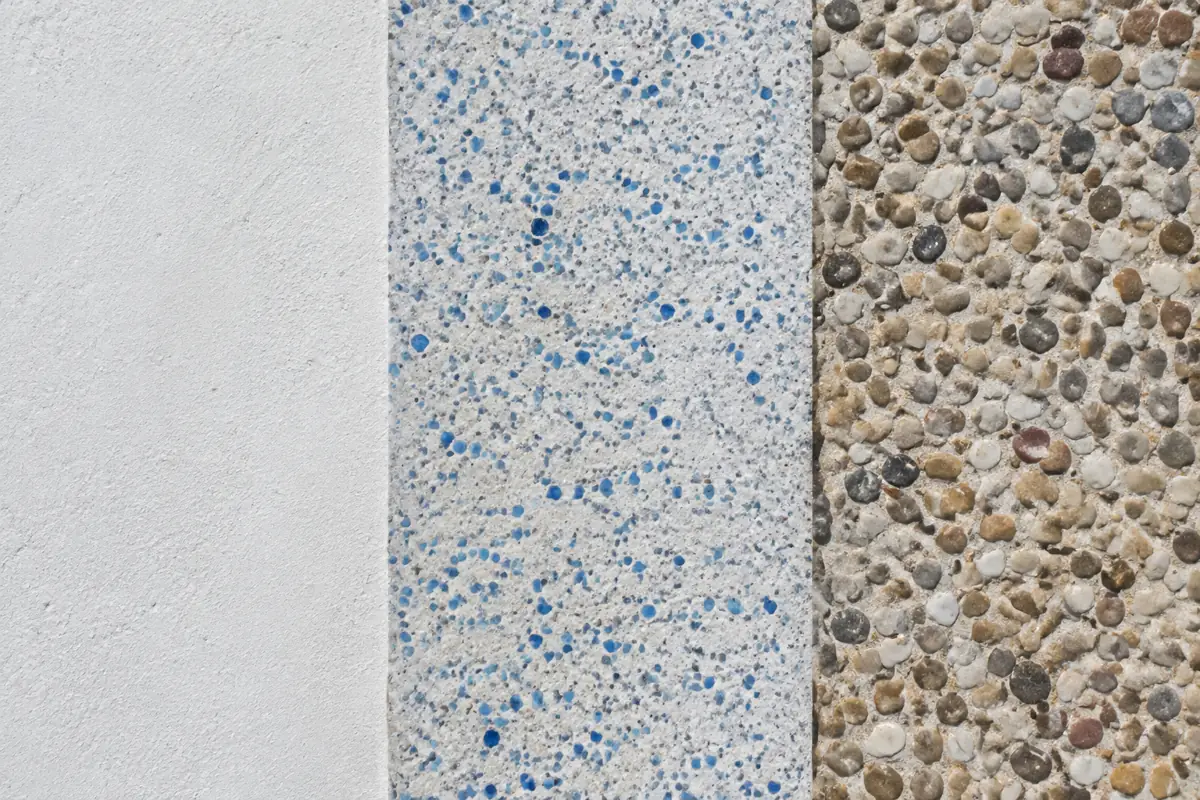
A quartz pool finish is white or pigmented cement blended with natural or colored quartz aggregate, smoother than pebble and harder than plain plaster. HomeGuide prices quartz plaster at $7 to $10 per square foot with 10 to 15 years of life (April 2025). SGM, which makes Diamond Brite, claims 15 to 20 years on one page and 12 to 18 on another.
Three quartz lines show how makers differ. SGM Diamond Brite uses natural colored quartz with polymer-modified cement (SGM). PebbleQuartz, from Pebble Technology International (PTI), uses silica-based aggregate in place of the marble in traditional quartz finishes (PTI). NPT QuartzScapes uses natural and colored quartz (NPT). None of the three publishes aggregate size in millimeters on its product pages, so ask for a physical sample board.
Material quantity is checkable. SGM says proper Diamond Brite coverage is 22 square feet per 80-pound bag and tells owners to ask each bidder how many bags they will apply (SGM consumer guide). A 16 x 32 ft pool with a 4.5 ft average depth has about 944 square feet of floor and wall, which works out to 42.9 bags, so 43 bags or 3,440 pounds. A bid that names fewer bags may be thinner than SGM specifies or a different product.
Pebble Tec cost: what does a pebble finish cost per square foot?
HomeGuide puts Pebble Tec at $10 to $20 per square foot, or $4,000 to $16,000 for a 400 to 800 square foot pool (March 2025), above its $7 to $15 range for pebble finishes in general. On a 16 x 32 ft pool with 944 square feet of floor and wall, that is $9,440 to $18,880 for Pebble Tec.
Same figures appear in the worked example table below the chart.
Source: HomeGuide, How Much Does Pool Resurfacing Cost? (April 25, 2025); Pebble Tec row from HomeGuide, How Much Does a Pebble Tec Pool Cost? (March 25, 2025). Download chart data (CSV)
| Finish | Price per sq ft | Price source | Cost for 944 sq ft | Lifespan used | Cost per year of service |
|---|---|---|---|---|---|
| Standard plaster | $6 to $8 | HomeGuide, April 2025 | $5,664 to $7,552 | 12 to 7 years | $472 to $1,079 |
| Quartz plaster | $7 to $10 | HomeGuide, April 2025 | $6,608 to $9,440 | 15 to 10 years | $441 to $944 |
| Pebble (all brands) | $7 to $15 | HomeGuide, April 2025 | $6,608 to $14,160 | 20 to 15 years | $330 to $944 |
| Pebble Tec | $10 to $20 | HomeGuide Pebble Tec page, March 2025 | $9,440 to $18,880 | 25 years | $378 to $755 |
| Tile | $8 to $30+ | HomeGuide, April 2025 | $7,552 to $28,320+ | No figure published | Not computable |
PC&S calculation. Area = 16 x 32 + 2 x (16 + 32) x 4.5 = 944 sq ft (flat-floor approximation). Prices and lifespans: HomeGuide resurfacing (April 2025) and HomeGuide Pebble Tec (March 2025). Download CSV
Cost per year narrows the gap. Pebble lands at $330 to $944 a year of service on 944 square feet against $472 to $1,079 for plaster, because HomeGuide gives pebble 15 to 20 or more years and plaster 7 to 12. Within the PTI range, HomeGuide rates PebbleTec and PebbleSheen as the lower price tier and PebbleFina and PebbleBrilliance as the higher one (HomeGuide). Only PTI Authorized Installers may apply the brand, and PTI calls PebbleSheen its most popular finish (PTI).
The finish is one line on the invoice. Draining, crack repair, waterline tile and refill water are priced separately, as our pool resurfacing cost guide shows. Refilling 20,000 gallons cost $39.00 to $649.98 across 25 US cities at rates in effect on October 4, 2026, with a median of $215.09, in our cost to fill a pool study.
Which pool finish lasts longest?
Pebble lasts longest among cement finishes in every source we checked: 15 to 20 or more years in HomeGuide, 20 or more in SGM, and 25 or more for Pebble Tec on HomeGuide. Tile is called the most durable by HomeGuide but carries no year figure. The one neutral planning number is Fannie Mae: 8 years for a pool plaster liner.
SGM publishes two different ranges for the same finishes on two of its own pages.
Source: HomeGuide (April 2025); SGM pool plaster page (May 2026) and comparison page (modified September 2026); Fannie Mae Form 4099.F Appendix F. Download chart data (CSV)
| Source | Type of source | Plaster | Quartz | Pebble | Date |
|---|---|---|---|---|---|
| HomeGuide resurfacing page | Cost guide | 7 to 12 years | 10 to 15 years | 15 to 20+ years | April 2025 |
| HomeGuide Pebble Tec page | Cost guide | n/a | n/a | 25 years or more (Pebble Tec) | March 2025 |
| SGM plaster page | Finish maker | 7 to 10 years | 15 to 20 years | 20+ years | May 2026 |
| SGM comparison page | Finish maker | 5 to 10 years | 12 to 18 years | 15 to 20 years | June 2025, modified Sept 2026 |
| National Plasterers Council consumer FAQ | Trade association | Up to 20 years with proper care | n/a | n/a | March 2023 |
| Fannie Mae Form 4099.F | Lender planning table | 8 years (plaster liner) | n/a | n/a | Appendix F, current |
Sources: HomeGuide, HomeGuide Pebble Tec, SGM plaster page, SGM comparison page, NPC FAQ, Fannie Mae Form 4099.F; accessed 2026-10-26. Download CSV
Two corrections follow from the source documents. First, SGM publishes two different lifespan sets: 7 to 10, 15 to 20 and 20 or more years for plaster, quartz and pebble on its May 2026 plaster page, but 5 to 10, 12 to 18 and 15 to 20 years on its comparison page. Second, the 8-year federal figure is for plaster only in Fannie Mae’s table; the U.S. Department of Housing and Urban Development (HUD) uses 8 years for a pool or spa plastic liner, which is vinyl, not plaster (HUD CNA e-Tool).
Water chemistry decides where a finish lands in those ranges. NPC Technical Bulletin 3 names low calcium hardness, low pH and low carbonate alkalinity as the conditions that dissolve cement around aggregate, and the NPC procedure warns that cyanuric acid at 100 ppm or more may permanently damage the surface (NPC). Our guides to calcium hardness and cyanuric acid cover how to test and correct both.
What do pool finish warranties actually cover?
Maker warranties cover the finish material, not the labor to fix it, and only if you register and keep water records. SGM extends a 1-year warranty to 10 years residential for Diamond Brite and River Rok, pro-rated. PTI covers PebbleTec material for at least 5 years. NPT offers 10 years, or lifetime limited with an Approved Applicator.
| Maker | Product line | Finish type | Aggregate as the maker describes it | Material warranty | Workmanship | Registration | Main exclusions | Transferable | Source |
|---|---|---|---|---|---|---|---|---|---|
| SGM | Diamond Brite; River Rok | Quartz; pebble | Natural colored quartz with polymer-modified cement; selected natural aggregates | 1 year; extended to 10 years residential or 5 years commercial, pro-rated, materials to repair the failed area only | Not covered; claims go to the applicator | Online within 30 days | Labor, delamination, check cracking, freeze-thaw, color variation, no monthly computerized water tests | No | SGM Pool and Spa Finish Warranty Terms |
| SGM | Durazzo; Ultra Pearl Brite; Diamond Brite Atlantic Blue | Polished marble; high-performance plaster | Marble aggregate; whitest marble with white Portland cement | 1 year; extended to 5 years residential only | Not covered | Online within 30 days | Same as above | No | SGM Pool and Spa Finish Warranty Terms |
| Pebble Technology International | PebbleTec, PebbleSheen, PebbleFina, PebbleBrilliance | Pebble; pebble with glass beads | More natural texture; slightly smaller pebbles; smallest natural pebbles; glass beads with stone | At least 5 years from installation | At least 5 years, provided by the Authorized Installer | Product registration offered | Defects not in the material; installs by non-authorized installers | No, original homeowner only | PTI Warranties page |
| Pebble Technology International | PebbleQuartz; PebbleCrystal | Quartz; compacted stone | Silica-based quartz aggregate; compacted stone | 1 year; 5 years if registered within 30 days | 2 years from the applicator if registered | Within 30 days | Same as above | No | PTI Warranties page; product pages |
| NPT | StoneScapes; QuartzScapes; PolishedScapes | Pebble; quartz; polished | Quartz pebble, Micro to Regular sizes; natural and colored quartz; marble and glass | 10 Year Limited; Lifetime Limited with an NPT Approved Applicator | Not covered (installation excluded) | Owner signs the warranty document | Installation, water chemistry, improper start-up | Not stated by NPT | NPT blog: NPT's Pool Finishes |
| NPT | ColorScapes | Colored plaster | Pigmented plaster | 10-year Standard Limited | Not covered | Owner signs the warranty document | Installation, water chemistry, improper start-up | Not stated by NPT | NPT blog: NPT's Pool Finishes |
Sources: SGM Pool and Spa Finish Warranty Terms (modified June 10, 2025), PTI Warranties (modified January 8, 2025), PTI PebbleCrystal, PTI PebbleQuartz, NPT finish guide (undated summary; NPT says the signed warranty document governs). Accessed 2026-10-26. Download CSV
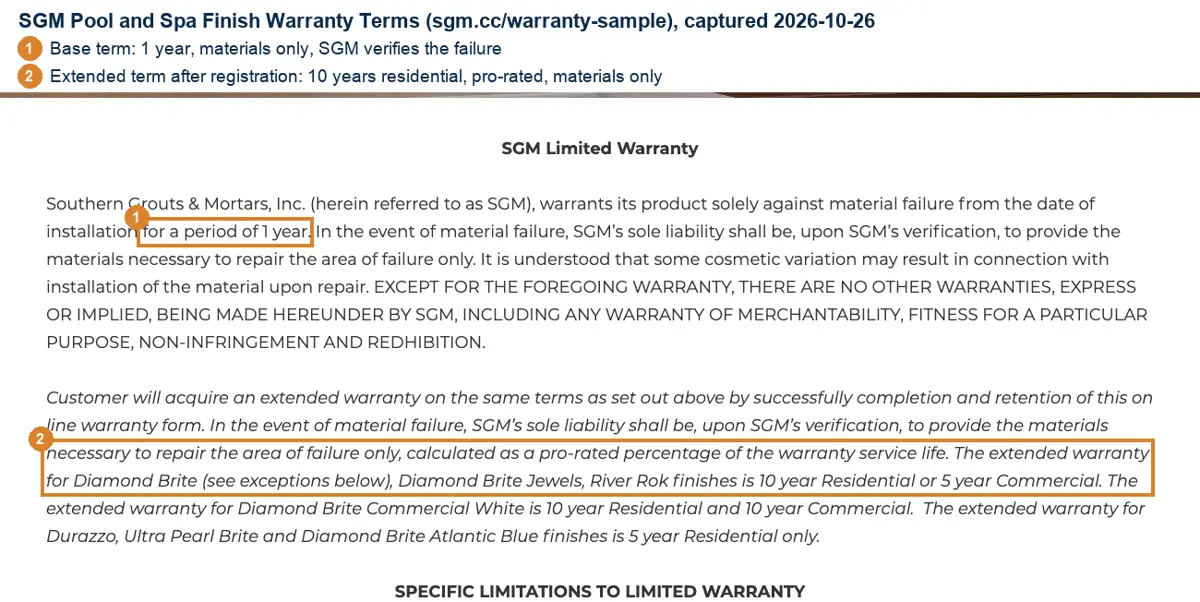
Read the exclusions before the term. SGM excludes labor, faulty workmanship, delamination, surface check cracking, freeze-thaw damage and color variation, and its warranty is void unless the applicator is paid in full and monthly printed water tests from a computerized system exist (SGM). PTI sends workmanship claims to the installer, who must cover them for at least 5 years (PTI). NPT covers pigment or quartz color out of specification and mislabeled product, not installation or water chemistry (NPT).
Some visual changes are not defects under any of these terms. An NPC-endorsed disclosure form says mottling and crazing (fine check cracks) are normal in cement finishes and that a finish is not guaranteed for evenness of color (NPC disclosure). Ask your contractor to give you that disclosure before work starts so the expectation is in writing. Which water color each named finish produces, maker by maker, is charted in our guide to pool plaster colors.
- Product and color by name SGM tells buyers to reject “or other exposed aggregate finish” wording and name the product, for example “Diamond Brite Cool Blue”.
- Bag count and batch numbers At 22 sq ft per 80 lb bag, a 944 sq ft pool needs about 43 bags of Diamond Brite; photograph the bag labels.
- Registration within 30 days SGM, PebbleQuartz and PebbleCrystal terms all start the clock at installation.
- Workmanship term in the contract PTI requires at least 5 years from its Authorized Installer; SGM leaves workmanship to the applicator.
- Water test records Keep printed reports: monthly for SGM, weekly testing recommended by PTI.
Get quotes on the finish you picked
When do glass bead and all-tile finishes make sense?
Glass bead suits owners who want a smooth feel with more sparkle than quartz, and all-tile suits owners who accept the top price for the longest-lived surface. HomeGuide prices aggregate finishes, which include glass bead blends, at $6 to $15 per square foot and tile at $8 to $30 or more, and calls tile the most durable option.
Glass bead lines come in two forms. NPT JewelScapes is all glass bead in white cement, sold in Classic, Reflective and Opal series (NPT). PTI PebbleBrilliance blends glass beads with natural stone, and PTI says the glass beads give extra foot comfort (PTI). HomeGuide does not price glass bead separately; it groups quartz, stone and glass bead blends as aggregate at $6 to $15 per square foot.
All-tile interiors sit at the top: $8 to $30 or more per square foot in HomeGuide, or $7,552 to $28,320 or more for 944 square feet. Most owners tile only the waterline band and finish the rest in cement. Fiberglass and vinyl pools follow other rules: a fiberglass shell can take a sprayed polymer coating, which HomeGuide prices at $10 to $15 per square foot for fiberglass or concrete, and a vinyl pool replaces its liner instead, as our pool liner replacement cost guide and gunite vs fiberglass vs vinyl comparison explain.
How do you protect a new pool finish in the first 28 days?
Follow the start-up procedure your finish maker names, which for most cement finishes is the NPC procedure. The NPC says a new finish is especially prone to staining, scaling and discoloration in its first 28 days, so the routine front-loads brushing, holds chlorine for 48 hours, holds salt for 30 days and raises calcium hardness in steps.
- Fill dayFill without stopping from the deepest point, with a clean cloth over the hose end; for a water truck, put 24 inches of water in the deep end first. No people or pets in the pool. Start filtration once full and run it continuously for 7 days, at least 72 hours.
- Day 1Test fill water. Bring total alkalinity to 80 to 100 ppm, then pH to 7.2 to 7.6 with pre-diluted 31 to 33% muriatic acid, then calcium hardness to 80 to 100 ppm in 10 lb increments hours apart. Brush the whole surface at least twice. No chlorine for 48 hours.
- Day 2Retest and raise calcium hardness to 100 to 150 ppm. Keep brushing twice daily.
- Day 3Add chlorine to 1.5 to 3.0 ppm. For a salt chlorine generator, add no salt within the first 30 days.
- Days 4 to 7Raise calcium hardness slowly to at least 200 ppm and begin cyanuric acid at 30 to 50 ppm through the skimmer.
- Days 7 to 28Remove leftover plaster dust with a brush vacuum. No wheeled vacuums or wheeled cleaners until after day 28.
| Start-up rule | NPC procedure (REV 03-2021) | SGM Diamond Brite terms | Pebble Tec care instructions |
|---|---|---|---|
| Brushing | At least twice daily until plaster dust is gone | Twice daily for 3 days, then daily for 2 weeks | Three times a day for 3 days, then twice a day for 10 days, nylon brush |
| First chlorine | None for 48 hours; 1.5 to 3.0 ppm on day 3 | None on days 1 and 2 | Not until pH and alkalinity are in range |
| Salt for a salt chlorine generator | Not within the first 30 days | Not for 28 days | Wait at least 28 days |
| Heater | Off until water is balanced and plaster dust is gone | Not stated | Wait at least 14 days |
| Wheeled or automatic cleaner | Not until after 28 days | No wheeled vacuum for 14 days; no automatic cleaner for 28 days | Not stated |
| Calcium hardness | 80 to 100 ppm day 1, 100 to 150 ppm day 2, at least 200 ppm from day 4 | At least 125 ppm for 3 days, then 200 to 400 ppm | Not stated |
| Ongoing balance | LSI 0.0 to +0.3, especially in the first 6 months | LSI 0.0 to +0.3 | Test at least once a week; keep printed reports |
Sources: NPC Recommended Start-up Procedures, REV 03-2021, SGM Initial Fill and Balancing, PTI Pool Care Instructions; accessed 2026-10-26. Download CSV
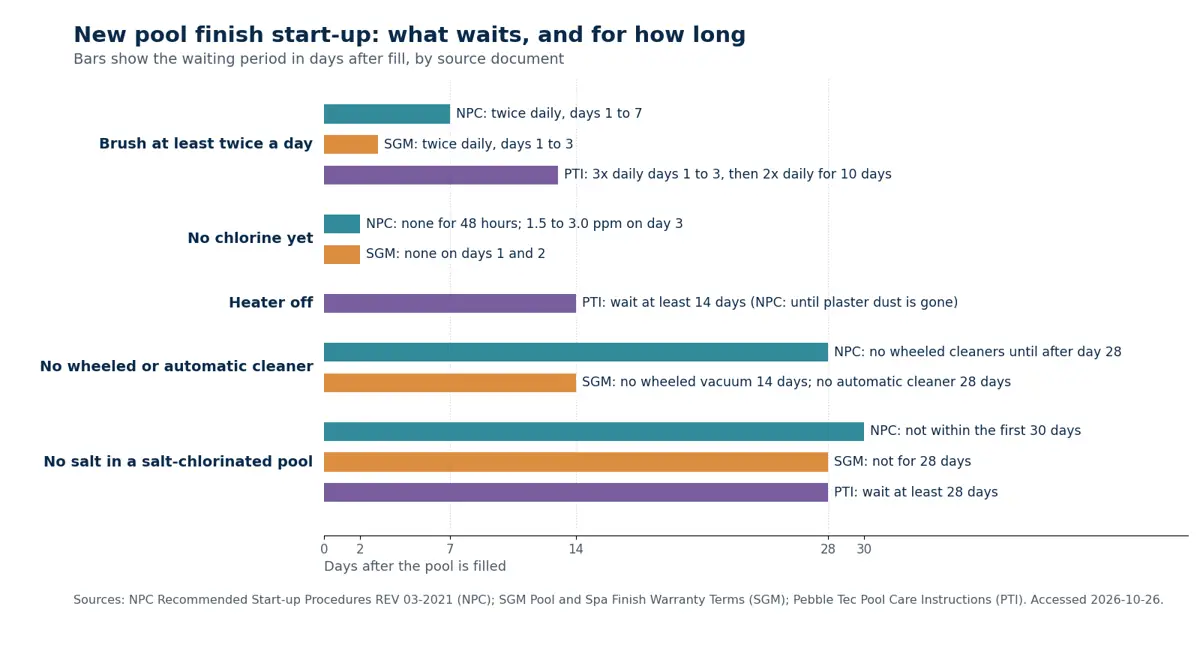
The three documents disagree on salt by two days: PTI and SGM say wait 28 days, the NPC says not within the first 30, and Pentair’s IntelliChlor guide says at least one month (PC&S saltwater study). Waiting 30 days satisfies all four. In Cal Poly test pools run for about 10 months, salt pools showed the most plaster etching, though the generators were oversized for the 7,900-gallon test pools (AQUA Magazine). Ongoing salt targets for each chlorinator model are in our salt water pool maintenance guide.
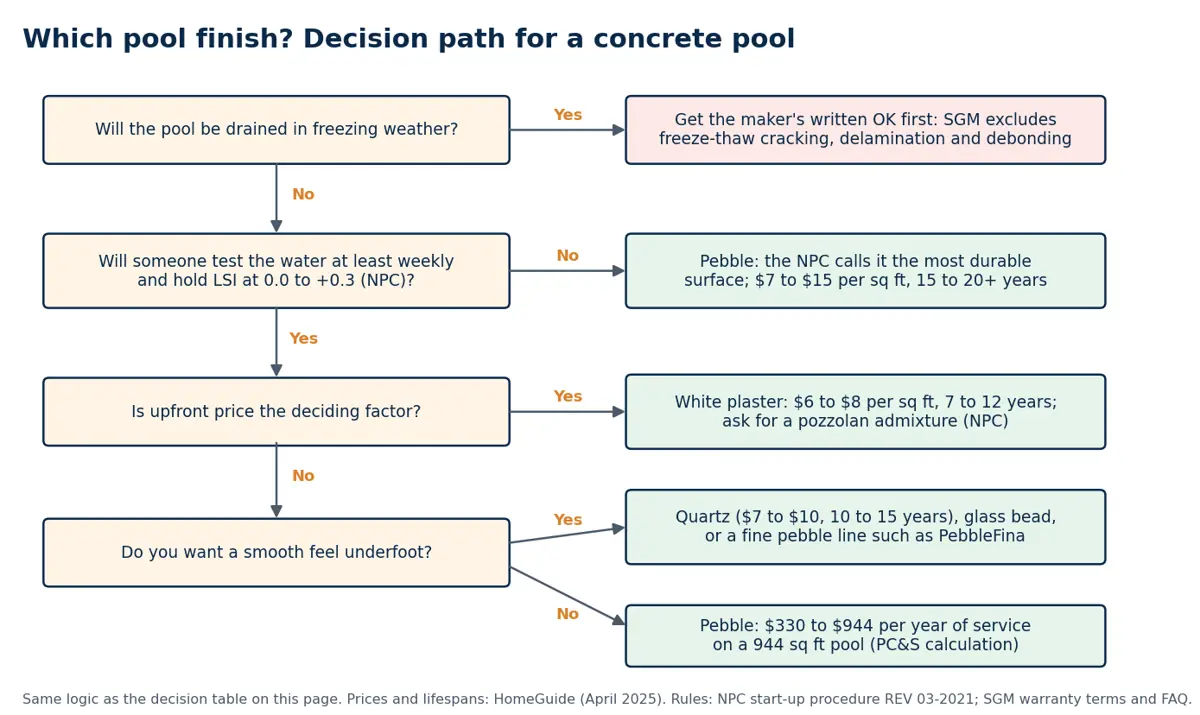
Which pool finish should you choose?
Choose by budget per year, feel underfoot and how well the water will be kept. Plaster wins on upfront price, pebble on cost per year and tolerance for imperfect chemistry, quartz and glass bead on smoothness with color. Warranty terms favor no one who drains the pool in a freezing winter or sells within the term.
| If your situation is | Do this | Why (source) |
|---|---|---|
| Lowest upfront price on a sound concrete shell | Standard white plaster, with a pozzolan admixture if offered | $6 to $8 per sq ft (HomeGuide); NPC says pozzolans lock up calcium hydroxide, the weakest compound |
| You want the lowest cost per year and do not mind texture | Pebble | $330 to $944 per year on 944 sq ft vs $472 to $1,079 for plaster (PC&S calculation from HomeGuide) |
| You want a smooth feel with more color and life than plaster | Quartz (Diamond Brite, QuartzScapes, PebbleQuartz) | 10 to 15 years at $7 to $10 per sq ft (HomeGuide) |
| Smooth feel plus sparkle, budget allows | Glass bead or PebbleFina | NPT JewelScapes is 100% glass beads; PTI says PebbleFina uses its smallest natural pebbles |
| Salt chlorine generator planned | Any cement finish, but no salt for 28 to 30 days and keep LSI 0.0 to +0.3 | NPC; SGM; PTI; Pentair says at least 1 month |
| Pool is drained for winter in a freezing climate | Ask the maker in writing before choosing; plan to keep water in | SGM excludes freeze-thaw cracking, delamination and debonding |
| Pool water is often unbalanced or serviced irregularly | Pebble over plaster; budget for a weekly test | NPC calls pebble the most durable surface; PTI requires weekly testing; SGM requires monthly printed tests |
| You may sell the house within the warranty term | Do not count on the finish warranty passing to the buyer | SGM and PTI warranties are non-transferable |
Sources: HomeGuide, NPC, SGM, SGM FAQ, PTI, NPT; PC&S calculation for cost per year. Download CSV
Season matters for application too. The NPC says no standard limits the air temperature for plastering, but crews should take precautions when the evaporation rate passes 0.2 pounds per square foot per hour, such as starting early and pre-wetting the shell (NPC). In freezing climates, ask how the finish is protected over winter before you sign, since our pool winterizing guide covers lowering the water rather than draining it. If the finish is part of a larger rebuild, our pool remodeling page covers tile, coping and deck work done while the pool is empty.
How we compiled this
We read 25 documents, accessed in October 2026: the published warranty terms, care instructions and product pages of three finish makers (14 pages from SGM, Pebble Technology International and NPT), six National Plasterers Council documents, two HomeGuide cost guides, the Fannie Mae and HUD useful-life tables and one AQUA Magazine report on Cal Poly test pools. We did not install or test any finish; every figure is quoted from those documents or calculated from them with the inputs shown.
Frequently Asked Questions
What is the best type of pool finish?
No single finish wins on every measure. Pebble lasts longest among cement finishes, 15 to 20 or more years per HomeGuide, and the NPC calls it the most durable surface. Plaster is cheapest upfront at $6 to $8 per square foot. Quartz sits between them at $7 to $10 and 10 to 15 years (HomeGuide).
What are the three most common finishes for concrete pools?
Plaster, quartz and pebble. SGM groups pool finishes into exactly these three categories, and HomeGuide prices them at $6 to $8, $7 to $10 and $7 to $15 per square foot (April 2025). Glass bead, polished marble and tile are less common alternatives (SGM).
What is the most affordable pool finish?
Paint is cheapest at $1 to $2 per square foot but lasts only 5 to 7 years. Standard white plaster, at $6 to $8 per square foot and 7 to 12 years, is the cheapest finish that lasts. Per year of service, pebble can cost less than plaster: $330 to $944 against $472 to $1,079 on a 944 sq ft pool, by our calculation from HomeGuide.
What is the longest-lasting pool finish?
Among cement finishes, pebble: 15 to 20 or more years per HomeGuide and 20 or more per SGM, with HomeGuide quoting 25 or more for Pebble Tec. HomeGuide calls tile the most durable option of all but gives no year figure. Fannie Mae plans on 8 years for a pool plaster liner (Fannie Mae).
How long does quartz pool finish last?
HomeGuide says quartz plaster lasts 10 to 15 years. SGM, maker of Diamond Brite, says 15 to 20 years on its plaster page and 12 to 18 on its comparison page. SGM’s extended warranty on Diamond Brite runs 10 years residential, pro-rated and for materials only, if registered within 30 days (SGM).
How much does a Pebble Tec pool cost?
HomeGuide puts Pebble Tec at $10 to $20 per square foot, or $4,000 to $16,000 for a 400 to 800 square foot pool and $8,000 to $20,000 for 800 to 1,000 square feet (March 2025). A 16 x 32 ft pool with 944 square feet of surface comes to $9,440 to $18,880 (HomeGuide).
Which pool finish is better, quartz or pebble?
Quartz is smoother and cheaper at $7 to $10 per square foot; pebble is textured, costs $7 to $15 and lasts longer, 15 to 20 or more years against 10 to 15 (HomeGuide). If feet comfort matters most, choose quartz or a fine pebble line such as PebbleFina, which PTI makes from its smallest natural pebbles (PTI).
Sources
- HomeGuide. How Much Does Pool Resurfacing Cost? (updated April 25, 2025). Accessed 2026-10-26.
- HomeGuide. How Much Does a Pebble Tec Pool Cost? (March 25, 2025). Accessed 2026-10-26.
- SGM. Pool Plaster: Types, Lifespan, Colors, and Repair (May 29, 2026). Accessed 2026-10-26.
- SGM. Colored Quartz vs. Pebble vs. Plaster (modified September 30, 2026). Accessed 2026-10-26.
- SGM. Pool and Spa Finish Warranty Terms (modified June 10, 2025). Accessed 2026-10-26.
- SGM. Warranty Information. Accessed 2026-10-26.
- SGM. A Consumer's Guide to Buying Pool Finishes. Accessed 2026-10-26.
- SGM. FAQs. Accessed 2026-10-26.
- Pebble Technology International. Warranties (modified January 8, 2025). Accessed 2026-10-26.
- Pebble Technology International. Pool Care Instructions. Accessed 2026-10-26.
- Pebble Technology International. PebbleQuartz. Accessed 2026-10-26.
- Pebble Technology International. PebbleCrystal. Accessed 2026-10-26.
- Pebble Technology International. PebbleSheen. Accessed 2026-10-26.
- Pebble Technology International. PebbleFina. Accessed 2026-10-26.
- Pebble Technology International. PebbleBrilliance. Accessed 2026-10-26.
- National Pool Tile (NPT). NPT's Pool Finishes: Understanding the Different Types. Accessed 2026-10-26.
- National Plasterers Council. NPC Recommended Start-up Procedures and Water Chemistry, REV 03-2021 (copy hosted by NPT). Accessed 2026-10-26.
- National Plasterers Council. Pool Interior Finish Disclosure (revised December 16, 2015). Accessed 2026-10-26.
- National Plasterers Council. Technical Bulletin Number 3: Swimming Pool Interior Finishes and Chemical Etching Deterioration. Accessed 2026-10-26.
- National Plasterers Council. Pool Plaster FAQ. Accessed 2026-10-26.
- National Plasterers Council. How Do You Choose the Proper Pool Finish?. Accessed 2026-10-26.
- National Plasterers Council. Hot Weather Considerations for Pool Plastering. Accessed 2026-10-26.
- Fannie Mae. Instructions for Performing a Multifamily Property Condition Assessment, Appendix F (Form 4099.F). Accessed 2026-10-26.
- U.S. Department of Housing and Urban Development. CNA e-Tool Estimated Useful Life Table. Accessed 2026-10-26.
- AQUA Magazine. Scratching the Surface (Cal Poly NPIRC test pools). Accessed 2026-10-26.
- PC&S research. Saltwater Pool vs Chlorine. Accessed 2026-10-26.
- PC&S research. Cost to Fill a Pool in 25 US Cities. Accessed 2026-10-26.
Related pages
Get Quotes From Licensed Local Pool Pros
Tell us what you need and your ZIP code. We match you with pool companies that cover your area.