Gunite Pool: Shell Standards, 30-Year Upkeep and What Goes Wrong
A gunite pool is a concrete pool shot from a hose over steel: the shell can outlast 50 years, but its plaster lasts 7 to 12, so plan on 2 to 4 replasters in 30 years.
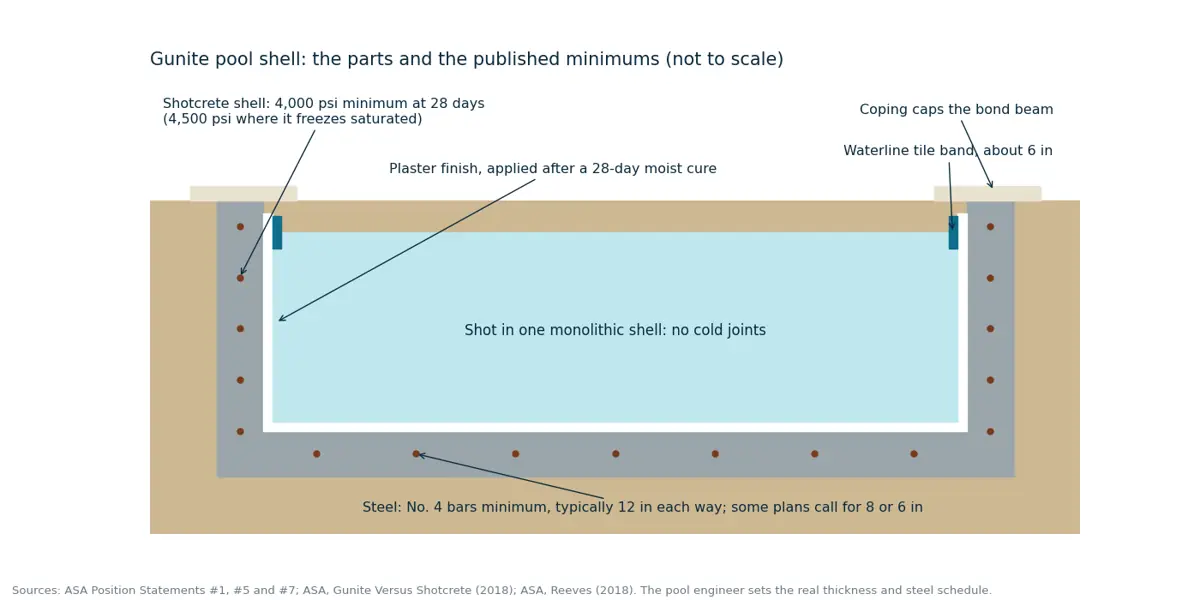
- ✓Built to a written standard4,000 psi shotcrete, No. 4 steel and a 28-day moist cure, per the American Shotcrete Association.
- ✓Priced over 30 yearsRenewals of $20,384 to $59,758 on a 15 x 30 ft pool, item by item with dated sources.
- ✓Checked against permits77.2% of 1,027 permits that name one shell material name gunite, shotcrete or concrete.
Key takeaways
- Gunite is dry-mix shotcrete: dry sand and cement shot through a hose with water added at the nozzle. “Gunite” began as a trade name, and the American Concrete Institute adopted “shotcrete” in 1951 (ASA, 2018).
- The American Shotcrete Association (ASA) sets 4,000 psi at 28 days as the minimum strength for pool shotcrete, and 4,500 psi with a water-cementitious ratio of 0.42 or less where the concrete freezes while saturated (ASA Position Statement #1).
- ASA asks for at least 7 days of soaking 3 to 5 times a day, then daily wetting to day 28; ACI 524 and the National Plasterers Council want 28 days of moist cure before a cement finish (ASA Position Statement #7).
- Of 1,027 new pool permits from 2023 to 2025 that name one shell material in six US places, 77.2% name gunite, shotcrete or concrete, from 99.0% in New Orleans to 44.1% in Nashville (PC&S analysis of city open data).
- White plaster lasts 7 to 12 years against 50+ years for the shell (HomeGuide), so a 15 x 30 ft gunite pool spends $20,384 to $59,758 on renewals by year 30, about $679 to $1,992 a year.
What is a gunite pool?
A gunite pool is an in-ground concrete pool whose shell is built by shooting a dry sand and cement mix through a hose at high velocity, with water added at the nozzle, over a grid of steel bars. The shell is then plastered, tiled at the waterline and capped with coping. The American Shotcrete Association calls the method dry-mix shotcrete, the term ACI has used since 1951.
The word is a fossil. ASA explains that “Gunite” was a trade name for the dry mix shot from the Cement Gun Company’s equipment, and that the American Concrete Institute (ACI) adopted the generic term “shotcrete” when it began writing standards in 1951, because trade names were frowned on in technical documents (ASA, Gunite Versus Shotcrete, 2018). Builders and homeowners kept the old word, so “gunite pool” now covers any shot-concrete pool, dry or wet mix.
In open permit data the word is common. Of the 793 permits in our six-place sample that name a concrete shell, most applicants wrote “gunite”; the rest wrote “shotcrete” or “concrete pool”. Harris County, Texas codes 117,056 of its 121,971 residential pools as gunite on the 2026 tax roll, 96.0%, which our pool property tax study tabulated from the appraisal district file.
| Measure | Figure | Date and place | Source |
|---|---|---|---|
| ASA minimum 28-day strength for pool shotcrete | 4,000 psi | United States, reaffirmed 2012 | American Shotcrete Association, Position Statement #1 |
| Strength where concrete freezes while saturated (ACI 350) | 4,500 psi, w/cm 0.42 max | United States, 2018 | ASA, Gunite Versus Shotcrete (2018) |
| Minimum bar size in a pool shell | No. 4 | United States, 2018 | ASA, Reeves (2018) |
| Moist curing of a shotcrete shell | 7 days soaked, wet daily to day 28 | United States, 2021 | ASA Position Statement #7 |
| Permits naming one shell material that name gunite, shotcrete or concrete | 77.2% | Six US places, 2023 to 2025, 1,027 permits | PC&S analysis of city and county open data |
| Residential pools coded gunite on the Harris County tax roll | 96.0% | Harris County, TX, tax year 2026 | Harris Central Appraisal District, via PC&S property tax study |
| White plaster lifespan | 7 to 12 years | United States, April 2025 | HomeGuide |
| Concrete pool structure lifespan | 50+ years | United States, July 2025 | HomeGuide |
Sources: ASA PS #1; ASA PS #7; ASA, Reeves 2018; HomeGuide; PC&S permit analysis. Download CSV
Gunite vs shotcrete: which is better for a pool?
Neither method makes a stronger pool on its own. ASA says dry-mix gunite and wet-mix shotcrete reach the same strength when properly applied, and holds both to 4,000 psi. Gunite runs a lower water-cementitious ratio, 0.35 to 0.40 against 0.40 to 0.45, while wet-mix shoots faster and with less rebound. The nozzleman matters more than the mix.
| Question | Gunite (dry-mix shotcrete) | Wet-mix shotcrete | Source |
|---|---|---|---|
| What it is | Dry sand and cement shot through a hose; water added at the nozzle | Ready-mixed concrete pumped, then shot with air at the nozzle | ASA, Gunite Versus Shotcrete (2018) |
| Where the name comes from | "Gunite" was a trade name for the Cement Gun Company process; ACI adopted "shotcrete" in 1951 | ACI term once pumps could shoot ready mix | ASA (2018) |
| Typical water-cementitious ratio | 0.35 to 0.40 | 0.40 to 0.45 (above 0.50 if water is added on site) | ASA (2018) |
| Rebound | More rebound; must be removed, never used to build steps or benches | Typically less rebound | ASA (2018); Lacher, Shotcrete (2007) |
| Time limit on material | Dry material can wait in a volumetric mixer | Place within 90 minutes of batching unless retarded | ASA (2018) |
| Walking on the fresh floor | Stiff: footprints only | Plastic: can displace floor steel | ASA (2018) |
| Production | Mixer at 8 to 12 rpm | Mixer at 20 to 25 rpm; can double output | ASA (2018), South Shore Gunite |
| Where one contractor uses it | Pools under 1,000 sq ft of surface, done in 1 day | Pools over 1,000 sq ft or multi-day shoots | ASA (2018), South Shore Gunite |
| Strength target | 4,000 psi minimum at 28 days | 4,000 psi minimum at 28 days | ASA Position Statement #1 |
| Cold joints between shoots | None when the old surface is prepared and shot at high velocity | Same rule | ASA Position Statement #5 |
Sources: ASA, Gunite Versus Shotcrete (2018); Lacher, Bad Benchmarks (2007); ASA Position Statement #5. Download CSV
The trade-offs are practical. Ready-mixed concrete has to be placed within 90 minutes of batching unless it is retarded, and ASA warns that adding water to stiffening wet-mix on site can push the ratio past 0.50. Dry material waits in a volumetric mixer as long as needed, and the shot floor is stiff enough to walk on with footprints only. South Shore Gunite, a Massachusetts contractor quoted by ASA, shoots pools under 1,000 sq ft of surface with dry-mix in one day and uses wet-mix for bigger multi-day jobs, where it can double output.
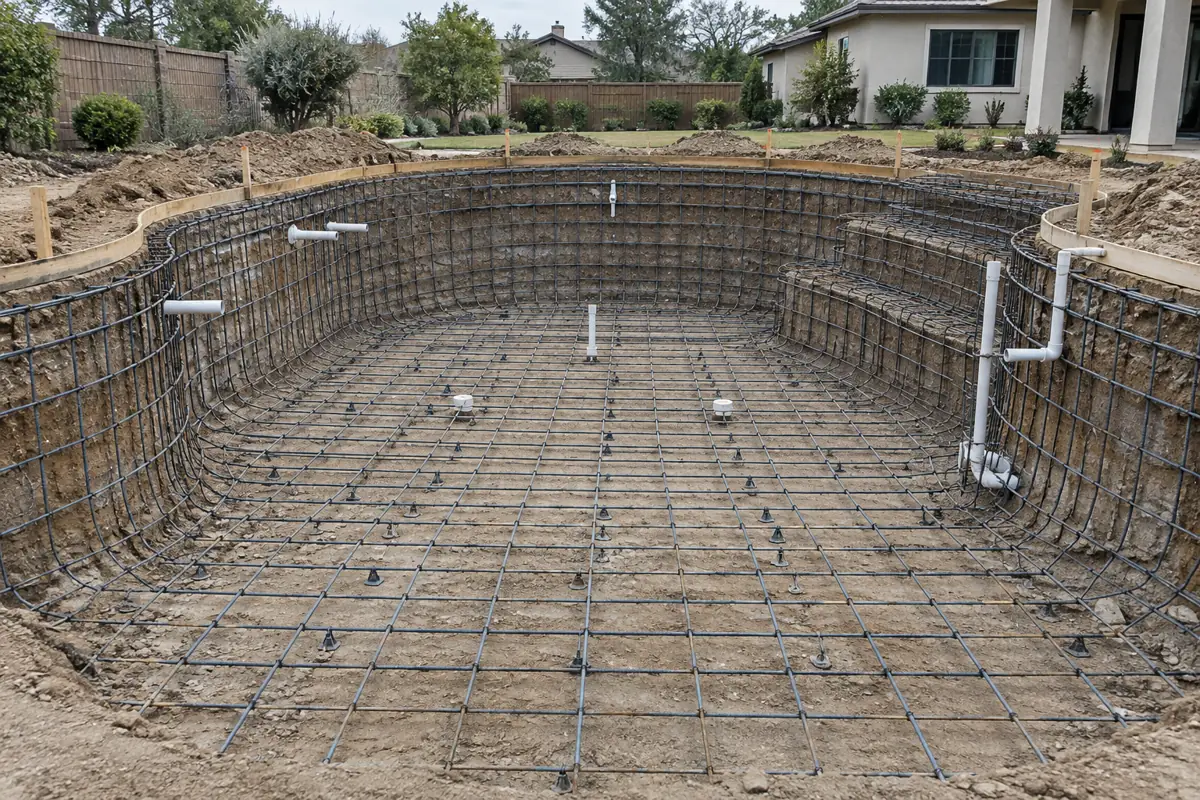
Rebound is the dry-mix risk. It is the sand and cement that bounces off the wall, and structural engineer Ron Lacher traced failing spa steps and benches to rebound and trimmings packed in as fill: “This material has no structural value in a pool shell” (Shotcrete, Spring 2007). Ask the bidder how rebound is removed before the floor is shot. What the two methods cost, per yard and per permit, is compared in our concrete pool cost guide.
How is a gunite pool built, and how long does it cure?
A gunite pool is dug, formed, tied with No. 4 or heavier steel at about 12 in each way, plumbed, inspected, shot in one monolithic pass, and kept wet. ASA wants 7 days of soaking 3 to 5 times a day and daily wetting to day 28; ACI 524 and the National Plasterers Council want that 28-day moist cure before a cement finish.
- Engineered plan and permitThe plan names shell strength, bar size and spacing. ASA points to ACI 350, the code for liquid-containing concrete, for cover, splices and spacing (Reeves, 2018).
- Dig and formShoot against firm native soil. ASA notes rain can liquefy unsupported soil and push the steel cage into the pool; clean it out and re-tie before shooting.
- SteelNo. 4 bars minimum, typically 12 in on center each way; many plans call for 8 or 6 in, and No. 5 or No. 6 bars where there is groundwater, pilings or a free-standing wall.
- Plumbing and bondingPipes are set back so the steel keeps full cover on both sides; ASA flags plumbing in the wall as a common weak spot.
- Pre-shoot inspectionMost cities inspect steel before the shell is shot; St. Helena, California lists pre-gunite, pre-deck, pre-plaster and final inspections.
- Shoot the shellOne monolithic shell with no cold joints (ASA PS #5). Rebound is removed, never used to build steps or benches.
- CureSoak 3 to 5 times a day for 7 days, wet at least daily from day 7 to day 28, then once or twice a week until plaster and fill (ASA PS #7).
- Tile, coping, deck, plaster, fillPlaster goes on after the 28-day moist cure; the NPC start-up keeps chlorine out for 48 hours and salt out for 30 days.
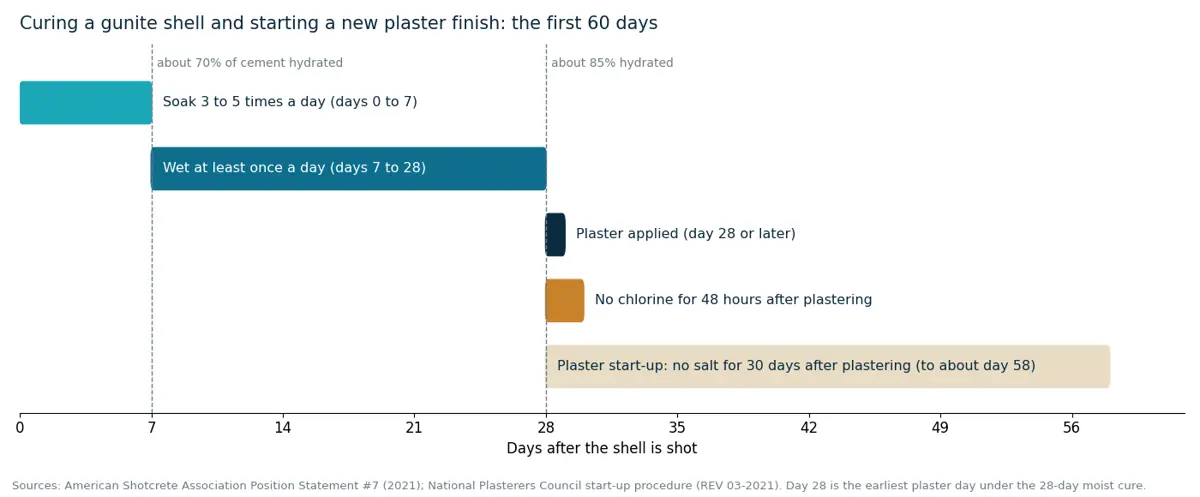
Curing is where schedules get squeezed. ASA reports that extending wet curing from 3 to 7 days cuts surface shrinkage cracking by 10 to 20% (ASA PS #7), and River Pools, a fiberglass maker, tells buyers the gunite needs roughly a month, 28 days, before plaster (River Pools). The full order of trades, inspections and payments is set out in our pool construction process guide.
How common are gunite pools in new permits?
Where a permit names the shell, it is usually concrete. Of 3,353 new residential in-ground pool permits filed from 2023 to 2025 in six places, 1,027 named exactly one material: 793 gunite, shotcrete or concrete (77.2%), 209 fiberglass (20.4%) and 25 vinyl liner (2.4%). The split runs from 99.0% concrete in New Orleans to 44.1% in Nashville.
Most permits do not name a material, so these are shares of the permits whose applicants wrote one down. Counts are in the table below.
Source: PC&S analysis of 3,353 new residential in-ground pool permits from six city and county open data portals, pulled November 8, 2026. Download chart data (CSV)
| Place | New in-ground pool permits, 2023 to 2025 | Name gunite, shotcrete or concrete | Name fiberglass | Name vinyl liner | Name more than one | Name no material | Concrete share of permits naming one material % | Source (open data portal) |
|---|---|---|---|---|---|---|---|---|
| New Orleans, LA | 520 | 206 | 1 | 1 | 2 | 310 | 99.0 | City of New Orleans, data.nola.gov Permits |
| East Baton Rouge Parish, LA | 418 | 255 | 15 | 0 | 1 | 147 | 94.4 | EBR Building Permits, data.brla.gov |
| Montgomery County, MD | 322 | 98 | 30 | 3 | 3 | 188 | 74.8 | Montgomery County Residential Permit, dataMontgomery |
| Raleigh, NC | 316 | 52 | 28 | 2 | 2 | 232 | 63.4 | City of Raleigh Building Permits (ArcGIS) |
| Fort Worth, TX | 1270 | 115 | 67 | 2 | 3 | 1083 | 62.5 | City of Fort Worth Development Permits (ArcGIS) |
| Nashville-Davidson, TN | 507 | 67 | 68 | 17 | 1 | 354 | 44.1 | Metro Nashville Building Permits Issued (ArcGIS) |
| Six places combined | 3353 | 793 | 209 | 25 | 12 | 2314 | 77.2 | PC&S tabulation |
Source: PC&S analysis of New Orleans, East Baton Rouge Parish, Montgomery County, MD, Raleigh, Fort Worth and Nashville open data, pulled November 8, 2026. Download CSV
Regional practice shows clearly. The two Louisiana jurisdictions are almost all concrete, 99.0% and 94.4%, which matches the 96.0% gunite share of Harris County, Texas tax-roll pools. Nashville is split evenly at 67 concrete and 68 fiberglass permits, and Raleigh and Fort Worth sit near two thirds concrete. If you want a type that is rare where you live, ask each bidder how many of that type they built last year.
What is the life expectancy of a gunite pool?
The concrete shell of a gunite pool is rated at 50 years or more by HomeGuide, while its plaster interior lasts 7 to 12 years, quartz 10 to 15 and pebble 15 to 20 or more. A builder’s claim of 50 to 100+ years has no study behind it. In practice the pool lasts as long as the shell, renewed every decade or so.
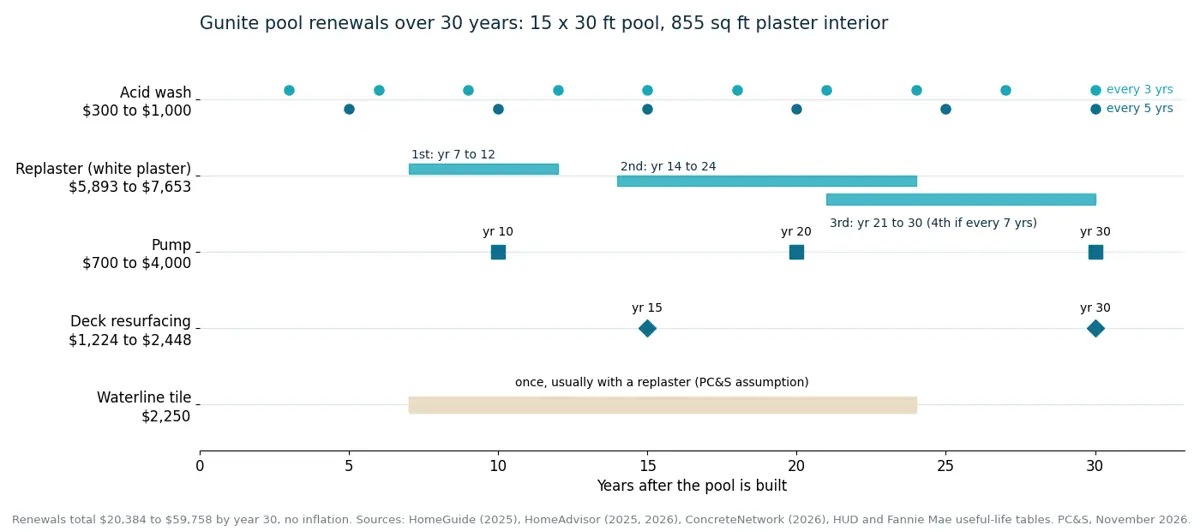
| Item | When in years 0 to 30 | Basis for the interval | Times by year 30 | Cost each time $ | Cost source and date | Total by year 30 $ |
|---|---|---|---|---|---|---|
| Build (gunite or shotcrete, plaster finish) | Year 0 | Fort Worth permit median | 1 | 76,000 | PC&S analysis of City of Fort Worth permits, 2023 to 2025 | 76,000 |
| Shell moist cure, then plaster | Days 0 to 28 | ASA Position Statement #7 (7 days soaked, wet daily to day 28) | 1 | In build price | ASA, 2021 | n/a |
| Acid wash | Every 3 to 5 years | HomeGuide (2025) | 6 to 10 | 300 to 1,000 | HomeGuide, July 2025 | 1,800 to 10,000 |
| Replaster, white plaster, 855 sq ft | Every 7 to 12 years | HomeGuide plaster lifespan (April 2025) | 2 to 4 | 5,893 to 7,653 | PC&S concrete pool cost guide from HomeGuide prices, 2025 | 11,786 to 30,612 |
| Pump replacement | Years 10, 20 and 30 | HUD useful life for pool pumps and equipment: 10 years | 3 | 700 to 4,000 | HomeAdvisor, June 2026 | 2,100 to 12,000 |
| Deck resurfacing, 306 sq ft | Years 15 and 30 | Fannie Mae and HUD useful life for a pool deck: 15 years | 2 | 1,224 to 2,448 | ConcreteNetwork $4 to $8 per sq ft, 2026 | 2,448 to 4,896 |
| Waterline tile replacement, 90 linear ft | Once, usually with a replaster | PC&S assumption | 1 | 2,250 | HomeAdvisor $25 per linear ft, April 2025 | 2,250 |
| Renewals subtotal | Years 1 to 30 | Sum of the five renewal lines | n/a | n/a | PC&S calculation | 20,384 to 59,758 |
| Routine upkeep | Every year | Angi concrete pool maintenance range | 30 | 2,700 to 4,000 | Angi, 2026 | 81,000 to 120,000 |
| All-in by year 30, including build | Years 0 to 30 | Build + renewals + upkeep, no inflation | n/a | n/a | PC&S calculation | 177,384 to 255,758 |
Sources: HomeGuide; HomeGuide inground; HomeAdvisor pump; HomeAdvisor tile; ConcreteNetwork; HUD EUL; Fannie Mae EUL; Angi. Download CSV
The replaster line is the largest and the widest, because plaster lasts 7 to 12 years in HomeGuide and the count of renewals moves from 2 to 4.
Source: PC&S calculation from HomeGuide (2025), HomeAdvisor (2025, 2026), ConcreteNetwork (2026), HUD and Fannie Mae useful-life tables. Download chart data (CSV)
Where the long claims come from: Anthony & Sylvan, a pool builder ranking near the top for this keyword, says gunite pools “can last 50-100+ years” and are replastered every 8 to 20 years (Anthony & Sylvan), but cites no data. The neutral planning tables are shorter: Fannie Mae assumes 8 years for a pool plaster liner and 15 for a pool deck, and HUD assumes 10 years for pool pumps and equipment (Fannie Mae; HUD).
Renewals are a fraction of the 30-year bill. Angi’s $2,700 to $4,000 a year of upkeep adds $81,000 to $120,000 over 30 years, so with the $76,000 Fort Worth permit median the all-in figure is $177,384 to $255,758. Plaster, quartz and pebble each move the replaster line differently; the per-finish arithmetic is in our pool resurfacing cost guide.
What are the downsides of a gunite pool?
Most gunite pool problems trace to the build or the water, not the method. ASA lists thin steel, poor soil, poor curing, temperature swings, shrinkage and rebound left in the shell as crack causes. The plaster fails by delamination, etching and staining, which the National Plasterers Council ties to low calcium, pH and alkalinity and to the first 28 days.
| Problem | What it looks like | Cause named in the source | Source |
|---|---|---|---|
| Shell cracks | Cracks through plaster that follow the structure | Too little steel, poor soil, poor curing, temperature swings, shrinkage, rebound left in the shell | ASA (2018) |
| Spa step and bench failure | Cracked or hollow steps and benches | Rebound and trimmings used to shape steps and benches | Lacher, Shotcrete (2007) |
| Plaster delamination | Hollow-sounding patches, flaking | Excluded from the SGM finish warranty, as are freeze-thaw damage and check cracking | SGM warranty terms (2025) |
| Etching and roughness | Rough, pitted plaster | Low calcium hardness, low pH, low alkalinity; cyanuric acid at 100 ppm or more | NPC Technical Bulletin 3; NPC start-up procedure (2021) |
| Etching in salt pools | Most etching of the test finishes | Salt-sanitized Cal Poly test pools of 7,900 gallons with oversized generators | AQUA Magazine (2006) |
| Early staining and scaling | Blotches in the first month | New finish most prone in its first 28 days | NPC start-up procedure (2021) |
| Freeze damage | Spalling and cracking after winter | Concrete saturated when it freezes; ACI 350 asks for 4,500 psi and w/cm 0.42 | ASA (2018); SGM FAQ |
Sources: ASA (2018); Lacher (2007); SGM warranty terms; NPC Technical Bulletin 3; NPC start-up procedure; AQUA Magazine. Download CSV
Delamination is the failure owners cannot fix with chemicals. A finish that separates from the shell sounds hollow when tapped, and SGM, a finish maker whose base warranty runs 1 year (10 years extended for some lines), excludes delamination, check cracking and freeze-thaw damage and covers material only (SGM). That puts the bond between plaster and shell on the applicator, so ask who warrants workmanship and for how long. Finish warranties by maker are compared in our pool finishes guide.
Etching is a water problem. The National Plasterers Council (NPC) says calcium hydroxide, 24 to 27% of fully hydrated white cement, is the first compound aggressive water dissolves, and puts the ideal saturation index at 0.0 to +0.3 (NPC TB3). In Cal Poly test pools of 7,900 gallons, the salt-sanitized pools showed the most etching, though their generators were oversized (AQUA Magazine).
| Side | Point | Figure | Source |
|---|---|---|---|
| Pro | Any shape, depth or attached spa | No factory width cap; fiberglass shells top out near 16 ft wide | River Pools; PC&S fiberglass pool cost guide |
| Pro | Strong, watertight shell when built to standard | 4,000 psi minimum; 4,500 to 9,000 psi typical when shot well | ASA Position Statement #1 |
| Pro | Longest structure life in cost guides | 50+ years | HomeGuide (2025) |
| Pro | What local builders know best in gunite markets | 96.0% of Harris County pools; 99.0% of New Orleans permits naming one material | HCAD 2026; PC&S permit analysis |
| Con | Interior needs renewal | White plaster 7 to 12 years | HomeGuide (2025) |
| Con | Highest upkeep of the three pool types | $2,700 to $4,000 a year | Angi (2026) |
| Con | Highest build price where permits name the material | $76,000 Fort Worth median vs $52,000 for fiberglass | PC&S permit analysis, 2023 to 2025 |
| Con | Longest wait before swimming | Shell cure to day 28, then a 28-day plaster start-up | ASA PS #7; NPC (2021) |
Sources: ASA PS #1; HomeGuide; Angi; PC&S permit and tax-roll analysis. Download CSV
Compare gunite pool bids for your yard
How much does a gunite pool cost?
Permits that name gunite or shotcrete had a $76,000 median in Fort Worth and $74,000 in New Orleans from 2023 to 2025, and California’s 2026 assessor schedule puts a 15 x 30 ft concrete pool at $42,300 to $77,850. Our concrete pool cost guide prices every line from shotcrete and steel to plaster and deck.
Against fiberglass in the same city, concrete costs more up front: the Fort Worth fiberglass median was $52,000. Over 30 years the gap widens with the renewals in the lifecycle table, since a fiberglass gelcoat is not replastered. The line-item budget, shotcrete quantities and permit medians by city are in our concrete pool cost guide, and the three-way comparison with vinyl is in gunite vs fiberglass vs vinyl pool.
Is a gunite pool right for your yard?
Choose a gunite pool when the design needs it: wider than 16 ft, a free-form shape, a deep end or an attached spa, or a market where most builders shoot concrete. Choose it with the 4,000 psi, No. 4 steel and 28-day cure written into the contract, and with $679 to $1,992 a year set aside for renewals.
| If your situation is | Do this | Threshold | Source |
|---|---|---|---|
| You need a pool wider than 16 ft, a custom shape or an attached spa | Price gunite or shotcrete; a fiberglass shell will not fit | 16 ft shell width | River Pools |
| A bid names 2,500 psi shotcrete | Ask for 4,000 psi at 28 days in the contract | 4,000 psi | ASA Position Statement #1 |
| Your winters freeze a full pool | Ask for 4,500 psi and a w/cm of 0.42 or less | 4,500 psi | ASA (2018), citing ACI 350 |
| The plan shows bars smaller than No. 4 or spacing wider than 12 in | Ask the engineer why before steel inspection | No. 4 at 12 in | ASA, Reeves (2018) |
| The builder wants to plaster within a week of shooting | Ask for the 28-day moist cure ACI 524 and the NPC recommend | 28 days | ASA Position Statement #7 |
| Your water has calcium hardness, pH or alkalinity below range | Raise them before you pay for a replaster | Saturation index 0.0 to +0.3 | NPC Technical Bulletin 3 |
| You want the lowest 30-year bill | Compare against fiberglass, which is not replastered | $20,384 to $59,758 of gunite renewals | PC&S calculation |
Sources: ASA PS #1; ASA 2018; Reeves 2018; ASA PS #7; NPC TB3; River Pools. Download CSV
If the yard and budget fit a standard shell no wider than about 16 ft, a factory pool is the alternative to price; how fiberglass shells are made and warranted is set out in our fiberglass pool guide. If you are hiring a builder for a custom shell, our inground pool builders page lists the state licenses to check.
How we compiled this
We read 24 documents between November 3 and 8, 2026: six American Shotcrete Association articles and position statements, NPC and SGM finish documents, HomeGuide, HomeAdvisor, Angi and ConcreteNetwork cost pages, the Fannie Mae and HUD useful-life tables, and seven earlier PC&S guides and studies. The permit shares are our own tabulation of 3,353 permits pulled from six city and county open data portals. We did not build, inspect or test a pool.
Frequently Asked Questions
What are the downsides of a gunite pool?
A gunite pool costs more up front, $76,000 against $52,000 for fiberglass on 2023 to 2025 Fort Worth permits, and more to keep: Angi puts upkeep at $2,700 to $4,000 a year. White plaster needs renewing every 7 to 12 years (HomeGuide), and a new shell needs a 28-day moist cure before plastering.
Which is better, concrete or gunite pool?
They are the same thing. Gunite is a way of placing concrete: dry sand and cement shot through a hose and wetted at the nozzle. The American Shotcrete Association calls it dry-mix shotcrete and holds it, and wet-mix shotcrete, to the same 4,000 psi minimum. A poured or shot concrete pool is judged on strength, steel and curing, not the label.
What is the life expectancy of a gunite pool?
HomeGuide rates the concrete shell at 50 years or more. The surface wears faster: white plaster lasts 7 to 12 years, quartz 10 to 15 and pebble 15 to 20 or more (HomeGuide, April 2025). Over 30 years a 15 x 30 ft pool needs 2 to 4 plaster renewals at $5,893 to $7,653 each.
Are gunite pools any good?
Yes, when built to the published minimums: 4,000 psi shotcrete, No. 4 bars at about 12 in each way and a 28-day moist cure (American Shotcrete Association). They are the default in many markets: 96.0% of Harris County, Texas pools are coded gunite, and 77.2% of permits that name one material in our six-place sample name concrete.
What is the difference between gunite and shotcrete?
Gunite is dry-mix: dry sand and cement with water added at the nozzle, typically at a water-cementitious ratio of 0.35 to 0.40. Wet-mix shotcrete is ready-mixed concrete pumped and shot, typically at 0.40 to 0.45 (ASA, 2018). Wet-mix has less rebound and higher output; dry-mix suits small one-day pools.
How long does a gunite pool take to cure?
The American Shotcrete Association recommends soaking the shell 3 to 5 times a day for 7 days, then wetting it at least daily to day 28. ACI 524 and the National Plasterers Council recommend that 28-day moist cure before a cement finish, and the plaster start-up then keeps salt out for 30 days.
Sources
- American Shotcrete Association. Gunite Versus Shotcrete in Pool Construction (Shotcrete, Summer 2018). Accessed 2026-11-08.
- American Shotcrete Association. Bad Benchmarks (Shotcrete, Spring 2007). Accessed 2026-11-08.
- American Shotcrete Association. Position Statement #1: Compressive Strength Values of Pool Shotcrete. Accessed 2026-11-08.
- American Shotcrete Association. Position Statement #5: Monolithic Shotcrete for Swimming Pools (No Cold Joints). Accessed 2026-11-08.
- American Shotcrete Association. Position Statement #7: Curing of Shotcrete for Swimming Pools (2021). Accessed 2026-11-08.
- American Shotcrete Association. Reinforcing bars in swimming pools (Shotcrete, Summer 2018). Accessed 2026-11-08.
- HomeGuide. How Much Does An Inground Pool Cost?. Accessed 2026-10-08.
- HomeGuide. How Much Does Pool Resurfacing Cost?. Accessed 2026-10-26.
- Fannie Mae. Multifamily Property Condition Assessment, Appendix F (Form 4099.F). Accessed 2026-10-26.
- U.S. Department of Housing and Urban Development. CNA e-Tool Estimated Useful Life Table. Accessed 2026-10-26.
- HomeAdvisor. How Much Does a Pool Pump Replacement Cost in 2026?. Accessed 2026-10-19.
- HomeAdvisor. How Much Does Installing Pool Tile Cost? (Wayback capture). Accessed 2026-11-02.
- ConcreteNetwork. Pool deck cost. Accessed 2026-10-27.
- Angi. How Much Does It Cost to Install a Pool? (Wayback capture). Accessed 2026-10-27.
- National Plasterers Council. Start-Up Procedure (REV 03-2021). Accessed 2026-10-26.
- National Plasterers Council. Technical Bulletin 3: Swimming pool deterioration. Accessed 2026-10-26.
- SGM. Pool and Spa Finish Warranty Terms. Accessed 2026-10-26.
- AQUA Magazine. Scratching the Surface. Accessed 2026-10-26.
- Anthony & Sylvan Pools. Gunite Pools. Accessed 2026-11-08.
- River Pools. What Is a Gunite Pool?. Accessed 2026-11-08.
- City of New Orleans. Permits (rcm3-fn58). Accessed 2026-11-08.
- City of Baton Rouge / Parish of East Baton Rouge. EBR Building Permits (7fq7-8j7r). Accessed 2026-11-08.
- Montgomery County, Maryland. Residential Permit (m88u-pqki). Accessed 2026-11-08.
- City of Fort Worth; Metro Nashville; City of Raleigh. Development Permits, Building Permits Issued, Building Permits (ArcGIS layers). Accessed 2026-11-08.
Related pages
Get Quotes From Licensed Local Pool Pros
Tell us what you need and your ZIP code. We match you with pool companies that cover your area.