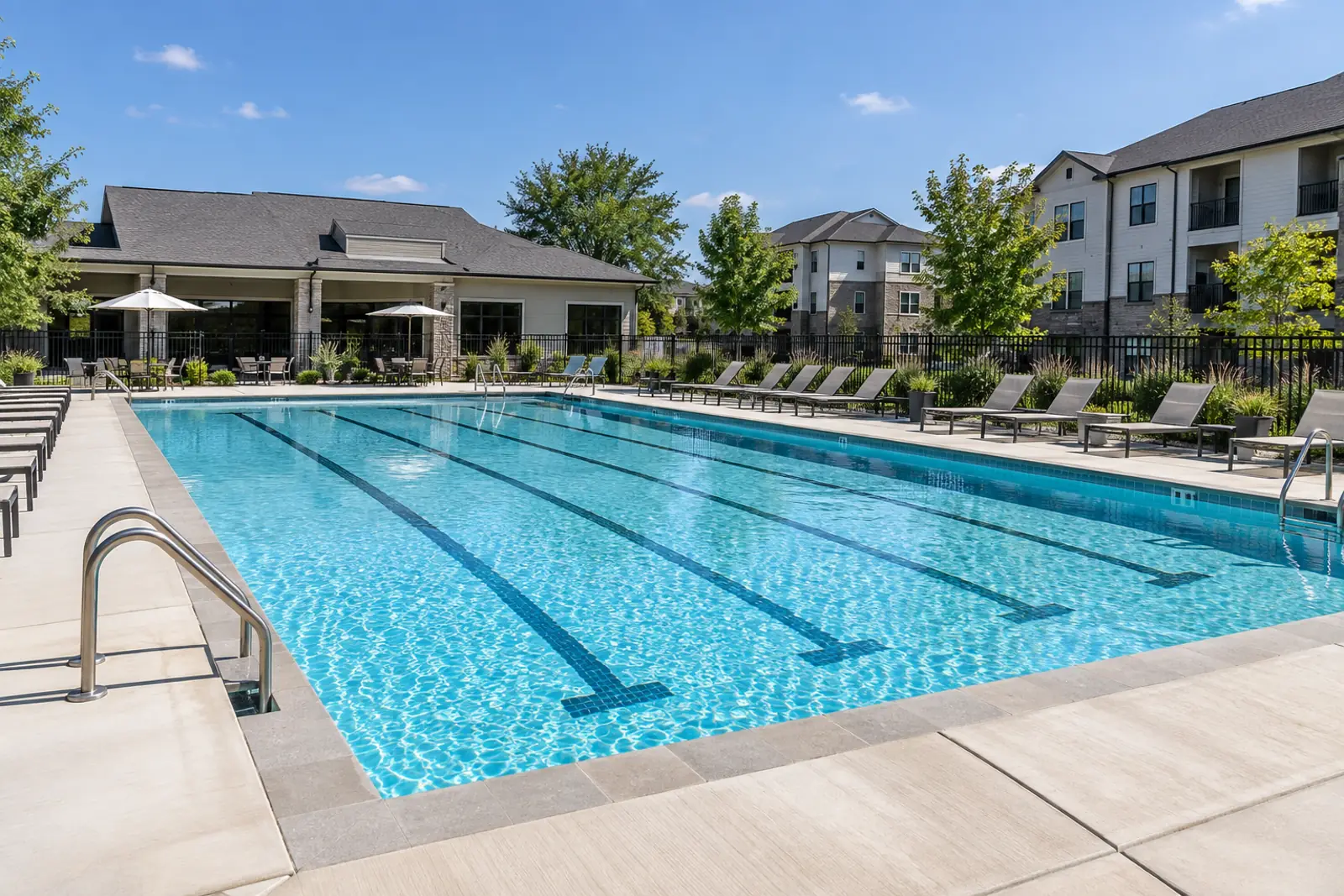
Commercial Pool Construction for HOAs, Hotels and Apartments
Commercial pool construction means building a pool that residents, guests or members share. It needs health department approval as well as a building permit, federal drain and access compliance, and a design an operator can keep legal.
- ✓About $488 per square footCounsilman-Hunsaker's 2024 average for city and commercial pool construction, up 90% in a decade (Recreation Management, August 2024).
- ✓Federal rules since 2008Public pools and spas must meet Virginia Graeme Baker Act drain cover rules (CPSC); the 2010 ADA Standards set pool entry requirements.
- ✓21 of 51 jurisdictionsRequire a certified or trained operator for public pools as of October 2026 (PC&S review); the design should make that operator's job easy.
What Counts as Commercial Pool Construction
Health codes usually define pools by who can use them, not by size. A small HOA pool can fall under the same chapter as a city aquatic center.
State codes typically call these public or semipublic pools: hotel and motel pools, apartment and condominium pools, HOA and community pools, clubs, schools and municipal pools. Arizona’s rules, for example, cover “Public and Semipublic Swimming Pools” in both its design and construction chapter and its operation chapter (Ariz. Admin. Code R18-5). Three things change when a pool is shared:
- A second approval. Health or environmental health reviews the plans, not only the building department.
- Federal law applies. Drain entrapment rules under the Virginia Graeme Baker Act cover public pools and spas, and the ADA covers pools at public accommodations.
- Someone has to operate it legally. Operator credentials, lifeguard rules and routine inspections depend on the state, and the design either supports or fights them.
If you are a homeowner, the residential pages fit better: inground pool builders or fiberglass pool installation.
Commercial Pool Construction Costs: The Published Benchmarks
No public dataset reports what HOAs, hotels or apartment owners pay for new pools. The best published numbers come from aquatic consultants and city capital budgets.
| Benchmark | Value | Scope | Source |
|---|---|---|---|
| Average construction cost, 2024 | About $488 per square foot | City and commercial aquatic projects; basis not stated | Counsilman-Hunsaker in Recreation Management, August 2024 |
| Change over the decade to 2024 | +90% | Same | Counsilman-Hunsaker in Recreation Management |
| Projected cost in 10 years | About $772 per square foot | Projection, not a quote | Counsilman-Hunsaker in Recreation Management |
| Outdoor pool lifespan | 30 to 50 years | Public and commercial pools | Counsilman-Hunsaker in Recreation Management |
| Indoor pool lifespan | 50 to more than 100 years | Public and commercial pools | Counsilman-Hunsaker in Recreation Management |
| Philadelphia capital program, 2026 | $70 million across 7 pools closed for the season | Municipal outdoor pools | City of Philadelphia, June 2026 |
Sources: Counsilman-Hunsaker in Recreation Management (August 1, 2024); City of Philadelphia (June 2026) via PC&S public pools by city. Download CSV
Aquatic design firm Counsilman-Hunsaker estimated the average cost of constructing a pool at about $488 per square foot in 2024, a 90% increase over the previous decade, and projected about $772 per square foot within ten years (Recreation Management). The article does not say whether the figure is per square foot of water or of building, and it reflects city and commercial aquatic projects, so treat it as a ceiling check for a small HOA or hotel pool rather than a quote.
City budgets show the scale at the top end: Philadelphia closed 7 pools for the 2026 season for capital work representing a combined $70 million investment (City of Philadelphia). Lifespan matters for reserve planning: the same Counsilman-Hunsaker article puts outdoor pools at 30 to 50 years and indoor pools at 50 to more than 100 years.
Two Approvals: The Health Department and the Building Department
| Jurisdiction | Who signs off | What the rule says | Source |
|---|---|---|---|
| Florida | County health department (DOH) and the local building department | An operating permit application goes to DOH before the building department can issue a construction or modification permit; no certificate of occupancy until DOH issues the operating permit. New public pools and spas need a gravity drainage system with a collector tank. | Florida DOH, Chapter 64E-9 F.A.C. |
| Los Angeles County, CA | County Public Health plan check, plus the building department | Plan review fees cover an initial and one revised review; new construction includes pre-gunite, pre-plaster and final inspections. | LA County Public Health |
| Arizona | ADEQ design rules; ADHS or delegated county for operation | Design and construction rules R18-5-201 to R18-5-240 cover public and semipublic pools; general-public pools need elevated lifeguard chairs, one per 3,000 sq ft. | Ariz. Admin. Code R18-5-238 |
| Texas | Varies by city and county; state rules set the standards | 25 TAC 265 Subchapter L sets public pool and spa standards: minimum free chlorine 1.0 ppm for pools and 2.0 ppm for spas; certified operators required at hotel, apartment and HOA pools. | Texas DSHS, 25 TAC 265 |
| California | Local environmental health and building departments | Title 22 (22 CCR 65501 to 65551) sets public pool rules; the state sets no operator credential. | Cal. Code Regs. tit. 22 |
Sources: Florida Department of Health; Los Angeles County Public Health, Pool Plan Check; Ariz. Admin. Code R18-5-238; Texas DSHS, 25 TAC 265; 22 CCR 65521. Download CSV
Florida shows the order of operations clearly. Under Chapters 514 and 553 of the Florida Statutes, the owner applies to the Department of Health for an operating permit before the building department can issue a construction or modification permit, and the building department cannot issue a certificate of completion or occupancy until DOH issues the operating permit (Florida DOH). DOH also recommends contacting it at least two weeks before the planned opening.
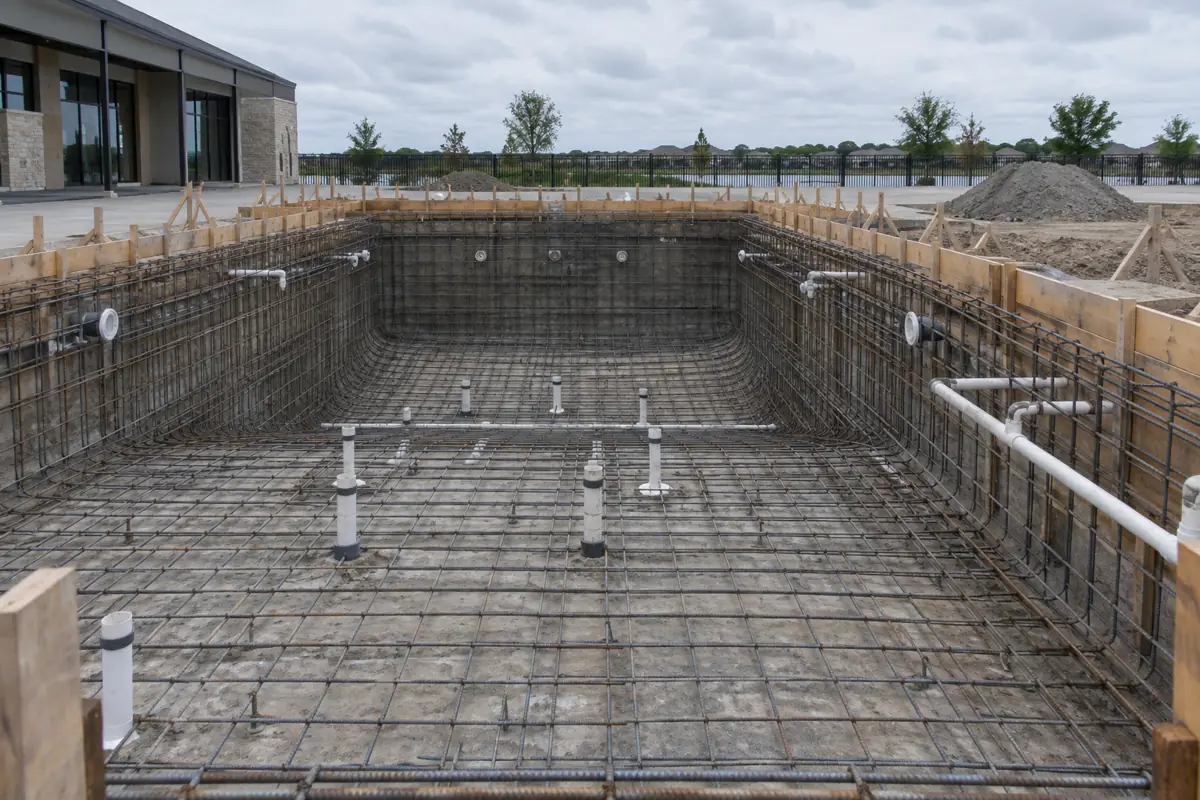
Los Angeles County builds health inspections into construction: its plan check fees cover a pre-gunite, a pre-plaster and a final inspection for new pools (LA County Public Health). Schedule those holds into the contractor’s timeline. For residential permit basics, see our pool permit guide, and for wait times by city, pool permit processing time.
Federal Rules: Drain Entrapment and Accessible Entry
| Federal rule | Applies to | Key requirement | Source |
|---|---|---|---|
| Virginia Graeme Baker Pool and Spa Safety Act (effective December 19, 2008) | Public pools and spas | Drain covers compliant with 16 CFR part 1450; a single blockable drain, or drains on the same plane less than 3 feet apart, needs a secondary anti-entrapment device or system | CPSC |
| VGB secondary systems | Pools with a single blockable main drain | Safety vacuum release system, suction-limiting vent, gravity drainage, automatic pump shut-off, or drain disablement | CPSC Pub. 361 |
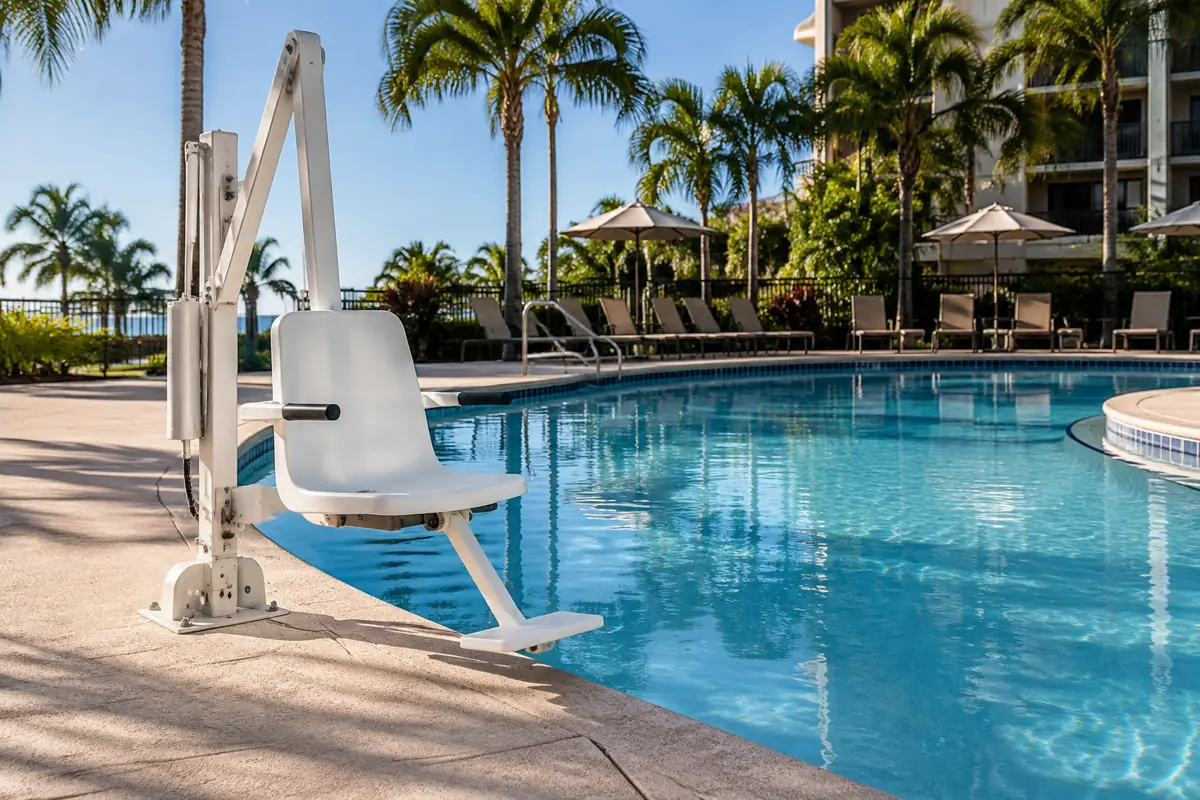
| 2010 ADA Standards 242.2 | Pools at hotels, clubs and other public accommodations | At least 2 accessible means of entry, 1 of them a lift or sloped entry; 1 is enough under 300 linear feet of pool wall if it is a lift or sloped entry | U.S. Department of Justice |
| 2010 ADA Standards 242.4 | Spas | At least 1 accessible means of entry; in a cluster, at least 1 spa and no more than 5 percent | U.S. Department of Justice |
Sources: CPSC drain cover guidance; CPSC Pub. 361; Pool Safely; 2010 ADA Standards for Accessible Design. Download CSV
The Virginia Graeme Baker Pool and Spa Safety Act was signed on December 19, 2007 and took effect on December 19, 2008 (Pool Safely). Since then, public pools and spas must use drain covers that meet 16 CFR part 1450, and a pool with a single drain that can be blocked, or drains on the same plane less than 3 feet apart, needs a secondary anti-entrapment device or system (CPSC). Inspectors keep finding problems here: suction (drain) covers were the most cited violation in Sacramento County, at 17.4% of 12,371 routine citations from April 2023 to March 2026 (PC&S analysis).
Under section 242.2 of the 2010 ADA Standards, a swimming pool needs at least two accessible means of entry, and at least one must be a pool lift or a sloped entry. A pool with less than 300 linear feet of wall needs only one, if it is a lift or a sloped entry. Spas need at least one accessible means of entry (section 242.4). Whether an HOA pool counts as a public accommodation depends on who can use it, so ask counsel early.
Operator, Lifeguard and Inspection Rules Shape the Design
The building lasts decades; the operating rules apply every day. They differ sharply by state.
Routine inspection status is not verified for 2 jurisdictions. Full matrix: /research/pool-operator-certification-requirements/.
Source: PC&S review of 51 state pool rules, October 7, 2026. Download chart data (CSV)
| State | Certified operator required | Hotels and motels | Apartments and condos | HOA and community pools | Lifeguard rule | Hotel pool lifeguards | Routine inspection mandate |
|---|---|---|---|---|---|---|---|
| Florida | Partial | Yes | Partial | Partial | Partial | No | Yes |
| Texas | Yes | Yes | Yes | Yes | Yes | Partial | No |
| Arizona | No | No | No | No | No | No | Partial |
| California | No | No | No | No | Yes | No | Local |
| Georgia | Yes | Yes | Partial | Partial | No | No | Yes |
| North Carolina | Yes | Yes | Yes | Yes | Partial | No | Yes |
| South Carolina | Yes | Yes | Yes | Yes | Yes | No | Partial |
| Tennessee | No | No | No | No | Yes | Partial | Yes |
| Nevada | Partial | Yes | Yes | Yes | Yes | Partial | Not verified |
| Colorado | Yes | Yes | No | No | No | No | No |
| New York | Partial | Partial | Partial | Partial | Yes | No | No |
| Illinois | No | No | No | No | Yes | Partial | Partial |
Source: PC&S pool operator certification requirements by state (state rules opened October 7, 2026). Download CSV
As of October 7, 2026, 21 of 51 jurisdictions require a certified or trained operator for public pools and 9 more require one for some pools, together covering 55.5% of U.S. residents. 26 jurisdictions require no lifeguard at hotel or motel pools, and only New Mexico and Oregon have adopted CDC’s Model Aquatic Health Code in full (PC&S review). CDC posted the 5th edition of that code on December 16, 2024 (CDC).
Texas is a useful contrast: no state license for pool builders, yet 25 TAC 265 requires certified operators at hotel, apartment and HOA pools. The common credential, PHTA’s Certified Pool & Spa Operator, is a 16-hour course valid for 5 years (PC&S research). Design choices that help an operator include an equipment room with space to test and store chemicals safely, automated chemical feed, flow meters and drain covers that can be reached for inspection.
What Health Inspectors Cite Once a Pool Opens
CDC benchmark: 12.3% of routine inspections in 16 jurisdictions in five states ended in immediate closure in 2013. Definitions: /research/public-pool-inspection-violations/.
Source: Health department open data; PC&S analysis. Download chart data (CSV)
Between 9.1% and 13.9% of routine inspections ended in a closure or a closure-level hazard in the latest year for six U.S. health departments with open data (PC&S analysis of Sacramento County, NYC DOHMH and other records). CDC’s multistate benchmark found 12.3% of routine inspections ending in immediate closure in 2013 (CDC MMWR). In Sacramento, disinfectant, pH and stabilizer problems made up 32.2% of citations.
Germs drive the design brief too. Of 269 outbreaks at U.S. pools from 2009 to 2023, 149 involved Cryptosporidium (CDC NORS; PC&S outbreak report), a parasite CDC describes as very chlorine tolerant (CDC). Ask your designer whether secondary disinfection is required or advisable for your venue, and plan water testing at least twice a day, hourly in heavy use, as CDC advises for public pools (CDC).
Licensing for Commercial Pool Builders
| State | Commercial pool license or class | Active licensees (date) | Source |
|---|---|---|---|
| Florida | Commercial Pool/Spa Contractor (class A); also covers residential pools | 1,543 (August 2026) | Florida DBPR licensee file |
| Arizona | A-9 and A-19 Swimming Pools (commercial); KA-5 dual residential and commercial; C-6 commercial pool service | A-9: 49; A-19: 4; KA-5: 413; C-6: 26 (July 2026) | Arizona Registrar of Contractors |
| Louisiana | Swimming Pools subclassification of the commercial Building Construction license | 154 active (October 2026) | Louisiana State Licensing Board for Contractors |
| Arkansas | Commercial license with the Swimming Pools, Spas specialty | 61 (October 2026) | Arkansas Contractors Licensing Board |
| Nevada | A-10 Commercial and Residential Pools | Not published | Nevada State Contractors Board (NAC 624) |
| Texas | None at state level; cities and counties regulate | Not applicable | Texas Business Permit Office |
Sources: Florida DBPR; Arizona ROC; Louisiana and Arkansas licensing boards; Texas Business Permit Office; compiled in PC&S license requirements by state. Download CSV
Florida separates commercial work cleanly: 1,543 current and active Commercial Pool/Spa Contractor (class A) licenses were on the August 2026 state file, and that class also covers residential pools (DBPR). Arizona’s commercial classes are small by comparison, with 49 A-9 licenses in July 2026. In 16 states, including Texas, home to 37.7% of U.S. residents, there is no state license or registration for pool building at all, so cities, counties and your own vetting carry the load (PC&S review).
Beyond the license, ask for commercial references with the same health jurisdiction, proof of insurance at the limits your board or lender requires, and the name of the engineer of record. Our builder checklist and vetting process explain what we check before an introduction.
A Project Sequence for Boards and Owners
- Define users and capacityWho will swim, how many at once and in which months; this drives depth, size, lifeguard and ADA decisions.
- Hire a design professionalHealth departments review engineered plans; pick someone who has worked with your county.
- Pre-application meetingAsk the health and building departments for their checklists and current code editions.
- Budget with escalationCounsilman-Hunsaker advises budgeting for cost increases between funding and construction start.
- Bid to licensed commercial buildersCompare itemized bids on the same plan set.
- Build with inspection holdsExpect health inspections at stages such as pre-gunite and pre-plaster, as in Los Angeles County.
- Operating permit and operatorLine up the certified operator, test kits and records before the final inspection.
Ongoing upkeep is a separate contract; see pool cleaning service for what weekly service covers and where shared pools need more.
Frequently Asked Questions
How much does commercial pool construction cost per square foot?
Aquatic design firm Counsilman-Hunsaker estimated about $488 per square foot for city and commercial pool construction in 2024, up 90% over a decade (Recreation Management). Small HOA or hotel pools can differ widely; get bids on a finished plan set.
Do pool contractors need to be licensed in Texas?
Texas has no state pool contractor license; cities and counties set rules (Texas Business Permit Office; PC&S review). Electrical work still needs a licensed electrician, and Texas does require certified operators at hotel, apartment and HOA pools under 25 TAC 265.
What kind of license do I need to build commercial pools?
It depends on the state. Florida issues a Commercial Pool/Spa Contractor (class A) license, with 1,543 active in August 2026 (DBPR), and Arizona has A-9 and A-19 commercial pool classes. 14 of 51 jurisdictions have a dedicated pool license and 16 states have none (PC&S review).
What are the requirements for commercial swimming pools in Florida?
Public pools follow Chapter 64E-9 of the Florida Administrative Code. The owner must apply to the Department of Health for an operating permit before the building department issues a construction permit, and new public pools and spas need a gravity drainage system with a collector tank (Florida DOH).
What happens if a commercial pool is built without health department approval?
In Florida, the building department cannot issue a certificate of completion or occupancy until DOH issues the operating permit (Florida DOH), so the pool cannot legally open. Other states use similar plan review and pre-opening inspections.
What are the current pool regulations in Texas for apartments and HOAs?
Texas public pool rules are in 25 TAC 265 Subchapter L. They require certified operators at hotel, apartment and HOA pools and set minimum free chlorine at 1.0 ppm for pools and 2.0 ppm for spas (Texas DSHS; PC&S research).
Does an HOA pool need a lifeguard?
Usually not, but it depends on the state. 28 jurisdictions require lifeguards at some public pools, 12 have no lifeguard rule, and 26 require none at hotel or motel pools (PC&S review, October 2026). Check whether your state’s rule turns on fees or public access.
Does a hotel pool need a pool lift?
Under the 2010 ADA Standards, a pool needs at least two accessible means of entry, one of them a lift or sloped entry; with less than 300 linear feet of wall, one lift or sloped entry is enough (U.S. DOJ).
Do commercial pools need a certified operator?
In 21 of 51 jurisdictions yes, and in 9 more for some pools (PC&S review). The PHTA Certified Pool & Spa Operator course is 16 hours and the certificate lasts 5 years. Some counties, such as Los Angeles, also certify pool service technicians.
What is the Virginia Graeme Baker Act?
A federal law effective December 19, 2008 that requires public pools and spas to use compliant anti-entrapment drain covers and, where there is a single blockable drain, a secondary system such as a safety vacuum release system or gravity drainage (CPSC; CPSC Pub. 361).
How long does a commercial pool last?
Counsilman-Hunsaker puts outdoor public and commercial pools at 30 to 50 years and indoor pools at 50 to more than 100 years (Recreation Management, 2024).
Can a commercial pool be built for $50,000?
That figure is in the range of residential permit values, not commercial ones: 2025 median declared values for residential pool permits ran from $35,000 in Los Angeles to $150,000 in Raleigh (PC&S analysis). Commercial projects add engineering, health review, VGB and ADA compliance.
Sources
- Recreation Management (Counsilman-Hunsaker). Realistic Pool Pricing for City & Commercial Pools. Accessed 2026-10-08.
- City of Philadelphia. 2026 Philadelphia public pool opening schedule. Accessed 2026-10-08.
- Florida Department of Health. Public Swimming Pools. Accessed 2026-10-08.
- Los Angeles County Department of Public Health. Pool Plan Check. Accessed 2026-10-08.
- Legal Information Institute. Ariz. Admin. Code R18-5-238. Accessed 2026-10-08.
- Texas Department of State Health Services. 25 TAC Chapter 265, Subchapter L. Accessed 2026-10-08.
- U.S. Consumer Product Safety Commission. Pool and Spa Drain Covers business guidance. Accessed 2026-10-08.
- U.S. Consumer Product Safety Commission. Pool Safely: Simple Steps Save Lives (Pub. 361). Accessed 2026-10-08.
- Pool Safely (CPSC). Pool & Spa Safety Act. Accessed 2026-10-08.
- U.S. Department of Justice. 2010 ADA Standards for Accessible Design. Accessed 2026-10-08.
- Sacramento County Environmental Management Department. Pool Inspections open data. Accessed 2026-10-08.
- NYC Department of Health and Mental Hygiene. NYC Pool Inspections. Accessed 2026-10-08.
- Centers for Disease Control and Prevention. MMWR Surveillance Summary 65(5). Accessed 2026-10-08.
- Centers for Disease Control and Prevention. National Outbreak Reporting System public dataset. Accessed 2026-10-08.
- Centers for Disease Control and Prevention. Operating and Managing Public Pools, Hot Tubs and Splash Pads. Accessed 2026-10-08.
- Centers for Disease Control and Prevention. Model Aquatic Health Code. Accessed 2026-10-08.
- Florida DBPR (Wayback capture). Construction licensee extract. Accessed 2026-10-08.
- Office of the Texas Governor. Texas Licenses and Permits Guide. Accessed 2026-10-08.
Related pages
Get Quotes From Licensed Local Pool Pros
Tell us what you need and your ZIP code. We match you with pool companies that cover your area.